


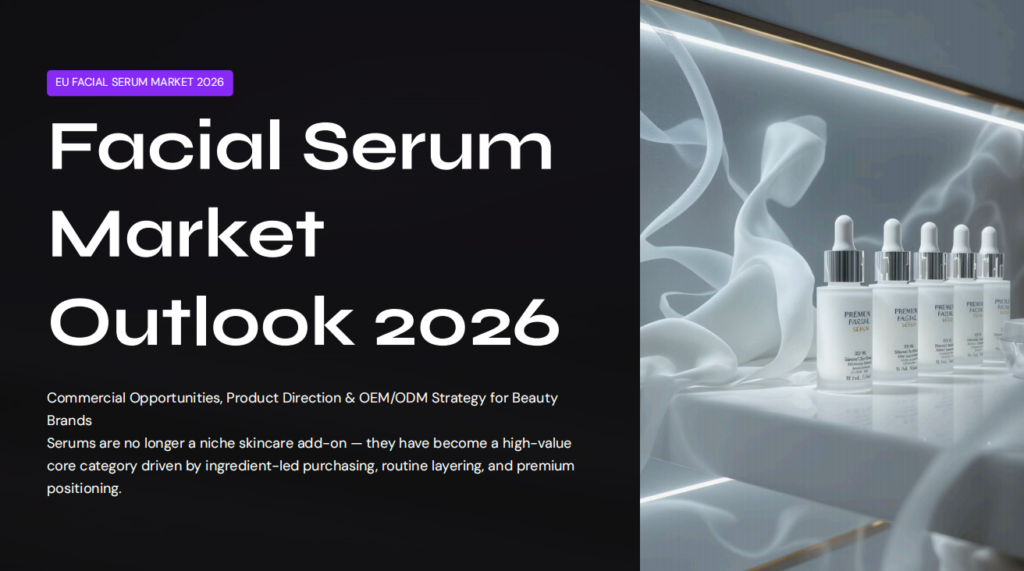
Executive Summary
This report explores the EU facial serum market in 2026, including hydration and barrier-support demand, ingredient-led purchasing, sensitive-skin positioning, pricing logic, compliance priorities, and OEM launch strategy. It is designed to help brands, importers, distributors, private label buyers, and e-commerce sellers turn market insight into a more practical serum launch plan.
EU Facial Serum Market 2026: Product Opportunities, Formulation Direction & Go-to-Market Strateg
The EU facial serum market in 2026 remains one of the most commercially attractive skincare categories because serums sit at the intersection of ingredient-led purchasing, routine sophistication, and premium-per-milliliter value.
For brands, importers, distributors, private label buyers, and e-commerce sellers, the opportunity is not in launching too many serum concepts at once. The stronger strategy is to enter with a tightly edited portfolio built around clear user needs, daily-use compatibility, and compliance-safe cosmetic claims.
This report translates the EU facial serum opportunity into a practical launch roadmap. It covers category direction, consumer demand, ingredient trends, format logic, pricing strategy, channel fit, compliance priorities, and an OEM-ready SKU system for 2026.
Executive Summary
The EU facial serum category continues to expand because serum is no longer viewed as an optional treatment step. It is increasingly treated as the active core of a skincare routine, especially in segments linked to hydration, skin balance, brightening appearance, barrier support, and anti-aging appearance.
For most buyers, the best commercial path is not a wide serum line. It is a focused 3-SKU structure built around one broad-use hero, one strong conversion SKU, and one more aspirational upgrade product.
A practical opening portfolio usually includes:
- a hydrating barrier-support serum
- a niacinamide balancing serum
- a vitamin C brightening appearance serum
This structure works because it gives one broad-demand daily-use SKU, one recognizable ingredient-led problem-solution SKU, and one premium-feeling appearance-led product that can support stronger margin and merchandising value.
Market Opportunity Overview
The EU facial serum market remains attractive because serum combines several commercial strengths at once. It offers concentrated format logic, visible ingredient storytelling, routine layering compatibility, and premium perception without requiring luxury-level entry pricing.
Unlike cleanser or toner, serum is often perceived as the most purposeful step in a skincare routine. Consumers associate serum with visible support, targeted benefits, and stronger performance relative to basic skincare.
This makes serum especially effective across multiple channels:
- Amazon
- DTC
- pharmacy-style retail
- masstige beauty
- premium skincare environments
The category continues to grow because serum fits the way consumers now buy skincare: targeted, layered, ingredient-aware, and repeatable.
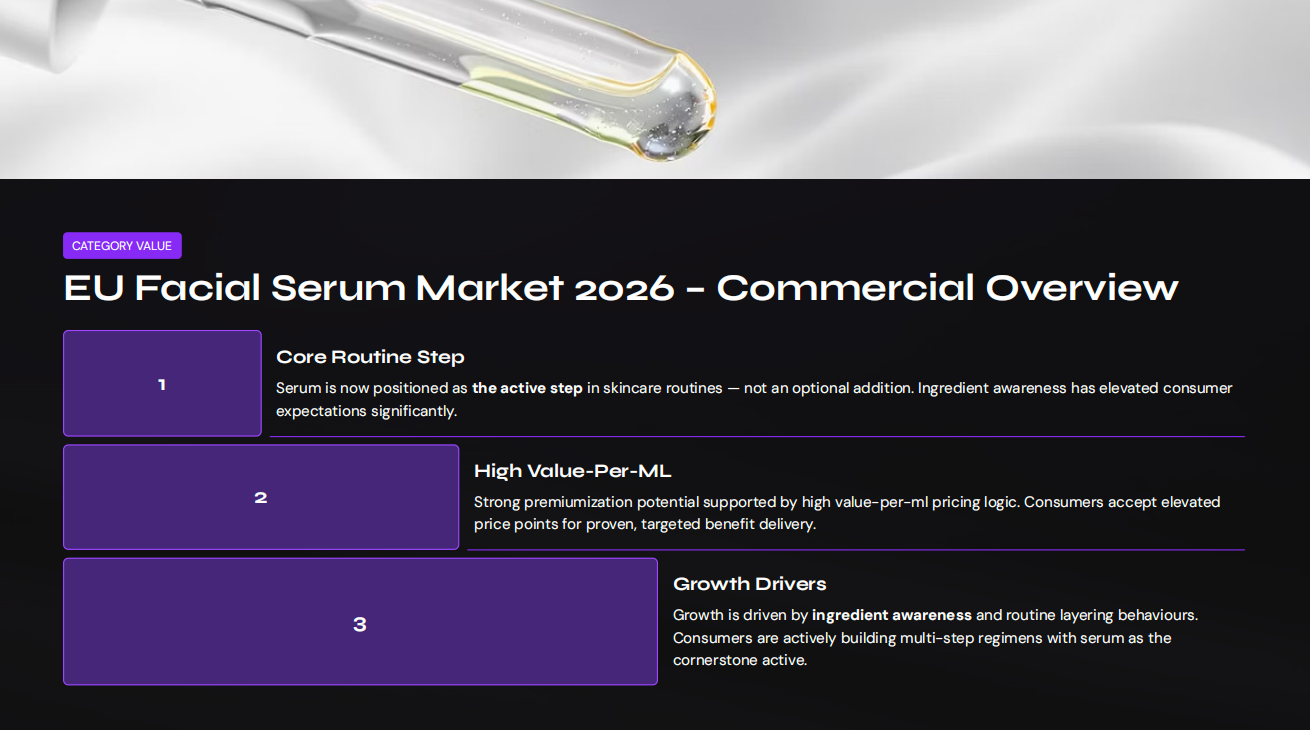
EU Facial Serum Market 2026 3 Commercial Overview
Why Facial Serum Continues to Grow
Facial serum continues to outperform many standard skincare formats because it adapts well to both mainstream and premium demand.
Consumers increasingly expect serum to deliver:
- lightweight hydration
- better layering under moisturizer and SPF
- visible support for skin texture and radiance
- routine sophistication without clinical heaviness
- stronger ingredient recognition than basic cream
This creates a category where smaller pack sizes can still support strong value perception. It also makes serum easier to premiumize than cleanser or toner, while keeping it more accessible than highly specialized treatment formats.
For buyers, this means serum should not be treated as a generic filler SKU. It should be treated as one of the most commercially meaningful products in the lineup.
Consumer Demand Signals
EU consumers are not buying serum only because it sounds technical. They buy it because it fits into a daily routine and promises one specific cosmetic benefit more clearly than a basic moisturizer.
The strongest demand signals in 2026 are centered around:
- hydration and skin comfort
- skin balance and texture refinement
- brightening appearance and radiance
- sensitive-skin compatibility
- lighter textures that absorb quickly
- recognizable active ingredients
This means buyers should define the product around one clear use case first. The strongest serums are not the most complicated formulas. They are the serums that make the consumer immediately understand why the product belongs in the routine.
Core Consumer Segments
A useful way to read the EU facial serum market is through five major consumer groups.
The first is the hydration-focused user. This is the broadest and safest entry group. These consumers want smoother, fresher, more comfortable-feeling skin and respond well to hydration and barrier-support language.
The second is the anti-aging appearance user. These buyers want smoother-looking skin, more refined-looking texture, and softer fine-line appearance, but they respond best when the product avoids exaggerated treatment claims.
The third is the brightening and uneven-tone user. This segment is interested in radiance, fresh-looking skin, and more even-looking complexion, especially when supported by recognizable actives such as vitamin C derivatives or niacinamide.
The fourth is the sensitive-skin user. This group values daily compatibility, low-irritation logic, fragrance-conscious formulas, and barrier-support language.
The fifth is the ingredient-conscious user. These consumers read ingredient lists, compare actives, and often respond to simple product stories with one hero ingredient and one clear benefit.
Each of these groups can support a serum launch, but the strongest opening move is usually to begin with the broadest daily-use need first.
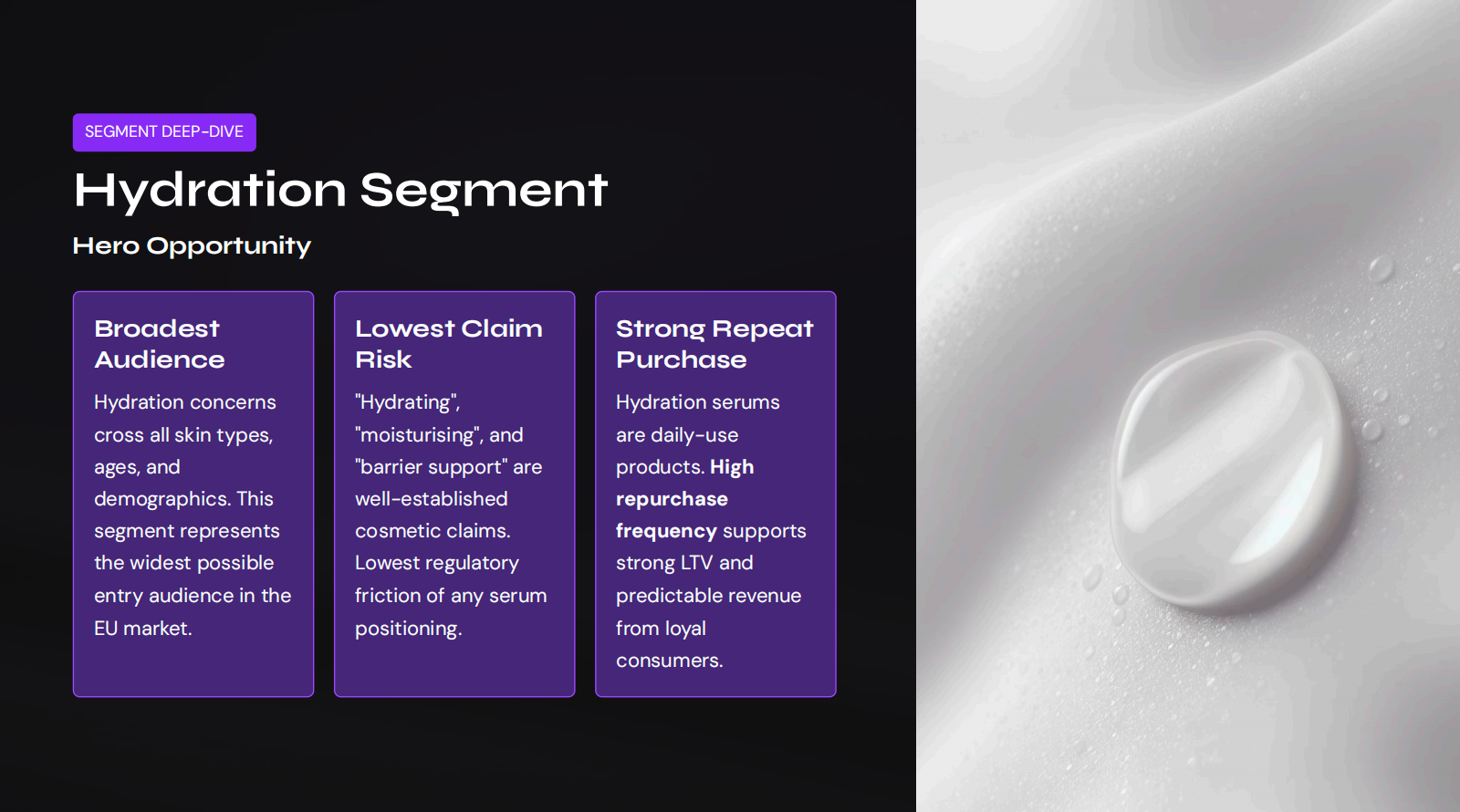
Hydration Segment
Ingredient and Positioning Directions
Ingredient-led purchasing remains one of the strongest commercial drivers in the EU facial serum market. Consumers continue to respond well to ingredients they can recognize, compare, and understand without needing a highly technical explanation.
The most commercially useful actives include:
- hyaluronic acid
- niacinamide
- vitamin C derivatives
- peptides
- panthenol
- ceramides
- ectoin
- soothing support complexes
These ingredients work well because they support familiar, easy-to-merchandise cosmetic claims.
The strongest positionings in 2026 include:
- hydration
- barrier support
- balancing
- brightening appearance
- smoother-looking skin
- suitable for sensitive skin
- anti-aging appearance support
For most buyers, the strongest formula logic is not to use many active ingredients at once. It is to combine one hero active with one support system and one clearly communicated routine role.
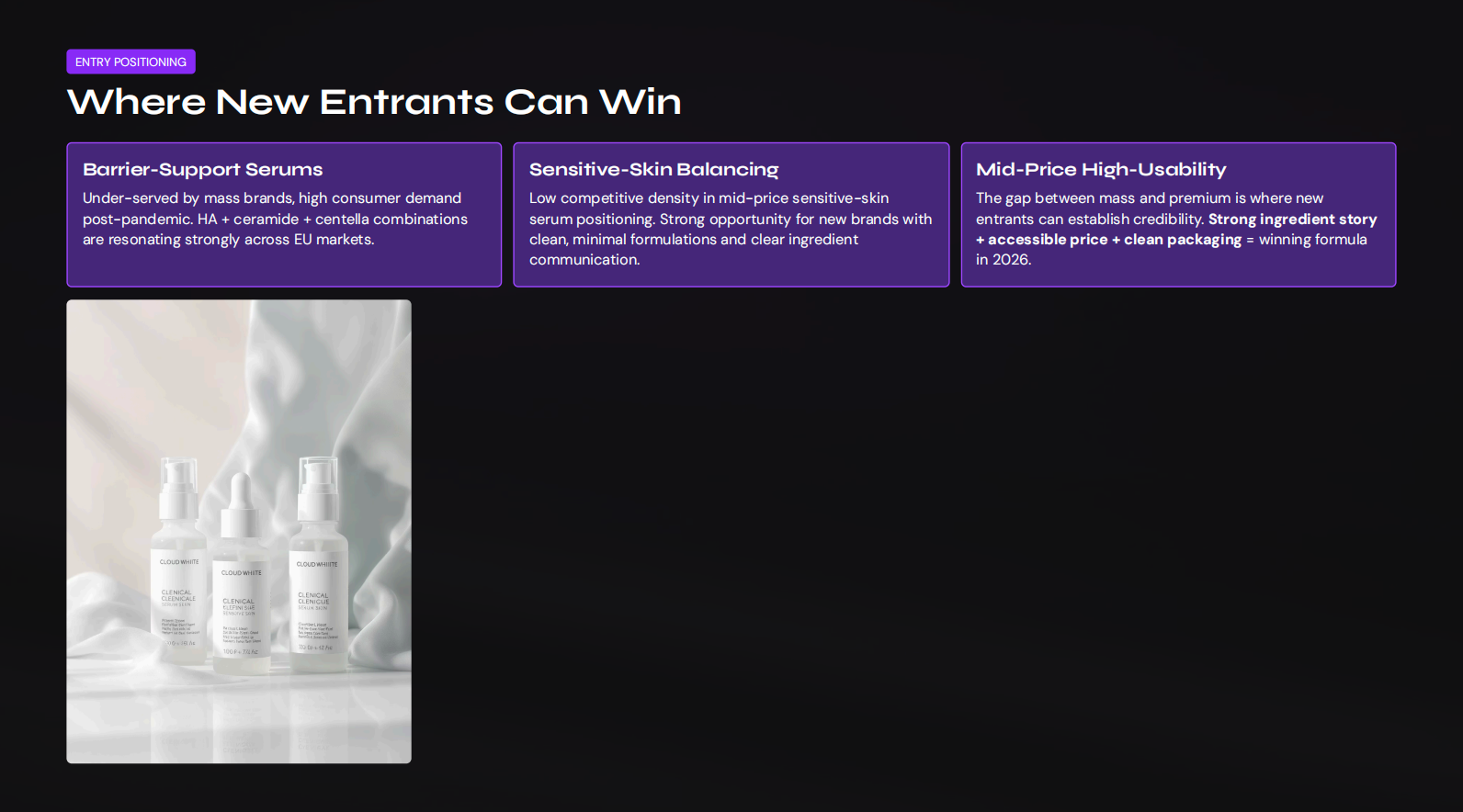
Where New Entrants Can Win
Format Trends
Water-based serum remains the most scalable and commercially practical format in the EU market. It works well for hydration, balancing, soothing, and daily layering.
Gel serum is especially relevant for balancing concepts, lighter skin-feel expectations, and users who prefer fast absorption or lower residue.
Airless formats are increasingly attractive for more stability-sensitive or premium-positioned concepts, especially vitamin C derivatives, peptide serums, and sensitive-skin formulas.
Oil serums remain useful, but they are usually better as dry-skin or premium-support extensions rather than first-entry mass products.
Ampoules and concentrates have value in gifting and premium routines, but they are usually better launched after the core serum portfolio is established.
For most buyers, the strongest opening move remains simple: scalable, daily-use serum first; more complex formats later.
Product Opportunity and SKU Strategy
A strong EU serum launch should not begin with too many overlapping concepts. A tighter, more disciplined SKU system is usually more commercial and easier to scale.
A highly practical first portfolio includes three core products:
1. Hydrating HA Barrier Serum
This should be the hero SKU. It offers broad consumer relevance, low education friction, strong repeat-purchase logic, and wide compatibility across Amazon, DTC, and pharmacy-style channels.
2. Niacinamide Balancing Serum
This is the traffic and conversion SKU. It benefits from strong ingredient recognition and clear digital search relevance, especially for skin balance, texture appearance, and daily-use simplicity.
3. Vitamin C Brightening Appearance Serum
This is the aspirational performance SKU. It supports stronger premium storytelling, visible radiance-oriented positioning, and a more elevated merchandising role.
After these three are validated, second-wave expansion can include:
- peptide anti-aging appearance serum
- sensitive skin soothing serum
- barrier-support serum
- gel serum for combination skin
- eye companion serum
For first launch, however, the smartest move is disciplined simplicity.
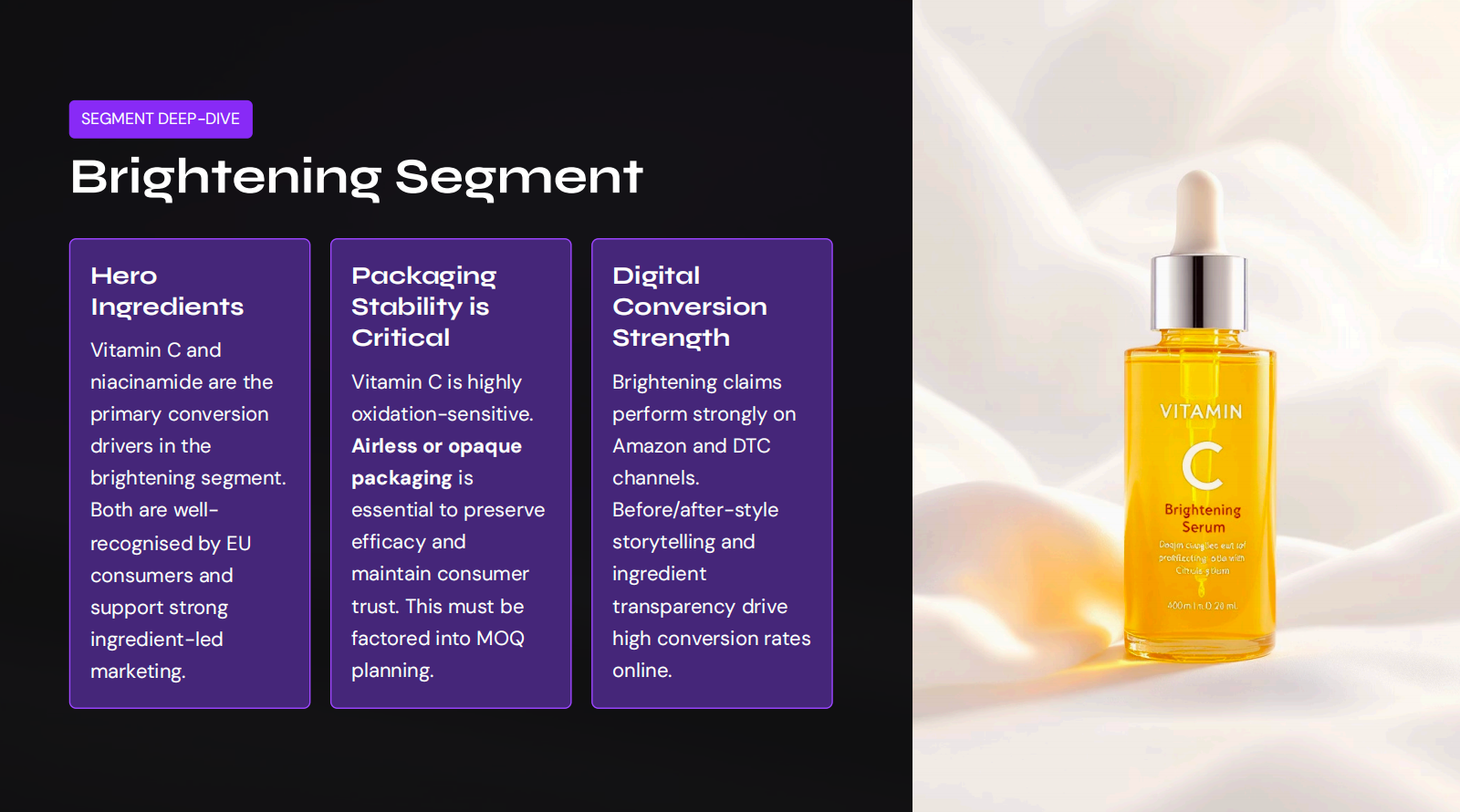
Brightening Segment
Pricing Strategy
The EU serum market is competitive across price tiers, but the strongest entry point for most buyers is the mid-priced segment.
Mass-priced serum can work for traffic and trial, but it often faces margin compression and high comparison pressure.
Mid-tier serum is usually the strongest opportunity because it allows:
- better texture quality
- stronger ingredient storytelling
- cleaner packaging
- wider channel flexibility
- better balance between conversion and margin
Premium serum works best for profit SKUs, especially peptides, ampoules, advanced hydration systems, and high-touch appearance-led concepts. However, premium is usually more effective as an extension rather than a first-volume entry point.
The best portfolio logic is not to treat every serum equally. It is to assign each serum a clear commercial role:
- hero SKU
- traffic SKU
- profit SKU
- bundle or cross-sell SKU
Channel Strategy
A strong EU facial serum launch should be channel-aware from the beginning.
For Amazon, the strongest serum concepts are usually those with recognizable actives, clear front-pack benefits, and high daily-use relevance. Niacinamide, hydration, and vitamin C concepts tend to translate well here when the message is simple and the packaging is reliable.
For DTC, the opportunity is broader. Barrier-support, soothing, peptide, and premium hydration concepts work especially well when supported by educational content, routine bundling, and stronger product storytelling.
For pharmacy-style or trust-led retail, calming design, sensitive-skin compatibility, barrier support, and lower-drama claims tend to work better than noisy trend-led concepts.
The strongest approach is not to sell the same serum portfolio the same way everywhere. It is to adapt the assortment and message to how each channel converts.
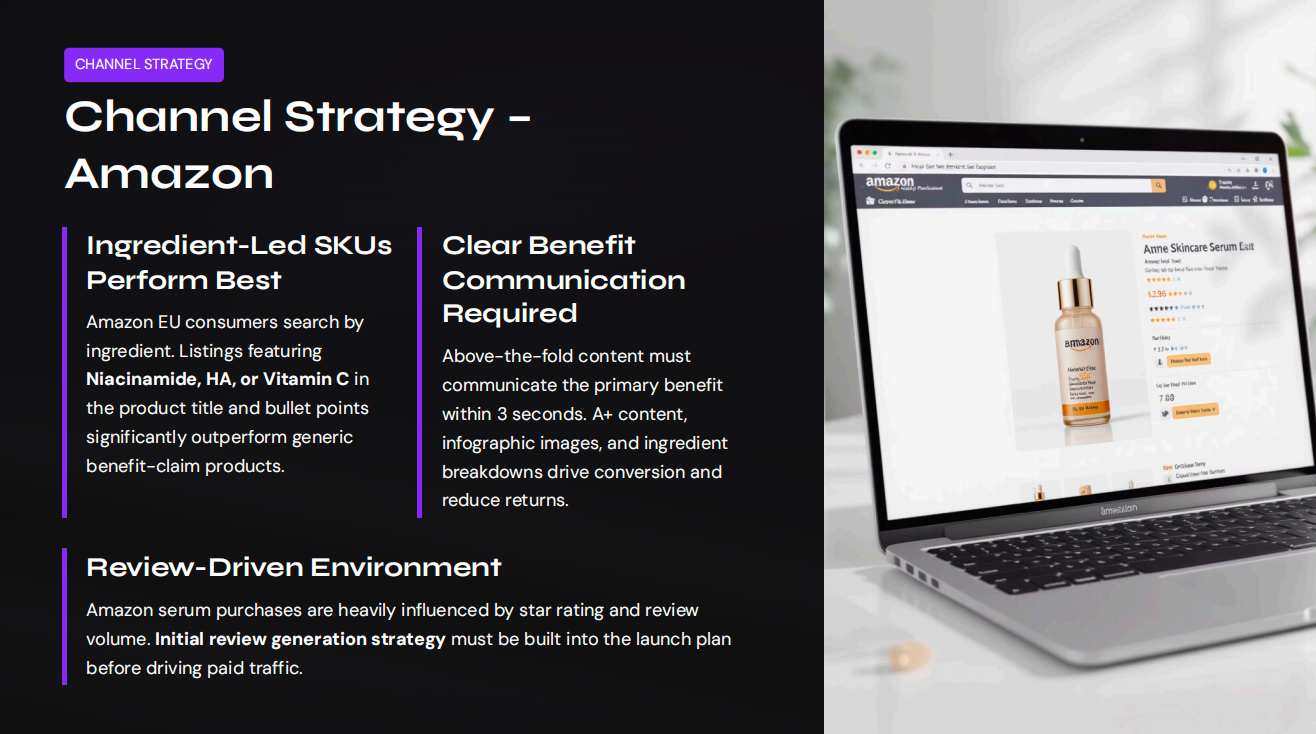
Channel Strategy 3
Amazon
Compliance and Risk Control
The EU facial serum category is attractive, but it also carries clear compliance risk if the product is positioned too aggressively.
The most common problem is claim overreach. A formula that is commercially useful can still create risk if the wording moves too close to treatment, medical, or exaggerated efficacy territory.
Safer cosmetic language includes:
- helps hydrate skin
- supports skin comfort
- helps improve the appearance of skin texture
- helps brighten the appearance of the complexion
- supports the skin barrier
- suitable for sensitive skin
- helps improve the appearance of fine lines
- helps maintain skin balance
Claims to avoid include:
- treats acne
- heals eczema
- reverses aging
- eliminates pigmentation
- permanent wrinkle removal
- disease-style or therapeutic wording
Compliance should be treated as part of commercialization, not as a final legal step. Formula, ingredient choice, packaging, labeling, and claims should all be aligned from the beginning.
Packaging and Presentation
Packaging plays an important role in serum conversion because this category is highly comparison-driven. Consumers often judge serums not only by formula story, but also by how usable, premium, and trustworthy the pack looks.
Useful packaging directions include:
- dropper bottles for classic serum recognition
- airless pumps for premium or stability-sensitive formulas
- clinical-clean visual design for balancing, barrier, and sensitive-skin concepts
- refined minimalist aesthetics for modern ingredient-led positioning
- clear portfolio architecture across multiple SKUs
The strongest packaging is not the most decorative. It is the packaging that helps the consumer immediately understand the serum’s role in the routine.
OEM and Launch Execution
For OEM or private label buyers, serum projects work best when the commercial brief is clear before sample development begins.
A stronger brief should include:
- target EU market or markets
- primary sales channel
- target retail price
- hero claim
- ingredient story
- sensitive-skin or fragrance preference
- preferred formula texture
- packaging format
- initial MOQ expectation
- launch timeline
The better these elements are aligned early, the easier it becomes to reduce revision cycles, improve sample relevance, and move faster from concept to quotation.
For first launch, it is usually better to reduce packaging complexity before pushing for ultra-low MOQ. A small number of stronger, better-defined SKUs is more commercial than a fragmented assortment.
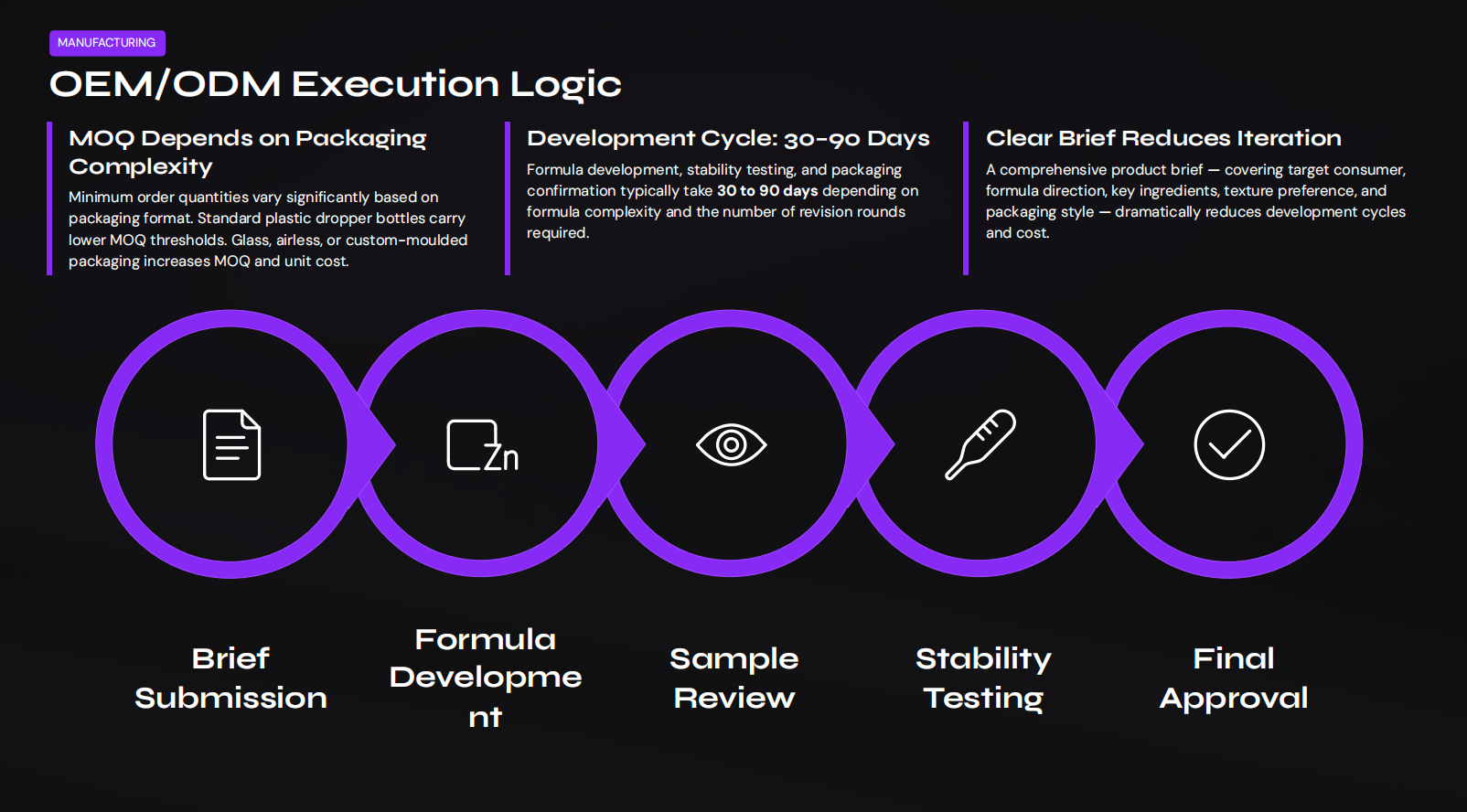
OEM/ODM Execution Logic
Final Takeaway
The EU facial serum market in 2026 remains one of the most commercially attractive skincare opportunities because serum combines premium perception, ingredient-led conversion, daily-use compatibility, and clear routine relevance.
The brands most likely to win are not the ones launching the largest assortment. They are the ones building the clearest commercial system: one broad hydration hero, one strong balancing converter, and one premium appearance-led upgrade SKU, all supported by elegant skin feel, disciplined claims, and channel-fit packaging.
If you are planning an EU facial serum launch, the smartest next step is to define your hero need, active logic, channel strategy, and compliance boundary first, then build the right SKU architecture from there.
CTA
Planning an EU facial serum launch?
Share your target market, serum concept, preferred format, price tier, and launch timeline — and we can help recommend the right SKU strategy, packaging direction, and OEM path for your brand.
Download the Full Report (PDF)
Tell us your target region, product category, and the decision you’re trying to make. We’ll suggest the closest existing report—or build a tailored version.