



Executive Summary
This report explores the U.S. hair oil market in 2026, including scalp care trends, repair-led demand, anti-frizz and multi-use product directions, pricing strategy, packaging formats, compliance priorities, and OEM launch planning. It is designed to help brands, distributors, product development teams, and e-commerce sellers turn market insight into a more practical hair oil launch strategy.
U.S. Hair Oil Market Report 2026: Scalp Care Trends, Repair Oils, and Go-to-Market Guide
The U.S. hair oil market in 2026 is no longer defined by one generic nourishing oil. It has evolved into a more structured category shaped by scalp care, damage recovery, anti-frizz performance, styling control, and ritual-based self-care.
For brands, distributors, product development teams, and e-commerce sellers, the opportunity is not simply to launch another oil with a botanical story. The stronger opportunity is to build a product that solves a specific problem, fits a real usage routine, and delivers a controlled texture that feels modern in daily use.
This report translates market trends into commercial launch logic. It covers consumer demand shifts, product types, texture expectations, price tiers, channel strategy, compliance priorities, packaging formats, and OEM execution planning for brands entering or expanding in the U.S. hair oil market.
Executive Summary
The U.S. hair oil category is entering a more functional phase in 2026. Consumers no longer shop hair oil only for shine or nourishment. They increasingly buy by problem to solve, such as scalp dryness, frizz control, heat damage, split ends, softness recovery, or multi-step repair routines.
This shift is changing the way hair oil should be developed and positioned. The strongest products are no longer generic heavy oils. Winners are more likely to be lightweight repair oils, scalp-support oil-serums, anti-frizz finishing oils, and multi-use products that fit into clear routines without feeling greasy or outdated.
For most new entrants, the best path is not to launch too many oil variants at once. It is to start with one hero repair-led oil, supported by one scalp-focused or finishing companion SKU, then expand only after repeat purchase and channel fit are validated.
Market Opportunity Overview
The U.S. hair oil market sits between treatment, styling, scalp care, and ritual beauty. This is what makes the category attractive, but also what makes it easy to get wrong.
Consumers do not treat all hair oils as interchangeable. Some are looking for post-wash softness and frizz control. Others want repair support for color-treated or heat-damaged hair. Another group is interested in scalp comfort and growth-adjacent routines. Still others want one product that can work across scalp, ends, overnight care, and styling.
That means the market opportunity is not in “selling oil” as a broad concept. The opportunity is in defining a precise use case and building the right formula texture, packaging format, and claim structure around it.
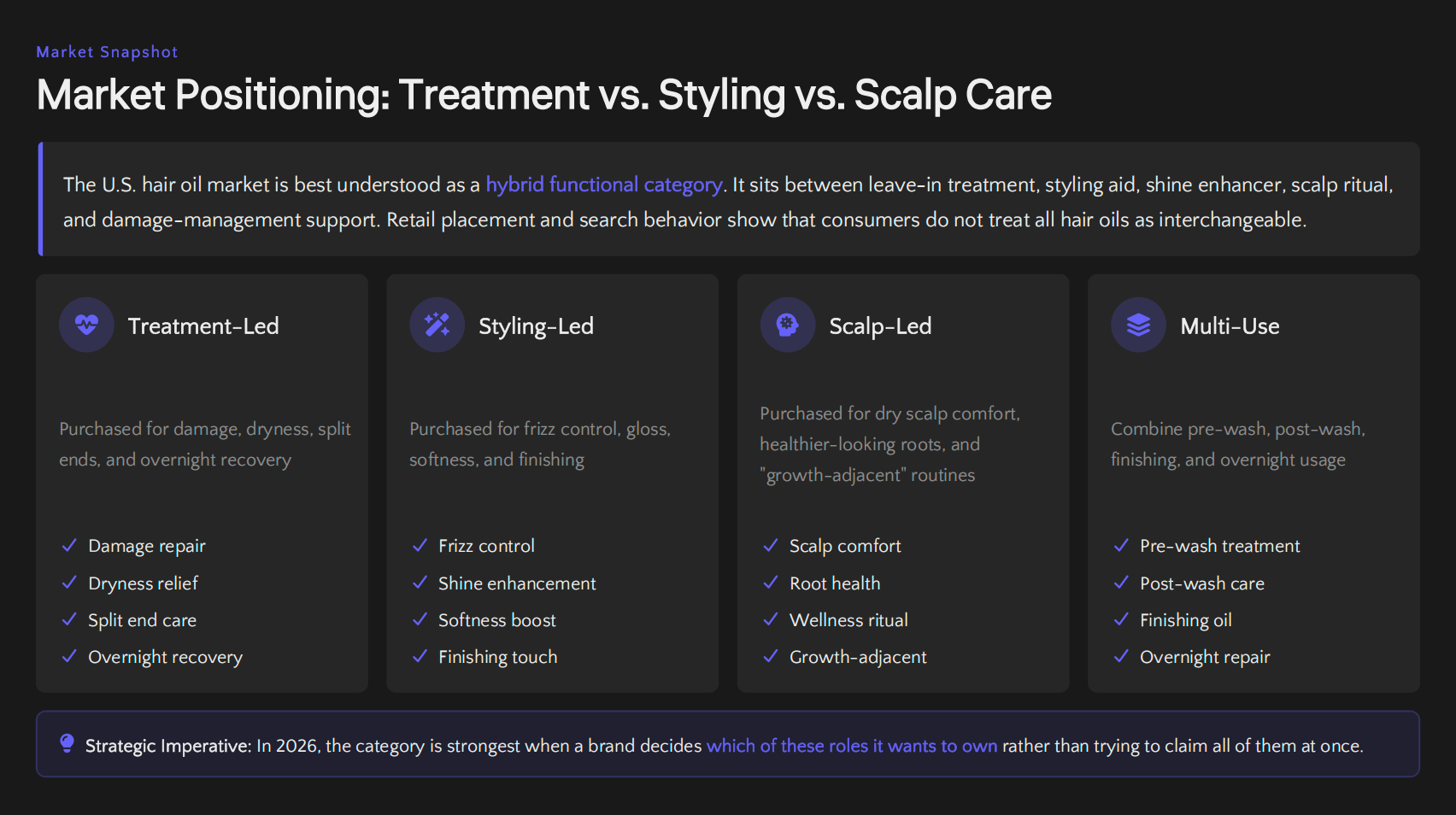
Market Positioning: Treatment vs. Styling vs. Scalp Careq
What Is Driving Demand in 2026
Several forces are expanding the category.
The first is the rise of scalp care. Consumers are increasingly treating the scalp more like skincare, which has created stronger demand for oils and oil-serums that fit into comfort, massage, and root-care rituals.
The second is continued demand for damage recovery. Coloring, bleaching, heat styling, and environmental stress keep repair-oriented products highly relevant, especially when they can smooth the hair without heaviness.
The third is styling practicality. Hair oils are still widely used for anti-frizz control, gloss, flyaway smoothing, and softness, especially when the texture is light enough for repeat daily use.
The fourth is routine simplification. Multi-use oils that can work pre-wash, post-wash, on dry ends, or overnight remain commercially attractive because they increase perceived value while simplifying the pitch.
The Main Product Types Shaping the Market
The category is strongest when viewed through product roles rather than ingredient names.
Scalp-Support Oils
These products are used for dry, tight, or uncomfortable scalps and often sit close to growth-oriented routines in consumer behavior. The strongest versions stay within cosmetic positioning while emphasizing scalp comfort, nourishment, and healthier-looking hair.
Repair Oils
These are aimed at damaged, color-treated, brittle, or heat-stressed hair. They typically perform best when positioned around softness, smoothness, frizz reduction, split-end appearance control, and healthier-looking ends.
Lightweight Daily Oils
These are designed for everyday use, especially for fine to medium hair. Their strongest selling points are shine, softness, anti-frizz control, and a non-greasy finish.
Multi-Use Oils
These products combine several routines into one offer, such as scalp use, length care, overnight treatment, and finishing. They are especially strong in DTC and Amazon when the formula is balanced enough to perform across use cases.
What Consumers Want from Hair Oil Now
Consumers in 2026 are much less forgiving of heavy, old-fashioned oil textures. They still want nourishment, but they expect that nourishment to come with a more elegant finish.
The strongest product expectations include:
- visible improvement in softness and smoothness
- shine without greasy buildup
- nourishment without collapsing fine hair
- easy dose control
- flexible use across wet hair, dry hair, scalp, ends, or overnight
- packaging that feels clean, stable, and easy to use
- a benefit story that is specific and believable
In practical terms, consumers want products that feel engineered rather than improvised. The formula must match the usage promise.
Growth Drivers and Key Demand Scenarios
Best Product Directions for 2026
The most commercially promising hair oil directions in the U.S. market include:
- lightweight repair oils for damaged and heat-stressed hair
- scalp-support oil-serums for dry scalp comfort
- anti-frizz gloss oils for daily finishing
- overnight recovery oils for dry or brittle hair
- curl-support oils for softness and seal-and-define routines
- oil-serum hybrids that bridge treatment and styling
- multi-use premium oils that support scalp, lengths, and shine without heaviness
The strongest direction for most brands is not the richest oil or the most “natural” story. It is the product that best combines problem clarity, texture control, and repeat-use comfort.
Price Band Strategy
The category is usually divided into entry, mass premium, and premium.
Entry-tier hair oils typically compete on value, size, and basic utility. They are easier to sell but also easy to commoditize.
Premium products can succeed through specialization, sensory refinement, and packaging quality, but they require stronger differentiation and more obvious performance.
For many new launches, the most attractive area is mass premium. This is often the best balance between price accessibility and performance credibility.
A practical mass-premium structure gives brands room to offer:
- better texture refinement
- more targeted positioning
- more polished packaging
- a stronger problem-solving message
- healthier repeat-purchase potential
For 2026 launches, this is often the safest place to build a scalable hero SKU.
Packaging Format Strategy
Packaging in hair oil is not just a container choice. It directly shapes how the product is understood.
Dropper
Best for scalp-support oils, ritual positioning, and more treatment-like usage. It signals precision, but it also carries more leakage risk.
Pump
Best for premium daily oils and repair oils. It supports better dosing, less mess, and a cleaner user experience.
Spray or Fine Mist
Best for ultra-light finishing oils or gloss-focused styling products. It works especially well for fine hair and lightweight daily use.
Glass vs. Plastic
Glass can elevate premium perception, but it increases breakage and shipping risk. Plastic can improve resilience and cost structure, especially for Amazon and broad e-commerce.
The right format should be chosen based on routine fit, not only aesthetics.
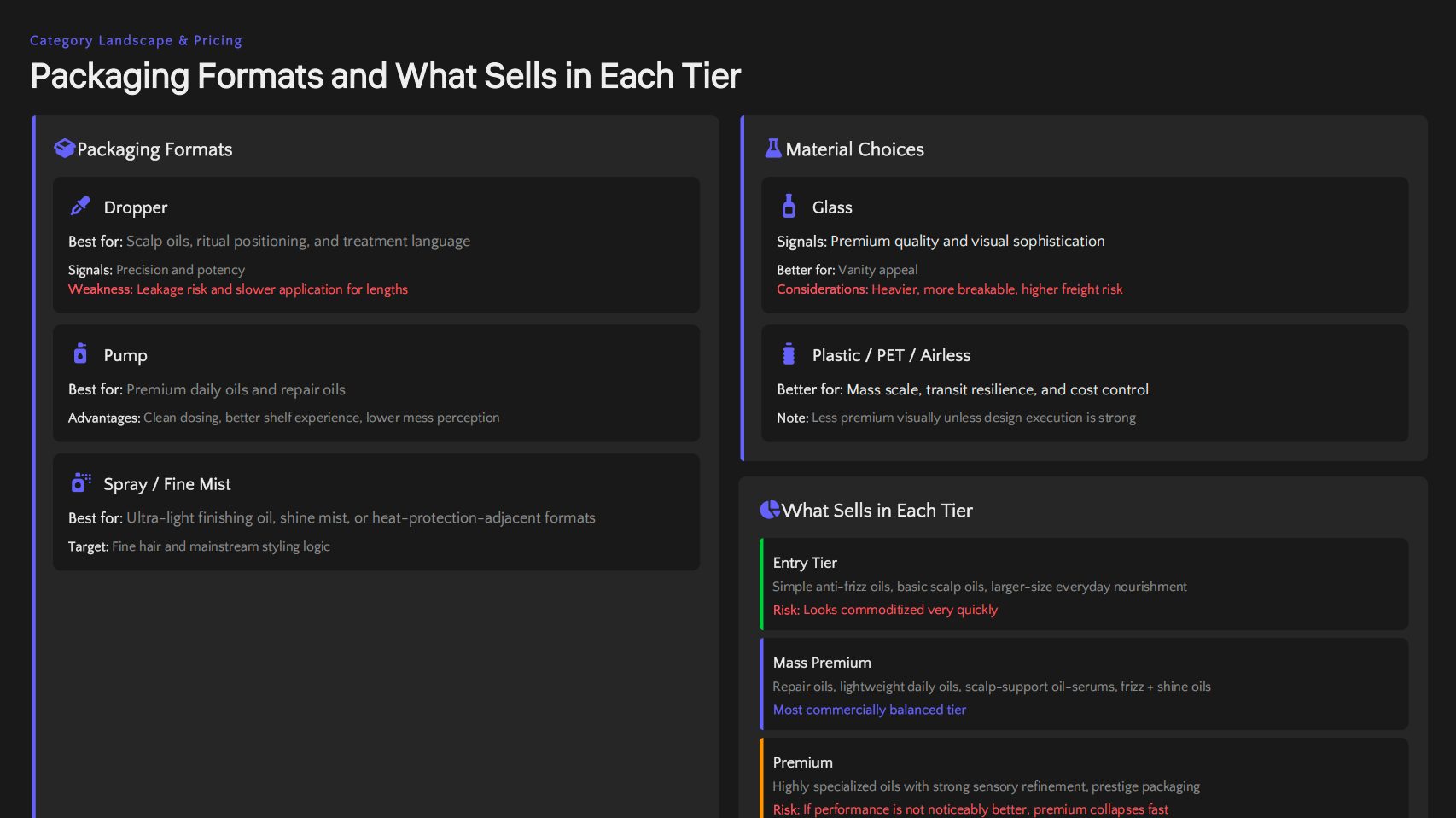
Packaging Formats and What Sells in Each Tier
By Hair Type and Use Case
A good hair oil launch should not assume one texture fits all.
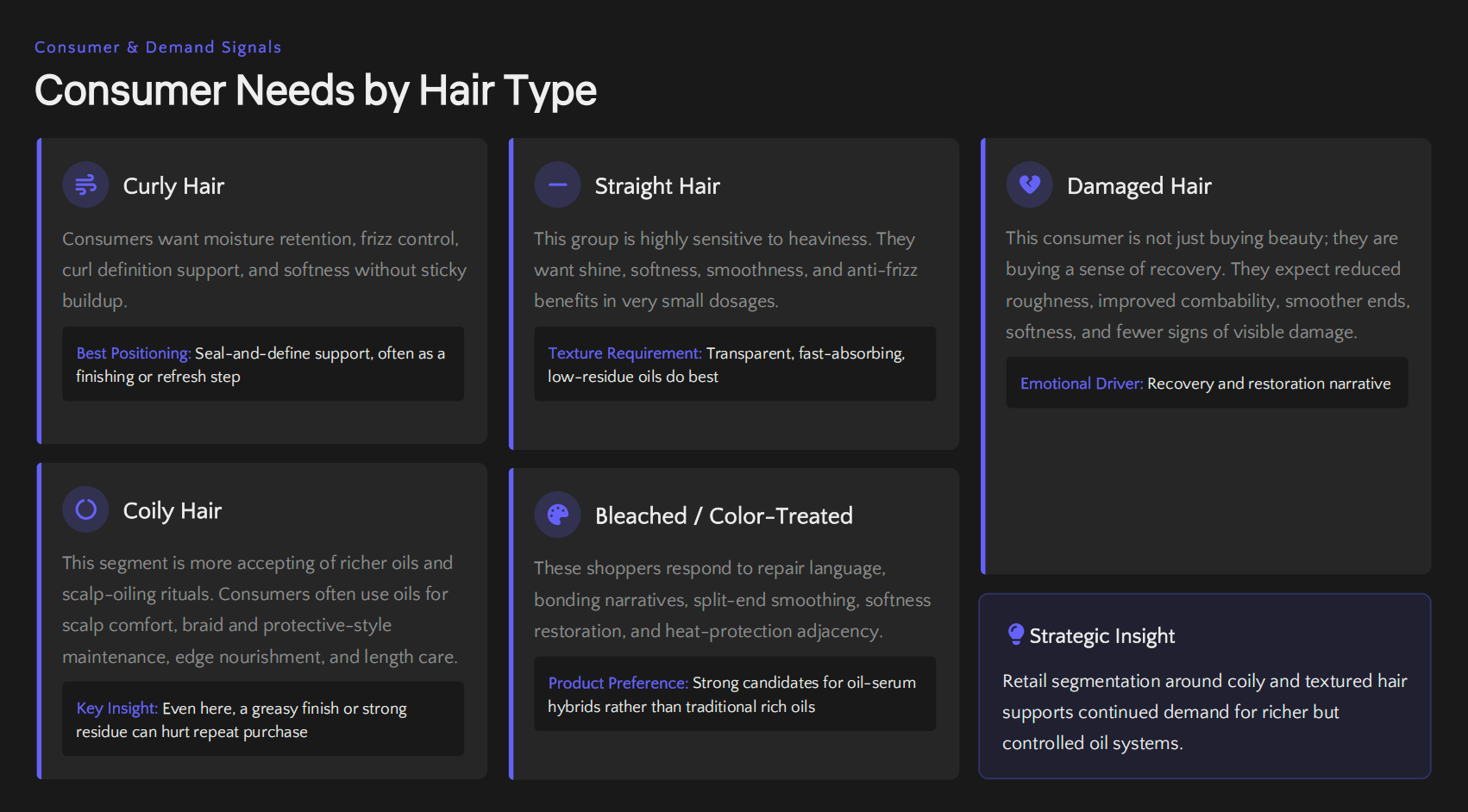
For curly hair, the product should support softness, moisture retention, and controlled frizz without sticky buildup.
For coily hair and protective-style users, richer systems can still work well, especially when positioned around scalp comfort, braid care, or length nourishment.
For straight or fine hair, heaviness is the main risk. Lightweight, transparent, low-residue formats are usually more effective.
For bleached or color-treated hair, repair-led oils and oil-serum hybrids often make more commercial sense than traditional rich oils.
That is why a tighter, use-case-led line architecture is stronger than a single undifferentiated oil launch.
Channel Strategy
Hair oil should be built for the right channel from the beginning.
Amazon
The strongest Amazon opportunities are clear-benefit oils that match strong search intent, such as repair oils, anti-frizz oils, scalp-support oils, and practical bundles. Packaging must be leak-resistant and e-commerce ready.
DTC
DTC is best for routine-based education, scalp rituals, multi-use premium oils, and texture-specific storytelling. It is also the best place to build bundle logic and explain usage depth.
Retail
Retail performs best with simpler, more immediately understandable products such as daily anti-frizz oils, repair oils, and shine-focused oils. Front-of-pack clarity matters more here.
Salon / Professional
Professional channels are strongest for technical stories such as bond repair, smoothing support, or heat-styling oil-serums. Stylist trust and visible performance matter more than botanical romance.
The strongest launches do not use the exact same product story everywhere. They adapt the product system to each channel’s buying logic.
Competitive White Space
The category does not need another generic nourishing oil. The clearest white spaces are more specific.
The strongest opportunity areas include:
- repair-first oils for damaged or bleached hair that still feel light enough for frequent use
- scalp-support oils that stay cosmetic-compliant and avoid overpromising
- texture-specific oils for fine hair, curls, coily hair, or protective styles
- oil-serum hybrids that feel more modern than traditional oils
- premium daily oils with low residue and stronger sensory elegance
- bundle-ready systems where hair oil is part of a larger repair or scalp routine
This is where better brands can still stand out.
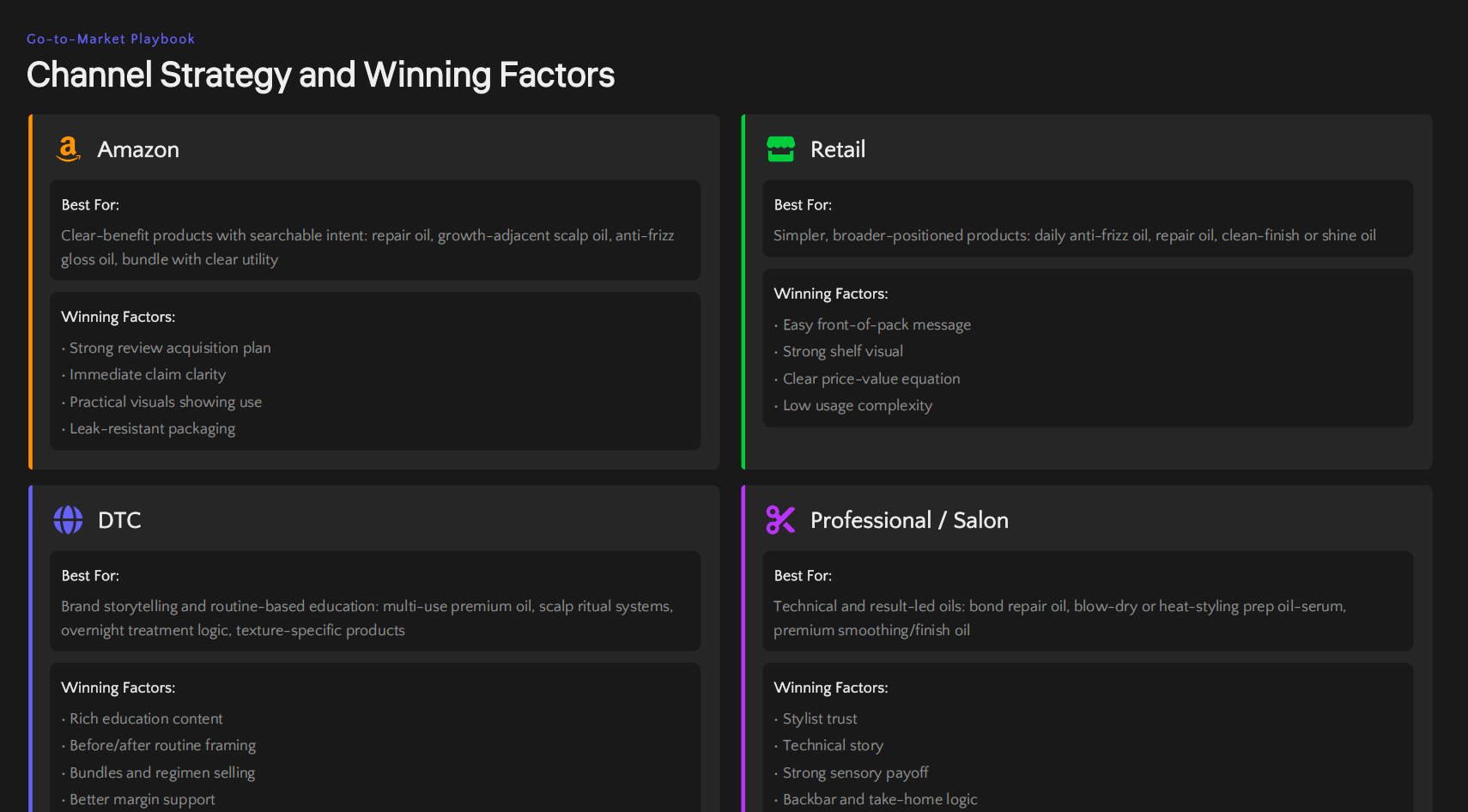
Channel Strategy and Winning Factors
Compliance and Risk Priorities
Hair oil may look simple as a product, but it can become high-risk very quickly if claims are not controlled.
The most important rule is to avoid pushing a cosmetic hair oil into drug-style territory through language such as:
- hair growth
- regrowth
- hair restoration
- anti-hair loss
A safer and more scalable path is to focus on cosmetic territory such as:
- nourishes scalp
- supports healthier-looking hair
- softens
- smooths
- helps reduce breakage
- improves shine
- comforts dry scalp
- helps reduce the appearance of rough, dry ends
Beyond claims, brands also need to manage:
- ingredient declaration accuracy
- responsible-party labeling
- operational MoCRA readiness
- packaging leakage
- oxidation and odor drift
- label adhesion on oil-contact surfaces
- batch traceability
- channel-specific documentation readiness
For U.S. launches, the most common mistake is not formula failure. It is claim overreach combined with under-tested packaging.
OEM Launch Strategy
The fastest way to improve hair oil development is to give the manufacturer a stronger brief.
A better OEM brief should include:
- target user
- main problem to solve
- price band
- target channel
- preferred texture
- ingredient direction
- packaging format
- claim boundary
- whether the SKU is stand-alone or part of a system
- expected first order quantity
- timeline expectations
The more specific these decisions are upfront, the easier it becomes to create a formula that actually matches the intended consumer and channel.
For most brands in 2026, the strongest launch path is:
- one hero lightweight repair oil
- one scalp-support companion SKU
- one optional lighter finishing oil or mini later
- stock packaging first if speed matters
- expand only after repeat and review data validate the line

OEM Considerations and Partner Evaluation
What Brands Should Do Next
If you are planning a U.S. hair oil launch, the smartest next move is not to launch several oils at once.
Instead:
- define the exact use case
- decide whether the first hero is repair, scalp, or anti-frizz
- lock the target texture before discussing packaging
- choose the primary channel early
- keep claims tightly cosmetic
- test leakage and oxidation before scale-up
- build one focused hero first, then expand
This approach reduces waste, improves quote quality, and increases the chance that the product will actually repeat in market.
Final Takeaway
The U.S. hair oil market in 2026 is attractive because it has moved beyond generic beauty oil positioning. It now rewards products that solve real concerns, fit real routines, and feel modern in texture and packaging.
The brands most likely to win are not the ones launching the broadest assortment. They are the ones building the clearest product system: a hero problem-solving oil, a tightly controlled claim set, a channel-ready package, and an OEM brief that translates strategy into a commercially usable product.
If your team is evaluating a 2026 hair oil launch, the strongest next step is to align target user, texture direction, package format, price band, and claim scope first, then move into sampling with a much more
Download the Full Report (PDF)
Tell us your target region, product category, and the decision you’re trying to make. We’ll suggest the closest existing report—or build a tailored version.