


Executive Summary
This report explores the UK scalp care market in 2026, including anti-dandruff, sensitive scalp, oil-balance, and thinning-support opportunities, along with product strategy, channel fit, claims direction, compliance priorities, and OEM launch planning. It is designed to help brands, distributors, importers, and e-commerce sellers turn market insight into a more practical scalp care launch strategy.
UK Scalp Care Market 2026: Anti-Dandruff, Sensitive Scalp, Thinning Support, and Launch Strategy
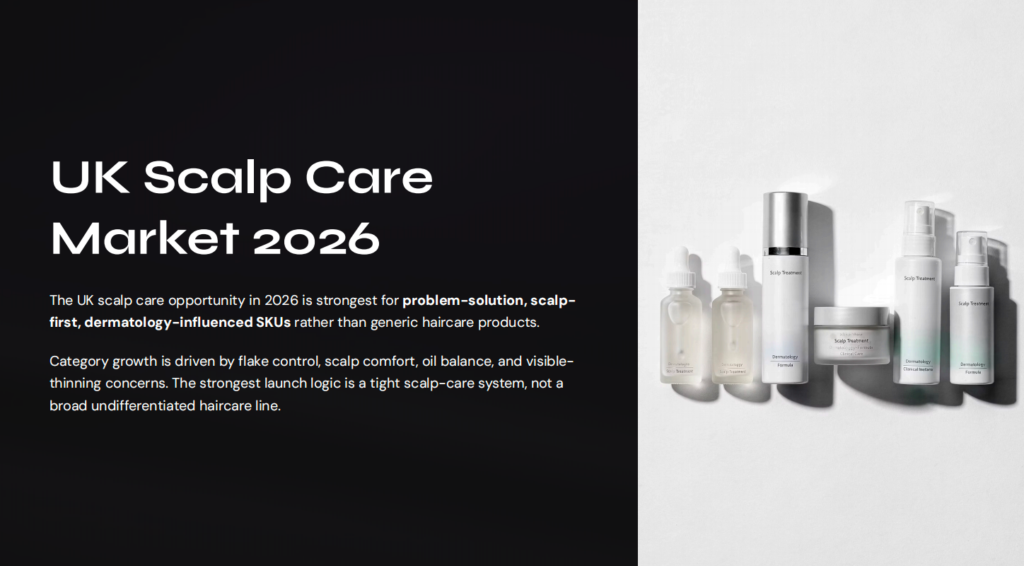
The UK scalp care market in 2026 is becoming one of the most commercially attractive problem-solution segments in haircare. Growth is no longer being driven by generic cleansing alone. It is being driven by visible flakes, scalp discomfort, oil imbalance, buildup, and thinning-related concerns that consumers actively want to solve.
For brands, importers, distributors, Amazon sellers, and product development teams, this creates a more structured opportunity than general haircare. Shoppers are looking for scalp-first products with clearer symptoms, better ingredient logic, and more credible positioning. In practical terms, that means anti-dandruff, sensitive scalp, and thinning-support routines are now more investable than broad “healthy hair” claims.
This report turns scalp care demand into launch logic. It covers market opportunity, consumer demand signals, product formats, price strategy, channel fit, claims direction, compliance priorities, and an OEM-ready path for brands entering or expanding in the UK scalp care category.
Executive Summary
The smartest way to enter UK scalp care in 2026 is not to launch a broad haircare line. It is to build a tight scalp-care system around one urgent condition and then expand through adjacent treatment formats.
The category is growing because scalp care solves visible problems. Flakes, itch, oiliness, tightness, sensitivity, and perceived thinning create stronger urgency than generic hair nourishment. That urgency supports higher search intent, faster trial, and better repeat purchase when the product logic is clear.
For most new entrants, the strongest commercial structure is a three-SKU starter system:
- one cleansing hero,
- one treatment differentiator,
- one higher-margin serum.
This creates a usable line for Amazon, DTC, pharmacy-style retail, and OEM quotation planning.
Market Opportunity Overview
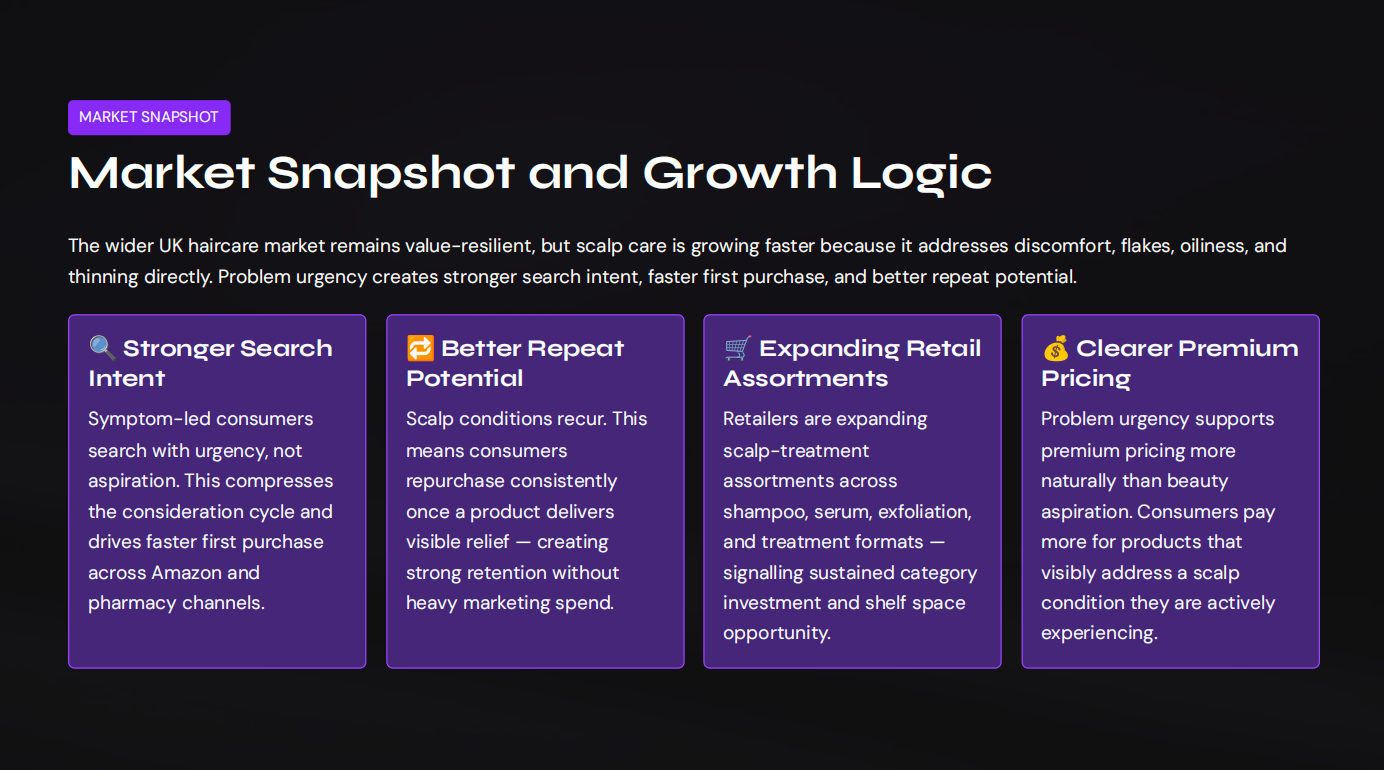
The wider UK haircare market remains resilient, but scalp care is becoming the more dynamic sub-category because it sits at the intersection of symptom-driven demand and skincare-style routine building.
Consumers increasingly see scalp health as the foundation of better-looking hair. This changes what products they are willing to buy. Instead of only choosing shampoo for cleansing, they are also open to scalp serums, leave-in treatments, exfoliants, detox formats, and tonic-style products.
That shift creates a commercially stronger category because scalp care:
- solves a more immediate problem,
- supports routine selling,
- fits both beauty and pharmacy environments,
- and can justify premium pricing when linked to comfort, clarity, or visible scalp improvement.
For brands planning a launch, the implication is simple: do not start with generic haircare and try to add scalp language later. Build the line around a specific scalp problem from day one.
Market Snapshot and Growth Logic
What Is Driving Demand in 2026
Several structural shifts are supporting scalp care growth in the UK.
The first is problem urgency. Consumers feel flakes, itch, grease, and scalp tightness much more directly than they feel abstract “hair nourishment” claims.
The second is skinification. Shoppers now accept scalp care in formats that look and behave more like skincare, including scalp serums, pre-shampoo treatments, leave-in lotions, and exfoliating products.
The third is ingredient education. Consumers increasingly respond to familiar functional ingredients such as salicylic acid, niacinamide, caffeine, oat extract, zinc, and piroctone olamine when the benefit is clear.
The fourth is trust. Sensitive scalp and anti-flake products benefit from dermatology-style presentation, controlled fragrance use, simpler claim language, and better compliance discipline.
The fifth is visible-thinning concern. Consumers are highly motivated by scalp and root concerns, but the winning route for cosmetic brands is not treatment language. It is appearance-led positioning around fuller-looking hair, reduced breakage-related fall, and improved scalp condition.
Core Consumer Segments
The UK scalp care market is not one audience. The strongest commercial opportunities come from distinct problem-led consumer groups.
Dandruff-Prone Consumers
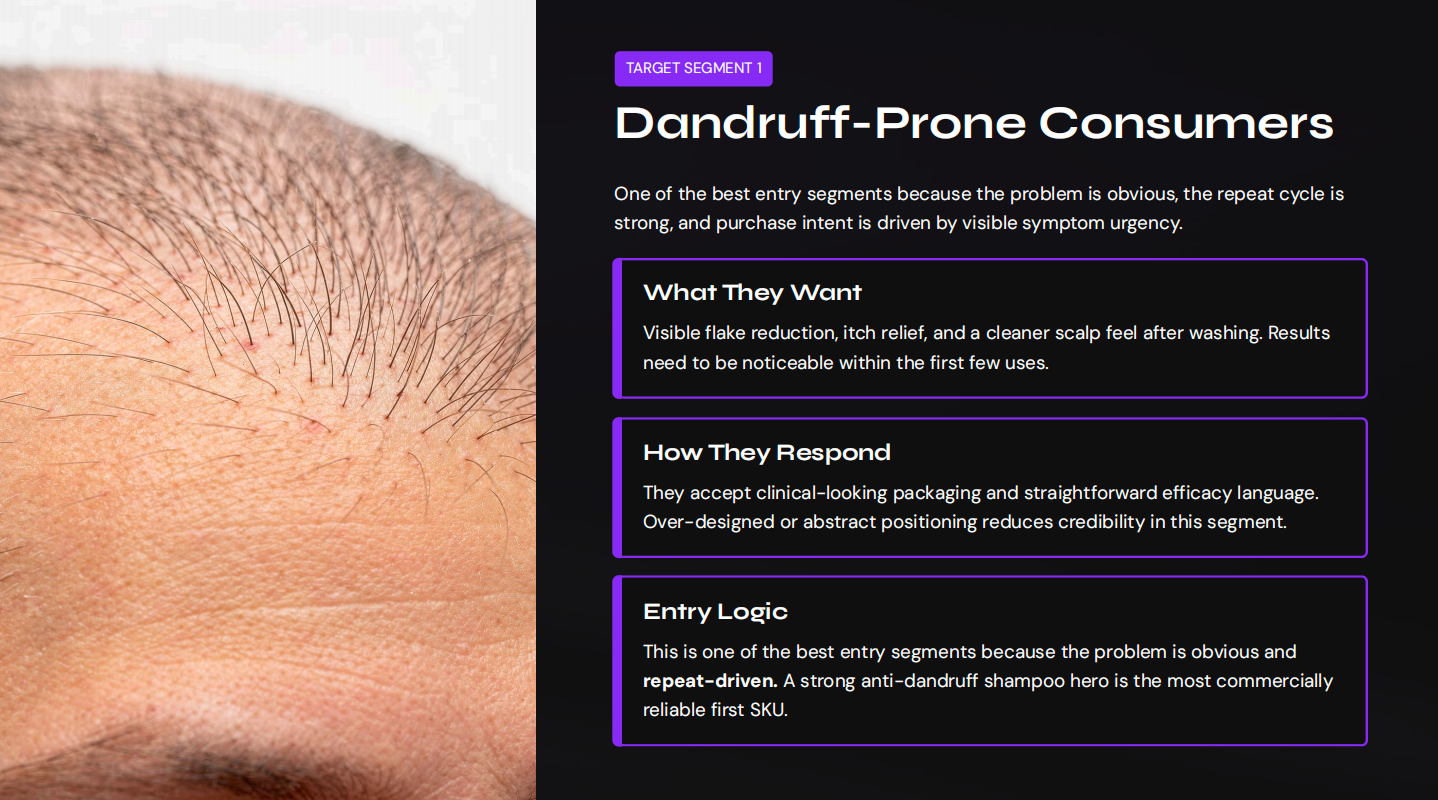
These shoppers want visible flake reduction, itch relief, and a cleaner scalp feel. They are comfortable with clinical-looking products and are often open to repeat shampoo purchase plus a supporting leave-in format.
Dandruff-Prone Consumers
Sensitive Scalp Consumers
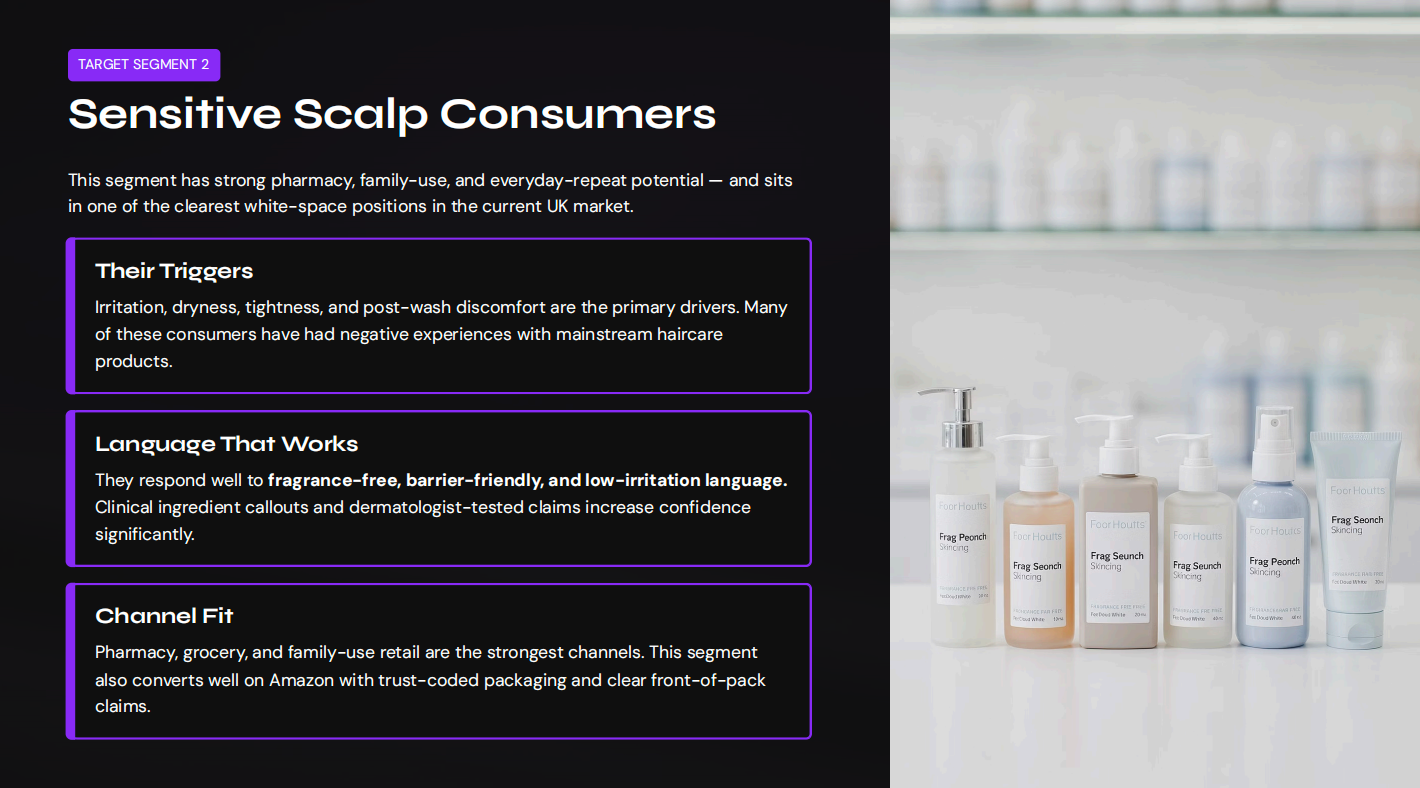
These shoppers react to dryness, tightness, irritation, post-wash discomfort, and fragrance sensitivity. They respond well to gentle, barrier-support, fragrance-free, and pharmacy-friendly positioning.
Oily Scalp and Buildup Consumers
These users are looking for cleaner roots, oil control, less heaviness, and better freshness between washes. They are strong candidates for pre-shampoo exfoliation, balancing shampoos, and lightweight leave-in treatments.
Thinning-Support Consumers
These shoppers are highly motivated but require careful product positioning. The safer and more scalable route is to focus on scalp condition, breakage-related hair fall, denser-looking appearance, and fuller-looking hair rather than growth or medicinal language.
Clean + Clinical Users
This audience wants fewer irritants, clearer ingredient logic, and better cosmetic credibility. They tend to perform well in DTC, premium e-commerce, and ingredient-led scalp routines.
Sensitive Scalp Consumers
Best Product Opportunities
In 2026, the strongest scalp care launches are not built around one oversized product range. They are built around a focused SKU mix.
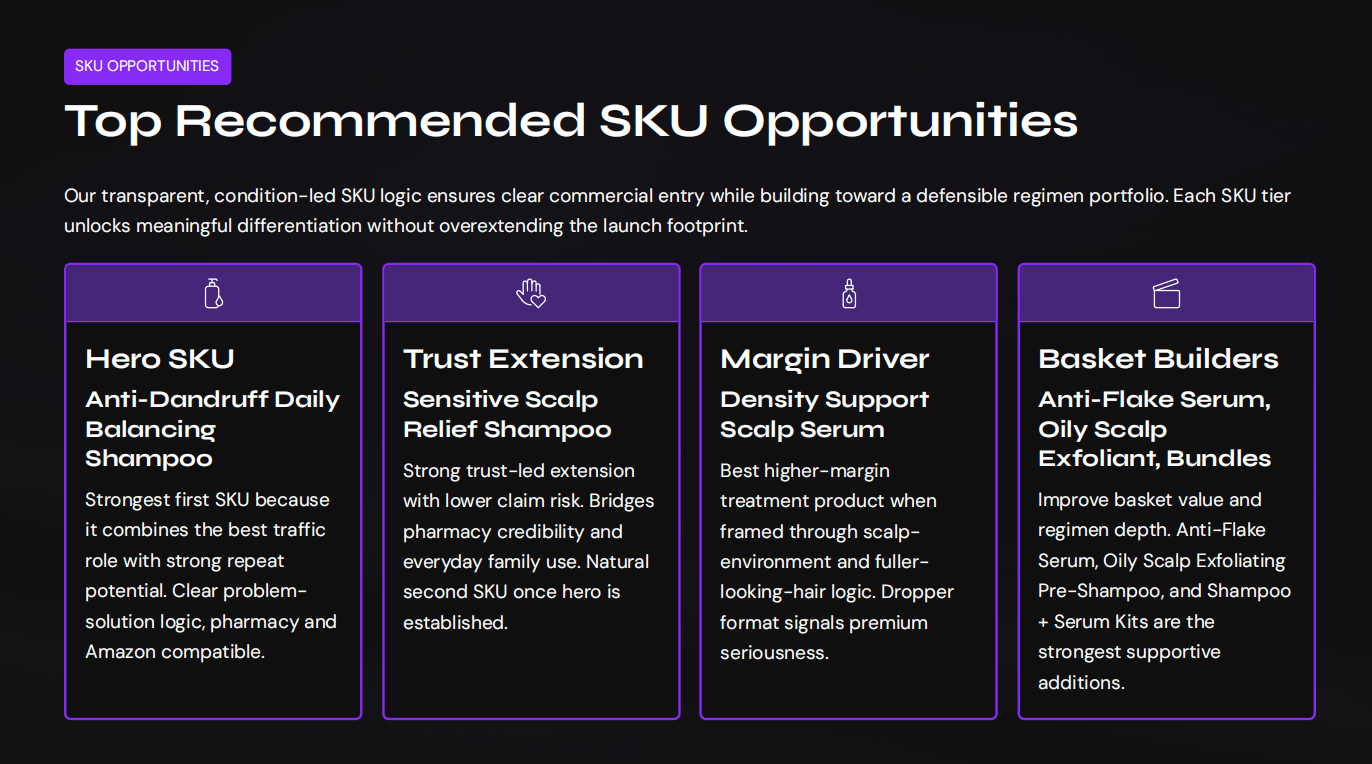
Anti-Dandruff Daily Balancing Shampoo
This should usually be the first hero SKU. It is easy for consumers to understand, easy to search for, and easier to repeat-purchase than treatment-heavy formats. A well-positioned anti-dandruff or balancing shampoo creates traffic and retail acceptance.
Sensitive Scalp Relief Shampoo
This is one of the clearest white-space opportunities because it combines pharmacy trust with daily usability. It works especially well for family use, fragrance-sensitive users, and derm-style retail.
Oily Scalp Exfoliating Pre-Shampoo Treatment
This is a trend-right format that reflects scalp skinification. It is especially suitable for buildup, greasy roots, and urban-use routines. It is better as a second-wave differentiator than as the only launch SKU.
Anti-Flake or Barrier Scalp Serum
These products add regimen depth and improve margin. They also create stronger DTC and Amazon storytelling because they look more targeted and more advanced than shampoo alone.
Density Support Scalp Serum
This is one of the highest-margin opportunities in the category, but claims must be tightly controlled. The strongest route is to position around scalp support, fuller-looking hair, appearance of density, and breakage-related fall rather than direct growth claims.
Shampoo + Serum Routine Kits
These sets increase average order value and make the line feel more intentional. They work particularly well when the kit is built around one specific problem such as flakes, sensitivity, oil balance, or thinning-support.
Recommended 3-SKU Entry Strategy
For most B2B buyers, the most efficient first portfolio is:
1. Cleansing Hero
Anti-Dandruff Daily Balancing Shampoo
This is the highest-velocity SKU and the strongest first entry point for retail, Amazon, and everyday use.
2. Treatment Differentiator
Sensitive Scalp or Oily Scalp Leave-In Treatment
This gives the line a more modern scalp-care identity and improves differentiation beyond basic shampoo.
3. Higher-Margin Serum
Density Support Scalp Serum
This creates stronger perceived value, better bundle logic, and a more premium route without requiring a large launch range.
This three-part structure is commercially efficient because it balances accessibility, trust, and margin.
IES
Top Recommended SKU Opportunities
Price Band Strategy
The best risk-adjusted entry point for most new brands is the mid-price segment.
Mass products can move quickly, but competition is high and differentiation is harder. Premium scalp care can offer strong margin, but acquisition is slower and trust requirements are higher. Mid-price scalp care with clinical clarity offers the strongest balance between credibility, affordability, and channel adaptability.
A practical pricing logic is:!
- cleansing hero in mass-mid,
- treatment SKU in mid,
- serum or premium leave-in in mid-premium.
This creates a believable ladder without overwhelming the buyer.
Product Format Strategy
The format mix matters as much as the claims.
Shampoo
Still the most important entry gate. Best for flakes, oil balance, and daily scalp maintenance.
Serum / Leave-In Treatment
Fast-growing and commercially attractive. Best for soothing, anti-flake support, scalp comfort, and thinning-support stories.
Pre-Shampoo Exfoliant
Useful for oily scalp, buildup, and scalp reset. Better as a differentiator than as the core entry SKU.
Scrub
Visually appealing and content-friendly, but usually less scalable than serum.
Tonic or Mist
Useful for daily refresh, maintenance, and post-workout use. Works well in lighter scalp-care routines.
The best launch systems do not try to lead with every format. They start with one hero condition and then expand into the formats that support that routine best.
Channel Strategy
A scalp care line should be channel-aware from the start.
Amazon
Best for anti-dandruff shampoos, scalp serums, and thinning-support products. Winning elements include symptom-led titles, clear benefit language, compliant visuals, bundle logic, and review-building potential.
DTC
Best for ingredient-led education, scalp routines, quiz-style diagnosis, and bundled systems. This channel is especially strong for scalp serums, sensitive scalp products, and higher-education formats such as exfoliating pre-shampoo treatments.
Pharmacy and Retail
Best for anti-dandruff, sensitive scalp, and derm-style hero products. Trust, packaging clarity, compliance discipline, and simple problem-solution language matter more than trendiness here.
The strongest retail starter pitch is usually:
- one anti-dandruff or balancing shampoo,
- one sensitive scalp shampoo,
- one supporting treatment SKU.
Packaging and Positioning Direction
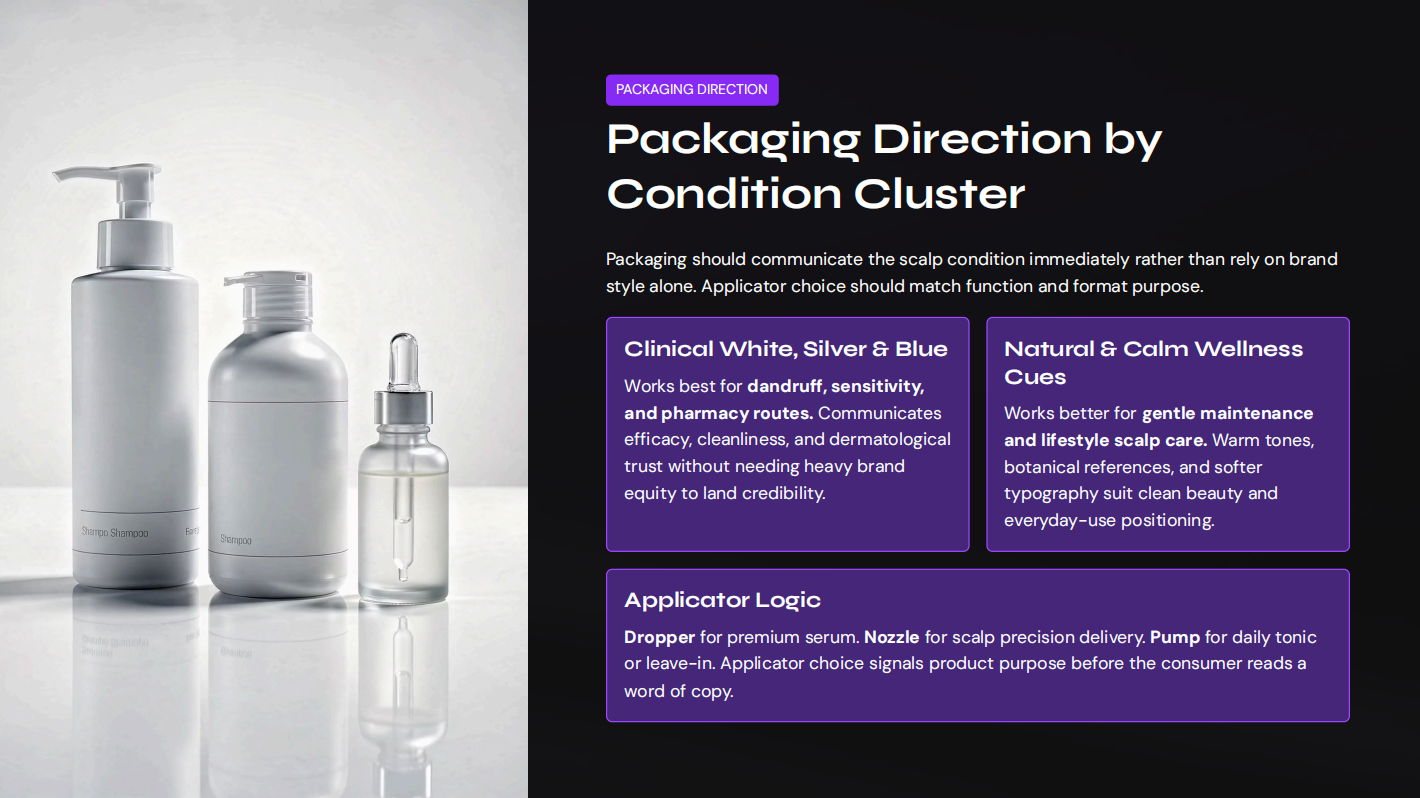
Packaging should follow the scalp problem, not the other way around.
Clinical Design
Best for dandruff, sensitivity, anti-flake, and pharmacy-style positioning. White, silver, blue, and structured layouts help communicate problem-solving credibility.
Modern Natural Design
Best for gentle detox, oil control, and lifestyle scalp wellness. Earth tones and softer ingredient storytelling work better here.
Premium Clinical Design
Best for density-support and serum-led scalp routines. Precision applicators, cleaner ingredient communication, and stronger regimen language help improve perceived value.
A simple rule works well:
- condition-led scalp solving = clinical,
- lifestyle scalp wellness = modern natural,
- thinning-support = premium clinical.
Packaging Direction by
Condition Cluster
Claims and Messaging Strategy
One of the biggest success factors in UK scalp care is claim discipline.
Stronger UK-Friendly Claim Language
- helps reduce visible flakes
- helps soothe itchy-feeling scalp
- helps balance excess oil
- helps refresh scalp and remove buildup
- helps maintain scalp comfort
- supports fuller-looking hair
- helps reduce breakage-related hair fall
- helps improve the appearance of hair density
Claims to Avoid or Tighten
- treats hair loss
- regrows hair
- prevents baldness
- stimulates follicles
- cures dandruff
- treats scalp disease
- treats alopecia
The strongest cosmetic brands in this category win by focusing on comfort, appearance, visible flakes, oil balance, and breakage-related support rather than drifting into medicinal territory.
Compliance Priorities
Compliance should be built into the project before artwork and launch planning are finalised.
Core areas to prepare include:
- Responsible Person route
- Product information and safety documentation
- correct label structure
- ingredient list and warnings
- batch coding
- substantiation file for claims
- notification pathway for the target market
- packaging compatibility and stability support
For brands selling into Great Britain and possibly the EU, route planning should happen early so that formula review, claims, and labelling are aligned with the actual launch market.
OEM and ODM Launch Planning
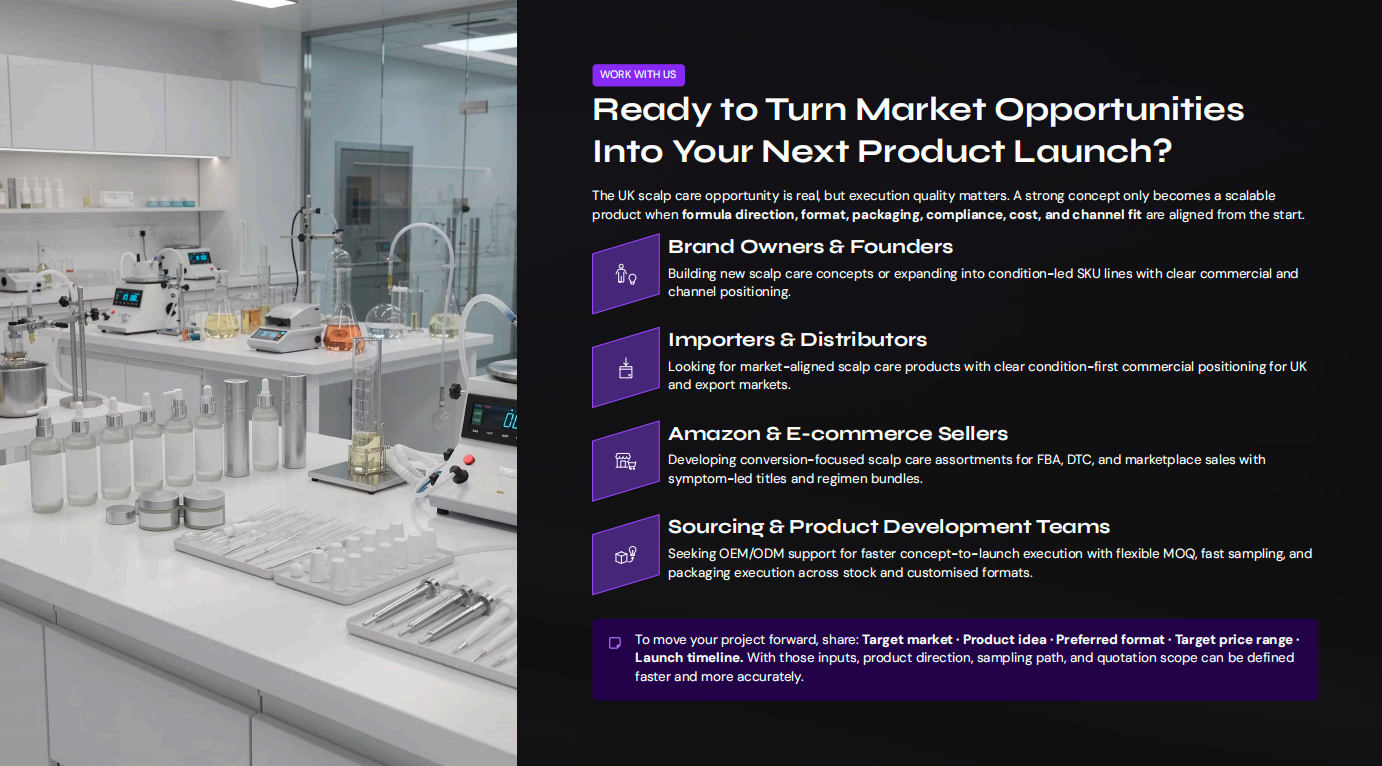
The fastest way to save time with a manufacturer is to send a sharper brief.
A stronger project brief should include:
- target market
- scalp condition to solve
- product type
- target price band
- target channel
- packaging direction
- benchmark products
- expected MOQ
- launch timeline
- desired claim territory
- fragrance-free or fragranced preference
The order of decision-making matters:
first choose the condition, then the format, then the claim, then the packaging.
This prevents overcomplicated products that try to solve dandruff, sensitivity, thinning, and detox all at once.
What Brands Should Do Next
If you are planning a UK scalp care launch in 2026, the smartest next move is not to build a large haircare catalogue.
Instead:
- choose one urgent scalp problem,
- benchmark the leading SKUs in that problem cluster,
- define your price band and channel,
- build two to three hero SKUs,
- lock the claim territory before final artwork,
- and launch with a routine story rather than a one-product story.
That sequence creates a more commercially usable range and a cleaner OEM path.
Ready to Turn Market Opportunities
Into Your Next Product Launch?
Final Takeaway
The UK scalp care opportunity in 2026 is strongest for brands that launch scalp-first, problem-solution, dermatology-influenced products rather than generic haircare extensions.
The most attractive route for most buyers is a mid-priced, condition-led system built around one cleansing hero, one treatment differentiator, and one higher-margin serum. Anti-dandruff, sensitive scalp, oily scalp, and thinning-support all offer opportunity, but the winners will be the brands that keep claims disciplined, formats practical, and routines commercially structured.
If your team is evaluating a scalp care launch for the UK market, the best next step is to define the problem cluster, price band, channel route, and product system first, then move into sampling with a much clearer brief.
Download the Full Report (PDF)
Tell us your target region, product category, and the decision you’re trying to make. We’ll suggest the closest existing report—or build a tailored version.