


Executive Summary
This report explores the U.S. premium men’s fragrance market in 2026, including consumer trends, scent roles, price architecture, concentration formats, travel and giftable products, channel strategy, compliance priorities, and OEM launch planning. It is designed to help brand owners, distributors, sourcing teams, and e-commerce sellers turn market signals into a more practical fragrance launch strategy.
U.S. Premium Men’s Cologne Market 2026: Consumer Trends, Gift Sets, and Launch Playbook
The U.S. premium men’s fragrance market in 2026 remains one of the most attractive fragrance categories for brands, distributors, and e-commerce sellers. However, the category is no longer driven by broad prestige momentum alone. Growth is becoming more selective, more concept-driven, and more dependent on execution quality.
Today’s premium men’s fragrance buyer is not simply purchasing a bottle. He is purchasing a role for that product in daily life, whether that means office confidence, date-night warmth, clean athletic freshness, seasonal rotation, premium gifting, or a more distinctive niche identity.
This report turns those market signals into launch logic. It covers demand shifts, price architecture, concentration formats, giftable and trial-friendly products, channel fit, packaging priorities, compliance considerations, and OEM execution planning for brands entering or expanding in the U.S. premium men’s fragrance market.
Executive Summary
The U.S. premium men’s fragrance market continues to benefit from premiumization, gifting demand, higher-concentration formats, and new brand launches. At the same time, 2026 is less about launching a broad line and more about launching the right product system.
Consumers are increasingly looking for products that combine stronger performance, clearer scent identity, and better value perception. This is why Eau de Parfum and Parfum formats continue to outperform more diluted options in premium positioning. Buyers also show growing interest in travel sprays, mini formats, discovery kits, and giftable bundles because these formats reduce trial friction and improve gifting relevance.
For most buyers, the most effective 2026 entry strategy is not to launch too many unrelated SKUs. It is to build a focused structure around one hero scent, one trial format, and one gift or discovery path, with optional extensions for evening wear or lighter daily freshness.
Market Opportunity Overview
The U.S. premium men’s fragrance category has become a cross-channel business rather than a department-store-only category. It now performs across Amazon, DTC, specialty retail, gifting periods, and social-led product discovery.
This matters because product planning can no longer rely only on traditional prestige assumptions. A fragrance today needs to perform in more than one environment. It needs to look premium on shelf, convert well online, survive shipping, and feel understandable to a buyer who may first discover it through social content rather than in-store testing.
For that reason, the market opportunity in 2026 is strongest for brands that combine premium scent positioning with a tighter SKU structure and stronger commercial logic.
Market Snapshot: U.S.
Premium Men's Fragrance
What Is Driving Demand in 2026
Several factors are shaping premium men’s fragrance demand.
The first is premiumization. Men are willing to trade up when the product clearly delivers better concentration, stronger longevity, a more refined bottle, or a more distinctive scent narrative.
The second is fragrance as personal identity. Premium fragrance now functions as a daily signature, not just a grooming product. Buyers increasingly rotate between scents depending on situation, mood, weather, and occasion.
The third is gifting resilience. Men’s fragrance remains one of the strongest beauty-adjacent gifting categories, especially around Father’s Day, Q4 holiday, and premium bundle periods.
The fourth is trial behavior. Mini sizes, travel sprays, and discovery kits help reduce online purchase hesitation and make premium fragrance more accessible without forcing a full-size commitment.
The fifth is channel diversification. Premium men’s fragrance is no longer sold only through traditional retail. Amazon, DTC, specialty e-commerce, and social discovery are all shaping category dynamics.
Core Consumer Demand Signals
Premium men’s fragrance buying behavior in 2026 is not driven by fragrance family alone. It is increasingly shaped by use occasion and identity logic.
The strongest recurring demand clusters include:
-
daily signature scents for office and all-day use
-
date-night and evening fragrances with warmer, richer profiles
-
giftable premium formats for holidays and men’s gifting occasions
-
distinctive but wearable scents for buyers seeking identity without extreme niche pricing
-
trial-friendly formats for first purchase and online conversion
This is why product briefs should define who wears the scent, when it is used, and why it wins in that situation.
Consumer & Demand Signals
Scent Roles with the Best Commercial Logic
A successful premium men’s fragrance line should not begin with raw notes alone. It should begin with scent roles.
The most commercially effective scent roles include:
-
clean woody office signature
-
warm amber-spice evening scent
-
fresh aromatic daily premium
-
modern oud with accessible wearability
-
skin-scent masculinity for understated luxury
-
coastal citrus or mineral freshness for seasonal rotation
-
premium gifting scent built around broad masculine appeal
The stronger the scent role, the easier the fragrance becomes to merchandise online, explain in retail, and position in marketing.
Price Tier Strategy
The U.S. premium men’s fragrance market is best understood through four commercial bands.
Entry premium works well for trial, body spray bridges, smaller formats, younger buyers, and first-purchase acquisition. Mid premium is often the strongest conversion zone because it balances attainable pricing with a clear premium feel. Premium is the most commercially balanced tier for margin and prestige perception. Luxury and niche-lite formats help elevate brand image, but they are not always the best cold-start launch point.
For many new entrants, the most practical price ladder includes:
-
one accessible premium trial format
-
one core premium hero SKU
-
one higher-value gifting or intensity extension
This allows the brand to support both acquisition and premium perception without overcomplicating the assortment.
Why EDP Should Be the Core Format
For 2026 launches, Eau de Parfum remains the strongest commercial core for premium men’s fragrance.
It offers:
-
stronger premium signaling than EDT
-
better longevity perception
-
broader consumer acceptance
-
better fit for gifting and hero SKU strategy
-
easier positioning in both DTC and retail
Parfum or more intense formats can work well as halo or evening extensions, but EDP should remain the commercial center for most new launches. EDT can still be useful for fresher daytime or lower-price concepts, while body sprays and lighter formats can serve as bridge products for younger buyers or routine-based use.
Category Landscape: Price,
Format & Packaging Trends
Travel Sprays, Discovery Kits, and Gift Sets
Premium men’s fragrance buyers increasingly need trial before commitment. That is why travel sprays, discovery kits, and giftable sets are strategically important.
Travel sprays help reduce first-purchase hesitation and improve portability. Discovery kits help online shoppers explore multiple scent identities without the risk of a full-size blind buy. Gift sets increase perceived value and improve sell-through during key seasonal windows.
A stronger launch system usually includes:
-
one hero full-size EDP
-
one travel spray version
-
one discovery or trial set
-
one premium giftable bundle
-
optionally one intense or night version
This structure makes the line more flexible for Amazon, DTC, gifting, and retail expansion.
Channel Strategy
A premium men’s fragrance launch should be built for channel fit from the beginning.
For Amazon, the best-performing products are usually travel sprays, review-friendly EDPs, occasion-based heroes, and premium-looking bundles with clear scent language. The packaging must also be ready for shipping, leakage prevention, and consistent fulfillment.
For DTC, the opportunity is broader. Discovery kits, storytelling-led hero SKUs, layered scent systems, and niche-lite concepts can work well when supported by content, visuals, and sampling logic.
For retail and offline channels, tactile packaging quality matters more. The bottle, cap, carton, and tester experience all affect whether the product feels truly premium at first contact.
For gifting channels, value visibility matters. A premium men’s fragrance product must look gift-ready, survive shipping and shelf handling, and clearly communicate what the customer is getting.
The strongest strategy is not to sell one identical pack structure everywhere. It is to adapt the assortment to the way each channel actually converts.
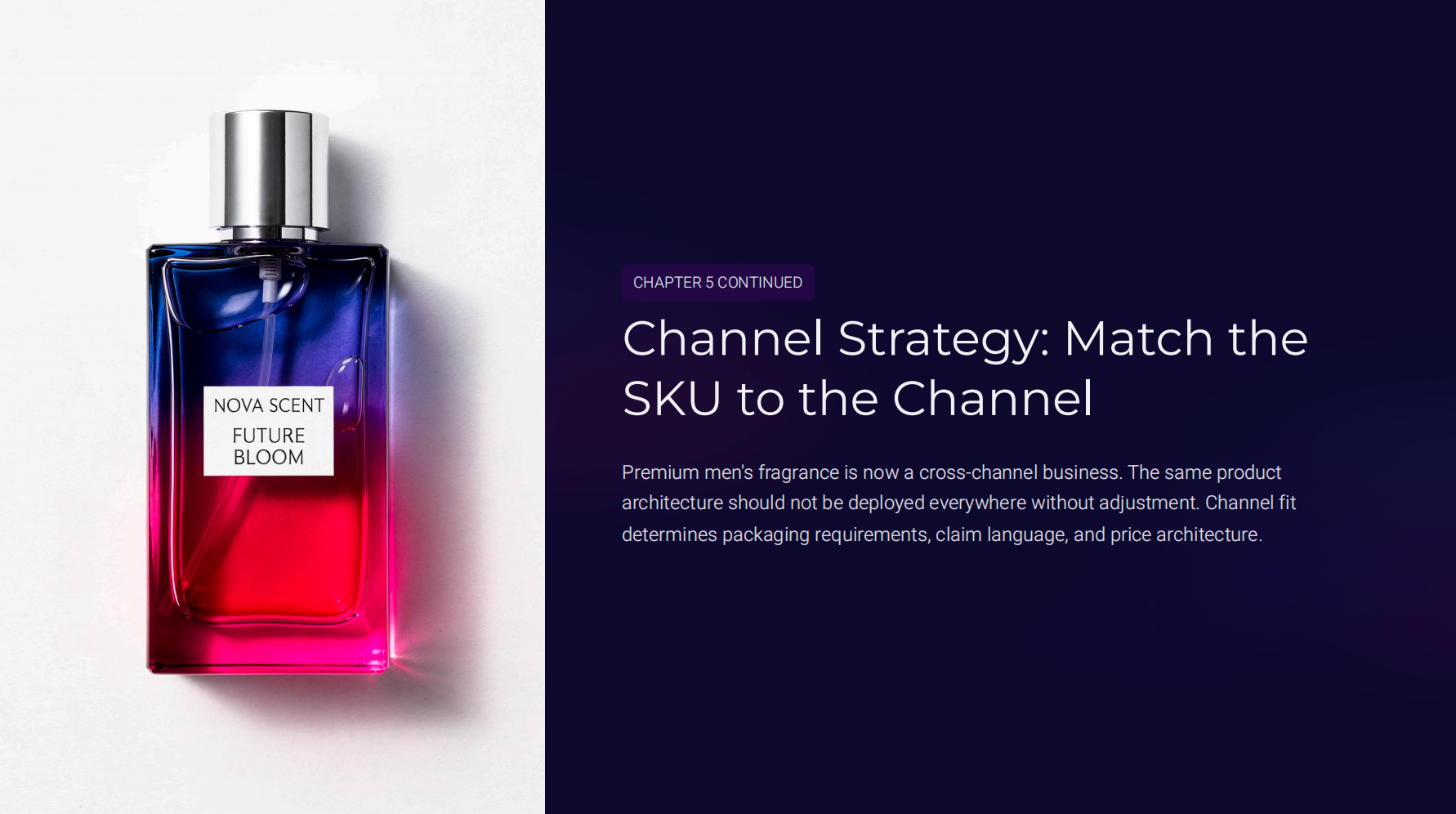
Channel Strategy: Match the
SKU to the Channel
Competitive White Space
The market is crowded, but there are still viable entry spaces for new brands.
The most practical competitive paths include:
-
value-premium fragrance with strong performance
-
niche-lite identity-led premium
-
giftable daily luxury
-
premium men’s fragrance with travel and discovery support
-
broad-appeal masculine scent with better packaging and documentation discipline
Trying to outcompete major designer brands head-on is usually the wrong approach. A better path is to create a product that is more readable, more channel-appropriate, and more conversion-friendly than many prestige incumbents.
Packaging and Perceived Value
In premium men’s fragrance, packaging is not secondary. It is part of the value equation.
Strong commercial packaging cues include:
-
weighted or well-fitting caps
-
consistent atomizer output
-
clean masculine bottle structure
-
matte glass or refined glossy finishes
-
metallic accents used with restraint
-
sturdy cartons that survive shipping
-
premium visual codes that match scent direction
A fragrance that smells expensive but leaks, chips, sprays poorly, or arrives damaged will lose repeat purchase quickly. Packaging performance is a commercial decision, not just an aesthetic one.
Compliance and Risk Control
Premium fragrance launches often fail because teams treat compliance and packaging validation as late-stage tasks instead of core launch criteria.
A commercially safer launch should include:
-
correct product identity on label
-
net contents in proper format
-
complete ingredient declaration
-
responsible party information
-
applicable warning statements
-
IFRA conformity for the intended use
-
safety substantiation support
-
packaging compatibility testing
-
transit durability testing
-
lot coding and batch traceability
It is also important to keep claims within cosmetic and fragrance positioning. Premium men’s fragrance can sell strongly through identity, use occasion, performance, and gifting logic without relying on exaggerated or risky language.
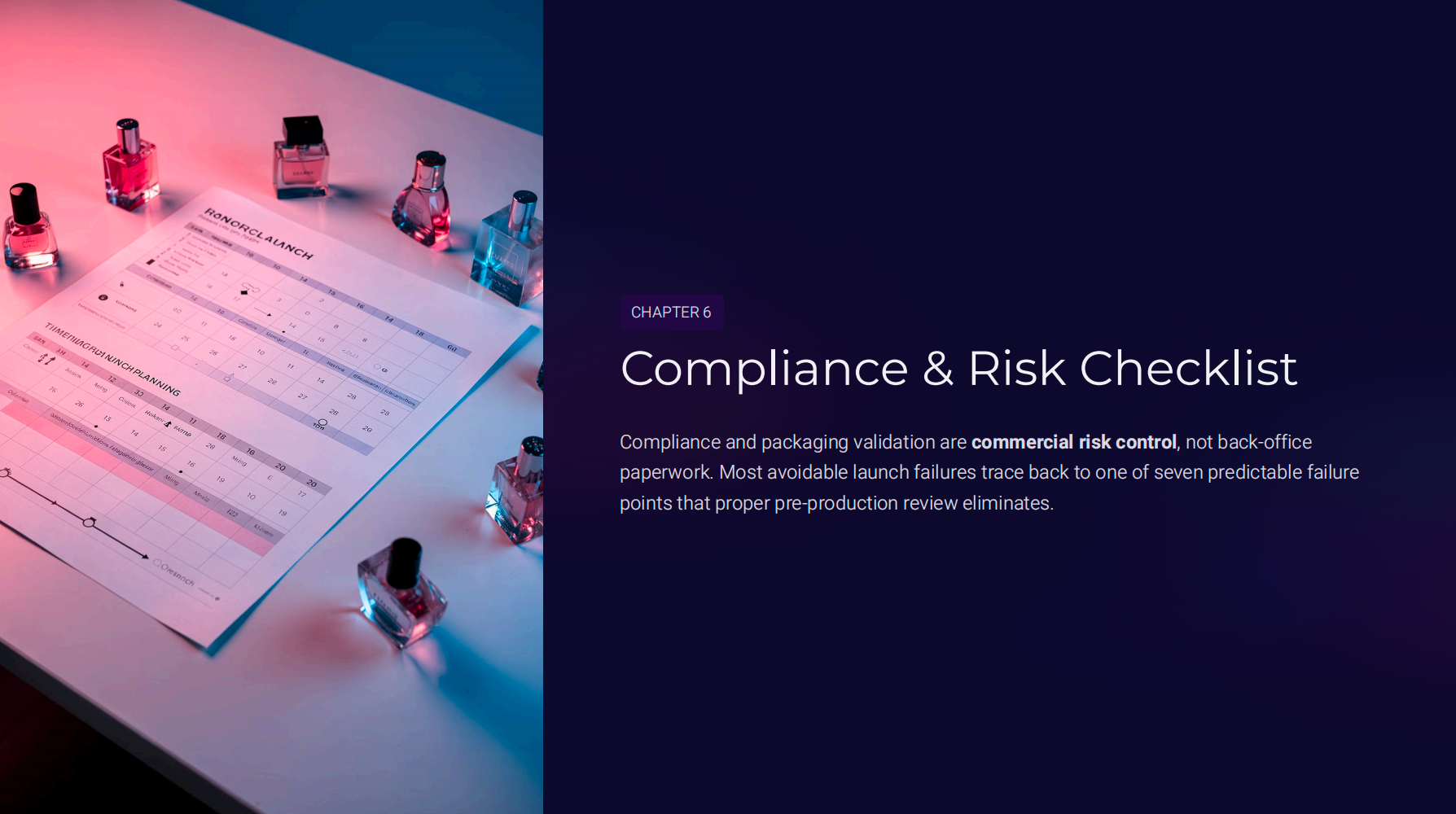
Compliance & Risk Checklist
OEM Launch Strategy
The fastest way to reduce delays and wasted sampling is to give the OEM partner a stronger commercial brief from the start.
A useful brief should include:
-
target customer
-
target channel
-
scent role
-
target retail price
-
concentration
-
preferred size
-
bottle and cap direction
-
packaging level
-
expected technical documents
-
first order quantity
-
long-term forecast
-
shipping assumptions
-
launch timing
The better the brief, the faster the supplier can align formula, packaging, price architecture, and production planning.
A capable OEM partner should not only fill fragrance. It should help translate commercial intent into formula development, packaging compatibility, documentation, pilot validation, and scalable production.
OEM Execution Plan: From
Brief to Production
What Buyers Should Do Next
If you are evaluating a U.S. premium men’s fragrance launch for 2026, the best next step is not to request a generic men’s perfume sample.
Instead:
-
define the hero scent role first
-
decide whether EDP is the commercial core
-
choose the right price tier for your target channel
-
build travel or discovery support early
-
align packaging and compliance before mass production
-
structure the line for gifting and repeat purchase, not just first impression
That approach improves speed, reduces rework, and creates a far more commercially usable product system.
Final Takeaway
The U.S. premium men’s fragrance market in 2026 remains highly attractive, but it no longer rewards broad or vague launches. The best opportunities sit where premium feel, clear scent roles, practical price logic, packaging performance, and channel fit all meet.
The brands most likely to win are the ones that launch a disciplined system: one hero full-size EDP, one travel or trial format, one gift or discovery path, and optional extensions for evening or lifestyle use.
If your team is planning a premium men’s fragrance line, the smartest move is to build the SKU architecture first, then scale with confidence.
Download the Full Report (PDF)
Tell us your target region, product category, and the decision you’re trying to make. We’ll suggest the closest existing report—or build a tailored version.