


Executive Summary
The U.S. fragrance category is no longer a “special-occasion luxury”—it’s becoming a daily self-care staple, with faster growth than many beauty segments and a clear path for new brands to win. This white paper breaks down what’s driving demand, where Americans actually buy fragrance, how to position your brand, and how to control cost, compliance, and go-to-market execution.
Unlocking the U.S. Perfume Goldmine (2026): The Fragrance Market Playbook for Brand Growth & Profitable Launches
Why this white paper matters (2026–2030 outlook)
The report projects the U.S. perfume market reaching ~$17.2B by 2030, supported by a resilient 4–8% CAGR and a post-pandemic rebound. More importantly, scent is shifting into an everyday habit—creating more frequent replenishment demand and more entry points for emerging brands.
Snapshot: the demand engine in one minute
-
Gen Z is mainstreaming fragrance: 83% adoption, fueling a 22% YoY surge alongside Millennials.
2026 US Fragrance Market Indust…
-
Social commerce is compressing the funnel: #PerfumeTok can turn niche scents viral fast and reduce awareness costs for new brands.
2026 US Fragrance Market Indust…
-
Lifetime value is extending: U.S. teens start buying scents at age 12, earlier than a decade ago.
What you’ll learn inside (contents overview)
This white paper is structured as a practical operator’s playbook across:
-
Market Size & Growth Engine
-
Omni-Channel Playbook
-
Winning Consumer Hearts
-
Supply & Cost Mastery
-
Marketing That Converts
-
Competitive Gaps & Positioning
Plus: Regulatory & Launch Checklist, Profit Formula & Next Steps, and Key Takeaways.
1) Where Americans actually buy fragrance (and why “omni-channel” is non-negotiable)
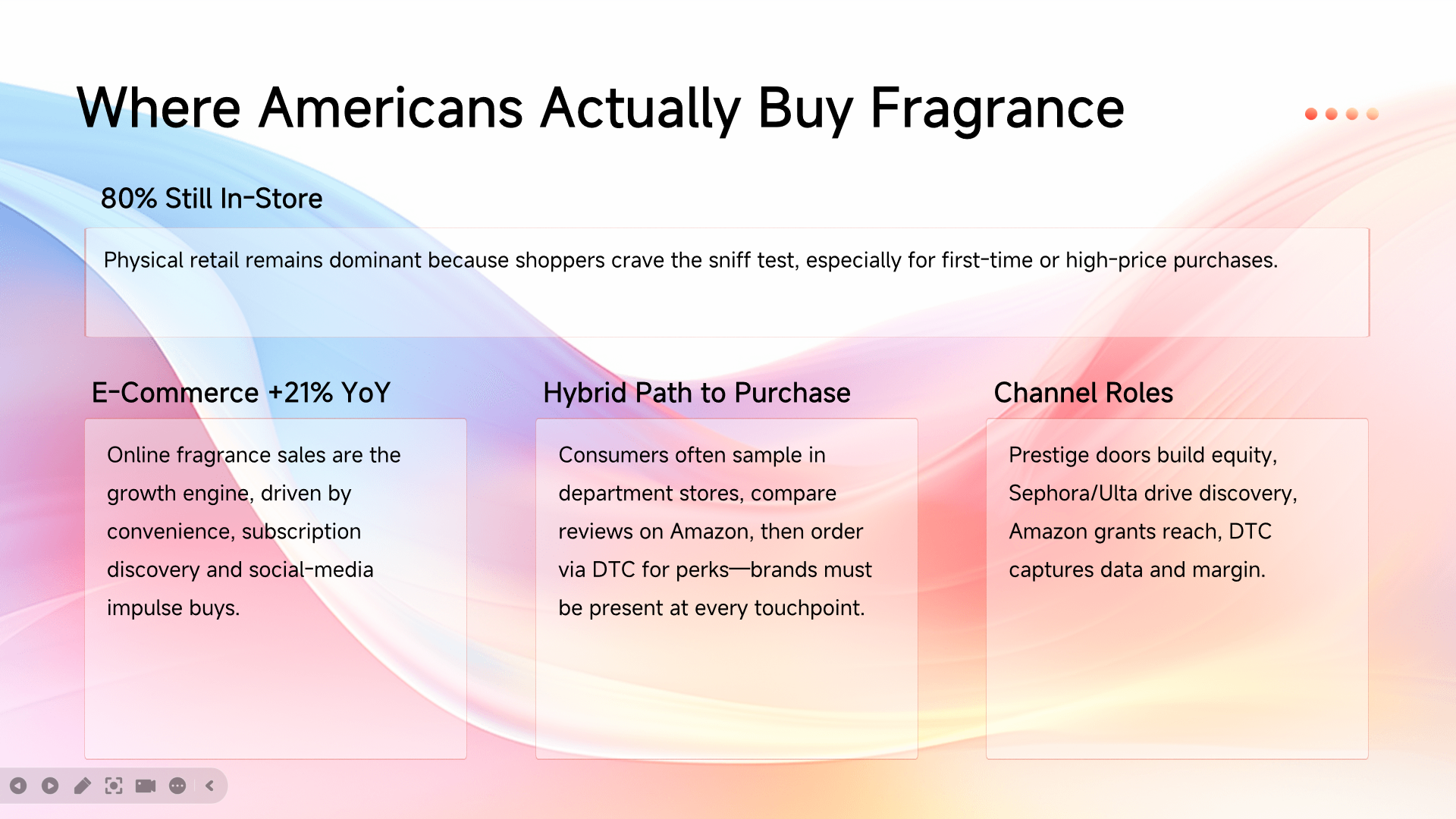
Even in 2026, in-store still dominates because many shoppers want the “sniff test,” especially for first purchases and higher price points. At the same time, e-commerce is growing +21% YoY, creating a clear two-speed market: retail for discovery + online for scale.
2026 US Fragrance Market Indust…
The hybrid path to purchase described in the report is especially important: consumers often sample in department stores, compare on Amazon, then buy via DTC for perks—meaning you need coverage across touchpoints, not a single-channel bet.
2026 US Fragrance Market Indust…
Amazon in fragrance: the under-discussed advantage
The report highlights a more balanced gender split on Amazon fragrance shoppers (50% male vs 33% in brick-and-mortar)—an opportunity for brands that want incremental buyers rather than fighting the same crowded audience everywhere.
2026 US Fragrance Market Indust…It also notes Amazon’s “premiumization” moves (e.g., 300+ prestige brands joining its curated Premium Beauty hub in 2024).
2) Winning consumer hearts: the trends shaping product strategy
Clean, natural, and transparent sells
The report points to 65% of consumers preferring naturally sourced ingredients and 45% willing to pay more for paraben-free, phthalate-free formulations—turning transparency into a conversion lever, not just branding.
2026 US Fragrance Market Indust…
Unisex and layering are accelerating personalization
Gender-neutral scents grew 20% (2023) and 45% of buyers enjoy layering—meaning discovery sets, layering-friendly collections, and inclusive positioning can outperform traditional “his/her” segmentation.
2026 US Fragrance Market Indust…
“Mood-lift” positioning—without drug claims
The report frames fragrance as functional wellness (e.g., citrus/mint for energizing, lavender for calming) while explicitly avoiding drug-type claims—useful for brand storytelling without stepping into regulatory risk.
3) Supply & cost mastery: packaging is the margin lever
One of the most actionable insights: bottle + packaging can eat 50–60% of unit cost—often exceeding the juice itself—so packaging choices directly control your margin more than most founders expect.
2026 US Fragrance Market Indust…
Stock vs. custom is the key trade-off:
-
Stock components can drop packaging to $1–2 per unit, accelerating launch and reducing risk.
2026 US Fragrance Market Indust…
-
Custom molds can boost perceived luxury but require higher MOQs and tooling fees.
2026 US Fragrance Market Indust…
The report also flags sustainability upside (recycled glass, refillables, FSC papers) as both a pricing and long-term packaging strategy.
4) Marketing that converts: trust, sampling, and measurable creator economics
Influencers beat ads on trust
61% of shoppers trust influencer reviews more than brand advertising—making creator content the fastest credibility builder for unknown perfumes.
2026 US Fragrance Market Indust…
Micro-influencers are a practical CAC strategy
Creators with 5–50k followers often accept product + small fees, frequently delivering strong engagement relative to cost.
2026 US Fragrance Market Indust…
The report also emphasizes performance measurement via affiliate codes/discount codes—so creator spend is optimized like paid media.
2026 US Fragrance Market Indust…
Sampling is the conversion unlock online
A 2ml vial (~$0.50) can remove hesitation and be credited toward a full bottle, lifting conversion above 15% in the report’s framework.
2026 US Fragrance Market Indust…
Subscription sampling (e.g., thousands of samples into discovery ecosystems) is presented as a scalable discovery lever.
5) Competitive gaps & positioning: avoid the squeezed middle
The report describes a barbell market:
-
Niche/luxury growing ~12% annually, driven by exclusivity and artistry
-
Value “dupes” winning attention under $40
-
Mid-tier designer scents growing only ~4%, caught between fatigue and price sensitivity
2026 US Fragrance Market Indust…
A direct takeaway: new entrants should win with authentic story + clear value proposition rather than drifting into “generic mid-tier.”
6) Regulatory & launch checklist (U.S.): what to get right before scale
The report’s checklist focuses on the essentials:
-
Labeling basics: identity, net contents, “Fragrance” in ingredient list, flammable warning, business address—no pre-approval required under current FDA requirements as summarized in the report.
2026 US Fragrance Market Indust…
-
MoCRA readiness: facility and product listing registration, and monitoring upcoming allergen disclosure updates to avoid penalties.
7) Profit formula & next steps: pricing that funds growth
The report’s profit logic: 4–8× markup is what covers CAC while leaving margin for reinvestment. One example given: a $12 production cost at 6× yields $72 retail, funding creator commissions and ads while maintaining 45%+ gross margin.
90-day launch sprint (execution model)
The report proposes compressing go-to-market timelines by running development in parallel: fragrance oil finalization, packaging sourcing, 3PL setup, and influencer shortlists concurrently—bringing “scent to sale” down to ~12 weeks.
A live KPI dashboard (ad spend, sample redemptions, repeat rate) is positioned as the control system for iteration before scaling inventory.
What is the projected size of the U.S. perfume market by 2030?
Who should download this white paper
-
Founders planning a U.S. fragrance launch (DTC, Amazon, retail, or hybrid)
-
Brand teams needing a channel + sampling + creator playbook that can be executed
-
Operators who want a cost and packaging framework to protect margin
-
Teams preparing for MoCRA and labeling fundamentals before scaling
Download the Full Report (PDF)
Tell us your target region, product category, and the decision you’re trying to make. We’ll suggest the closest existing report—or build a tailored version.