



Executive Summary
This report explores the Russia body mist market in 2026, including consumer demand, scent direction, pricing structure, marketplace-first strategy, compliance priorities, packaging requirements, and OEM launch planning. It is designed to help brands, importers, distributors, private label buyers, and e-commerce sellers turn market opportunity into a more practical body mist launch strategy.
Russia Body Mist Market 2026: Trends, Pricing, Product Strategy, and Launch Guide
The Russia body mist market in 2026 is a commercially viable opportunity, but not because consumers are looking for a low-end perfume substitute. The stronger opportunity lies in body mist as a daily, easy-to-use, giftable fragrance format that sits between deodorant-style refreshment and entry-level fragrance indulgence.
For brands, importers, distributors, private label buyers, and e-commerce sellers, the key is not to position body mist as diluted perfume. The key is to build a product system around frequency of use, familiar scent direction, visible value, affordable pricing, and packaging reliability.
This report translates the Russia body mist opportunity into a practical launch plan. It covers market logic, consumer demand, scent direction, pricing structure, marketplace-first entry strategy, compliance priorities, packaging control, and OEM launch planning.
Executive Summary
Russia can support body mist, but the category has to be positioned correctly. The strongest commercial angle is not prestige fragrance. It is accessible fragrance utility: a product that feels light, wearable, giftable, and easy to repurchase.
That makes body mist strongest in the mass to premium-accessible range, especially for younger female consumers, gift buyers, and daily-use fragrance shoppers who want rotation without perfume-level commitment. The format works best when it is clearly separated from EDT and EDP in price logic, scent intensity, and usage role.
For most new entrants, the best route is a marketplace-first strategy supported by a disciplined SKU ladder. A strong launch should begin with one hero scent, one freshness-led daily-use scent, and one gift or mini format designed for trial, bundles, and seasonal uplift.
Market Opportunity Overview
Russia is not a market where body mist should be sold as a climate-driven essential. Instead, it performs better as a convenience fragrance product: something for daily freshness, indoor reapplication, gym bags, travel, casual gifting, and lower-risk fragrance experimentation.
This matters because perfume still holds the higher-status position in the fragrance hierarchy. Body mist succeeds when it occupies a separate role rather than trying to compete directly with stronger fragrance concentrations.
The category opportunity is strongest where consumers want:
- lower commitment than perfume
- easier purchase decisions
- lighter scent intensity
- visible value in size and packaging
- simple online replenishment
- familiar and emotionally clear scent profiles
In commercial terms, body mist is closer to daily routine than to luxury occasion use.
Why Russia Can Be a Good Market for Body Mist
The Russia body mist opportunity is supported by a few important structural factors.
The first is the continued strength of beauty and fragrance demand. Consumers still buy fragrance-related products, but there is room for more affordable-premium access formats.
The second is the rise of marketplaces as a central buying path. Products that are visually understandable, review-friendly, and price-accessible can scale efficiently online before broader offline rollout.
The third is the increased relevance of local replacement, private-label-style, and fast-moving beauty propositions. This makes the market more open to practical, well-positioned new offers.
For exporters and OEM buyers, this means body mist can work well when it is designed for marketplace conversion, not when it is treated like a prestige perfume extension.
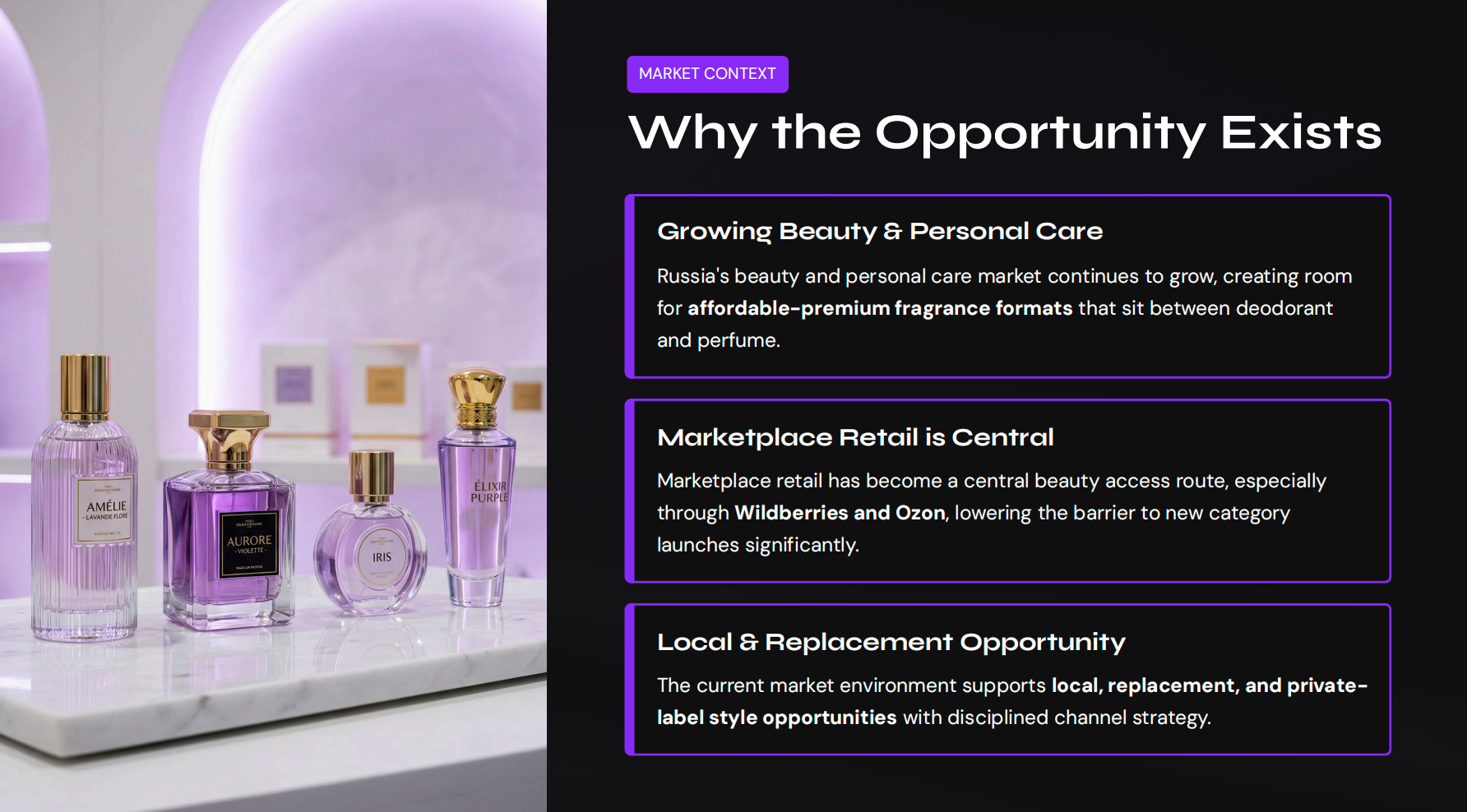
Why the Opportunity Exists
Core Consumer Segments
The most important buyer is not the prestige perfume collector. It is the consumer who wants light scent rotation at an easier price.
Teens and Early 20s
This segment responds strongly to sweetness cues, visual packaging, and low-risk trial. Fruity, playful, and giftable body mist products usually convert well here.
Young Working Women
This segment looks for affordable daily fragrance, clean freshness, soft floral positioning, and scents that feel office-safe or casual rather than overwhelming. Packaging quality and spray performance are especially important for repeat purchase.
Gift Buyers
This group buys for birthdays, New Year, seasonal gifting, and simple beauty bundles. Appearance, coordinated packaging, and recognizable scent families matter more than concentration terminology.
Layering and Routine Users
These users combine shower products, lotion, and fragrance. They respond well to matching fragrance families and soft, wearable scents that can be reapplied without pressure.
How Body Mist Should Be Positioned
One of the biggest commercial mistakes is to position body mist as a cheap perfume alternative. That weakens both trust and repeat purchase.
A better positioning route is to define body mist as:
- a daily fragrance utility product
- a lighter daytime scent
- a casual reapplication format
- an easy first fragrance
- a bundleable or giftable beauty item
- a layering product that fits body care routines
This approach gives the category its own use case and makes the value easier for consumers to understand.
Pricing Logic and Category Structure
Body mist works best when price architecture stays clearly below EDT and EDP. Once the price gap becomes too small, the consumer starts asking why she should not simply buy a perfume instead.
The most useful commercial structure is a three-step ladder:
Entry
Impulse-friendly, youth-oriented, promotion-led, and highly accessible.
Mass
The core commercial band and usually the best balance between repeat purchase and margin.
Premium Accessible
A stronger packaging and fragrance proposition with better giftability, but still clearly below perfume pricing.
The real planning logic is not fixed ruble numbers. It is maintaining a visible value ladder between entry, core, and premium-accessible body mist while protecting the gap versus EDT.
Best Size Strategy
Size plays a major role in perceived value.
50 ml
Best for trial, gifting, travel, and lower-risk first purchase.
80–100 ml
Good for compact everyday use and entry positioning.
120–150 ml
The strongest core commercial format and the most practical launch size for volume.
200+ ml
Only makes sense if packaging quality, freight economics, and value communication are strong enough.
For most launches, 120–150 ml should be the hero format, while mini sizes support bundles, trial, and seasonal gifting.
Scent Directions with the Strongest Commercial Potential
The Russia body mist market is not the place to begin with abstract niche fragrance concepts. The stronger path is emotionally legible, familiar, and wearable scent direction.
Fresh / Citrus
Strong for refreshment, post-shower use, gym bags, and summer daytime rotation.
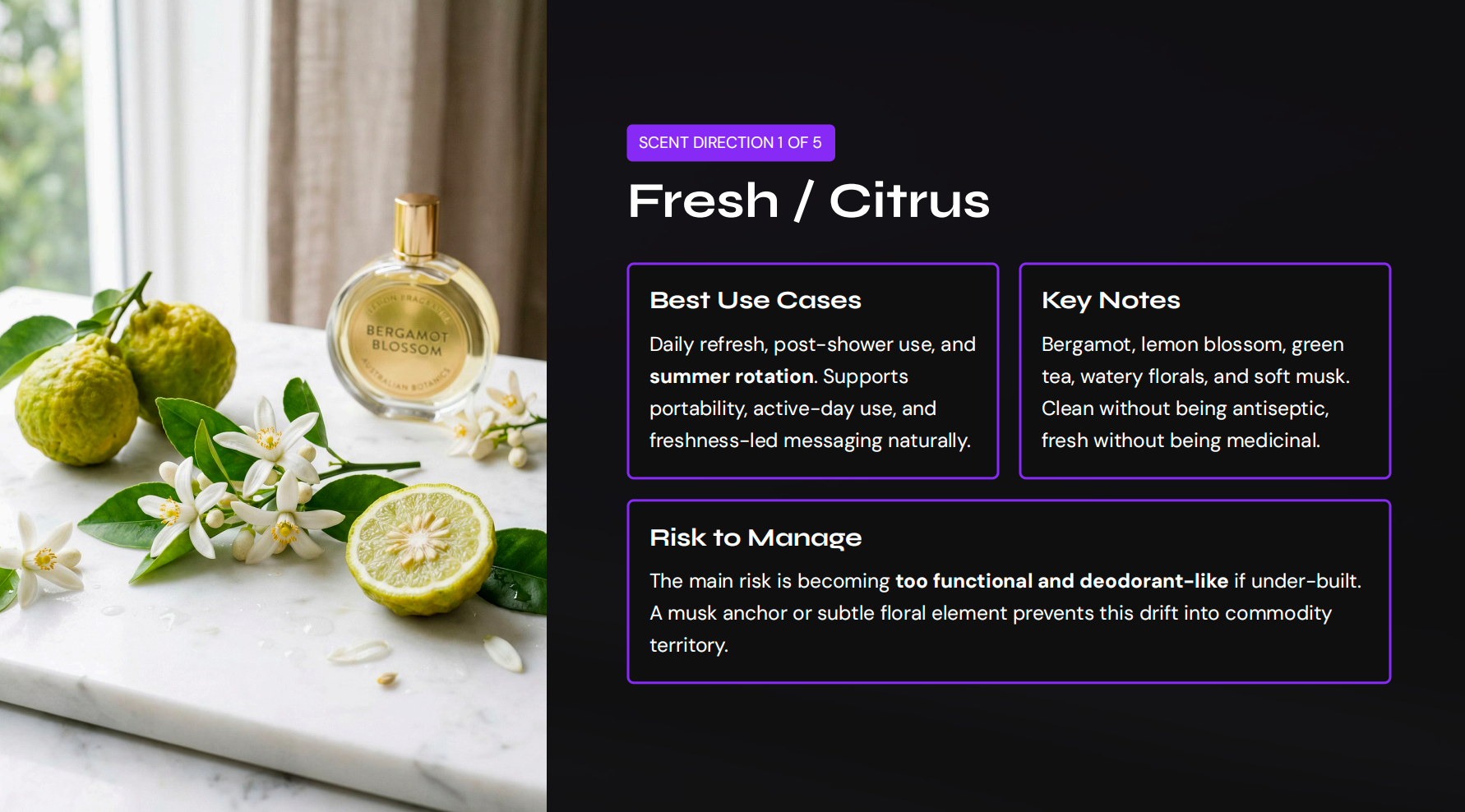
Fresh / Citrus
Fruity Sweet
Especially effective with younger buyers, entry-price products, and marketplace-driven conversion.
Soft Floral
Broadly acceptable, feminine, and commercially safe for mass and gifting.
Airy Gourmand
Works well in colder seasons and gifting periods when positioned as cozy, soft, and wearable rather than heavy dessert fragrance.
Clean / Skin Scent
Strong for office-safe, everyday, and repeat-purchase logic, especially with slightly older buyers.
The most practical scent poles to start with are:
- fruity-gourmand for conversion
- clean-floral or citrus-musk for repeatability
That gives the range both emotional pull and daily-use logic.
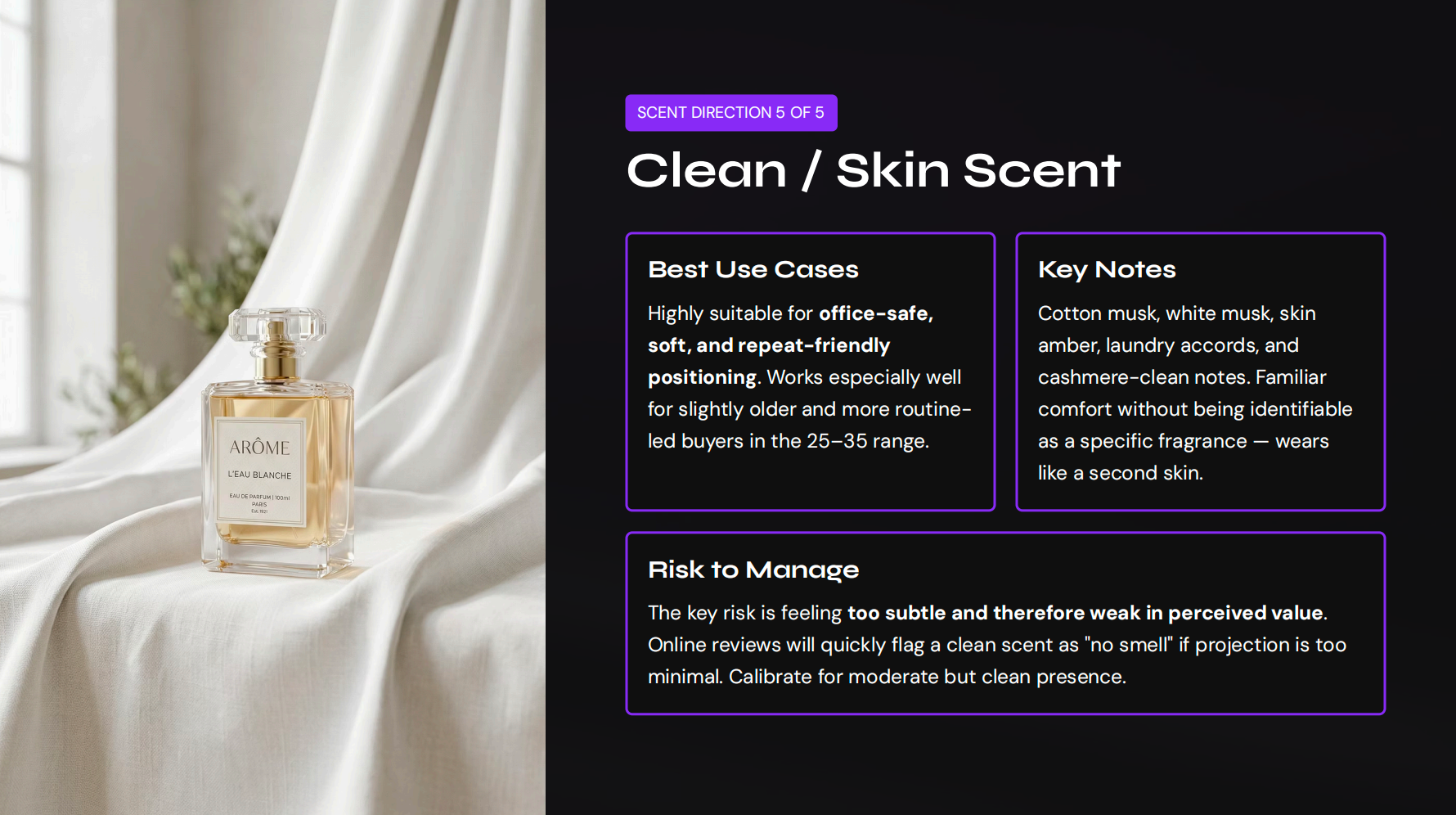
Clean / Skin Scent
What Works in Localization
The strongest local-market performance usually comes from:
- familiar scent language
- wearable sweetness
- feminine but not childish bottle identity
- light, simple claims such as refresh, daily fragrance, and easy use
- giftable packaging
- performance expectations that feel realistic for a mist
What tends to fail:
- overly abstract naming with no emotional cue
- bottles that look too generic online
- harsh citrus without a soft drydown
- perfume-level longevity promises
- oversized formats without quality perception
For this category, confidence comes from familiarity plus polish.
Competitive Reality
The relevant competitive field is broader than global fragrance brands. It includes mass beauty labels, marketplace imports, retailer ecosystems, and fast-moving private-label-style products.
Mass brands usually win on visible value, bright packaging, and familiar scent direction. Imported brands often perform better on finish and perceived sophistication but can lose if pricing becomes disconnected from local value expectations. Fast-follow or private-label offers may scale quickly online, but often suffer from inconsistent spray quality, leakage, or weaker fragrance refinement.
A new entrant does not need the most original scent. It needs the most convincing total offer at its price point:
- fair price-per-ml
- convincing packaging
- familiar scent family
- stable review performance
- low packaging complaint rate
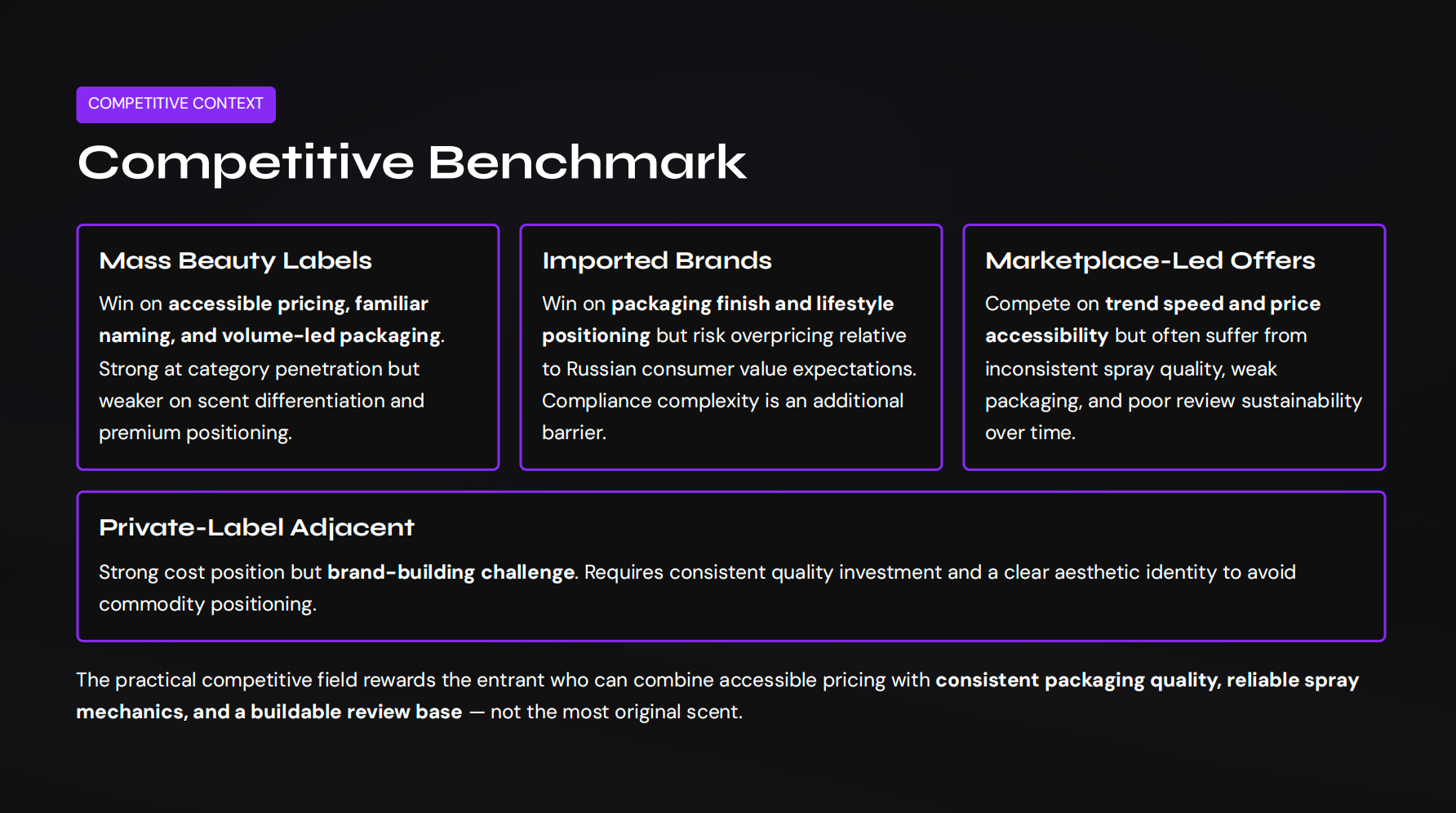
Competitive Benchmark
Product Strategy and SKU Architecture
Body mist works best when the SKU system is disciplined. Too many scents at launch will fragment reviews, inventory, and consumer attention.
A stronger opening assortment usually includes:
1. Hero SKU
A 120–150 ml fruity-floral or soft gourmand scent with a feminine, polished bottle and clear daily-fragrance positioning.
2. Daily-Use SKU
A 100–150 ml fresh or clean scent, such as citrus-musk or soft floral, designed to support repeat use and reduce scent fatigue.
3. Gift or Discovery SKU
A 30–50 ml mini, duo, or small set designed for gifting, trial, and seasonal promotions.
A practical launch range is usually 5–6 SKUs:
- 2 hero commercial scents
- 1 freshness-led daily-use scent
- 1 clean or repeat-use scent
- 1 gift or discovery format
- 1 seasonal gourmand extension
That is enough to support platform merchandising without overcomplicating the range.
Go-to-Market Strategy
The strongest Russia body mist launch is not channel-wide from day one. It is channel-sequenced.

Ready to Turn Market
Opportunities Into Your Next
Product Launch?
Marketplaces First
This is usually the most efficient first route because it supports:
- faster review accumulation
- price comparison visibility
- national reach
- promotion mechanics
- lower offline barrier
Marketplaces should be the main validation channel in the first phase.
Owned E-commerce or Brand-Led Selling
Useful for better storytelling, bundles, and higher-AOV curated offers.
Offline Retail
Best pursued after hero SKUs are proven, packaging is stable, and repeat-purchase logic is visible.
Social Content and Social Commerce
Useful as an attention driver and conversion-assist layer rather than the primary fulfillment route.
The strongest first-year approach is narrow entry, rapid learning, and scaling only proven winners.
Recommended Launch Sequence
Phase 1: Validation
Launch 3 full-size SKUs and 1 mini or gift format. Focus on building real reviews and identifying top-performing scent profiles.
Phase 2: Optimization
Drop the weakest scent, improve packaging where complaints cluster, and refine listing content and bundle logic.
Phase 3: Expansion
Add one seasonal extension or discovery pack and begin selective offline conversations with proven performance data.
Phase 4: Consolidation
Introduce related body care or gifting formats and build larger bundles around the strongest-performing fragrance family.
This sequencing reduces risk and keeps the business review-led rather than assumption-led.
Compliance and Risk Control
Body mist may look operationally simple, but cross-border execution requires discipline. This is still an alcohol-based cosmetic fragrance product with labeling, traceability, and circulation requirements.
Key priorities include:
- correct local-market label logic
- ingredient list accuracy
- batch coding and traceability
- shelf-life support through stability testing
- EAC marking after conformity procedures
- claims discipline
- transport and leakage validation
- pump compatibility and cap integrity
- cold and heat stability checks
One of the biggest export mistakes is validating formula, packaging, claims, and label separately. For Russia, they should be frozen together.
Packaging Quality Is Not Optional
In body mist, packaging failure can damage the business faster than scent failure.
The most common issues are:
- leakage in transit
- weak actuator performance
- cap breakage
- scratch-prone decoration
- poor label durability
- inconsistent atomization
- bottle instability in parcels
That is why packaging should be treated as a core conversion and repeat-purchase driver, not just a sourcing detail.
For first launch, the strongest route is usually:
- dependable fine-mist actuator
- secure overcap
- stable bottle shape
- alcohol-compatible decoration
- optional carton for premium-accessible lines
- mandatory carton for gift sets
- no fragile decorative add-ons
OEM / ODM Launch Planning
For most buyers, the highest-probability route is not a fully custom package from day one. It is a disciplined stock-pack architecture with customized fragrance and artwork.
A practical first-launch structure usually includes:
- 3 full-size SKUs
- stock bottle architecture
- custom scent direction
- 1 mini or duo support format
- conservative claims
- compliance documents prepared in parallel
This approach improves speed, lowers MOQ pressure, and keeps operational risk under control.
A stronger development brief should define:
- target user
- price band
- scent family
- bottle size
- packaging route
- claims boundary
- compliance needs
- target launch timing
- first-order quantity
- testing requirements
The more clearly these decisions are made upfront, the easier it becomes to quote accurately, shorten sample cycles, and protect launch timing.

Go-To-Market, Compliance & OEM Execution
Final Takeaway
The Russia body mist market in 2026 is real, but it is more execution-sensitive than a generic fragrance-growth headline suggests.
The brands that win will not be the ones with the most complicated concept. They will be the ones with:
- clearer product architecture
- safer and more scalable scent direction
- stronger packaging discipline
- realistic pricing below EDT
- marketplace-first launch planning
- better compliance control from the start
The strongest commercial model is not luxury fantasy. It is a disciplined affordable-fragrance system built for daily use, feminine gifting, online scale, and controlled OEM execution.
Download the Full Report (PDF)
Tell us your target region, product category, and the decision you’re trying to make. We’ll suggest the closest existing report—or build a tailored version.