


Executive Summary
This report explores the U.S. scalp care market in 2026, including consumer trends, high-potential product formats, pricing structure, competitive gaps, channel strategy, compliance priorities, and private label OEM launch planning. It is designed to help brands, distributors, Amazon sellers, and product teams turn market opportunity into a clearer scalp care launch strategy.
U.S. Scalp Care Market 2026: Trends, Product Opportunities, and Private Label OEM Strategy
The U.S. scalp care market in 2026 is no longer a niche add-on inside hair care. It is becoming a distinct problem-solution category built around flakes, itch, excess oil, buildup, sensitivity, and thinning-related scalp support.
For brands, distributors, Amazon sellers, and product development teams, this creates a clear product opportunity. Consumers are no longer looking only for “healthy hair.” They are increasingly searching for specific scalp solutions that feel effective, modern, and easy to use in daily routines.
This report translates market demand into launch logic. It covers consumer trends, product format opportunities, pricing structure, competitive patterns, go-to-market strategy, compliance priorities, and OEM development planning for scalp care brands entering or expanding in the U.S. market.
Executive Summary
Scalp care is moving from a secondary hair-care topic into a dedicated problem-solution category. In 2026, the strongest demand is centered on dandruff and flakes, itch relief, oily scalp management, buildup removal, sensitive scalp balance, and scalp support for thinning-related concerns.
The biggest commercial shift is format premiumization. Shampoos still matter, but they are no longer the only way consumers approach scalp care. Leave-in scalp serums, exfoliating treatments, microbiome-positioned products, soothing tonics, and scalp-first routines are expanding the category into higher-margin territory.
For most new entrants, the best launch strategy is not to build a full routine immediately. The stronger route is to launch one hero scalp serum with one support SKU, such as a scalp shampoo, pre-wash scrub, or soothing treatment. This keeps the value proposition sharp, protects initial MOQ, and creates a cleaner path to scale.
Market Opportunity Overview
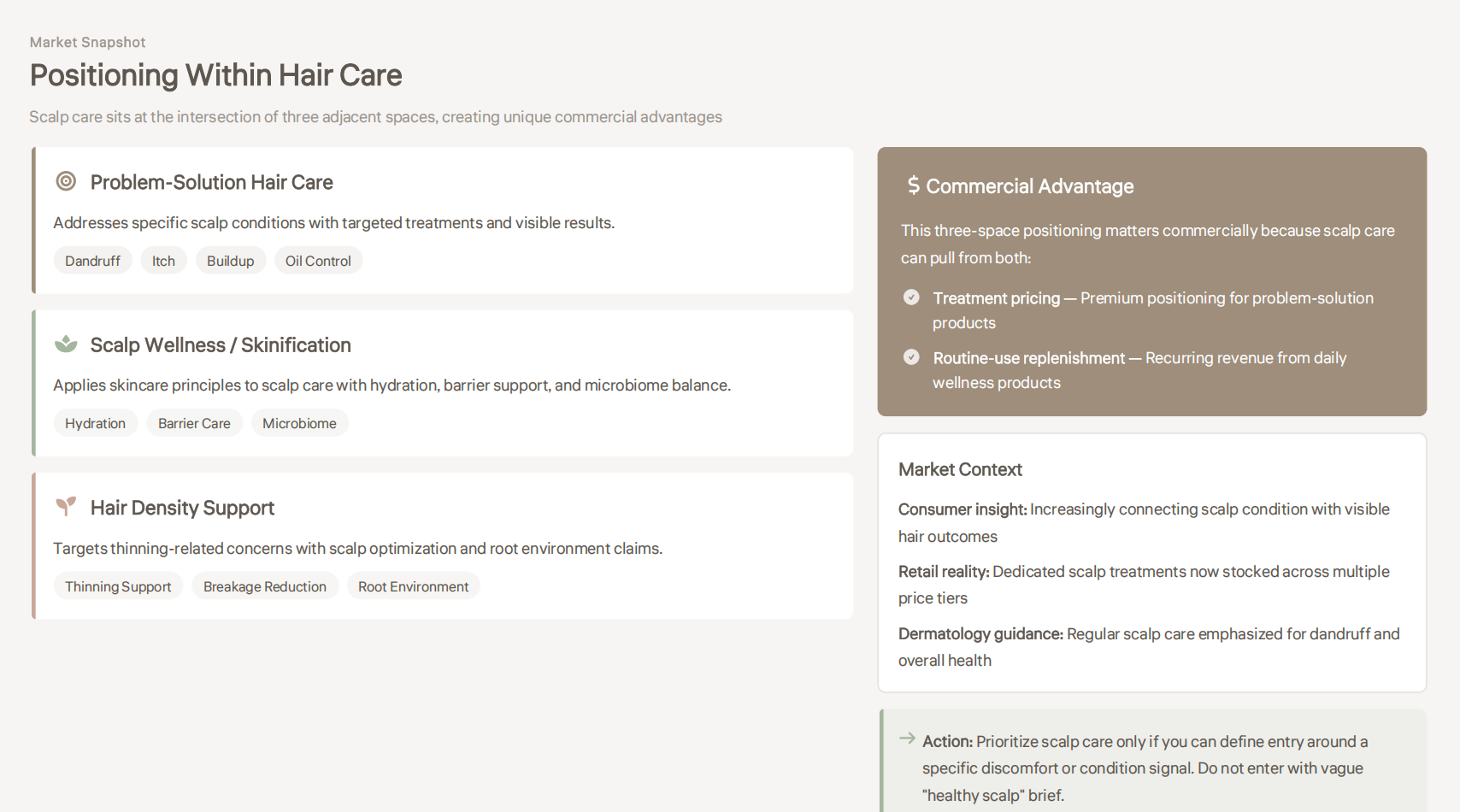
The U.S. scalp care category now sits at the intersection of three adjacent spaces: problem-solution hair care, scalp wellness, and scalp-led hair density support.
That matters because scalp care combines two strong commercial advantages. First, it is highly pain-point driven, which improves conversion. Second, it can support repeat-use replenishment, especially in shampoos, daily serums, and weekly treatments.
Consumers increasingly connect scalp condition with visible hair results. Oil, buildup, flakes, irritation, and discomfort are no longer seen as separate from beauty. They are part of the overall hair and scalp experience. This shift is allowing scalp care to command more shelf space, stronger search demand, and more premium product development.
For brands entering the category, the opportunity is real, but only when the entry point is specific. The market is not rewarding vague “healthy scalp” positioning. It is rewarding clearly defined problem-solution products.
Positioning Within Hair Care
What Is Driving Demand in 2026
Several trends are shaping the U.S. scalp care market.
The first is the move from beauty language to functional scalp health. Consumers increasingly want products that solve flakes, reduce itch, control oil, remove buildup, soothe sensitivity, or support a better scalp environment.
The second is the skinification of scalp care. Ingredients once associated with skincare, such as salicylic acid, niacinamide, hyaluronic acid, peptides, and prebiotic or microbiome language, are now helping brands signal efficacy and justify higher pricing.
The third is premiumization through format. Leave-in serums, scalp tonics, exfoliating pre-wash treatments, and microbiome-support products now allow brands to move beyond commodity shampoo pricing.
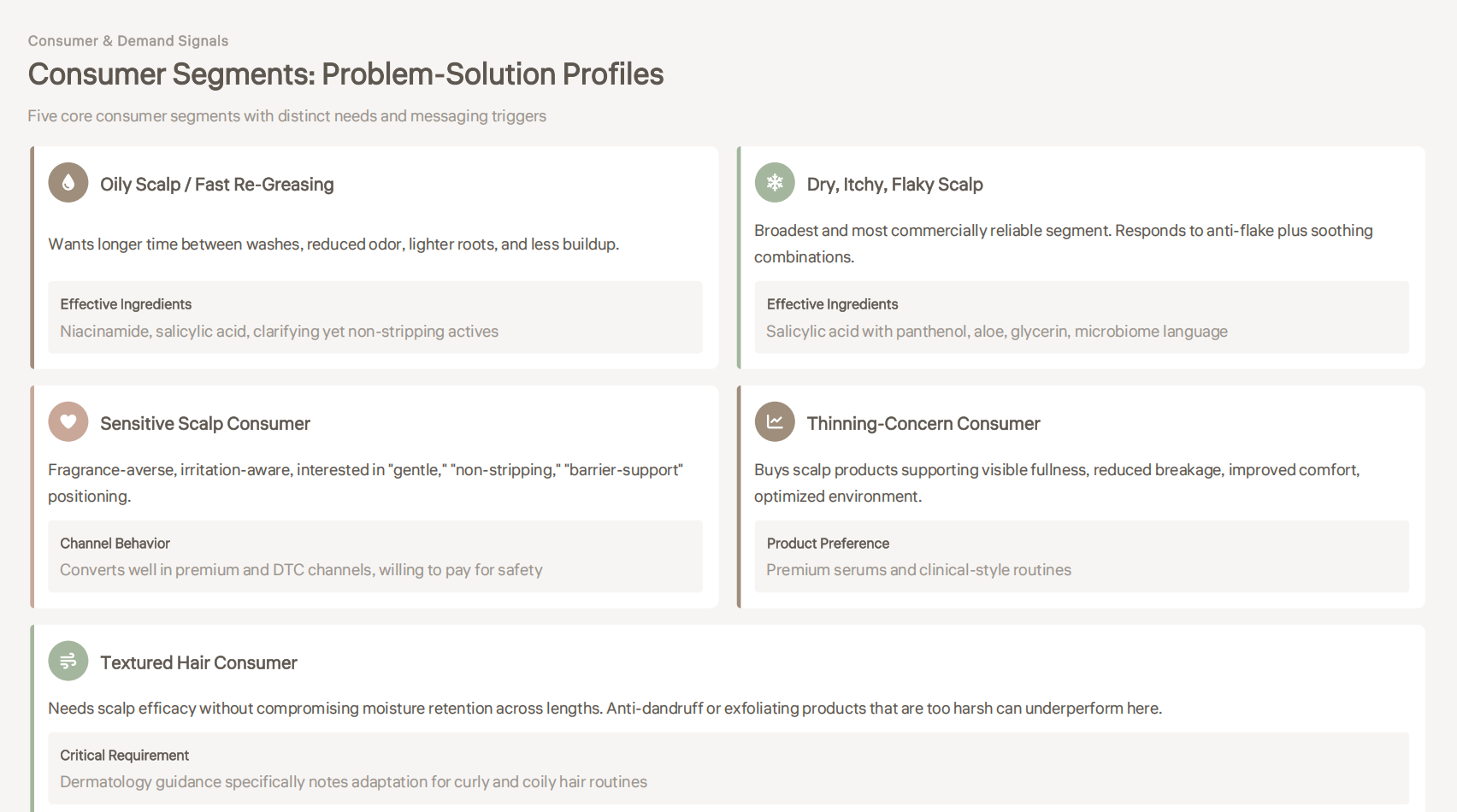
The fourth is target-user segmentation. Oily scalp users, dry flaky scalp users, sensitive scalp consumers, thinning-concern buyers, and textured-hair consumers all require different formulas, textures, and messaging. Broad positioning is becoming less effective.
Core Consumer Segments
The category is being shaped by several strong need-state groups.
Oily Scalp / Fast Re-Greasing
This user wants cleaner roots, longer time between washes, and less residue or odor buildup. Lightweight oil-control serums and balancing scalp treatments work especially well here.
Dry, Itchy, Flaky Scalp
This is one of the largest and most reliable segments. Products that combine visible flake control with scalp comfort have strong conversion logic.
Sensitive Scalp
These consumers respond to fragrance-light, gentle, non-stripping, and barrier-support messaging. They are often willing to pay more for perceived safety and comfort.
Thinning-Concern Consumer
This segment is drawn to premium scalp care products that support scalp environment, reduce breakage-related shedding, improve comfort, and contribute to fuller-looking hair.
Textured Hair Consumer
This group needs scalp efficacy without compromising moisture retention across the lengths. Strong opportunities exist in scalp treatments that manage flakes or buildup while staying moisture-conscious.
Consumer Segments: Problem-Solution Profiles
Best Product Opportunities in 2026
The strongest product opportunities are highly format-specific.
1. Oil-Control Leave-In Scalp Serum
A water-based serum for oily roots and fast re-greasing is one of the most scalable entry products in the category. It solves a clear problem, fits daily use, and works well for Amazon, DTC, and social commerce.
2. Dry Itchy Scalp Relief Serum
A soothing serum for dry, tight, itchy, or flaky scalp has broad commercial appeal. This is especially attractive when the texture is lightweight, cooling, and residue-light.
3. Microbiome Balance Scalp Serum
This is a stronger premium opportunity. It works best for sensitive scalp, recurring discomfort, and daily scalp wellness positioning.
4. Anti-Dandruff Comfort Serum
This format modernizes dandruff care by moving it beyond shampoo-only solutions and into more elegant between-wash maintenance.
5. Pre-Wash Exfoliating Scalp Treatment
This format is strong for oily scalp, buildup, styling residue, and wash-day reset positioning. It also has strong education and content potential.
6. Scalp Scrub for Oily or Flaky Scalp
A scrub can be highly visual and content-friendly, especially when it combines exfoliation with comfort and easy rinse-off.
7. Textured-Hair Scalp Treatment
This is an underserved opportunity for scalp products that manage discomfort without drying curls or coils.
8. Clinical-Style Density Support Scalp Serum
This is one of the strongest premium-margin formats, especially for consumers concerned about thinning, fuller-looking hair, and scalp optimization.
Product Format Strategy
In scalp care, format matters almost as much as formula.
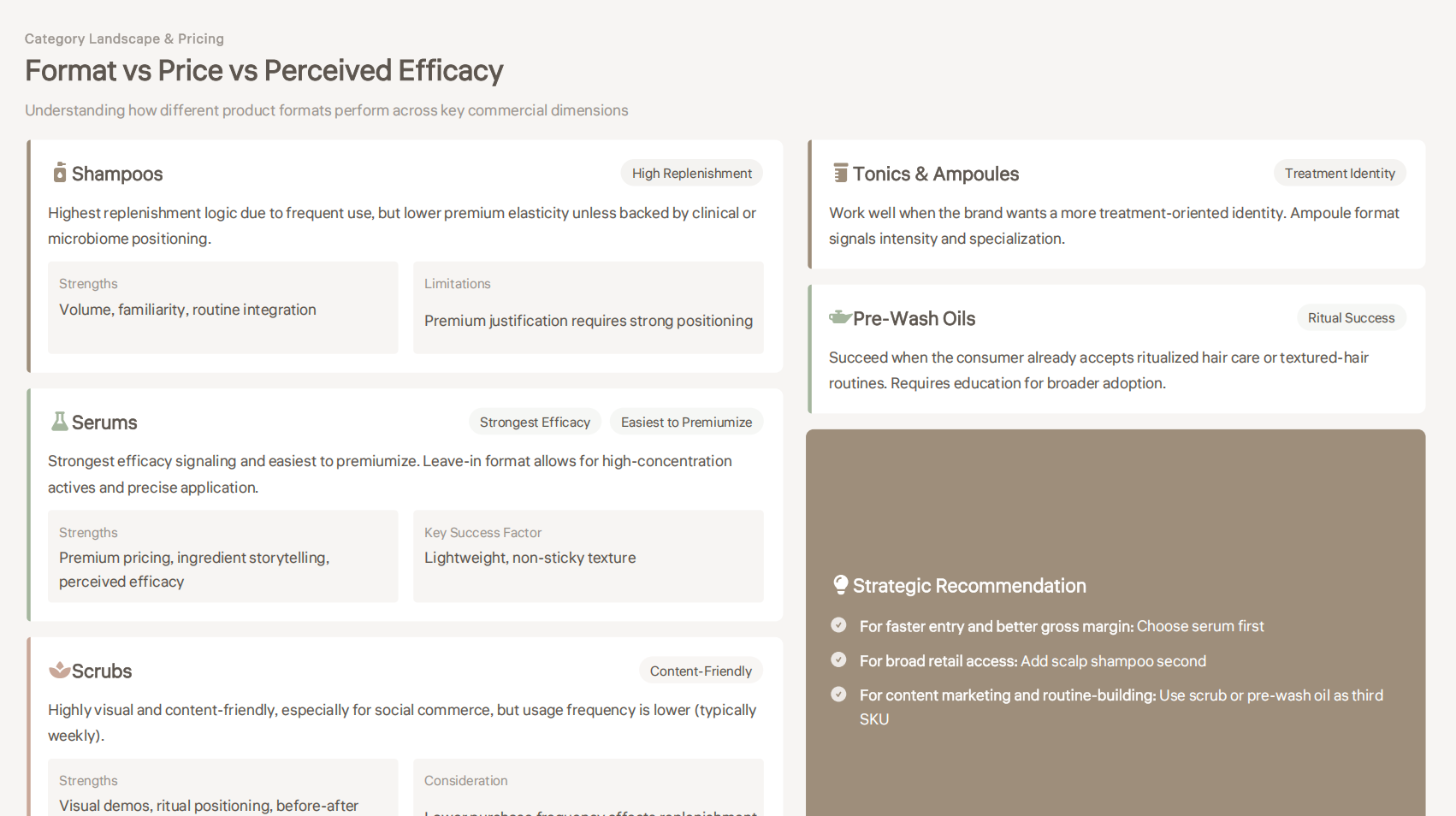
Shampoos have the strongest replenishment logic but are harder to premiumize unless they are supported by clinical or microbiome positioning.
Serums are currently the most commercially flexible format because they combine:
- higher perceived efficacy
- stronger ingredient storytelling
- premium packaging potential
- daily-use compatibility
- better margin structure
Scrubs are highly demonstrable and useful for content marketing, but usually have lower usage frequency.
Tonics and ampoules help position a line as more treatment-oriented.
Pre-wash oils can work well in ritualized routines, especially when targeted at dry or tight scalp users.
For most new brands, serum first remains the strongest entry logic.
Format vs Price vs Perceived Efficacy
Pricing Structure
The category can be grouped into three major pricing zones.
Mass
Mass scalp care is led by anti-dandruff shampoos, basic scalp refresh sprays, and symptom-control products. The value proposition is affordability and fast problem recognition.
Masstige
This is one of the strongest zones in 2026. Products in this range combine better textures, cleaner ingredient stories, stronger packaging, and more premium design while staying accessible.
Premium / Clinical
This tier wins on specialized positioning, elegant sensorials, dermatologist-style branding, and higher-end packaging. Premium scalp serums are especially attractive because they can be priced closer to facial serums.
A clean ladder for many new brands looks like:
- entry SKU for traffic and trial
- core SKU for conversion
- premium SKU for margin
- add-on SKU for routine building
Competitive White Space
The market is getting crowded, but there are still several clear opportunities.
New brands can still win through:
- better sensorials
- better target-user specificity
- better price-to-efficacy balance
The most promising gaps include:
- dry itchy scalp serums with elegant non-greasy textures
- oily scalp balancing serums with low residue
- sensitive-scalp microbiome products with low-fragrance positioning
- textured-hair scalp treatments that preserve moisture
- modern anti-dandruff leave-ins that balance efficacy and comfort
- clinical-style scalp systems for women 30+ and men 25+ concerned about visible density support
What is becoming saturated is vague tea tree positioning, generic detox scrub concepts, and broad “healthy scalp” shampoo launches with weak differentiation.
Go-To-Market Strategy
A scalp care launch should be built around channel fit.
Amazon
Best for problem-solution products with clear naming, visible use cases, and strong review logic. Oil-control serums, anti-flake leave-ins, scalp scrubs, and targeted shampoos perform well here.
TikTok Shop
Best for visual formats, cooling serums, exfoliating products, and applicator-led content that can show an obvious use ritual.
Retail
Best for scalp shampoos, masstige serums, dandruff-plus-comfort solutions, and dermatologist-style scalp care with faster consumer decoding.
Salons
Best for detox, pre-wash scalp rituals, post-color soothing, and treatment add-on services.
For most new brands, the cleanest structure is:
- one hero serum
- one support cleanser
- one bundle offer
That gives enough assortment for conversion without overbuilding inventory too early.
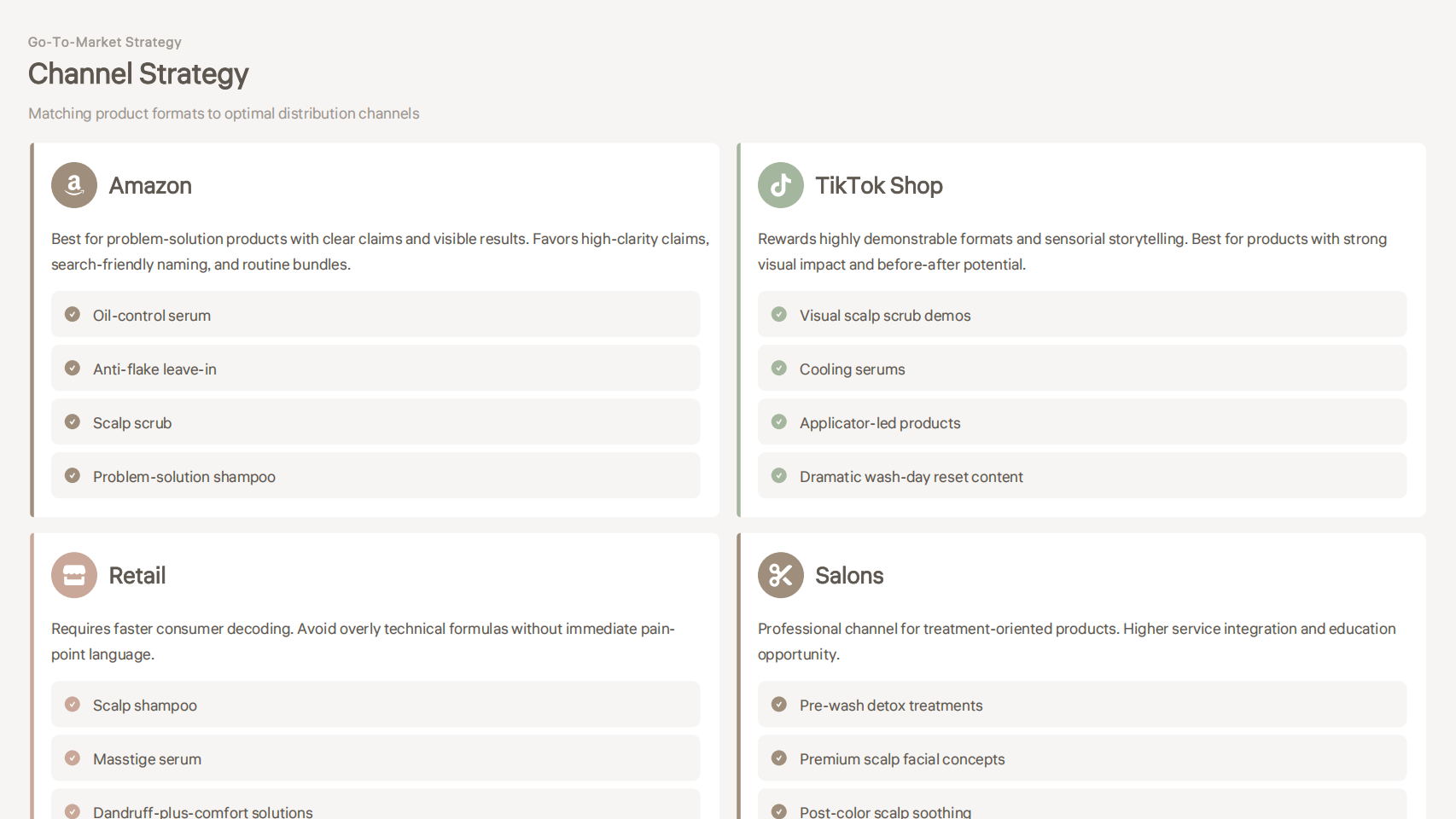
Channel Strategy
Compliance and Risk Considerations
Scalp care may look trend-driven, but execution still needs discipline.
Claims Risk
Claims around hair growth, regrowth, or hair loss treatment can create higher regulatory exposure. It is safer to position products around scalp balance, visible fullness support, comfort, flake reduction, oil control, and scalp environment support.
Formula Sensitivity
Scalp products are used on a sensitive area and often repeatedly. Overuse of acids, essential oils, fragrance, or aggressive cooling agents can reduce repeat purchase and increase complaint risk.
Stability and Compatibility
This is especially important in serums, oils, exfoliating systems, and low-viscosity formulas. Packaging should not be chosen before validating viscosity, closure performance, and formula compatibility.
Leakage Risk
In e-commerce, closure failure, dropper leakage, pump issues, and poor transportation performance can quickly damage ratings and repeat sales.
The best way to reduce risk is to review claims, formula design, and packaging compatibility together from the beginning.
OEM / ODM Execution Strategy
The fastest way to improve development efficiency is to brief the OEM partner clearly.
A stronger development brief should include:
- target consumer
- core problem to solve
- hero benefit
- intended price band
- channel
- target texture
- packaging preference
- fragrance preference
- claims boundary
- launch timeline
For most brands, a practical development roadmap looks like this:
- define commercial brief
- align benchmarks
- complete sample round one
- revise formula
- validate package fit
- test stability and compatibility
- prepare production
To manage cost better, start with lower MOQ on the hero SKU and standardize shared packaging across support SKUs where possible.
The best OEM partners do more than make formula. They help turn a market opportunity into a commercially sharper, easier-to-scale product system.
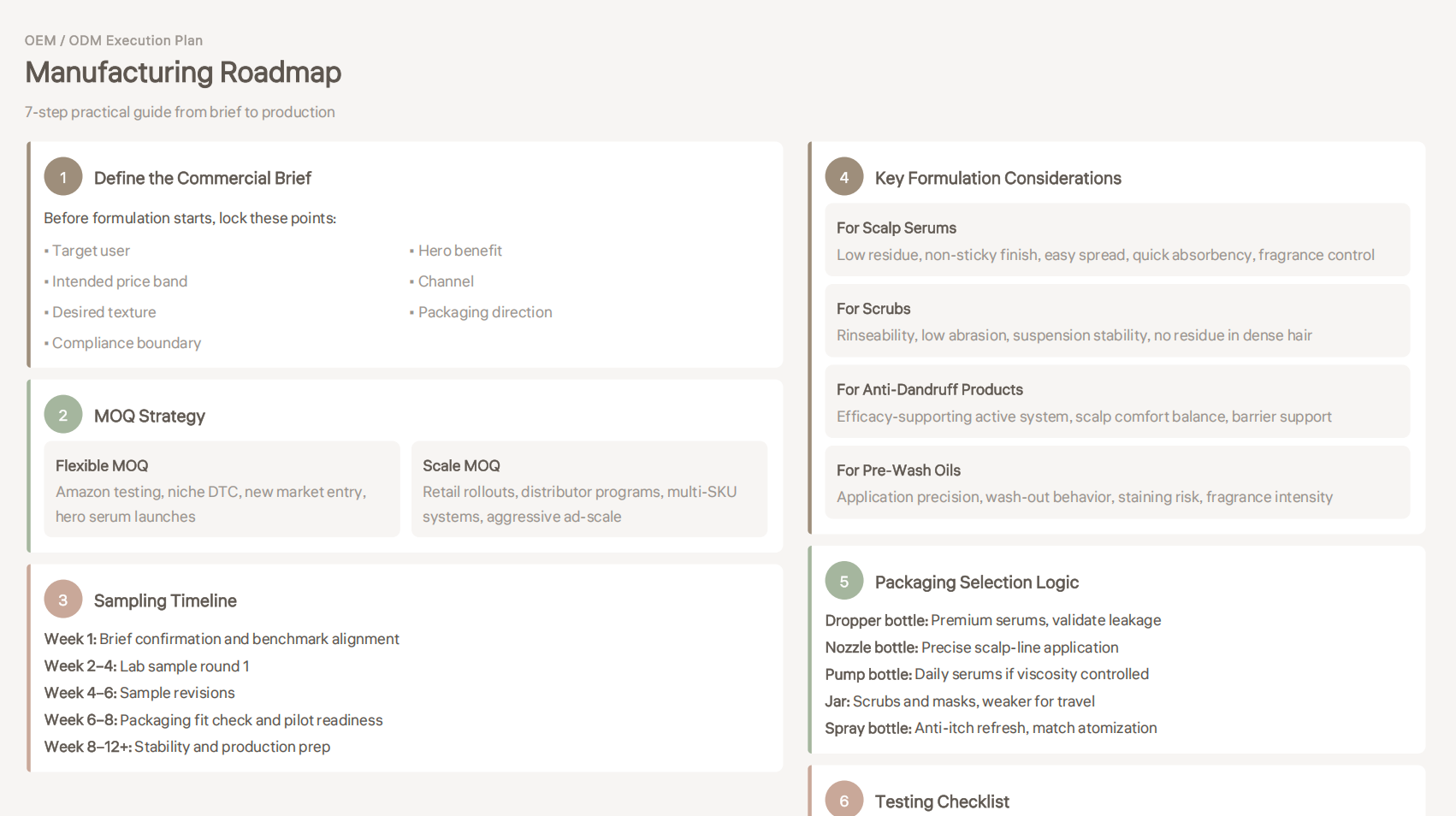
Manufacturing Roadmap
Recommended Starter Portfolio
For a new brand, the strongest 4-SKU starter system is:
- 1 hero scalp serum
- 1 scalp shampoo
- 1 weekly treatment or scrub
- 1 premium upgrade serum
If you want a simpler launch path, choose one of these two routes:
Mass-Premium Route
- anti-dandruff comfort serum
- scalp shampoo
- scalp scrub
Clinical Route
- density support serum
- microbiome balance serum
- gentle scalp cleanser
Do not mix both routes in the first launch unless the brand already has strong distribution and clear merchandising support.
Final Takeaway
The U.S. scalp care market in 2026 is creating strong room for brands that combine narrow problem-solution positioning with good product execution.
The biggest mistake is entering the category with a vague “healthy scalp” idea. The stronger path is to define the target discomfort, match it to the right format, and build a clean commercial system around one hero SKU and one support product.
For most new entrants, the most practical entry point is a hero scalp serum with a sharp problem-solution message, supported by one cleanser or weekly treatment. That structure gives the best balance of clarity, margin, content potential, and OEM execution speed.
Download the Full Report (PDF)
Tell us your target region, product category, and the decision you’re trying to make. We’ll suggest the closest existing report—or build a tailored version.