


Executive Summary
This report explores the U.S. hair serum market in 2026, including product positioning, pricing architecture, anti-frizz and repair trends, scalp-aware formats, channel fit, compliance priorities, and OEM launch planning. It is designed to help brands, distributors, Amazon sellers, and product development teams turn market insight into a more practical serum launch strategy.
2026 U.S. Hair Serum Market Guide: Product Positioning, Pricing & OEM Opportunities
The U.S. hair serum market in 2026 is no longer limited to shine and smoothing. It has evolved into a broader performance category shaped by anti-frizz protection, heat defense, repair support, scalp awareness, lightweight treatment, and styling convenience.
For brands, importers, distributors, Amazon sellers, and product development teams, the opportunity is no longer in launching a generic hair serum. The more commercially effective path is to launch a serum with a clear job, a defined user, and a texture system that matches how people actually style and treat their hair.
This report translates category signals into practical launch logic. It covers product positioning, pricing architecture, consumer demand shifts, channel fit, compliance priorities, and OEM launch planning for brands entering or expanding in the U.S. hair serum category.
Executive Summary
Hair serum is becoming a more strategic category in the U.S. market. Consumers are no longer looking only for shine or slip. They increasingly expect one serum to do multiple jobs well: reduce frizz, protect from heat, improve softness, support damaged hair, or help the scalp feel more balanced without leaving residue.
That shift is changing how products should be developed and sold. The strongest launches in 2026 are not broad “one serum for all hair” concepts. They are sharper, more benefit-led formulas with clear problem-solution logic and better texture performance.
For most new entrants, the best commercial starting point is not a wide SKU rollout. It is a focused serum architecture that begins with anti-frizz plus heat protection, adds a repair-led leave-in serum, and then expands into scalp-aware or specialty texture formats when the base line is proven.
Market Opportunity Overview
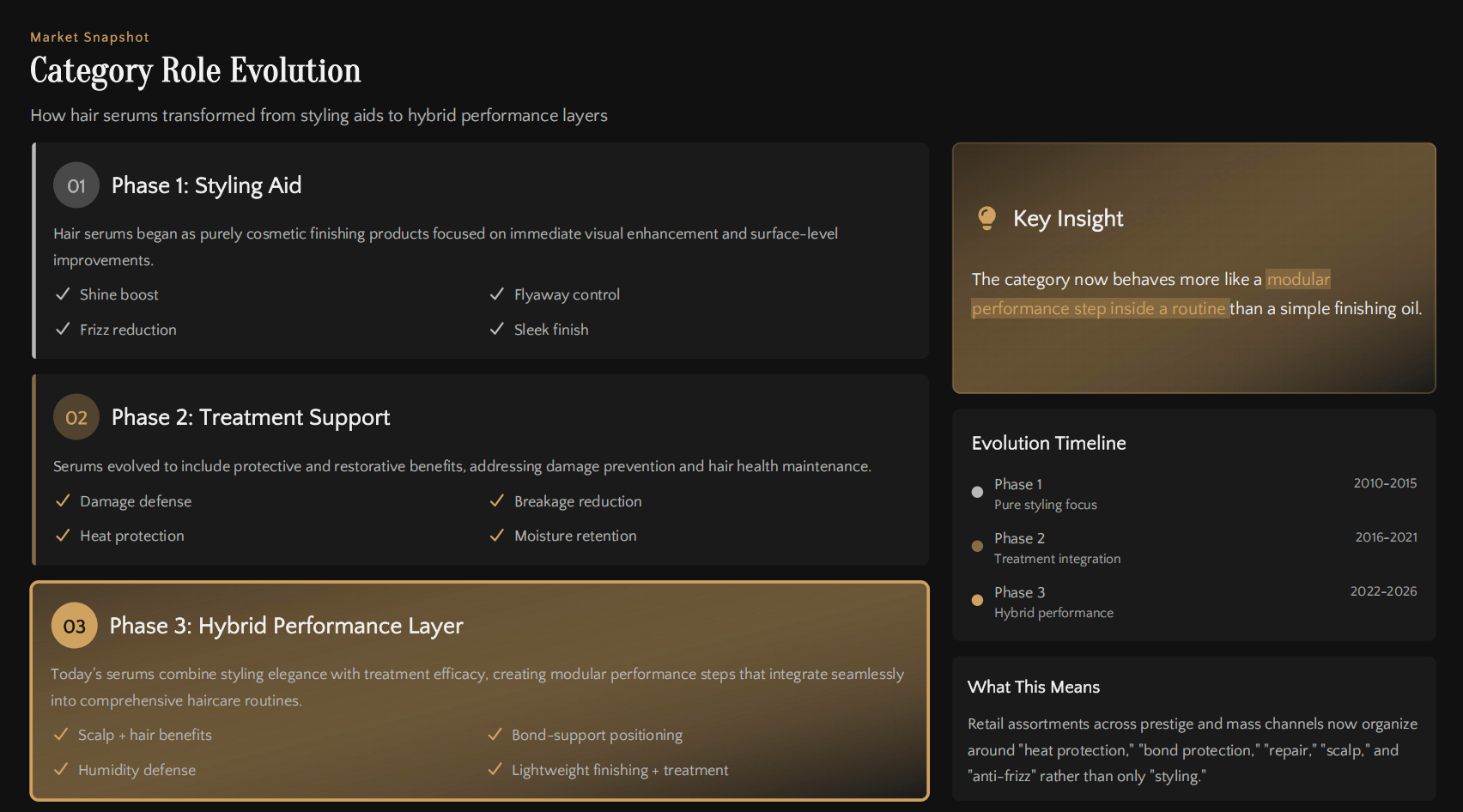
The U.S. hair serum category has moved from a styling accessory to a modular performance step within the haircare routine. Instead of being treated as a finishing product only, serum is now part of treatment, protection, scalp support, and styling preparation.
This matters because the category now overlaps with several high-demand problem areas:
- frizz and humidity defense
- heat protection
- breakage and damage support
- shine without heaviness
- scalp comfort and root-level care
- simplified multi-benefit routines
For buyers entering the market, the commercial opportunity is strongest when the serum is built around one visible styling problem and one longer-term care concern. That is where the category has the clearest repeat-purchase logic.
What Is Driving Demand in 2026
Several shifts are pushing the category forward.
The first is damage and overprocessing. Color treatment, bleaching, hot tools, and frequent washing continue to create strong demand for products that help hair feel smoother, softer, and less fragile.
The second is heat styling culture. Blow-drying, smoothing tools, diffusers, hot brushes, and salon-inspired styling routines keep heat protection highly relevant, especially when combined with anti-frizz and shine.
The third is the shift toward lighter textures. Consumers want serum payoff without greasy residue, weight, or buildup. That makes sensorial performance a core purchase driver, not a secondary detail.
The fourth is scalp care spillover. As consumers become more familiar with scalp routines, the market is opening to hybrid products that connect scalp comfort with stronger-looking, better-managed lengths.
The Product Directions with the Strongest Commercial Potential
The most attractive hair serum opportunities in 2026 are not random variants. They cluster around a few clear product directions.
The strongest ones include:
- anti-frizz plus heat protect daily serums
- bond-repair leave-in serums
- humidity-defense smoothing topcoat serums
- curl-softening oil-serum hybrids
- scalp plus length lightweight serums
- overnight repair serums
- fine-hair weightless shine serums
- blowout prep serums
These directions work because each one solves a practical use case. Consumers do not search for “a nice serum.” They search for products that help with frizz before styling, damage after bleaching, softness without oiliness, or scalp comfort without heaviness.
That is why the strongest product development briefs should define the user problem first, then the texture, then the benefit cluster.
Consumer Demand Signals
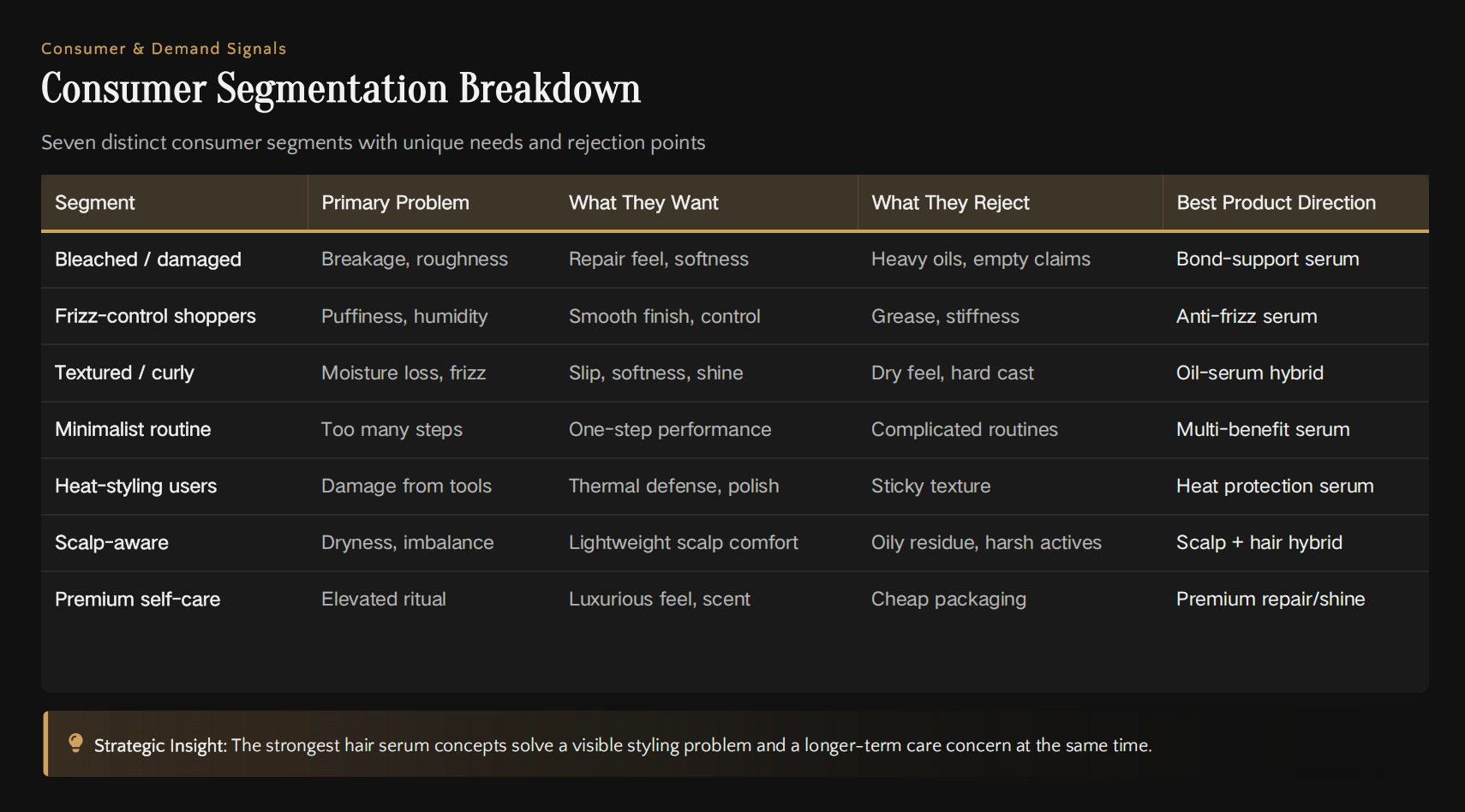
Hair serum shoppers are increasingly segmented by problem state, hair type, and routine style.
The most commercially important segments include:
- damaged and color-treated hair users
- frizz-control and humidity-defense shoppers
- textured and curly hair users
- minimalist routine users who want one-step performance
- heat-styling users
- scalp-aware consumers
- premium self-care shoppers
Across these groups, the common expectation is the same: visible payoff without residue.
Consumers increasingly want:
- lightweight spread
- no sticky finish
- no oily buildup
- smooth comb-through
- shine without limpness
- heat compatibility
- layering ease with creams, sprays, or leave-ins
This means texture is not just a formulation detail. It is a conversion factor.
Consumer Segmentation Breakdown
Why Texture Engineering Matters More Than Ever
In hair serum, texture often determines repeat purchase more than the headline claim.
A formula can sound strong on paper but still fail commercially if it feels greasy, weighs hair down, leaves buildup, or does not cooperate with heat styling. This is especially important in Amazon and DTC channels, where user reviews quickly punish sensory failure.
The most commercially relevant texture archetypes include:
- water-light serum for anti-frizz and heat defense
- silky emulsion serum for repair support
- dry-touch oil-serum for textured hair and shine users
- thin fast-absorbing serum for scalp and length hybrid use
- cream-serum hybrid for blowout prep
The more closely the texture matches the target user and usage moment, the stronger the product’s chance of success.
Pricing Strategy and Category Architecture
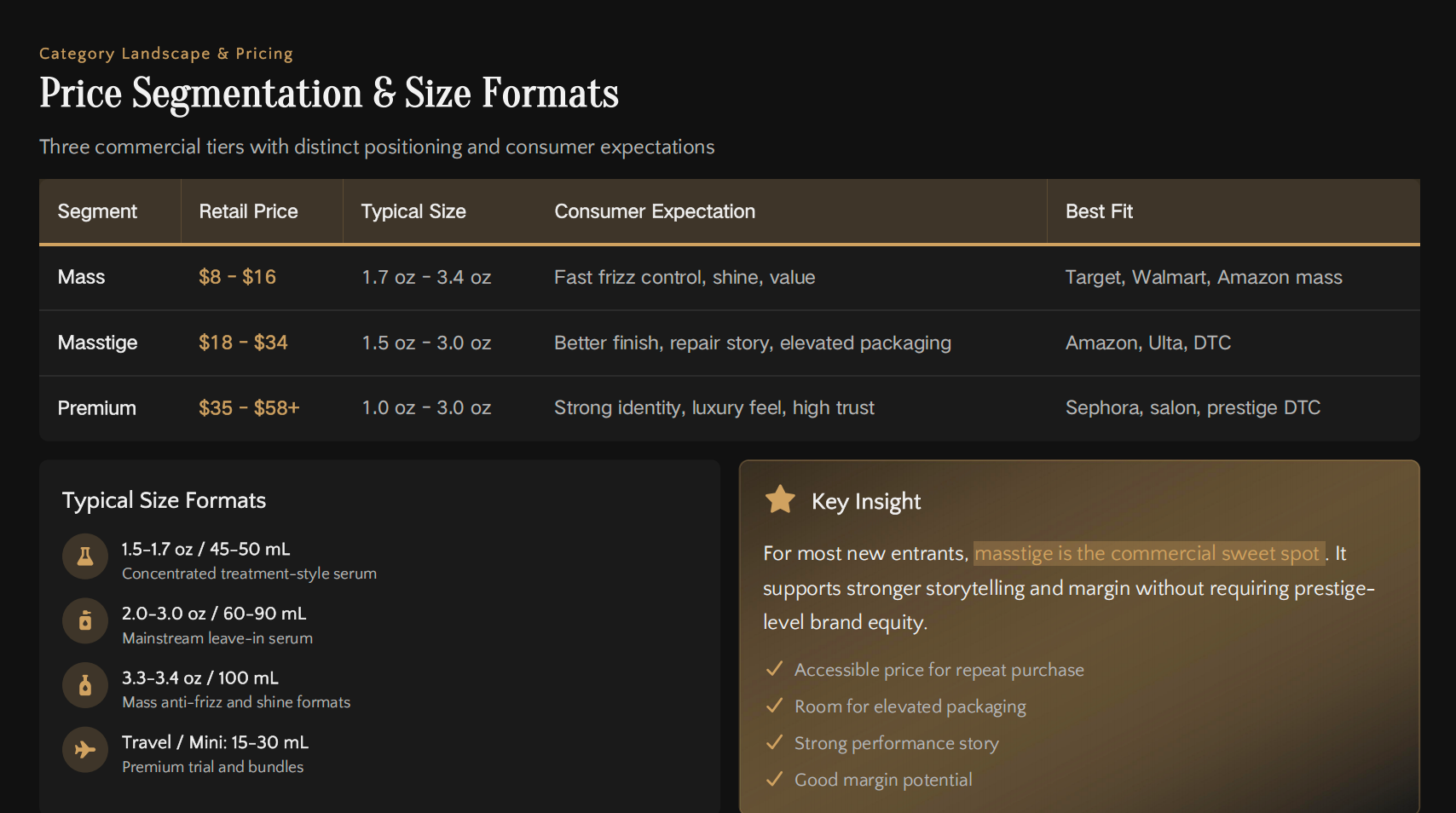
The U.S. hair serum market is now clearly divided into mass, masstige, and premium bands.
Mass still performs well for value-driven anti-frizz and shine products. Premium remains attractive where brand identity, package quality, and ritual value are strong. But for many new entrants, the most practical launch point is masstige.
Masstige works because it allows:
- stronger positioning than low-end mass
- better margins than purely promotional SKUs
- enough pricing room for better packaging and texture
- easier storytelling around repair, heat defense, and scalp care
A practical launch ladder often looks like this:
- traffic SKU at a sharp entry price
- hero SKU in the mid-price everyday-use zone
- margin SKU with stronger repair or scalp story
- travel or duo bundle for conversion and AOV growth
This gives the assortment better range without turning it into a bloated line.
Best Price Logic for New Entrants
For many brands, the most commercially usable pricing structure is:
- anti-frizz heat protect serum as the broad-entry hero
- bond repair serum as the higher-value margin product
- scalp or specialty serum as the premium add-on
- mini or duo bundle as the conversion tool
This works because it maps neatly to both search behavior and retail logic. A broad-use anti-frizz SKU captures volume. A repair SKU supports higher perceived value. A scalp-led or specialty format adds premium depth. A mini or duo helps first purchase and gifting.
The key is not to overprice a serum if the visible performance does not justify it. Premium pricing must be earned through finish, packaging, texture, scent, and product identity.
Price Segmentation & Size Formats
Channel Strategy
A strong serum launch should be built around channel fit from the start.
For Amazon, anti-frizz, heat-protect, and bond-repair serums tend to work best because they match clear search intent. What wins here is tight price discipline, strong listing clarity, and benefit language that is easy to understand quickly.
For DTC, there is more room for scalp hybrid formats, textured-hair serums, premium repair positioning, and bundles. Storytelling, routine education, and bundle architecture matter more in direct channels.
For retail, broad-use daily serums often work best because they are easier to explain at shelf. Anti-frizz and weightless shine concepts usually outperform more complex positioning here.
For salon and professional channels, damage recovery, blowout prep, overnight treatment, and bond-support concepts often feel more credible because they align with how the products are used in practice.
The strongest product systems do not force one exact SKU structure into every channel. They adapt the lineup to the way each channel converts.
Competitive White Space
The category is active, but there are still several open win zones.
The most attractive gaps include:
- anti-frizz plus heat protection hybrid serums with strong daily relevance
- bond repair serums below prestige-level pricing
- elegant textured-hair oil-serum hybrids in masstige space
- honest scalp plus hair crossover serums that stay cosmetic-safe
- travel and full-size duo systems built for conversion
Many existing products are either too cosmetic and shallow or too treatment-heavy and difficult to use daily. That creates room for well-balanced serum systems that combine clear immediate payoff with credible long-term support positioning.
The market rewards clarity more than complexity.
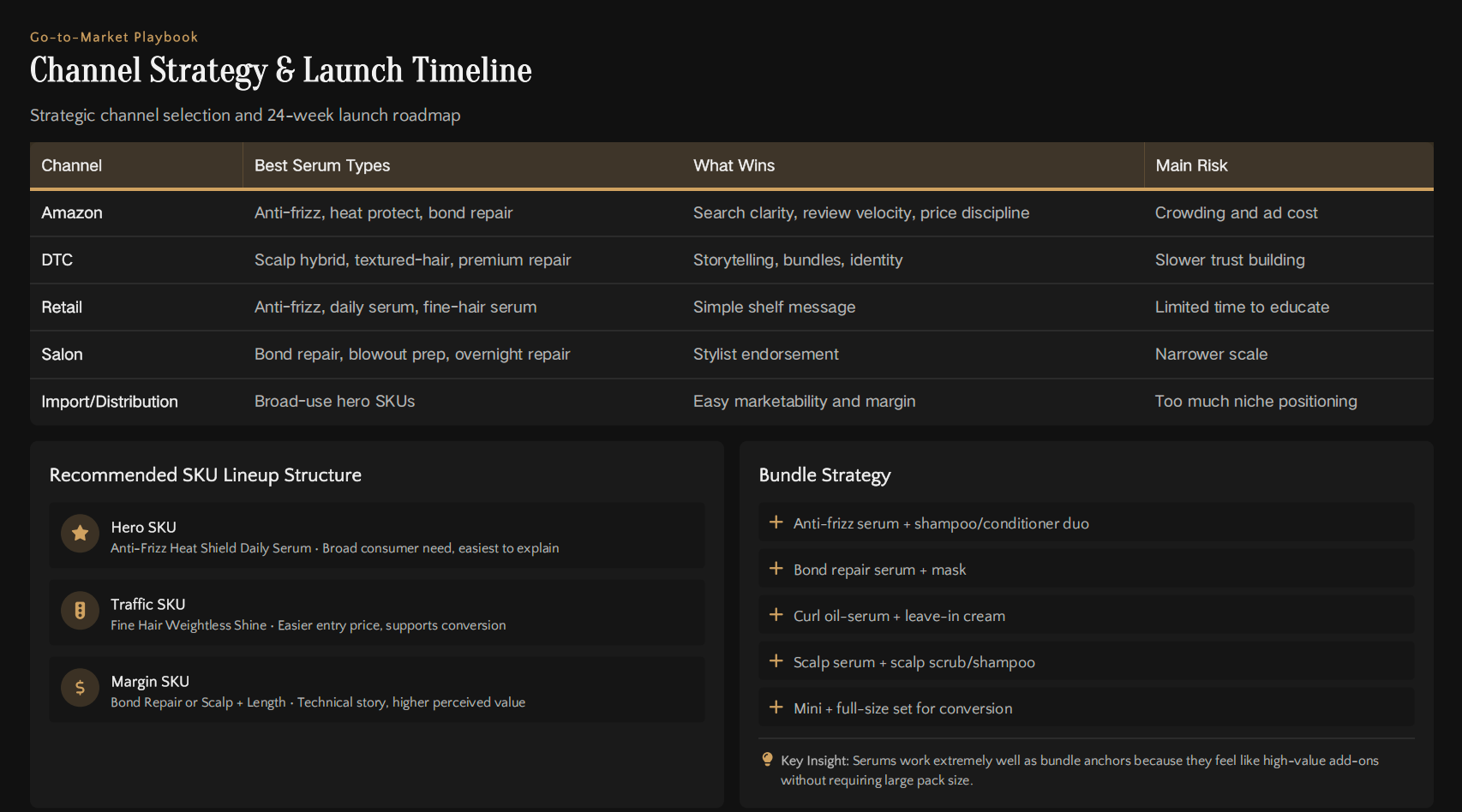
Channel Strategy & Launch Timeline
Compliance and Quality Priorities
Hair serums in the U.S. cosmetic category need to stay inside cosmetic claim boundaries. That means brands should focus on supported, visible, cosmetic-safe benefits.
Claims that are usually easier to support include:
- smooths frizz
- adds shine
- helps reduce breakage
- helps protect from heat
- conditions hair
- helps strengthen the look and feel of hair
- supports softness and manageability
Higher-risk territory includes:
- hair regrowth
- hair loss treatment
- medical scalp treatment language
- permanent damage reversal
- drug-like scalp benefit claims
Beyond claim language, brands also need to get the basics right:
- accurate ingredient declaration
- traceable batch coding
- package compatibility
- leakage testing
- fragrance stability
- correct label hierarchy
- realistic warning and usage instructions
In this category, many commercial failures come from formula-package mismatch rather than from the active story itself.
OEM Launch Strategy
The fastest way to reduce wasted development time is to give the OEM a stronger brief.
A better RFQ should define:
- target market
- sales channel
- target user
- core benefit cluster
- target texture
- product format
- packaging type
- target retail price
- benchmark products
- fragrance or no-fragrance direction
- first order quantity
- launch timeline
Do not brief an OEM with only “I want a hair serum.”
A commercially useful brief should explain who the product is for, what problem it solves, how it should feel in use, and where it will be sold.
For serum projects, a good OEM partner should help pressure-test not only the formula, but also the package match, claim logic, price feasibility, and channel fit.
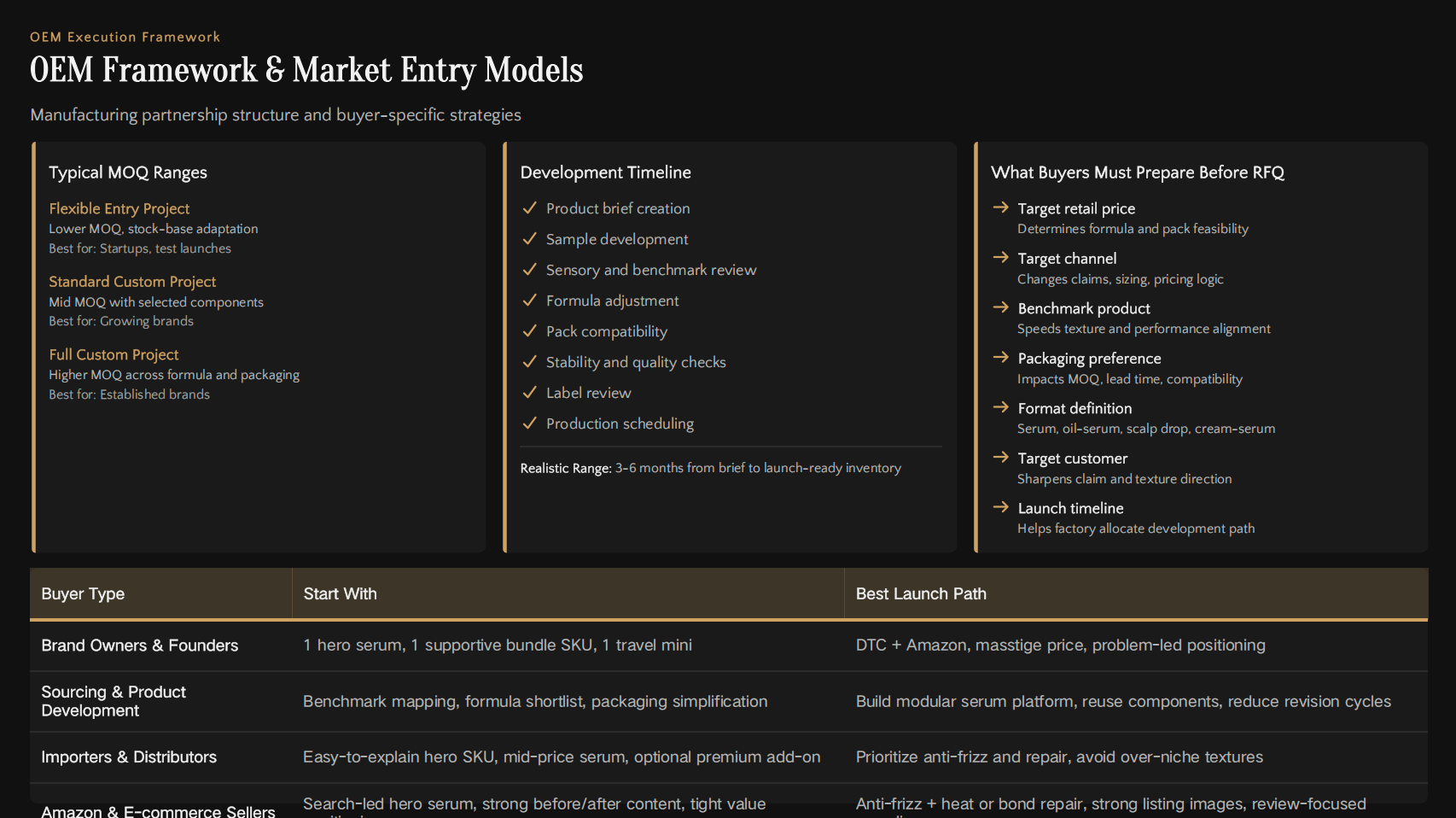
OEM Framework & Market Entry Models
Recommended Entry Model
For most new entrants, the most efficient launch path is a 3-SKU serum architecture.
A practical starter structure is:
- one anti-frizz plus heat protect hero SKU
- one bond repair or damage-support conversion SKU
- one scalp plus length or specialty expansion SKU
If budget is tighter, the simplified route is:
- one broad-use hero SKU
- one repair-support SKU
- add scalp or specialty formats later after packaging and claims are stable
This keeps the line commercially usable without overbuilding from day one.
What Buyers Should Do Next
If you are planning a U.S. hair serum launch, the smartest next move is not to build the broadest line.
Instead:
- define one clear user problem first
- choose the right texture system
- set the target price band early
- match packaging to usage ritual
- align claims with cosmetic-safe positioning
- build the hero SKU first, then add margin and bundle support
That approach leads to faster development, easier selling, and better repeat-purchase potential.
Final Takeaway
The U.S. hair serum market in 2026 is attractive because it sits at the center of several strong demand drivers: anti-frizz protection, heat defense, repair support, scalp awareness, and simplified multi-benefit routines.
The brands most likely to win are not the ones launching the most serum variants. They are the ones building the clearest product logic: one defined user, one visible problem, one strong texture system, and one price band that fits the intended channel.
If your team is evaluating a new hair serum line, the best next step is to align the user, benefit ladder, texture, and price band first, then move into sampling with a more channel-specific and OEM-ready brief.
Download the Full Report (PDF)
Tell us your target region, product category, and the decision you’re trying to make. We’ll suggest the closest existing report—or build a tailored version.