


Executive Summary
This report explores the UK hair mask market in 2026, including repair, hydration, anti-frizz, and scalp-care demand, plus pricing logic, channel fit, product opportunities, compliance priorities, and OEM launch planning. It is designed to help brands, importers, distributors, Amazon sellers, and product development teams turn market insight into a more practical launch strategy.
UK Hair Mask Market Report 2026: Repair, Hydration, Scalp Care, and OEM Launch Guide
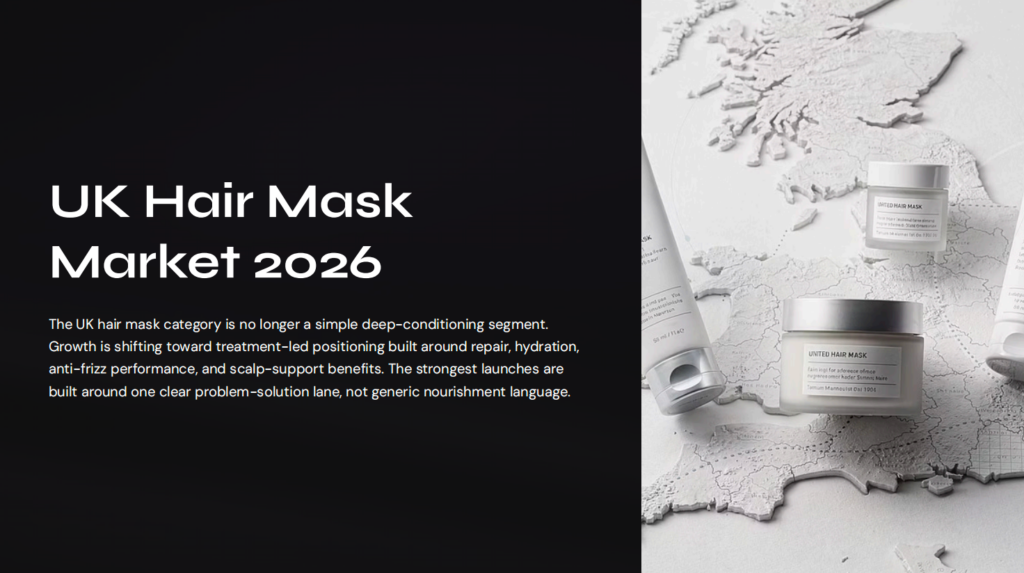
The UK hair mask market in 2026 is no longer a simple deep-conditioning category. It is evolving into a more treatment-led segment shaped by bond repair, intense hydration, anti-frizz performance, and rising scalp-care demand.
For brands, importers, distributors, Amazon sellers, and product development teams, this shift creates a more structured opportunity. Consumers are no longer looking only for a generic nourishing mask. They are increasingly searching for masks that solve visible, practical problems such as bleach damage, dryness, rough ends, frizz in damp weather, scalp discomfort, and heaviness from poorly matched formulas.
This report turns those market signals into practical launch logic. It covers category direction, consumer demand, pricing strategy, channel fit, product opportunity mapping, compliance priorities, and OEM launch planning for businesses entering or expanding in the UK hair mask market.
Executive Summary
The UK hair mask category is moving away from broad “nourishing” language and toward more specific treatment positioning. Repair remains one of the strongest commercial lanes, but it is also becoming more crowded. Hydration still performs well, although plain moisture claims are no longer enough on their own. At the same time, scalp care is expanding from niche into a more meaningful growth pocket.
This means the opportunity in 2026 is not to launch another generic hair mask. The stronger path is to choose one clear commercial lane and build the formula, texture, claims, packaging, and channel strategy around that lane.
For most new entrants, the most practical opportunities sit in hybrid formats. Bond repair plus hydration, scalp comfort plus hair conditioning, and lightweight repair masks for fine hair users all have stronger commercial logic than basic one-dimensional nourishment stories.
Market Opportunity Overview
The UK hair mask market is increasingly driven by treatment behavior rather than occasional pampering. Consumers are using masks as targeted care for colour damage, dryness, frizz, rough texture, scalp discomfort, curl recovery, and weekly repair routines.
This matters because the category is widening in two directions at the same time. On one side, there is stronger demand for science-coded repair products. On the other, there is rising interest in scalp-support formats that feel modern, beauty-led, and easy to integrate into routine use.
For a new entrant, the goal is not to compete in every lane at once. The goal is to identify one strong product message with one supporting benefit and make it commercially clear from day one.
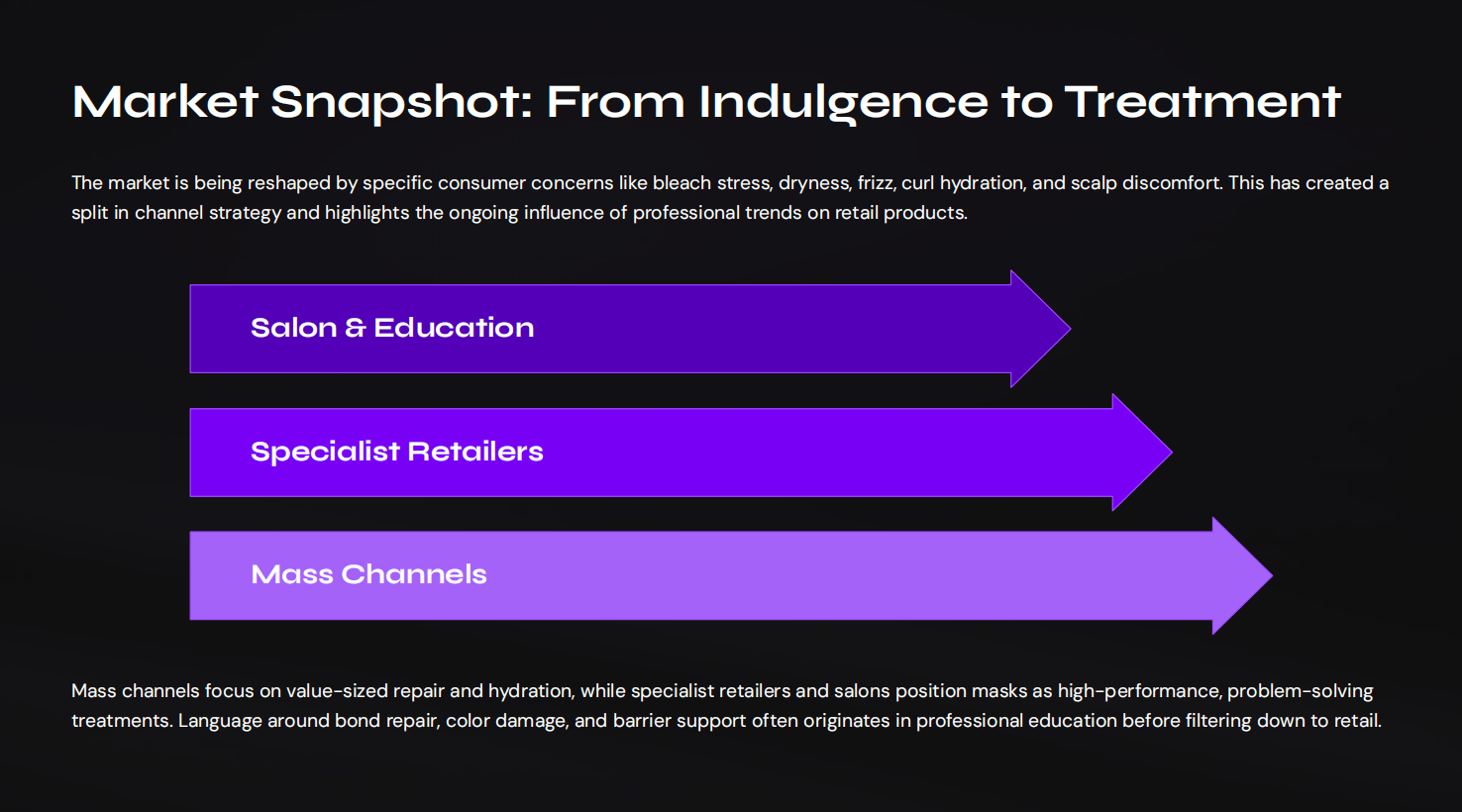
Market Snapshot: From Indulgence to Treatment
What Is Driving Demand in 2026
Several shifts are shaping the UK market.
The first is visible damage care. Bleach, colour treatment, frequent washing, and heat styling have made repair language more commercially important.
The second is hydration-plus logic. Consumers still want softer and smoother hair, but they increasingly expect hydration to be linked with another result such as frizz control, shine, manageability, or damage recovery.
The third is scalp expansion. Scalp masks are becoming more accepted, especially when positioned around dryness, comfort, buildup reset, or barrier support rather than old-fashioned medicated language.
The fourth is local hair behavior. Hard water, damp weather, rough-feeling ends, and frizz-prone hair all shape product expectations in the UK. Buyers respond better to practical benefits they can feel and see than to vague wellness messaging.
Core Consumer Demand Segments
A useful way to understand the category is through four core user groups.
The first is damaged-hair users. These consumers are focused on bleach stress, colour damage, split-end appearance, roughness, and breakage look. They are highly responsive to repair-led products that feel technical but still give quick sensory payoff.
The second is dry and frizz-prone users. They are usually looking for softness, shine, smoother feel, and less puffiness in damp conditions. Immediate feel matters more here than abstract treatment language.
The third is scalp-concern users. This group includes people dealing with dryness, itch discomfort, sensitivity, flaking, buildup, or oil imbalance. They respond best when the product is explained clearly as a scalp-support mask, not as a medicated treatment.
The fourth is hybrid users. These consumers have both fibre and scalp concerns, such as oily roots with dry ends, or bleach damage with a tight-feeling scalp. They are ideal targets for dual-use or hybrid masks.
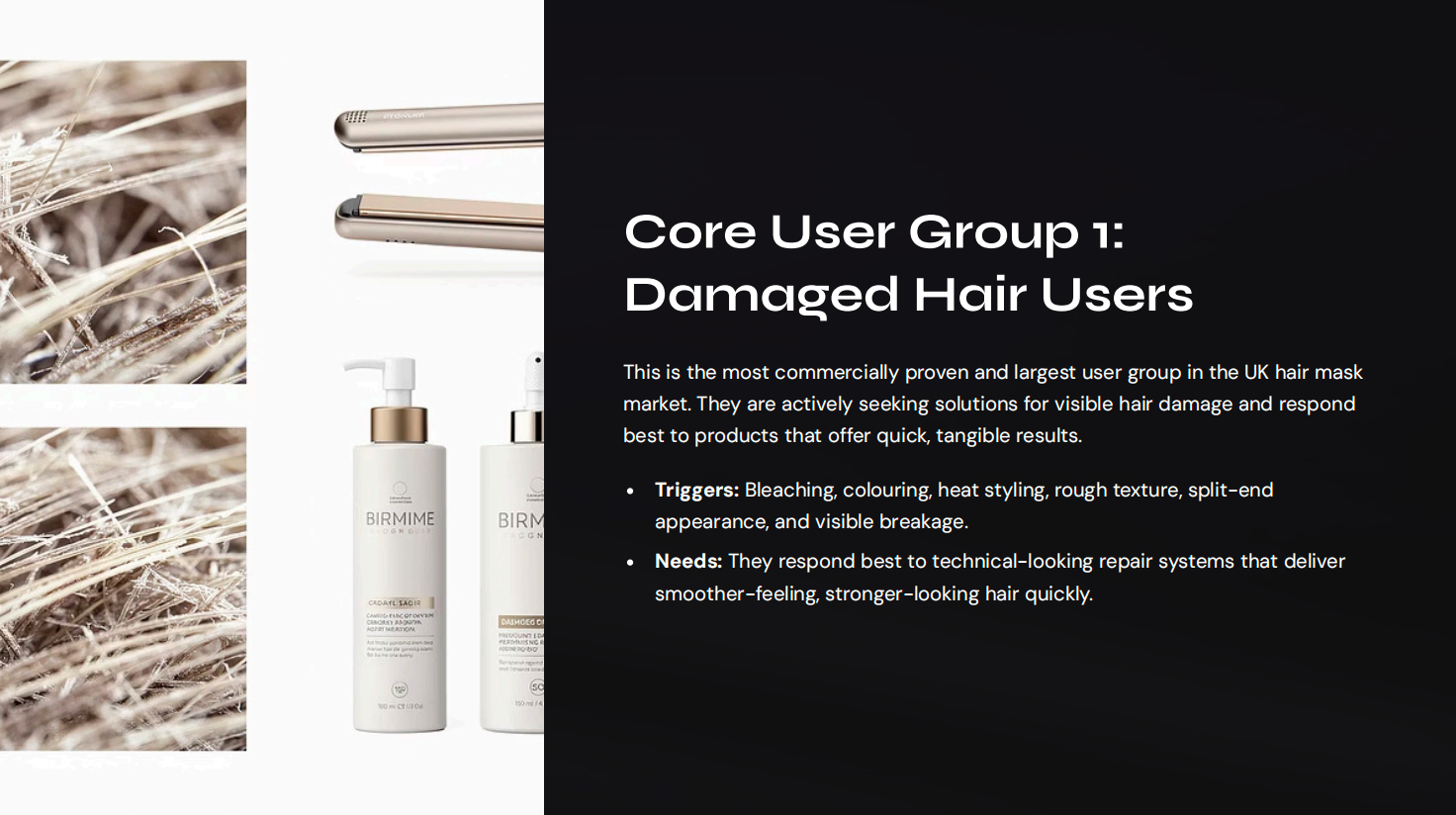
Core User Group 1:
Damaged Hair Users
High-Conversion Consumer Triggers
The most commercially useful triggers in the UK market include:
- damaged-feeling hair after bleaching or colouring
- dry ends that still feel rough after conditioner
- frizz triggered by damp weather
- a desire for softer hair after one use
- scalp dryness or discomfort
- the need for repair without heaviness
- salon-looking hair without salon pricing
Products that respond clearly to these triggers tend to convert more effectively than masks built around broad lifestyle language alone.
Product Lanes That Make the Most Sense
For most brands entering the category, there are three commercially strong lanes.
The first is repair. This remains the most proven lane, especially for damaged, coloured, and heat-stressed hair.
The second is hydration and anti-frizz. This lane works especially well when moisture is paired with manageability, softness, shine, or weather-resistant smoothness.
The third is scalp plus hair dual-use care. This is still less saturated than classic repair and offers stronger differentiation if the formula is well designed.
For most OEM and private label buyers, the safest route is to launch one hero mask with one strong functional promise and one supporting benefit.
Price Segmentation and Commercial Logic
The UK hair mask market is clearly segmented.
Mass products are usually driven by generous size, easy hydration language, and family-friendly pricing. They work best in high-volume retail and value-led online channels.
Masstige is one of the most commercially attractive price bands for new brands. Consumers in this segment expect better texture, stronger functional language, better packaging, and more visible results.
Premium products rely more on technical authority, stronger brand equity, or salon-adjacent credibility. This can work well, but it usually requires stronger product story and better sensorial performance.
For many new launches, the most practical retail band is in the mid-range. It gives enough room for better ingredients, stronger packaging, and clearer margin structure without requiring luxury-brand authority.
Recommended Format and Size Strategy
Different product lanes work better in different packaging systems.
Jars are strong for hydration-led, family-size, and volume-driven products. Tubes are usually better for cleaner premium positioning, repair-focused concepts, and scalp-support messaging. Mini formats are useful for trial, travel, sampling, and premium conversion. Sachets can work well for promotions, Amazon bundles, and salon-led acquisition.
For most new launches, one of the safest structures is:
- one hero treatment mask
- one supporting extension later
- one sample or mini format for acquisition
That is usually more effective than launching too many overlapping SKUs at once.
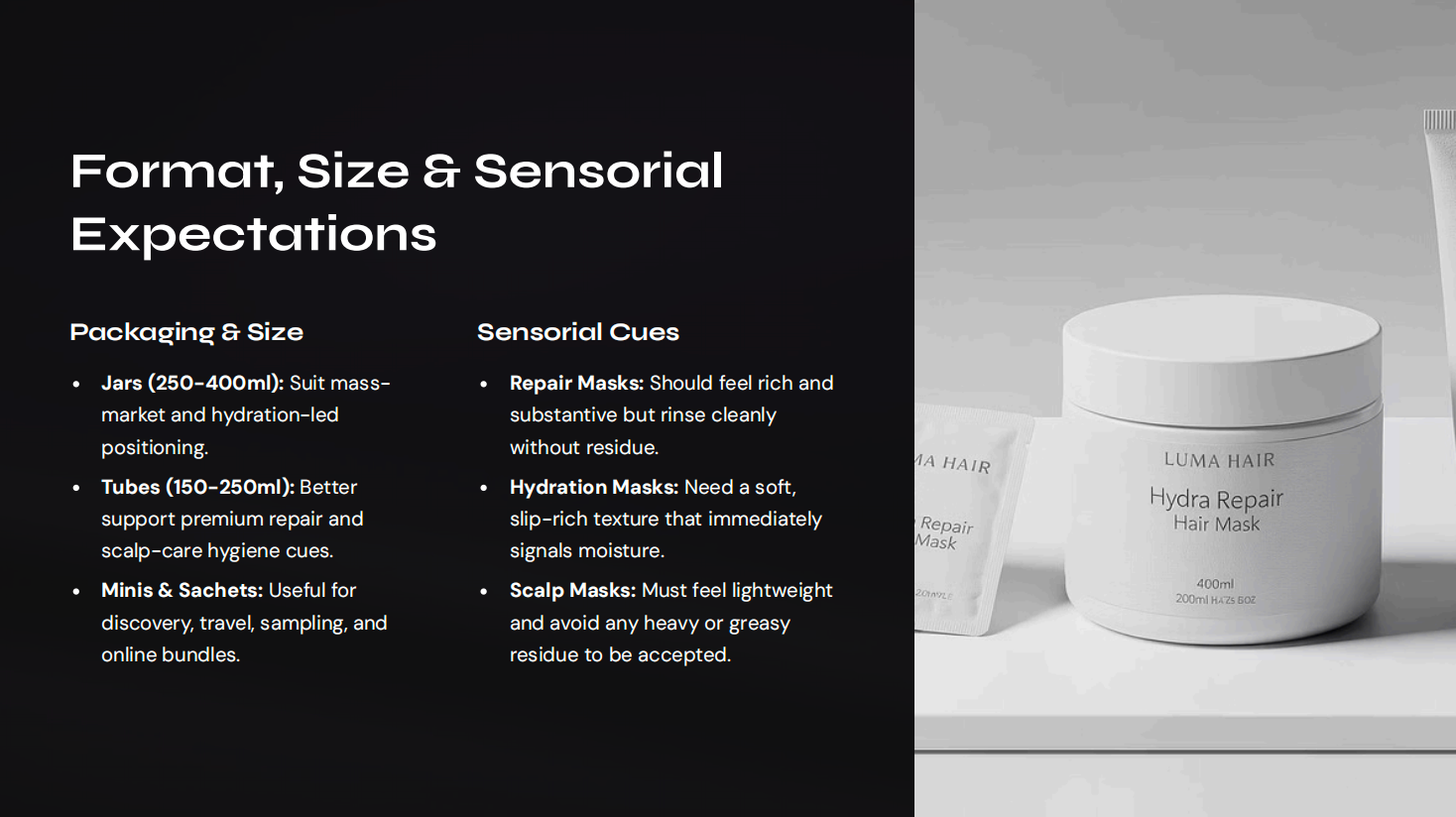
Format, Size & Sensorial
Expectations
Best Product Opportunities for 2026
The strongest opportunities in the UK market are not generic “nourishing” masks. They are clearer, more targeted concepts.
The most commercially attractive opportunities include:
- a bond rescue moisture mask for damaged or colour-treated hair
- a lightweight repair mask for fine-to-medium hair
- an anti-frizz hydration mask built for damp-weather softness
- a scalp barrier and soft lengths mask for dual-use care
- a scalp reset mask for buildup-prone roots and dry ends
- a post-bleach recovery mask with salon-style positioning
- a curl recovery mask for moisture and definition support
- an overnight repair mask for next-day softness claims
- a hard-water defence moisture mask
- a value-led family repair mask for mass retail
Among these, hybrid concepts are particularly attractive because they solve real unmet needs without requiring extreme formulation novelty.
Why Hybrid Masks Are a Stronger White Space
One of the clearest commercial insights in the market is that hybrid masks are more promising than one-dimensional claims.
A bond repair mask with hydration support is stronger than a vague repair-only product. A scalp calming mask that also improves hair softness is more useful than a scalp concept that ignores lengths. A lightweight repair mask for fine hair solves a real review-led objection in online channels.
This hybrid logic is important because it reflects how UK consumers actually buy. They want fewer steps, clearer outcomes, and visible results that fit real hair conditions.
Channel Strategy
A strong hair mask launch should be channel-specific from the beginning.
Amazon is well suited to repair-led, problem-solving, and review-driven masks. Simple claim language, clear benefit hierarchy, and strong review performance are critical.
Boots and Superdrug-style retail are stronger for mass and masstige hydration or repair concepts. Shelf clarity matters here. Large, visible benefit words such as Repair, Hydrate, Frizz, or Scalp Comfort tend to perform better than overcomplicated technical language.
The salon channel is stronger for post-colour recovery, bond-support stories, and higher-premium treatment positioning. Trial performance and routine fit matter more here.
DTC works especially well for newer or more differentiated concepts such as scalp-plus-hair masks, fine-hair repair masks, and content-led routines that need stronger explanation.
The strongest launch strategy is not to build one message for every channel. It is to match the hero concept to the channel where it can convert most clearly.
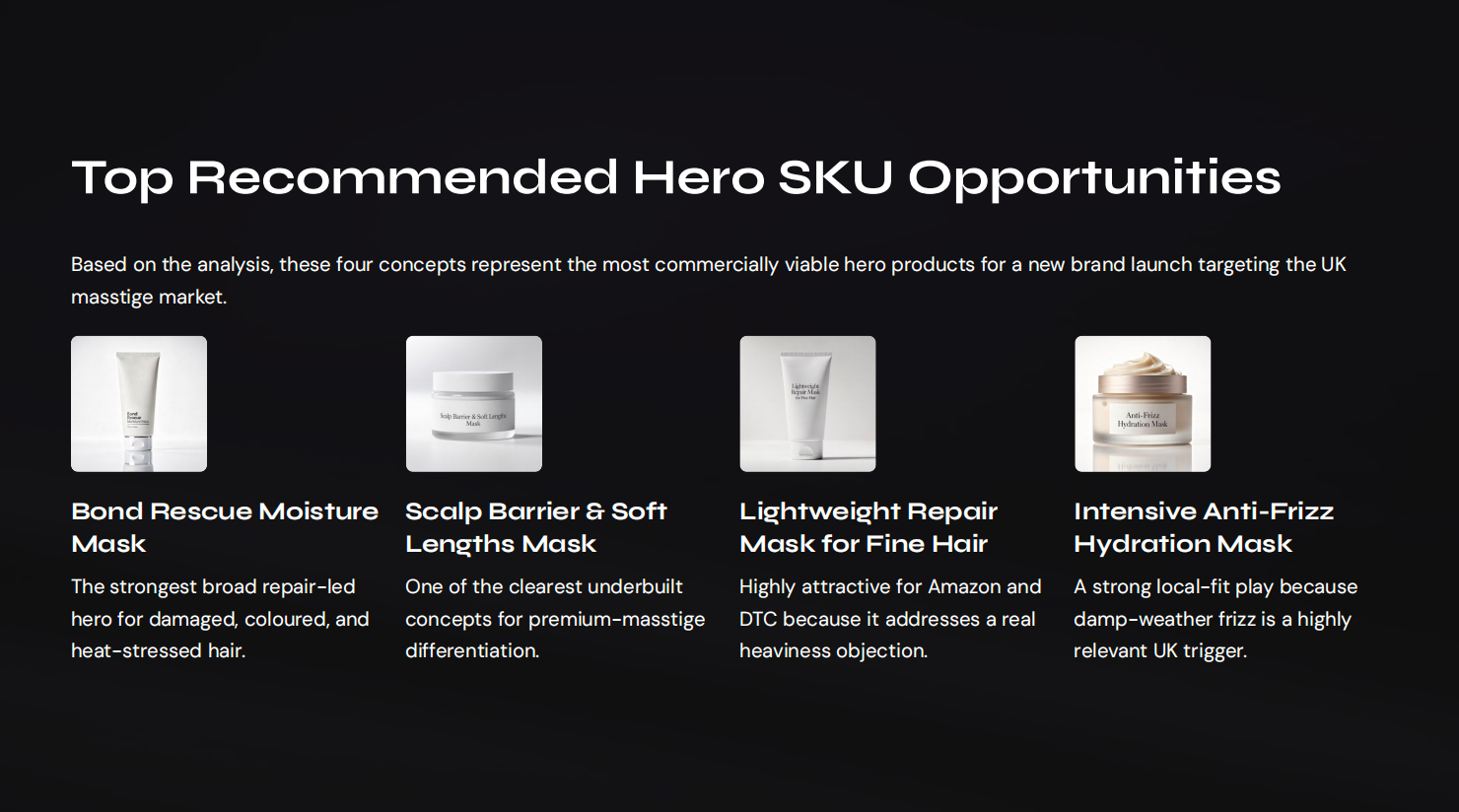
Top Recommended Hero SKU Opportunities
Claims and Compliance Priorities
In the UK market, the most sensitive area is claims discipline. Products can safely use language around conditioning, softness, smoothness, manageability, hydration, and helping reduce the look of damage, but stronger structural repair language needs much more careful support and wording.
Scalp products require additional caution. If the copy starts sounding medicinal or therapeutic, risk rises. The safest route is to stay within comfort, hydration, soothing, freshness, and scalp-support territory unless the product is developed for a different regulatory path.
For scalp-focused products, fragrance discipline matters more than in standard hair masks. Over-fragranced formulas can undermine a comfort-led positioning, especially if the product is aimed at dryness or sensitivity concerns.
Common Launch Mistakes to Avoid
The most common mistakes include:
- launching a generic nourishing mask with weak differentiation
- using repair language too aggressively without clear support
- formulating a scalp mask that feels too heavy or too fragranced
- building too many masks at once instead of focusing on one hero
- overcomplicating the benefit structure
- copying salon-science aesthetics without real formula authority
- neglecting pack compatibility and texture stability
- underestimating consumer dislike of heaviness in fine hair products
Avoiding these mistakes is often more valuable than adding more claims or trend ingredients.
OEM / ODM Launch Planning
For OEM and private label development, a clear brief saves time, cost, and revision cycles.
A stronger RFQ should define:
- target retail price
- intended channel
- hero claim
- preferred texture
- size preference
- fragrance direction
- benchmark products
- MOQ target
- launch timeline
- compliance expectations
The better these points are defined, the easier it is to recommend the right format, texture, formula direction, and packaging route.
For UK hair mask launches, the strongest development path is usually:
- concept alignment
- first lab sample
- one to two revisions
- stability and pack compatibility work
- production confirmation
- channel-specific launch readiness
A focused hero SKU almost always launches faster and cleaner than a broad collection.
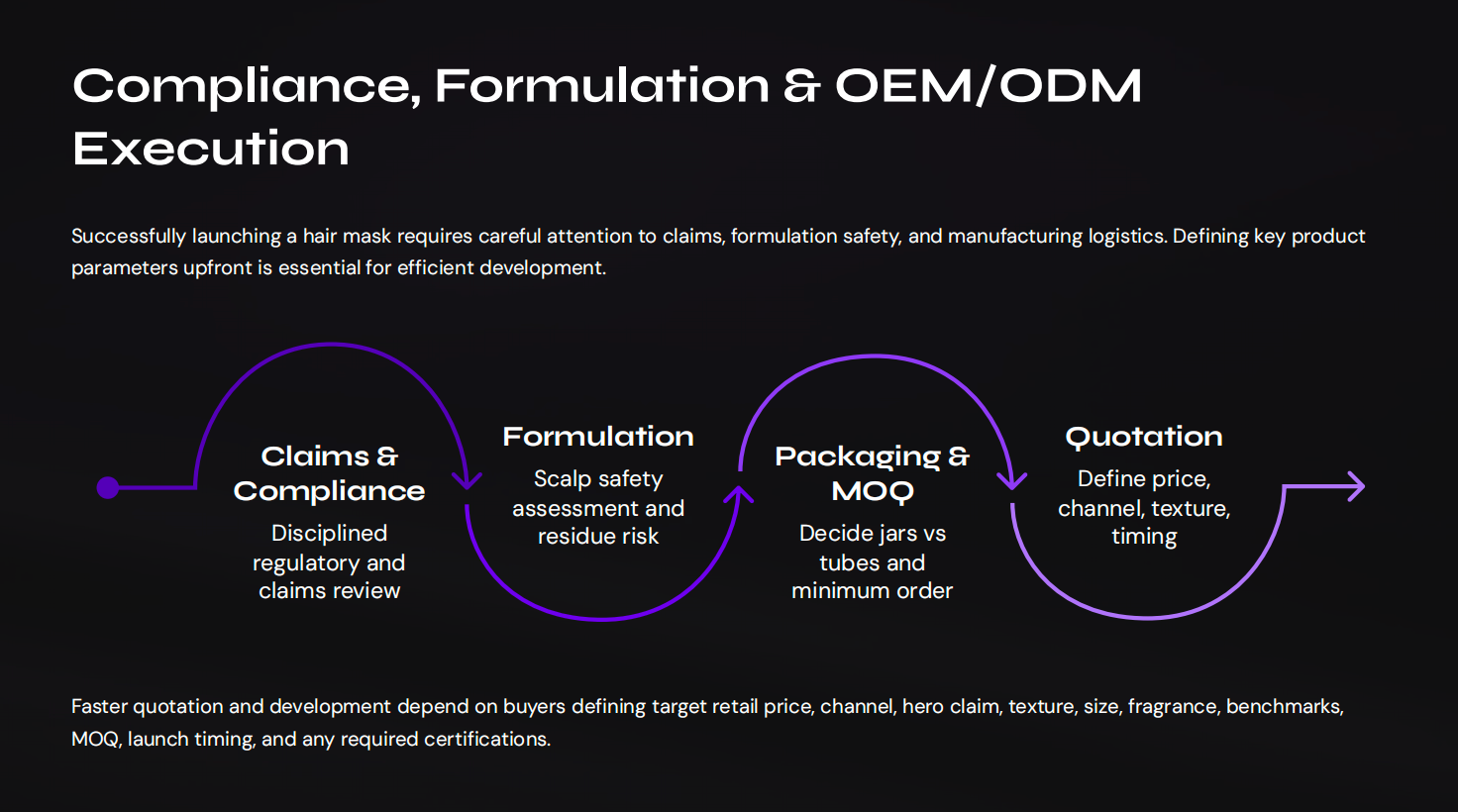
Compliance, Formulation & OEM/ODM
Execution
What Brands Should Do Next
If you are evaluating a UK hair mask launch, the smartest next step is not to ask for a generic nourishing sample.
Instead:
- choose one clear lane: repair, hydration/frizz, or scalp-plus-hair
- define the target channel first
- decide whether the hero should feel rich, lightweight, or dual-use
- set the retail band before sampling
- choose one primary claim and one supporting claim
- brief the supplier against real benchmark products
That approach leads to faster quoting, better samples, stronger packaging decisions, and a more commercially usable launch.
Final Takeaway
The UK hair mask market in 2026 is attractive because the category is becoming more treatment-led, more segmented, and more function-driven.
The products most likely to win are not the ones with the broadest “nourishing” claims. They are the ones with the clearest commercial lane, the best-matched texture, the strongest practical payoff, and the most channel-appropriate execution.
If your business is planning a repair, hydration, anti-frizz, or scalp-care hair mask launch, the strongest next step is to align your target user, channel, price band, and formula direction first, then build the right SKU path from there.
Download the Full Report (PDF)
Tell us your target region, product category, and the decision you’re trying to make. We’ll suggest the closest existing report—or build a tailored version.