


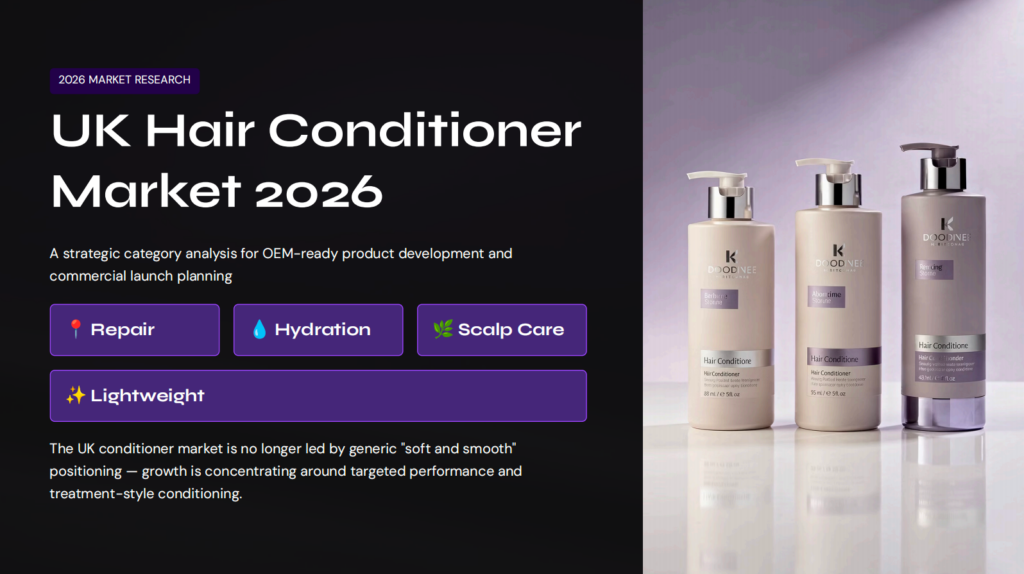
Executive Summary
This report explores the UK hair conditioner market in 2026, including repair, hydration, scalp comfort, pricing architecture, channel fit, compliance priorities, and OEM-ready launch strategy. It is designed to help brands, distributors, importers, and e-commerce sellers turn market insight into a more practical conditioner launch plan.
UK Hair Conditioner Market 2026: Repair, Hydration, Scalp Care, and OEM Launch Guide
The UK hair conditioner market in 2026 is moving beyond generic softness claims. Consumers now expect conditioners to solve clearer problems, such as visible damage, dryness, frizz, scalp discomfort, heaviness, and weak volume performance.
For brands, distributors, importers, and e-commerce sellers, this means the category is no longer best approached with one broad “all hair types” formula. The stronger opportunity lies in sharper segmentation, clearer problem-solution positioning, and a more structured product architecture that supports both retail and online conversion.
This report translates current market direction into practical launch logic. It focuses on the product territories, price ladders, channel requirements, compliance considerations, and OEM-ready opportunities that matter most for a 2026 UK hair conditioner launch.
Executive Summary
The UK hair conditioner market is increasingly defined by function-led buying. Shoppers are looking for formulas that can repair damage, restore moisture, improve manageability, support scalp comfort, or condition without leaving the hair heavy.
This creates a more polarized category. Entry-level and value-led products still play an important role in everyday family use, but premium and treatment-style conditioners are gaining strength by offering more technical narratives, better textures, more refined sensory cues, and stronger need-state positioning.
For most new entrants, the best opportunity is not one hero conditioner alone. It is a compact assortment made up of an accessible entry SKU, a stronger core repair or hydration conditioner, and at least one premium treatment-style or scalp-focused extension. That structure improves channel flexibility, strengthens average order value, and makes it easier to build a long-term haircare routine rather than a standalone product.
Market Direction in 2026
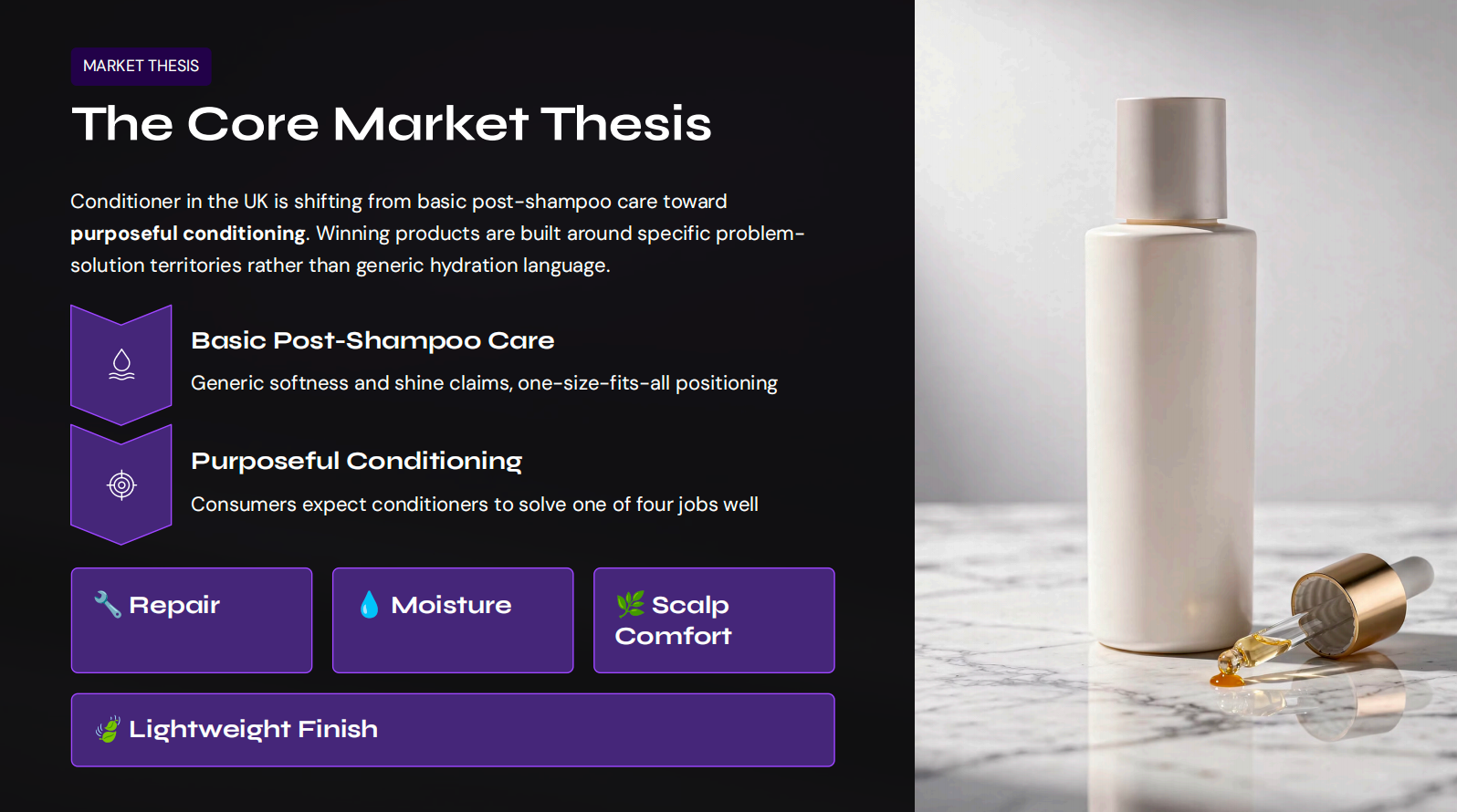
The conditioner category in the UK is shifting from basic post-shampoo care toward more purposeful conditioning. Buyers increasingly expect a conditioner to do one job particularly well.
The strongest commercial demand areas are:
- repair for damaged or stressed hair
- hydration for dry or rough lengths
- frizz smoothing and manageability
- scalp comfort and reduced discomfort
- lightweight conditioning for fine or easily weighed-down hair
- fuller-feeling or volume-support performance
This matters because generic claims such as “soft and smooth” no longer provide enough reason to switch. Consumers want more specific outcomes and more relevant targeting.
The Core Market Thesis
What Is Driving Demand
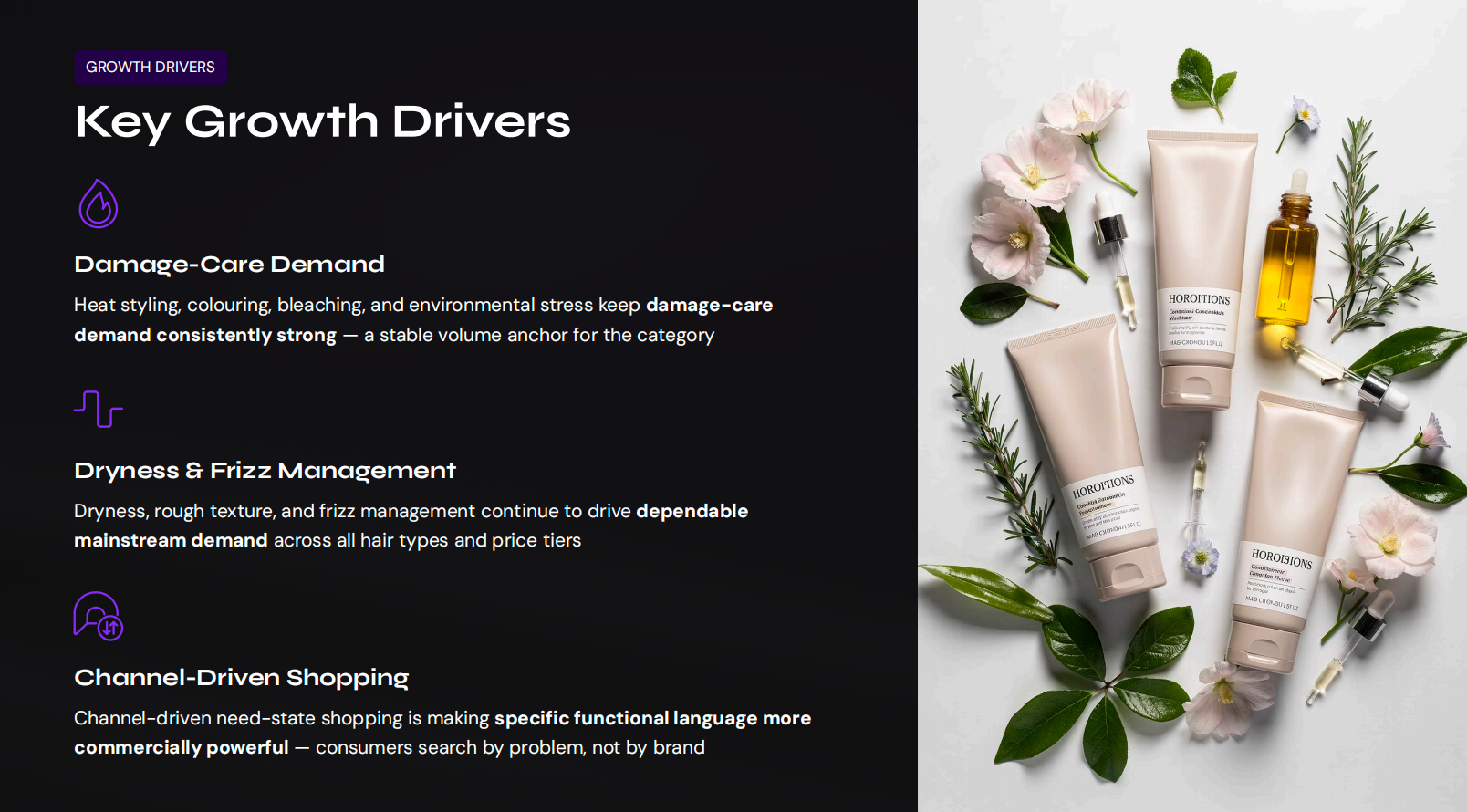
Several category shifts are creating stronger opportunities in 2026.
The first is damage-led care. Heat styling, colouring, bleaching, brushing, and environmental exposure continue to support strong demand for repair conditioners.
The second is dryness and frizz control. These remain highly dependable conversion territories because they map closely to visible and easy-to-understand consumer problems.
The third is scalp-comfort crossover. Shoppers are no longer limiting scalp concerns to shampoos or treatment products. There is increasing room for rinse-off conditioners that support both softer hair and a more comfortable scalp feel.
The fourth is premiumization through treatment logic. Consumers are more willing to trade up when the formula feels intensive, strengthening, bond-style, salon-inspired, or more technical than a basic daily conditioner.
The fifth is channel-led search behaviour. Online platforms reward clear need-state language. The more precisely a conditioner is positioned, the easier it is to match real shopper intent.
Consumer Demand and Usage Behaviour
Hair conditioner remains an everyday-wash essential for many UK consumers, but the way it is used is changing. The market now shows two overlapping habits.
The first is daily conditioning for softness, detangling, and easier management.
The second is performance conditioning for specific needs such as damage, scalp comfort, or deeper moisture.
This creates space for multiple-conditioner behaviour. Consumers are more open than before to:
- owning more than one conditioner
- rotating conditioner by need state
- pairing conditioner with a mask or scalp treatment
- using different formats for daily care and deeper treatment
For brands, this means a line with role clarity is more commercially useful than a single broad product.
Key Growth Drivers
Ingredient and Sensory Expectations
Ingredient positioning still matters, but it works best when attached to a clear need state. Claims such as vegan, cruelty-free, silicone-free, gentler, or plant-based perform better when they support a more functional message such as hydration, scalp comfort, lightweight conditioning, or reduced build-up.
Texture also matters commercially. Consumers expect different textures depending on the performance promise.
Typical expectations include:
- cream or lotion textures for daily conditioners
- richer creams for damage repair and moisture care
- lighter gel-cream or fluid cream textures for fine hair or scalp-comfort positioning
The rinse feel and after-feel are especially important. UK shoppers generally respond well to:
- easy-rinse performance
- immediate softness
- reduced roughness
- easier detangling
- low residue
- a cleaner finish
Fragrance direction should also match the product role. Daily mass products can carry more accessible clean scents, while premium products benefit from more refined salon-style fragrance. Scalp-sensitive products usually need a more restrained fragrance profile.
Category Structure and Price Architecture
The UK hair conditioner market is clearly segmented across value, mid-market, and premium tiers.
Entry-level products are usually more value-led and designed for frequent, broad family use. Mid-market products win by combining accessibility with better benefit segmentation, stronger design, and better shelf clarity. Premium products justify higher prices through more technical language, better textures, expert cues, scalp positioning, and treatment logic.
A practical market architecture often looks like this:
- entry tier for everyday softness and broad value
- core mid-tier for repair, hydration, or frizz management
- premium tier for treatment, scalp expertise, or bond-style care
For new brands, the strongest launch zone is usually not the cheapest end of the category. It is the visible-performance zone where the formula looks and feels more premium than its price point.
Where the Best Product Opportunities Are
The best product opportunities in 2026 are not the most generic ones. They are the ones that solve a clear need in a more targeted way.
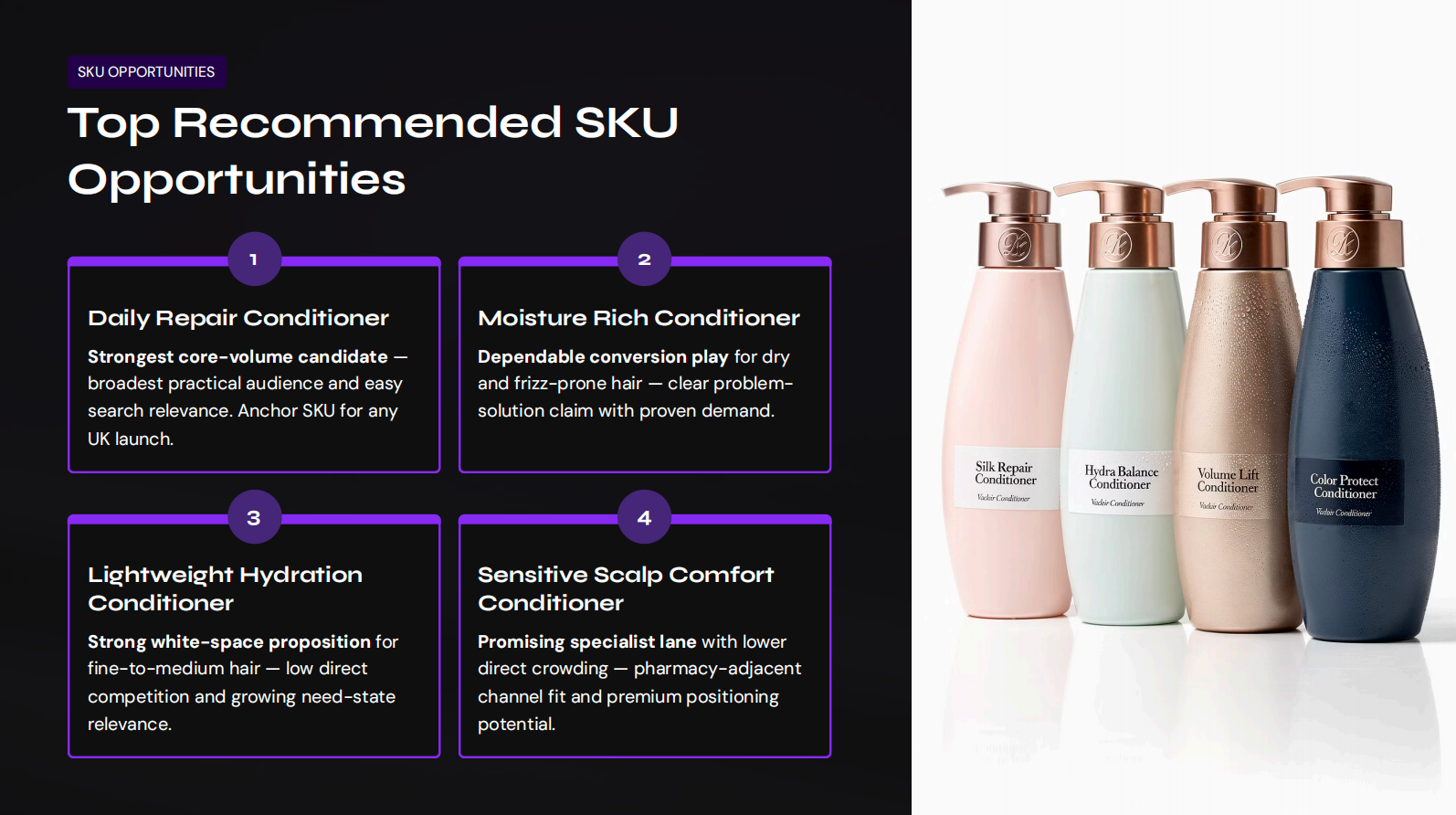
The strongest opportunities include:
- daily repair conditioners for damaged hair
- moisture-rich conditioners for dry and frizz-prone hair
- lightweight hydration conditioners for fine-to-medium hair
- sensitive scalp comfort conditioners
- volume-support conditioners for limp or flat hair
- premium bond-style or intensive repair conditioners
- treatment-style conditioner-mask hybrids
These product types are easier to search, easier to explain, and easier to place into a wider routine architecture.
Recommended SKU Strategy
A stronger launch should not begin with too many SKUs. It should start with a focused architecture.
Entry SKU
Vegan Daily Softness Conditioner
Role: accessible traffic driver, broad appeal, easier promotional participation
Core SKU
Daily Repair Conditioner
Role: main sales driver, strongest practical audience, clear search relevance
Secondary Core SKU
Moisture Rich or Lightweight Hydration Conditioner
Role: solves one of the most common demand spaces while improving assortment balance
Premium SKU
Intensive Bond-Style Repair Conditioner
Role: raises ASP, builds expertise, strengthens premium perception
Optional Extension
Sensitive Scalp Comfort Conditioner or Conditioner-Mask Hybrid
Role: need-state differentiation, higher basket value, routine expansion
This kind of good-better-best structure helps the line scale across price points and channels more efficiently.
Top Recommended SKU
Opportunities
Product Positioning by Need State
Repair
The broadest commercial anchor. Works well when positioned around visible damage, softness, smoother ends, reduced breakage feel, and easier comb-through.
Hydration
Reliable and high-frequency. Best when split into rich moisture for dry hair and lightweight moisture for fine hair.
Scalp Comfort
A more differentiated opportunity. Strong when positioned around soothing care, gentle conditioning, lower irritation cues, and a lighter scalp feel.
Volume and Lightweight Care
A useful niche with strong online relevance. The key is to condition without flattening the hair.
Premium Treatment
Best used to raise margin and brand credibility. Works especially well with bond-style, strengthening, salon-inspired, or intensive language.
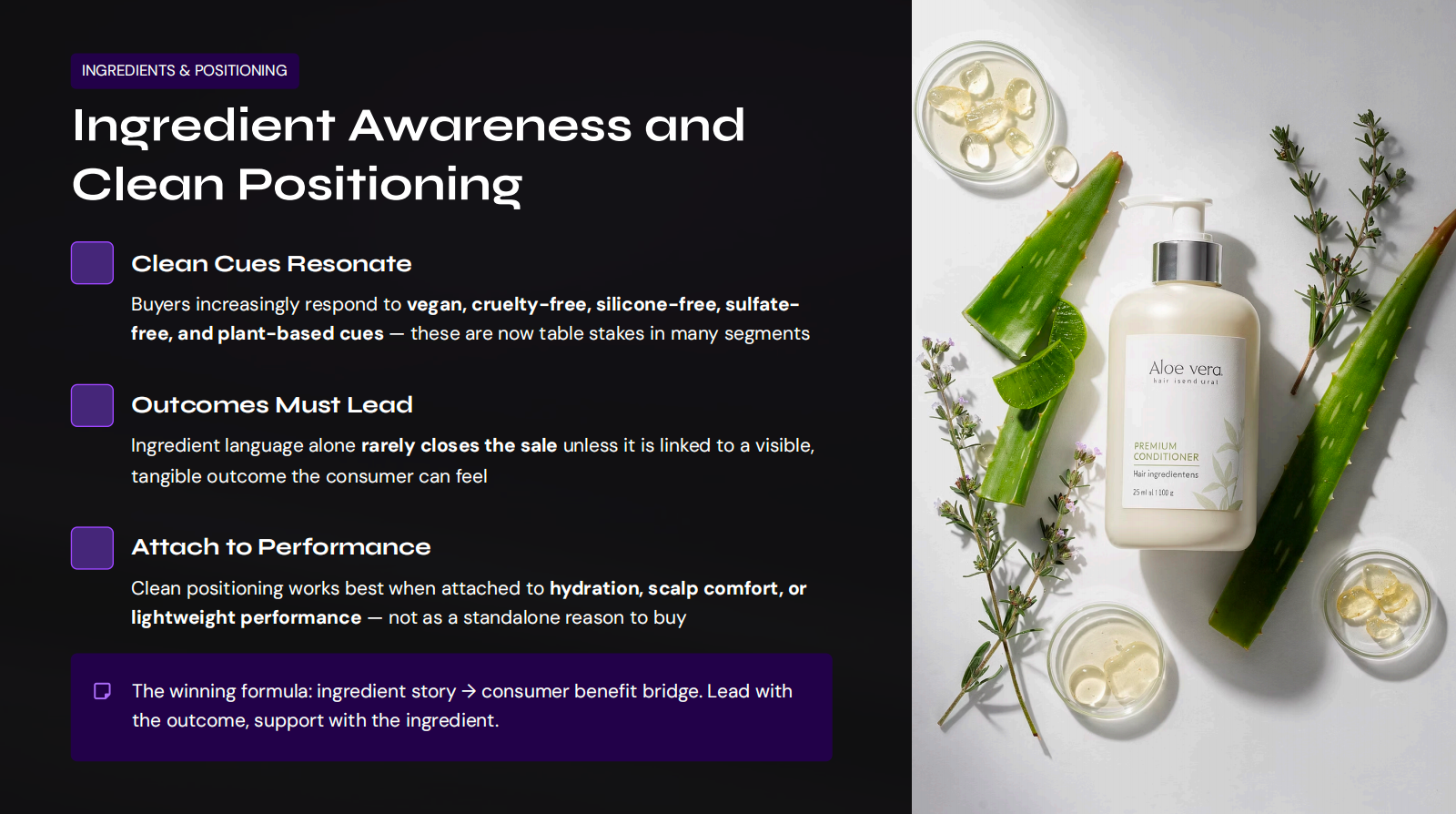
Ingredient Awareness and
Clean Positioning
Channel Strategy
Amazon
Amazon works best for repair, hydration, volume, and search-led niche products. Winning listings usually need:
- very clear benefit-led headlines
- visible need-state positioning
- clean product comparison structure
- strong bundle logic
- review-building support
Boots-Style Retail and Pharmacy-Adjacent Channels
These channels are especially suitable for:
- premium-mass conditioners
- scalp comfort products
- more specialist repair products
- cleaner or gentler formulation stories
The packaging needs to look more credible and more structured than entry-tier mass products.
DTC
Direct-to-consumer is strongest for:
- premium treatment stories
- ingredient education
- bundle selling
- routine-building
- subscription or repeat-use logic
DTC allows a brand to explain why a conditioner belongs inside a wider system rather than as a single product.
Pricing Strategy
A launch price should always leave room for promotion. In the UK, conditioner performance is closely tied to size-value perception, promo readiness, and routine compatibility.
A practical launch ladder may look like this:
- entry: accessible daily softness or vegan care
- core: repair or hydration with clearer benefit language
- premium: treatment, bond-style repair, or scalp expertise
What matters is not just RRP. What matters is whether:
- the formula justifies the pack and claims
- the pack looks competitive at its price point
- the brand can survive promotion pressure
- the portfolio has enough price separation between levels
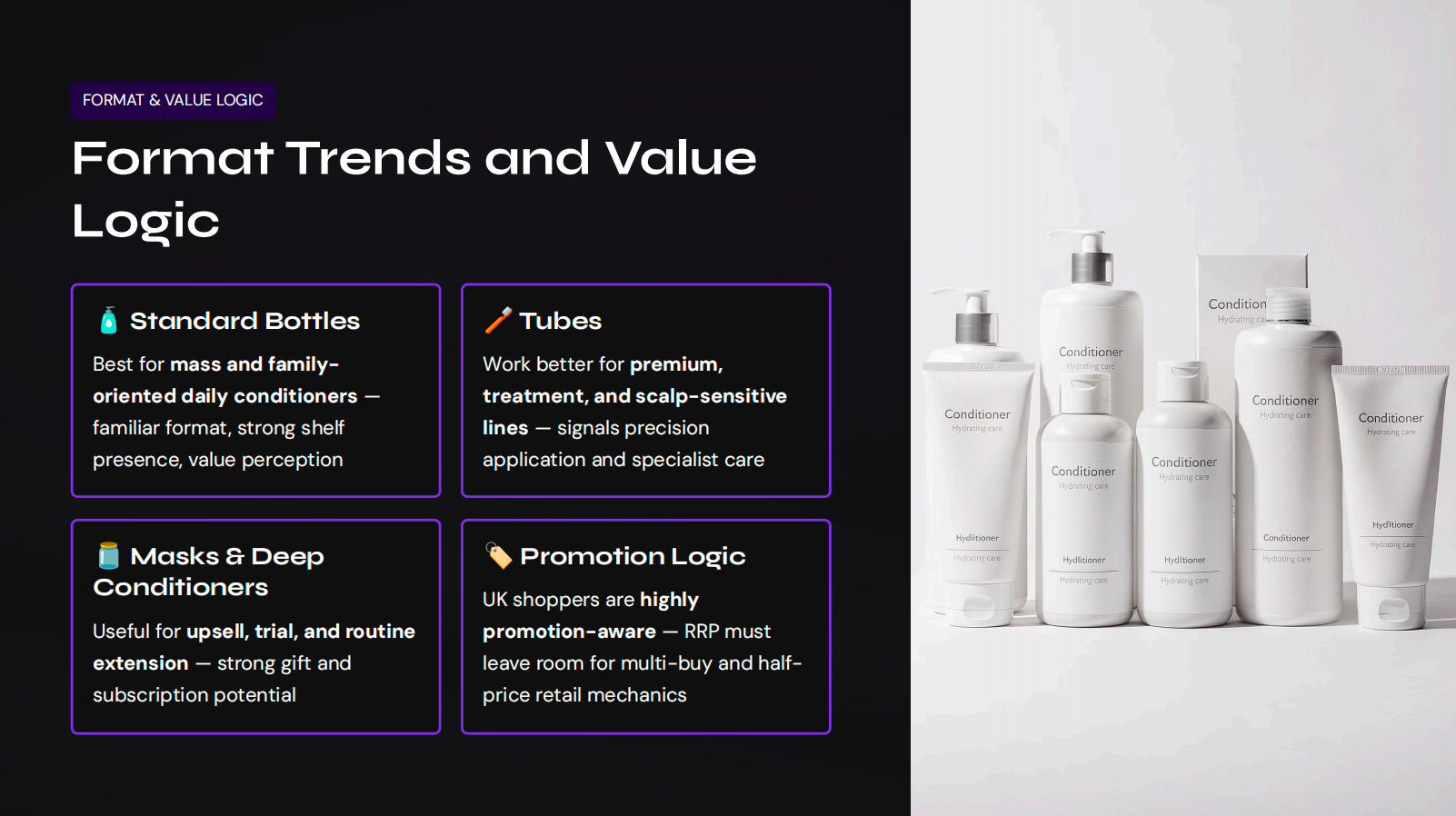
Format Trends and Value
Logic
Claims and Messaging Strategy
The strongest claims are clear, cosmetic, and outcome-focused.
Good examples include:
- repairing conditioner for damaged hair
- helps reduce the look of damage
- smooths rough, dry lengths
- lightweight hydration without heaviness
- conditions while helping scalp feel more comfortable
- leaves hair soft, manageable, and easy to detangle
- salon-inspired intensive care
What should be avoided:
- medicinal or therapeutic language
- hair growth claims without strong support
- claims implying treatment of scalp conditions
- fear-based “free from” messaging
- exaggerated absolutes such as complete repair or guaranteed results
Clear cosmetic claims are easier to defend and easier to execute across UK retail and e-commerce channels.
Compliance Considerations for the UK Market
Conditioner launches for the UK market should be planned with compliance in mind from the beginning.
Key priorities include:
- clear product function on label
- accurate INCI list
- correct Responsible Person details
- batch traceability
- durability or PAO information where required
- appropriate precautions
- compliant claims wording
- GB notification workflow before sale where applicable
It is also important to avoid treating UK and EU execution as identical in practice. Brands planning multi-market rollout should align documentation market by market rather than assuming one process covers all cases.
OEM and ODM Launch Framework
The most effective OEM projects start with a more detailed brief.
Buyers should prepare:
- target market
- target channel
- target retail price
- target ex-factory range
- main need-state positioning
- preferred pack type and size
- claims priorities
- timing expectations
- compliance needs
- benchmark products if available
A capable OEM partner should then deliver:
- formula options matched to target price and claim territory
- multiple sample directions if needed
- packaging recommendations
- testing plan
- documentation support
- claims guidance
- production planning visibility
The faster route to market usually comes from adapting or refining a strong existing base rather than developing everything from zero.
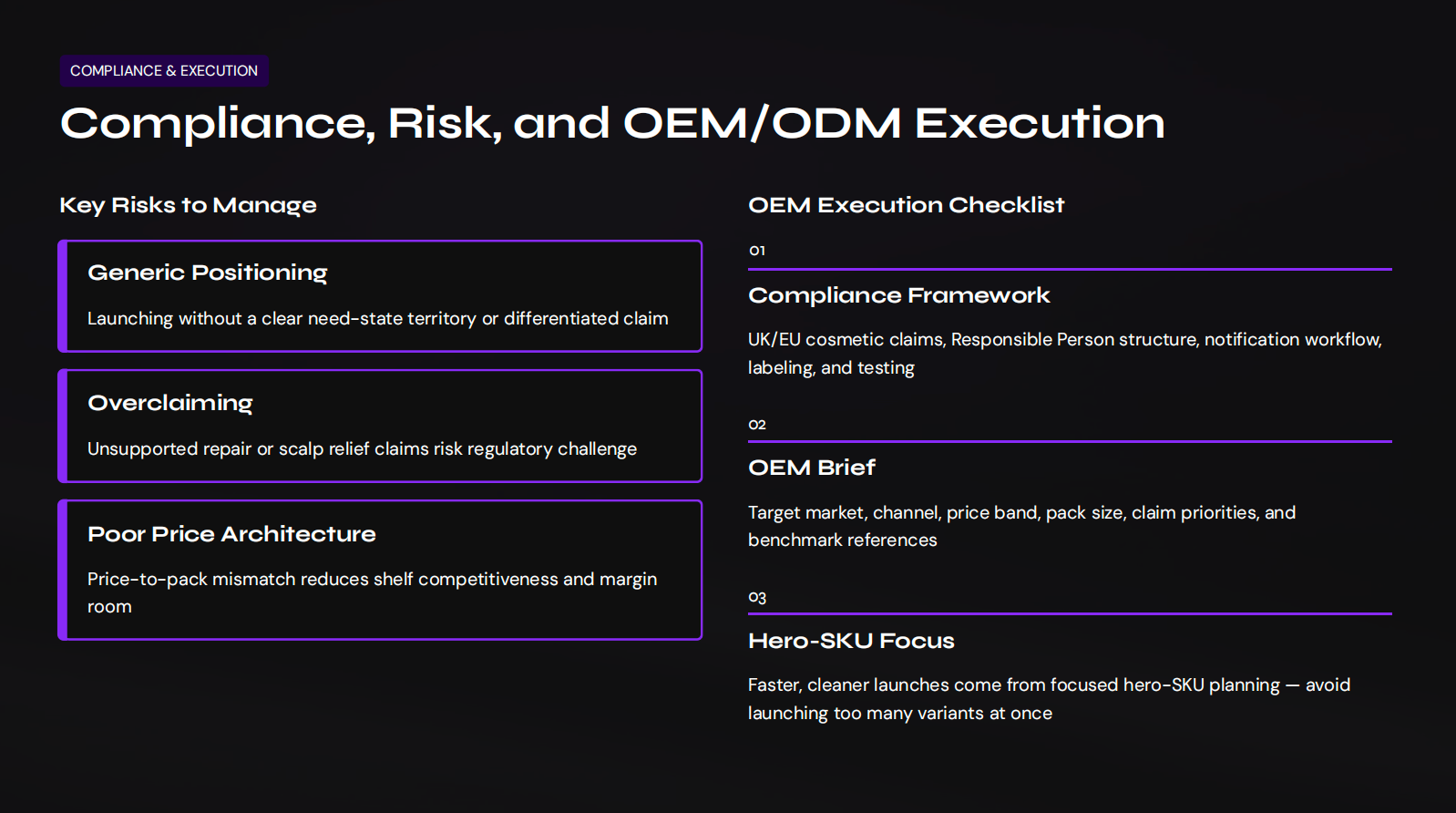
Compliance, Risk, and OEM/ODM Execution
What Brands Should Do Next
If you are planning a UK hair conditioner launch, the strongest next step is not to begin with one broad everyday formula.
A better approach is to:
- choose one core demand territory
- define one target hair type
- set a channel-specific price ladder
- create a focused launch architecture
- separate daily, premium, and scalp-sensitive bases where needed
- align packaging, compliance, and claims before final artwork
This reduces wasted sampling, improves positioning clarity, and gives the range a much better chance of commercial success.
Final Takeaway
The UK hair conditioner market in 2026 is becoming more targeted, more treatment-led, and more segmented by real need states. Repair, hydration, scalp comfort, lightweight care, and premium treatment logic are shaping the strongest product opportunities.
The brands most likely to win are not the ones launching the broadest conditioner. They are the ones building the clearest system: a specific need-state, the right texture and pack, a promotion-ready price ladder, and a structured SKU architecture that works across Amazon, retail, and DTC.
If your team is evaluating a UK hair conditioner launch, the smartest next step is to align problem-solution territory, format, price tier, and OEM path first, then move into development with a much clearer brief.
Download the Full Report (PDF)
Tell us your target region, product category, and the decision you’re trying to make. We’ll suggest the closest existing report—or build a tailored version.