


Executive Summary
This report explores the Russia scalp care market in 2026, including consumer scalp concerns, product opportunities, pricing logic, formulation direction, channel fit, compliance priorities, and OEM launch strategy. It is designed to help brands, importers, distributors, and e-commerce sellers turn market insight into a more practical scalp care launch plan.
Russia Scalp Care Market 2026: Trends, Product Opportunities, and OEM Launch Strategy
The Russia scalp care market in 2026 remains commercially attractive because it sits inside a large, replenishment-driven hair care category where shampoo still dominates consumer routines and problem-solution products continue to convert well.
For brands, importers, distributors, and e-commerce sellers, scalp care is not primarily a luxury niche. It is a functional, repeat-purchase market shaped by visible consumer concerns such as dandruff, dryness, sensitivity, scalp discomfort, and hair thinning-related anxiety.
This report translates market demand into practical product strategy. It covers consumer concerns, pricing logic, format preferences, formulation direction, competitive whitespace, channel fit, compliance considerations, and OEM launch planning for brands preparing to enter or expand in Russia scalp care.
Executive Summary
Russia remains a practical and scalable scalp care opportunity in 2026. The category is not driven by novelty alone, but by frequent-use needs linked to visible scalp problems and routine cleansing behavior.
The most important demand drivers are straightforward. Consumers want visible reduction in flakes, relief from itch and discomfort, daily-use formulas that do not feel too harsh, and clear product messaging that solves a familiar problem. This makes scalp care especially effective when built around shampoo and supported by easy-to-use leave-in formats such as serums or tonics.
The best commercial opportunities are concentrated in three areas: anti-dandruff shampoo, sensitive scalp or soothing daily shampoo, and higher-margin scalp serum or tonic formats designed for scalp comfort, oil balance, or scalp strengthening. Products with microbiome-friendly or scalp barrier support positioning can work well as expansion SKUs, especially in mass-premium and pharmacy-adjacent segments.
For most new entrants, the strongest launch route is a focused portfolio rather than a large routine. One hero anti-dandruff shampoo, one gentle or sensitive-scalp shampoo, and one leave-in scalp serum or tonic provide a strong balance between traffic, repeat purchase, and margin.
Market Opportunity Overview
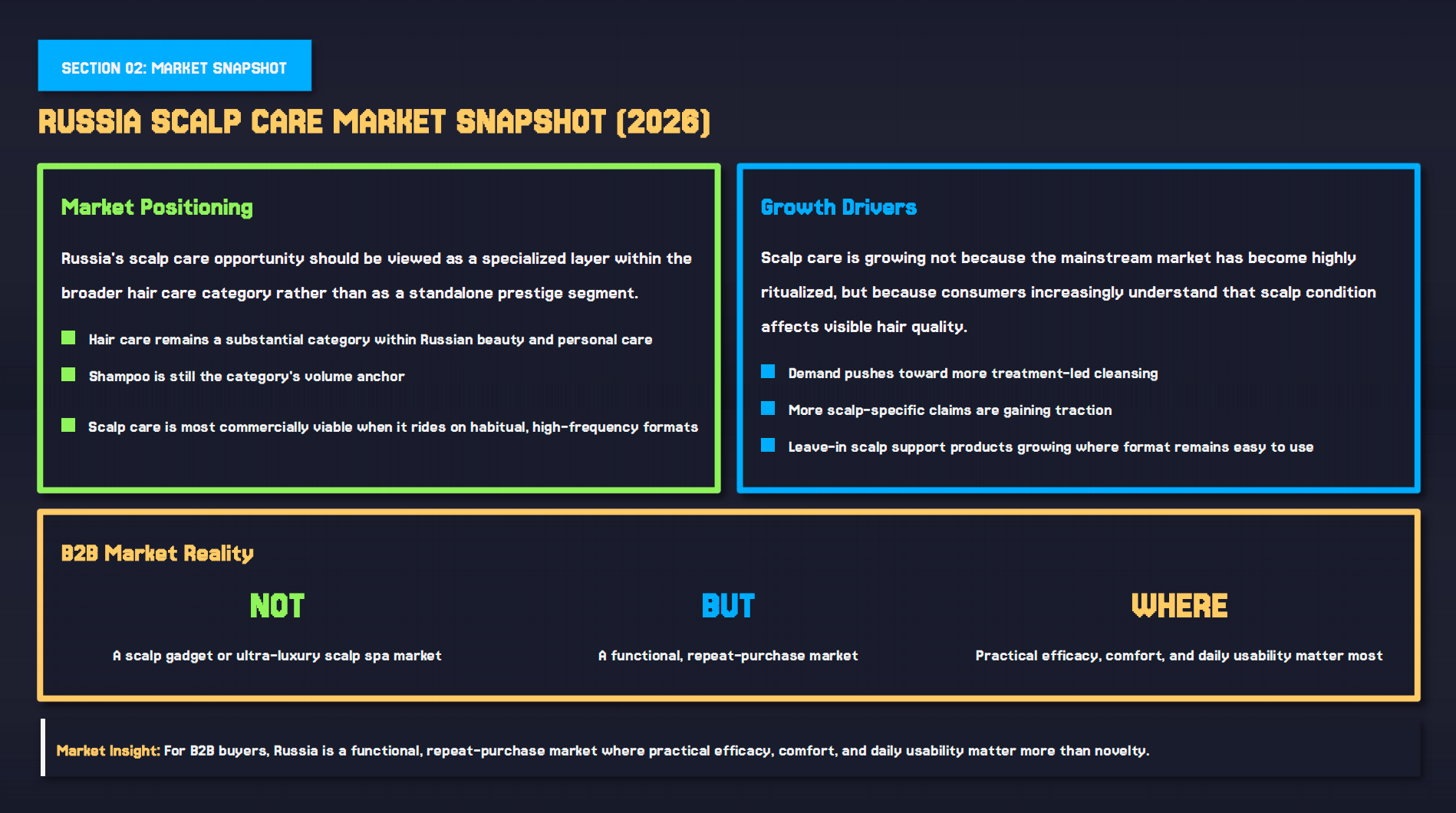
The Russia scalp care opportunity should be understood as a specialized layer within the broader hair care category rather than as a standalone prestige market.
This matters because shampoo remains the dominant format in Russian hair care. Consumers are far more likely to adopt scalp care when it fits into familiar wash routines than when it demands a highly ritualized or time-intensive regimen. That makes scalp care most commercially viable when it is anchored in cleansing, scalp comfort, and visible everyday performance.
In practical terms, the market is supported by recurring environmental and behavioral triggers. Dry indoor heating, long winters, hat use, scalp dryness, itch, flaking, and oil imbalance all reinforce the need for products that offer comfort and visible scalp improvement.
For B2B buyers, this means Russia scalp care is best approached as an efficacy-led, replenishment-based category with strong repeat-use potential rather than as a niche trend market.
RUSSIA SCALP CARE MARKET SNAPSHOT (2026)
Consumer Demand and Scalp Concerns
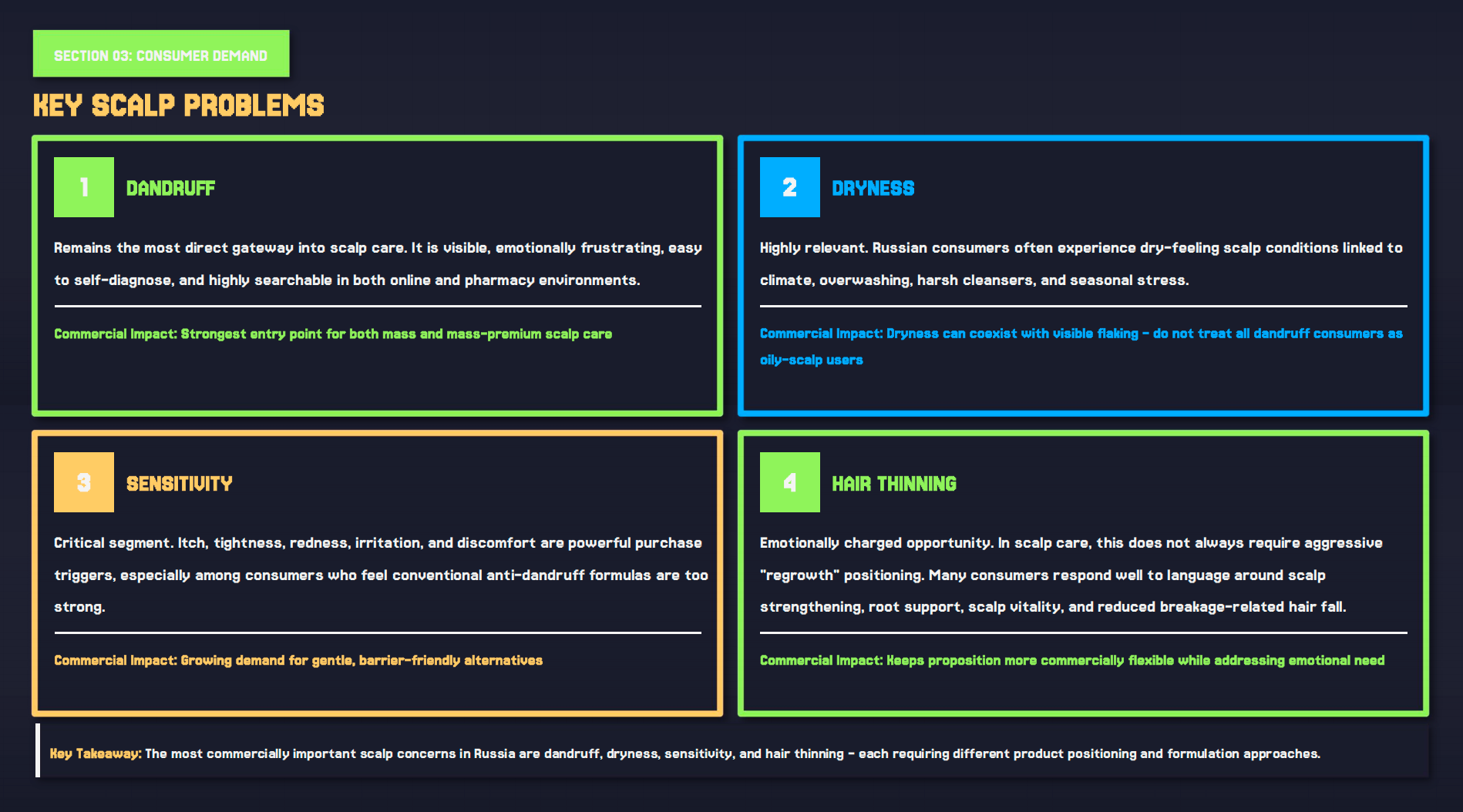
The most commercially important scalp concerns in Russia are dandruff, dryness, sensitivity, and hair thinning-related anxiety.
Dandruff remains the strongest entry point. It is visible, emotionally frustrating, easy for consumers to identify, and highly compatible with problem-solution shopping behavior in both e-commerce and pharmacy-adjacent channels.
Dryness is also highly relevant, especially in a market where climate conditions and indoor heating can intensify scalp discomfort. Importantly, dryness and flaking often overlap, which means not all anti-dandruff consumers should be treated as oily-scalp users.
Sensitivity is another key driver. Itch, tightness, discomfort, and irritation create strong purchase intent, especially among consumers who feel traditional anti-dandruff shampoos are too harsh.
Hair thinning and weak-root concerns create an additional opportunity. Brands do not need to over-medicalize this segment. Positioning around scalp vitality, scalp strengthening, stronger-feeling roots, and reduced hair fall due to breakage is often more scalable and commercially flexible.
KEY SCALP PROBLEMS
What Russian Consumers Actually Want
Russian scalp care consumers generally prefer simple, easy-to-understand problem-solution products rather than complicated routines.
The most effective product characteristics are:
- visible flake reduction
- quick relief from itch or discomfort
- a clean but non-stripped scalp feel
- formulas that feel gentle enough for repeat use
- simple, trustworthy benefit communication
This is why multifunctional concepts have strong commercial potential. Instead of building highly technical multi-step systems from day one, brands can win more easily with combinations such as:
- anti-dandruff plus soothing
- sensitive scalp plus hydration
- scalp strengthening plus anti-hair fall support
- purifying plus comfort
- daily scalp balance plus soft hair finish
The strongest launches are the ones that translate ingredient systems into clear consumer outcomes.
Category Structure and Pricing Logic
Russia scalp care works best when structured across three practical tiers: mass, mass-premium, and premium.
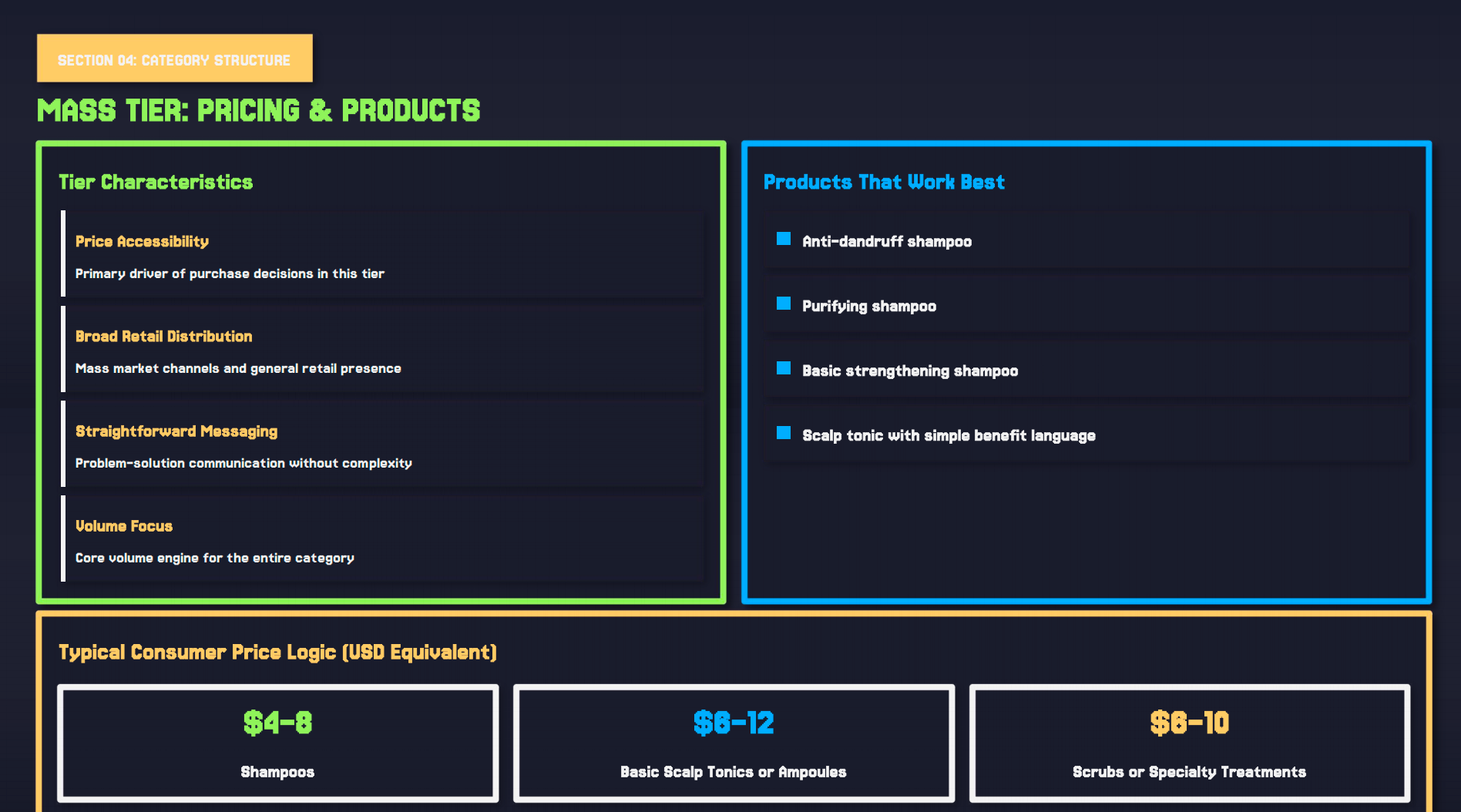
Mass
Mass remains the core volume engine. This tier is driven by accessibility, straightforward benefit language, and broad distribution. It works best for anti-dandruff shampoo, purifying shampoo, basic strengthening shampoo, and simple scalp tonics.
Mass-Premium
This is the most attractive entry zone for many new brands. Consumers in this tier are more willing to pay for better efficacy cues, dermatological language, improved sensory experience, and more modern ingredient narratives.
Mass-premium is especially suitable for:
- gentle anti-dandruff shampoo
- sensitive scalp shampoo
- scalp serum or tonic
- exfoliating scalp care
- barrier-support scalp formats
Premium
Premium exists, but it is more selective and needs stronger justification. It works best when the product delivers clear dermatological credibility, visible treatment value, premium packaging, or stronger scalp barrier and hair-thinning support logic.
For most new entrants, mass-premium offers the best balance between pricing flexibility, trust positioning, and commercial scalability.
Format Strategy and Pack Logic
The strongest format hierarchy in Russia scalp care is clear:
- Shampoo
- Serum / tonic / essence
- Treatment shampoo or scalp mask
- Scrub / exfoliator
- Oil
Shampoo leads because it matches existing consumer behavior and drives repeat purchase. Serum and tonic formats are strategically important because they increase perceived treatment value and improve margin. Scrubs and oils are better as expansion products rather than initial hero SKUs.
A practical launch pack logic includes:
- 200–250 ml shampoo for entry, trial, and premium cues
- 300–400 ml shampoo for value and repeat purchase
- 50–100 ml serum or tonic for focused treatment positioning
- 100–150 ml scrub for weekly scalp reset concepts
- 30–50 ml oil for premium pre-wash or dry-scalp support
If the goal is scale, shampoo should anchor the line. If the goal is margin expansion, serum should be the second strategic SKU.
MASS TIER: PRICING & PRODUCTS
Competitive Landscape and Whitespace
The visible competition in Russia scalp care is concentrated around anti-dandruff shampoos, pharmacy-adjacent dermo products, mass problem-solution shampoos, and online treatment products.
Most leading products emphasize:
- anti-dandruff performance
- itch relief
- sensitive scalp suitability
- cleansing without excessive dryness
- practical dermatological trust
- oily-versus-dry scalp differentiation
- scalp comfort and barrier support
Packaging that converts best tends to be functional and trust-led rather than decorative. Clean medical-style codes, practical bottles, controlled color use, and strong front-panel claims work well in this category.
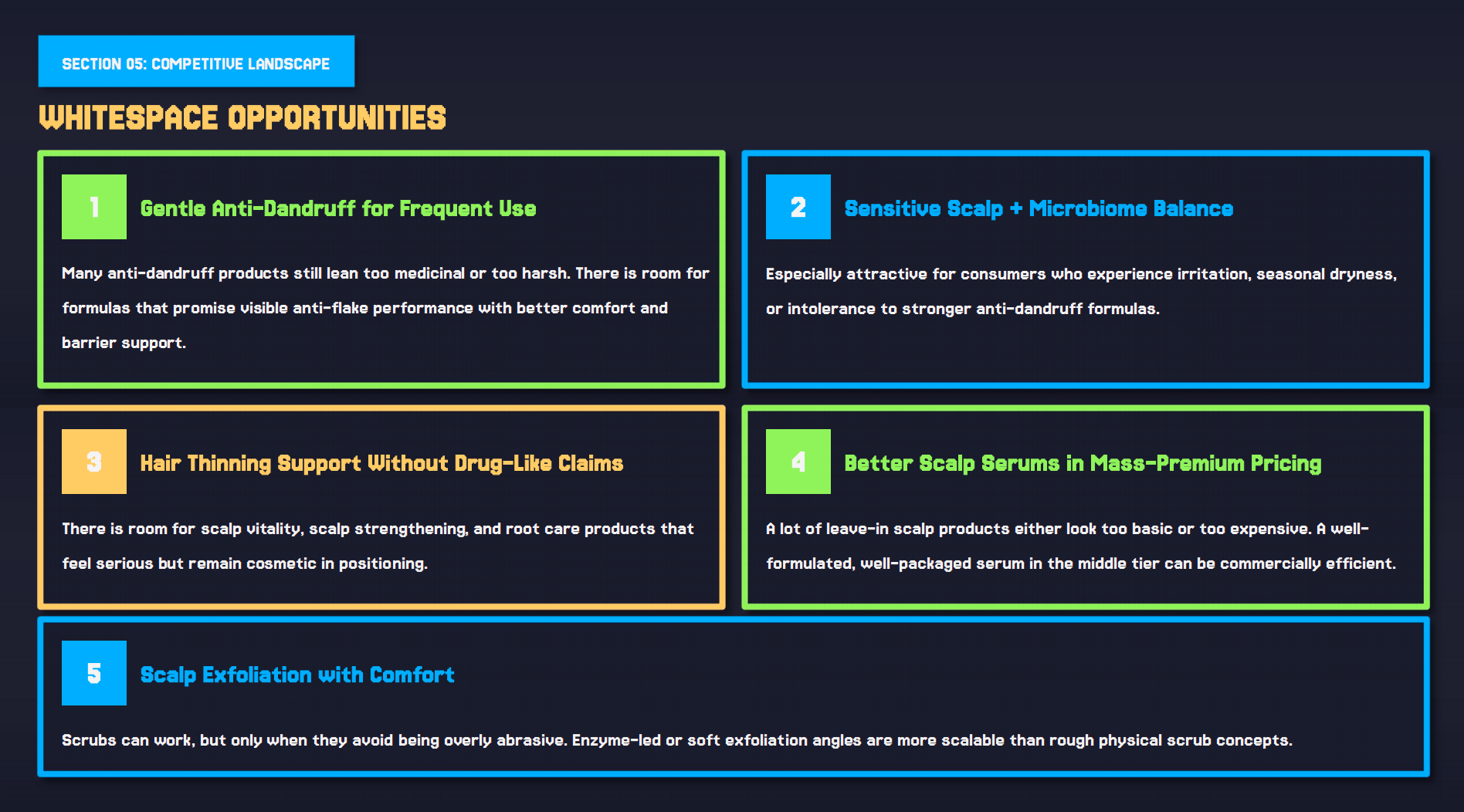
The most attractive whitespace areas include:
- gentle anti-dandruff for frequent use
- sensitive scalp plus microbiome balance
- scalp strengthening without medical hair-growth claims
- better mass-premium scalp serums
- exfoliating scalp care with comfort rather than harsh abrasion
These are commercially stronger spaces than overly niche or ritual-heavy scalp concepts.
WHITESPACE OPPORTUNITIES
Formulation and Ingredient Direction
Formula logic matters more than buzzwords in Russia scalp care.
For anti-dandruff products, the market expects visible flake control, itch relief, and better scalp normalization. The strongest commercial route is not necessarily the strongest-feeling formula, but the formula that balances efficacy with comfort and repeat-use acceptability.
For sensitive scalp and dryness, soothing and barrier-support systems are increasingly important. This allows brands to move beyond simple treatment language and position products around ongoing scalp wellness, daily comfort, and scalp resilience.
The strongest formulation directions include:
- anti-dandruff plus soothing
- barrier-support daily shampoos
- non-sticky scalp serums or tonics
- lightweight hydration for scalp comfort
- microbiome-friendly support used as a secondary value layer, not the only selling point
- gentle exfoliation rather than rough physical scrubs
In sensory terms, shampoos should foam well and rinse clean without leaving hair heavy. Serums and tonics should be lightweight, fast-absorbing, and non-greasy. Scrubs should exfoliate without feeling abrasive. Oils are better positioned as pre-wash care rather than daily leave-in treatment.
Recommended Product Launch Architecture
The best Russia scalp care launch portfolio is focused, practical, and commercially disciplined.
A strong starter architecture includes:
1. Anti-Dandruff Daily Balance Shampoo
A hero shampoo designed for visible flake control and scalp comfort, positioned for normal to oily scalp and suitable for frequent use.
2. Anti-Dandruff Comfort Shampoo for Dry or Sensitive Scalp
A gentler anti-flake option designed for users who want dandruff relief without the harsh feel of traditional medicated-style products.
3. Sensitive Scalp Soothing Shampoo
A barrier-friendly daily shampoo targeting itch, tightness, and scalp discomfort.
4. Scalp Strengthening Serum
A leave-in serum or tonic designed around scalp vitality, stronger-feeling roots, and a more premium treatment image.
5. Purifying Scalp Tonic
A lightweight leave-in solution for oily roots, freshness, and scalp reset.
6. Microbiome or Barrier Scalp Essence
A premium-support product positioned around scalp balance and comfort.
7. Gentle Scalp Exfoliating Scrub
A weekly-use product for buildup removal and scalp refresh.
8. Pre-Wash Scalp Oil for Dry or Tight Scalp
A more niche but higher-margin treatment for dry scalp comfort and weekly routine building.
For most new entrants, the smartest first phase is not all eight SKUs. It is three to five SKUs:
- one hero anti-dandruff shampoo
- one sensitive scalp or soothing shampoo
- one scalp serum
- optionally one tonic
- optionally one exfoliating support SKU
That is a much stronger commercial entry structure than launching a broad but unproven line.
Best Launch Logic by Buyer Type
For Brand Owners and Founders
Start with two shampoos and one serum. Keep the line focused and let the hero SKU prove demand before expanding.
For Importers and Distributors
Lead with anti-dandruff and sensitive scalp shampoos first, then add one premium scalp serum for margin and assortment upgrade.
For Amazon and E-commerce Sellers
Prioritize high-conversion, problem-solution products with visually simple claims and easy-to-understand benefits.
For Sourcing and Product Teams
Build the line around compatible surfactant logic, shared packaging components, and controlled fragrance direction to improve MOQ efficiency.
Go-to-Market Strategy
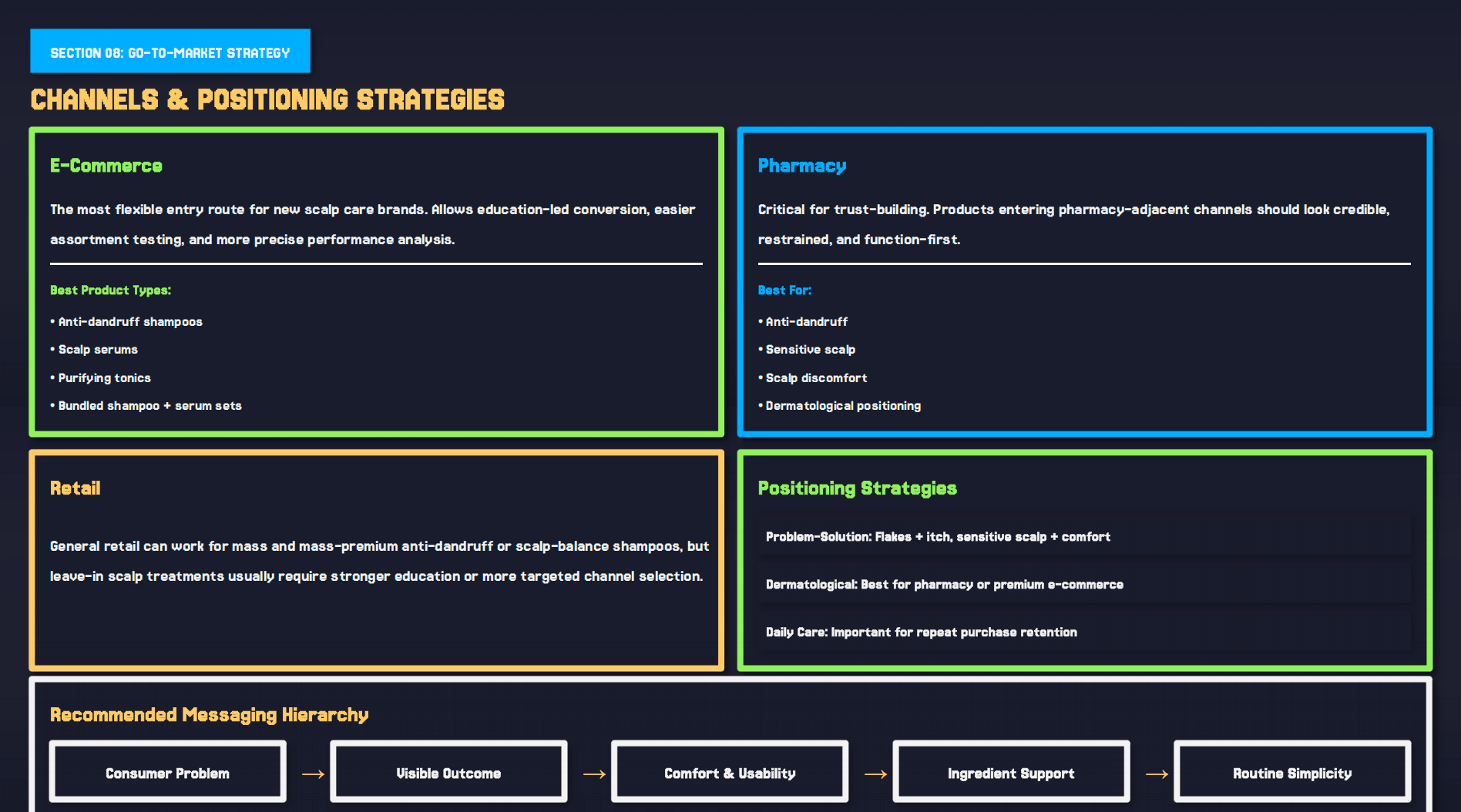
E-Commerce
E-commerce is the most flexible route for new scalp care brands because it supports education-led conversion, assortment testing, and clearer performance measurement.
Best e-commerce product types include:
- anti-dandruff shampoos
- scalp serums
- purifying tonics
- shampoo plus serum bundles
Pharmacy
Pharmacy-adjacent channels are especially important for trust-building around anti-dandruff, sensitive scalp, scalp discomfort, and dermocosmetic positioning.
Retail
General retail can work well for mass and mass-premium shampoos, but leave-in scalp treatments often require stronger education and more selective channel planning.
Positioning Strategy
The strongest entry route remains problem-solution positioning. In this market, the most effective messaging order is:
- consumer problem
- visible outcome
- comfort and usability
- ingredient support
- routine simplicity
That order usually converts better than leading with ingredient complexity.
CHANNELS & POSITIONING STRATEGIES
Compliance and Product Development Priorities
Scalp care products need disciplined claims handling because they can easily move too close to therapeutic or medical language.
Higher-risk wording includes:
- treats hair loss
- stimulates hair growth
- cures seborrhea
- medical treatment claims
- exaggerated microbiome claims without support
Safer cosmetic language includes:
- helps reduce visible flakes
- helps soothe scalp discomfort
- supports scalp balance
- helps reduce hair fall due to breakage
- helps maintain a healthy-feeling scalp
- suitable for sensitive scalp
- daily-use scalp care
Product development should also account for:
- active compatibility with cleansing systems
- preservative robustness in leave-in watery products
- viscosity stability
- fragrance suitability for sensitive-scalp claims
- packaging compatibility for active systems
- pump and nozzle functionality
- cold-weather transport and storage resilience
In this category, stable performance and claim discipline are just as important as a strong ingredient story.
OEM and ODM Execution Strategy
A strong Russia scalp care OEM project should be commercially disciplined from the start.
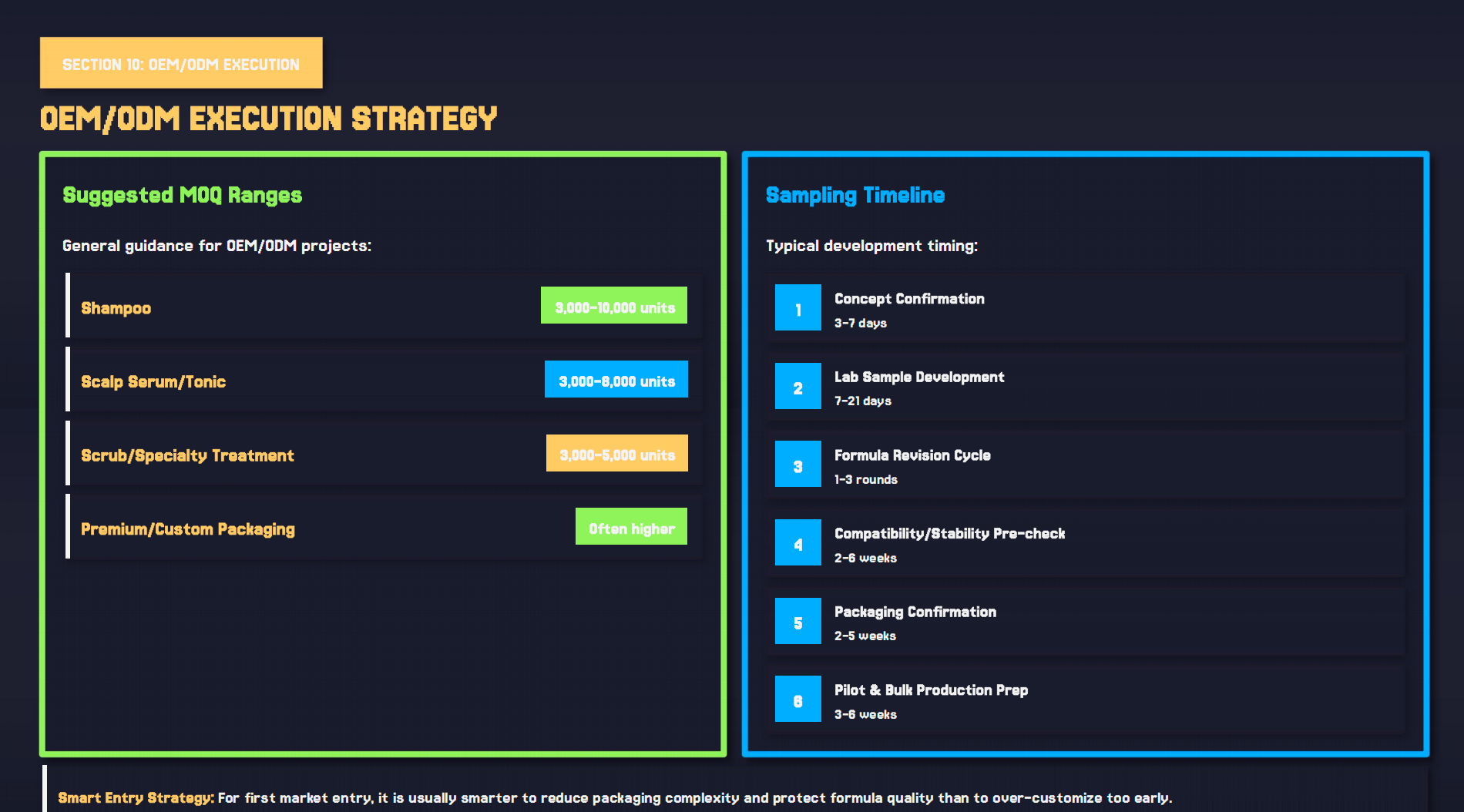
For first entry, it is usually better to control packaging complexity and protect formula quality than to over-customize too early.
A practical development workflow includes:
- defining the primary scalp problem
- setting the target consumer, channel, and price tier
- choosing the strength-versus-gentleness balance
- developing two or three formula routes where needed
- validating stability and packaging compatibility
- aligning artwork with trust cues and local compliance needs
- preparing a clean pilot and launch timeline
A stronger RFQ should define:
- target market
- product type
- scalp problem to solve
- target price tier
- target channel
- formula direction
- key actives
- sensory target
- packaging format
- claims boundary
- timeline
- MOQ and forecast
The better the brief, the faster the sampling process and the more commercially useful the final formula.
OEM/ODM EXECUTION STRATEGY
What Brands Should Do Next
If you are planning a Russia scalp care launch, the smartest next step is not to build a broad routine from the start.
Instead:
- define the first scalp problem to solve
- choose one hero shampoo
- add one leave-in treatment for value and margin
- align the right price tier before development
- keep packaging clinically credible and easy to read
- prepare compliance language early
- build a bundle path for shampoo plus serum or tonic
That structure improves conversion, supports repeat purchase, and makes expansion easier once the hero products are validated.
Final Takeaway
Russia scalp care in 2026 works best when treated as an efficacy-led extension of mainstream hair care rather than a luxury niche.
The strongest opportunities are:
- anti-dandruff shampoos with better comfort
- sensitive scalp and dry-scalp solutions
- simple leave-in scalp serums with strong functional messaging
- mass-premium positioning with pharmacy-style trust codes
- daily-use formulas that balance efficacy and gentleness
The most common mistakes are:
- launching overly complex routines
- using claims that sound medicinal
- pricing too high without visible added value
- relying on harsh formulas
- launching too many specialist formats before proving hero SKUs
For most brands, the best entry strategy is a focused three-to-five SKU architecture led by one strong anti-dandruff shampoo, one gentle soothing shampoo, and one leave-in scalp serum or tonic. That structure provides the right mix of traffic, repeat purchase, and margin expansion.
Download the Full Report (PDF)
Tell us your target region, product category, and the decision you’re trying to make. We’ll suggest the closest existing report—or build a tailored version.