



Executive Summary
This report explores the Russia hair shampoo market in 2026, including consumer trends, functional demand, SKU opportunities, pricing logic, marketplace fit, compliance priorities, and OEM launch planning. It is designed to help brands, importers, distributors, and private label buyers turn market insight into a more practical shampoo launch strategy.
Russia Hair Shampoo Market 2026: Consumer Trends, Product Opportunities, and Channel Strategy
The Russia hair shampoo market in 2026 remains commercially attractive because shampoo continues to be the largest and most practical entry category within hair care. This is not a trend-only market driven by novelty. It is a scale category shaped by daily use, repeat purchase, climate-related needs, and strong marketplace behavior.
For brands, importers, distributors, and private label buyers, the opportunity lies less in ultra-premium niche positioning and more in building commercially clear, problem-solving shampoo lines that fit how Russian consumers actually shop. Repair, anti-dandruff, scalp balance, anti-hair loss, and moisture-focused care all show stronger market logic than abstract concept-driven launches.
This report translates market signals into launch strategy. It covers consumer behavior, function-led demand, pricing structure, SKU opportunities, marketplace fit, compliance priorities, and OEM execution logic for shampoo brands entering or expanding in Russia.
Executive Summary
Russia remains one of the more practical hair care opportunities in 2026 because shampoo is still a high-frequency, replenishment-driven category. The market rewards products that solve visible hair and scalp problems in a simple, understandable way.
Consumers are not looking only for luxury or novelty. They are looking for products that help with dandruff, dryness, damage, scalp discomfort, hair fall, frizz, and everyday manageability. That makes shampoo a category where functional clarity is often more important than brand storytelling alone.
The strongest commercial opportunities sit in three layers. First, there is mass demand for daily-use family and anti-dandruff shampoos. Second, there is growing interest in mass-premium problem-solution products such as keratin repair, sulfate-free care, scalp balance, and anti-hair loss. Third, there is selective premium demand for more refined salon-style formulas and larger-value formats that still feel practical.
For most new entrants, the best path is not to launch one hero SKU only. It is to build a tiered assortment with a traffic SKU, a stronger conversion SKU, and a margin-supporting premium or specialist SKU.
Market Opportunity Overview
The Russia shampoo market should be approached as a high-volume, daily-use category with selective premium pockets. This is important because it changes how brands should think about entry.
A prestige-first strategy is rarely the fastest route. Instead, the stronger entry logic is to start with products that fit the core behaviors of the market: frequent use, visible function, clear claims, practical pack sizes, and strong value perception.
The market is especially favorable for products that can combine three things well:
- a recognizable problem-solution promise
- a familiar ingredient or function story
- a pack-price format that works on marketplaces and in repeat purchase scenarios
This makes Russia a commercially attractive shampoo market for brands that can translate market demand into clear and scalable SKUs.
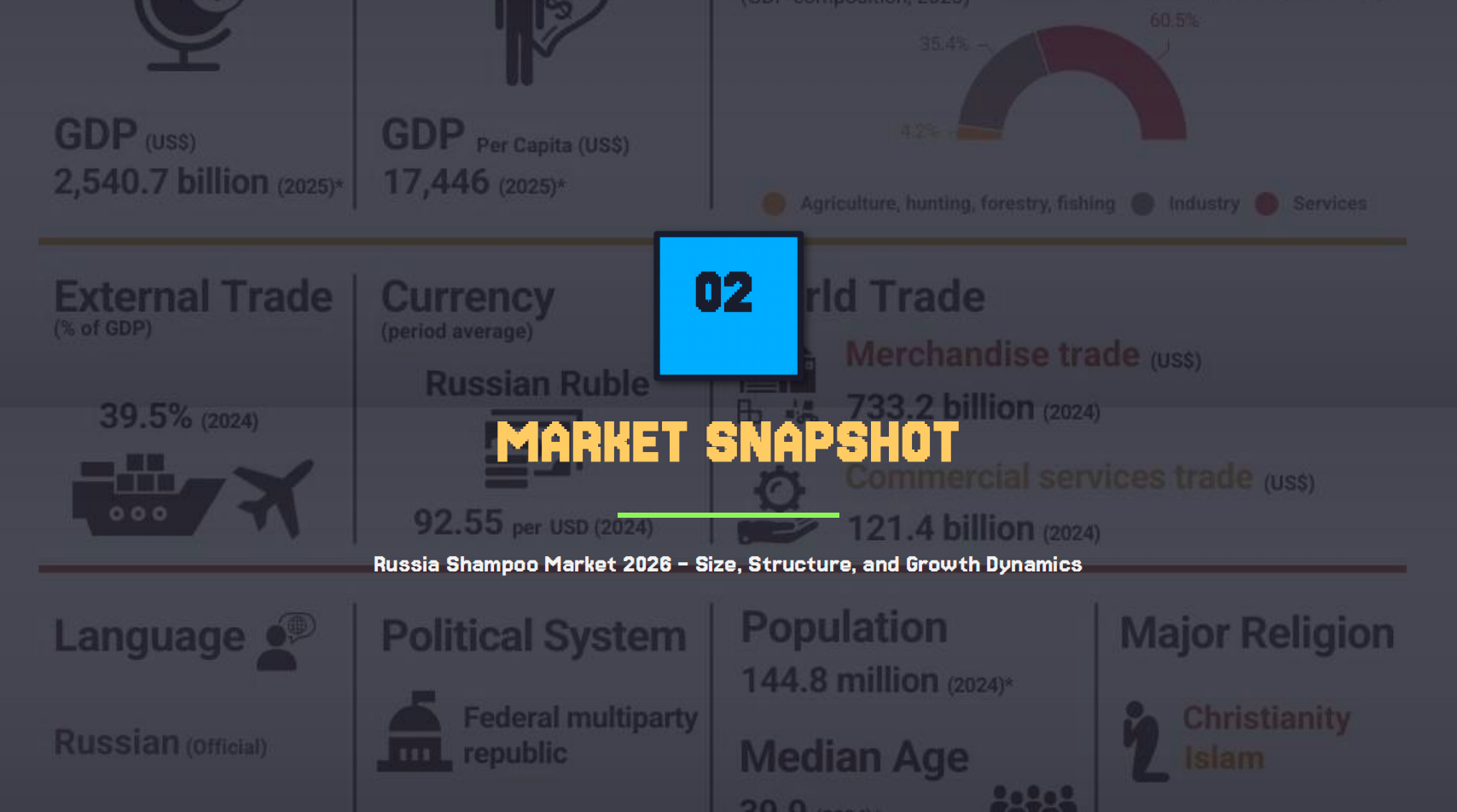
MARKET SNAPSHOT
What Is Driving Demand in 2026
Several forces are shaping Russia’s shampoo market.
The first is climate and seasonality. Cold weather, dry indoor heating, winter static, brittle lengths, and scalp discomfort create strong demand for moisture, repair, anti-frizz, and scalp comfort narratives.
The second is the practical nature of hair care purchasing. Shampoo is not treated only as a beauty item. It is also a household necessity. This keeps large formats, family packs, and repeatable daily-use products highly relevant.
The third is problem-led shopping behavior. Russian consumers respond strongly to shampoos that address visible and emotionally important needs such as dandruff, hair fall, scalp sensitivity, and damaged hair.
The fourth is marketplace-driven comparison. On platforms, products need to communicate their value fast. Consumers compare by function, pack size, ingredient shorthand, price-per-ml, and review volume more than by abstract brand positioning.
Consumer Behavior and Demand Signals
Russian shampoo demand can be understood through four practical buyer types.
The first is the mass household buyer. This customer is focused on affordability, size, and everyday practicality.
The second is the family-care buyer. This buyer prefers simple, multipurpose shampoos in larger formats that feel reliable and easy to use.
The third is the mass-premium beauty buyer. This segment responds better to smoother, shinier, sulfate-free, keratin-led, or salon-inspired formulas that still remain reasonably priced.
The fourth is the problem-solution buyer. This is one of the most commercially important segments because it is driven by visible needs such as dandruff, scalp imbalance, hair thinning, breakage, and winter-related damage.
For commercial planning, this means the market should not be segmented only by demographics. It should be segmented by problem-to-solution logic.
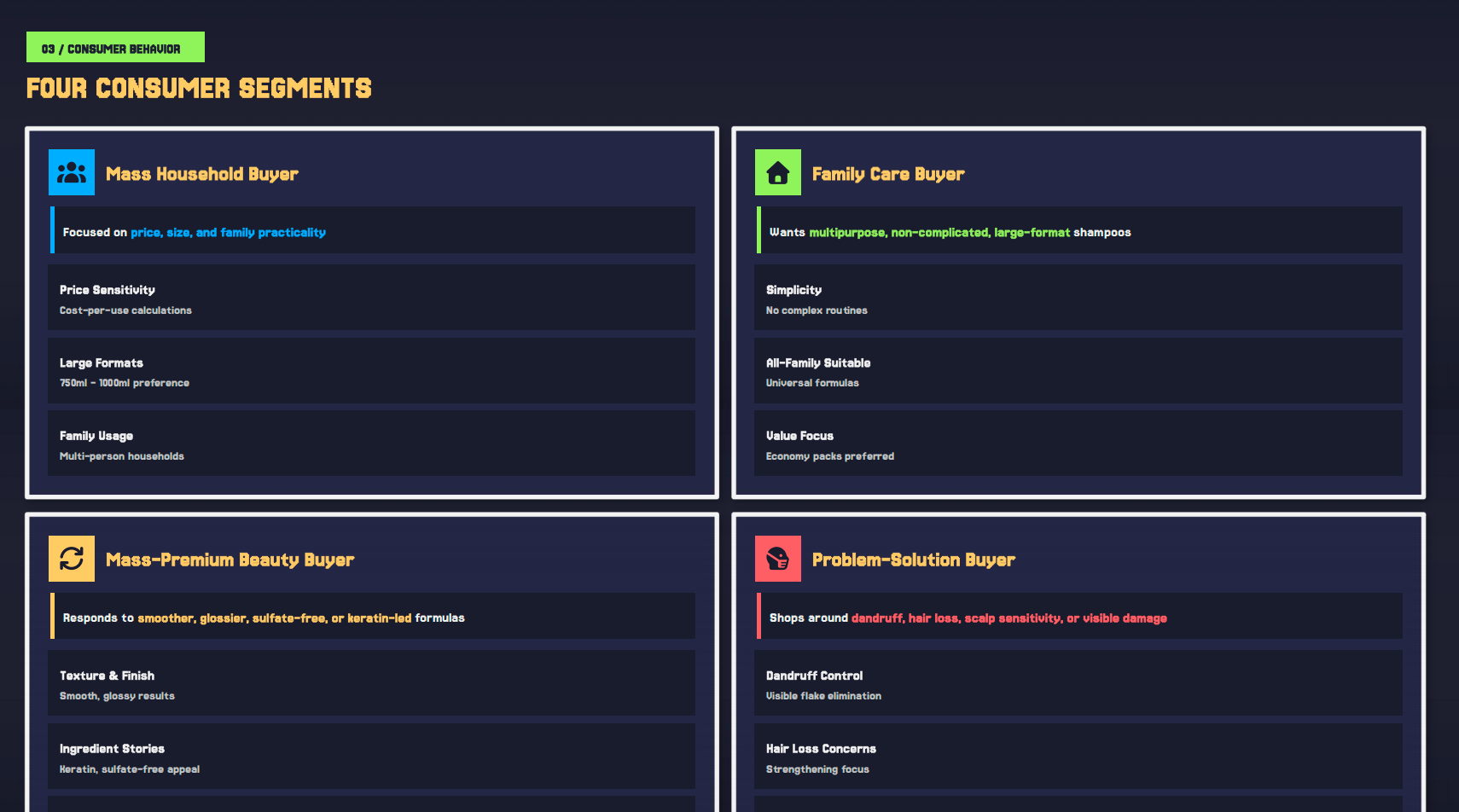
FOUR CONSUMER SEGMENTS
The Highest-Conversion Functional Segments
The strongest demand in Russia is concentrated in a few functional pillars.
Anti-Dandruff
Anti-dandruff remains one of the most conversion-friendly shampoo functions because it solves a visible issue and supports repeat need. It works in both value formats and more premium scalp-care formats.
Anti-Hair Loss
Hair thinning and breakage are emotionally powerful buying triggers. Products positioned around root strength, reduced breakage, biotin, caffeine-style support, and stronger-looking hair have strong commercial potential.
Repair and Damage Care
Repair remains essential because consumers often deal with dry lengths, colored hair, rough texture, and cold-weather brittleness. Keratin, amino acids, proteins, oils, and restoring language all work well when framed clearly.
Moisture and Softness
Moisturizing shampoos are especially relevant in Russia because dryness often appears through climate and indoor heating. Claims related to softness, smoothness, anti-static, anti-frizz, and nourishment fit this need well.
Scalp Balance
Scalp-balance products can bridge the gap between anti-dandruff and premium care. This is one of the more promising mass-premium white spaces because it feels modern, practical, and more beauty-led than pharmacy-led.
Product and Category Structure
The Russia shampoo market works best when viewed through price tier, function, and pack format.
In mass, the strongest products are anti-dandruff basics, family care, strengthening shampoos, and practical large-format products.
In mass-premium, the strongest opportunities include keratin repair, scalp balance, sulfate-free care, anti-hair loss, and moisturizing shampoos with a stronger ingredient story.
In premium, the market supports more refined salon-style and specialist products, but these usually need stronger positioning, cleaner packaging, and clearer result expectations.
What matters most is not how complex the formula sounds. What matters is whether the product promise is easy to understand, easy to compare, and easy to justify at the target retail price.
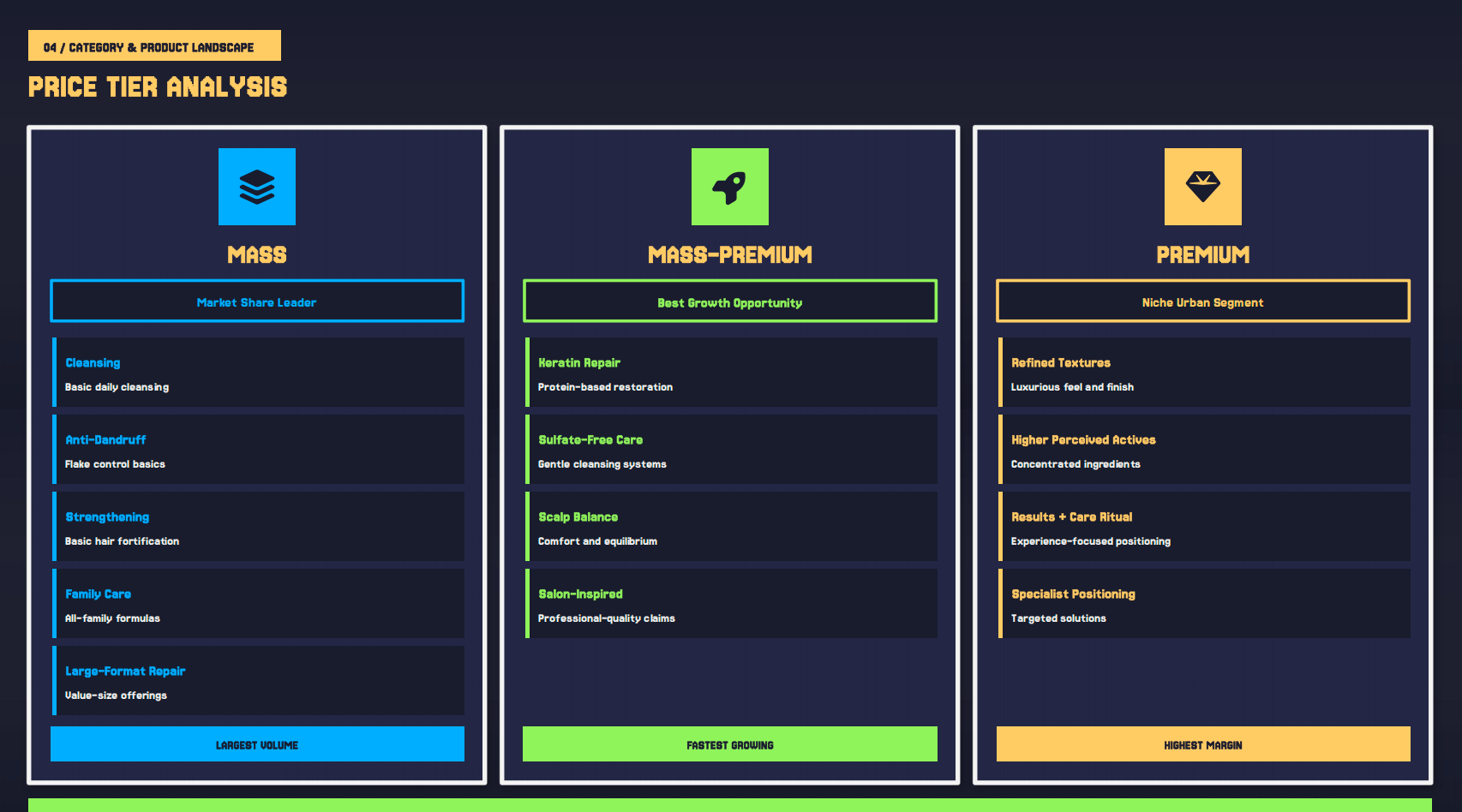
PRICE TIER ANALYSIS
Packaging and Pack-Size Logic
Packaging in Russia is highly practical. Large bottles, pump formats, and value packs are especially visible in shampoo.
Standard 350ml to 450ml sizes remain important for mainstream launches. But 800ml to 1,000ml formats also have strong commercial relevance, especially for family care, anti-dandruff, repair, and salon-style value positioning.
A practical launch structure often includes:
- one standard bottle for daily retail and marketplace conversion
- one larger family or value format for stronger price-per-ml appeal
- one cleaner premium bottle for margin and positioning support
Buyers should not treat packaging as an aesthetic decision only. In Russia, pack size is part of the value proposition.
Price Strategy and Market Positioning
The market can be understood in three practical price bands.
Entry
This is the traffic layer. Products here compete through affordability, visible function, and value size. This is where anti-dandruff basics, family care, and everyday cleansing products can perform well.
Mid / Mass-Premium
This is often the most attractive band for new entrants. Products here can justify better packaging, a clearer ingredient story, and stronger problem-solution positioning without becoming too expensive.
Premium
This tier supports salon-style, specialist, sulfate-free, and higher-perceived-value formulas. But the market is narrower, so execution and channel fit matter more.
For most new entrants, the best route is not to compete only in the cheapest segment. The stronger path is to build a good-better-best structure that creates both scale and margin.
Recommended SKU Strategy for 2026
The best assortment for Russia is not one hero shampoo. It is a small but structured SKU ladder.
A strong launch architecture would be:
Traffic SKU
Daily Anti-Dandruff Shampoo
A clear, easy-to-understand functional SKU designed for strong price-value perception and repeat purchase.
Core Conversion SKU
Keratin Repair Shampoo
A mass-premium repair line targeting damaged, dry, colored, or winter-stressed hair.
Margin SKU
Anti-Hair Loss Strengthening Shampoo
A more premium problem-solution product built around stronger emotional triggers and better perceived value.
Expansion SKU
Scalp Balance or Sulfate-Free Smooth Care Shampoo
This gives the line a more modern, premium extension and helps widen channel fit.
Size Extension
1,000ml Family or Salon Pack
This works especially well once demand is validated and larger-format economics become attractive.
This structure gives brands flexibility across marketplaces, offline retail, and future line expansion.
Channel Strategy
Russia’s shampoo market should be approached as a channel-specific launch problem.
Ozon
Ozon is a strong fit for more structured assortment building and clearer product-detail communication. It suits anti-hair loss, scalp care, sulfate-free, and repair products that benefit from stronger explanation and better visual presentation.
Wildberries
Wildberries is stronger for higher-volume, price-sensitive, visually simple products. Anti-dandruff, family care, repair, and large-format shampoos fit especially well here. Competition is often sharper on price, so value communication matters more.
Offline Retail
Offline remains important for broad household penetration. Daily care, family care, anti-dandruff, and standard repair products are generally the easiest to scale through this route.
The strongest launch strategy is not to treat every channel the same. It is to adapt the assortment, pack format, and pricing logic to how each channel converts.
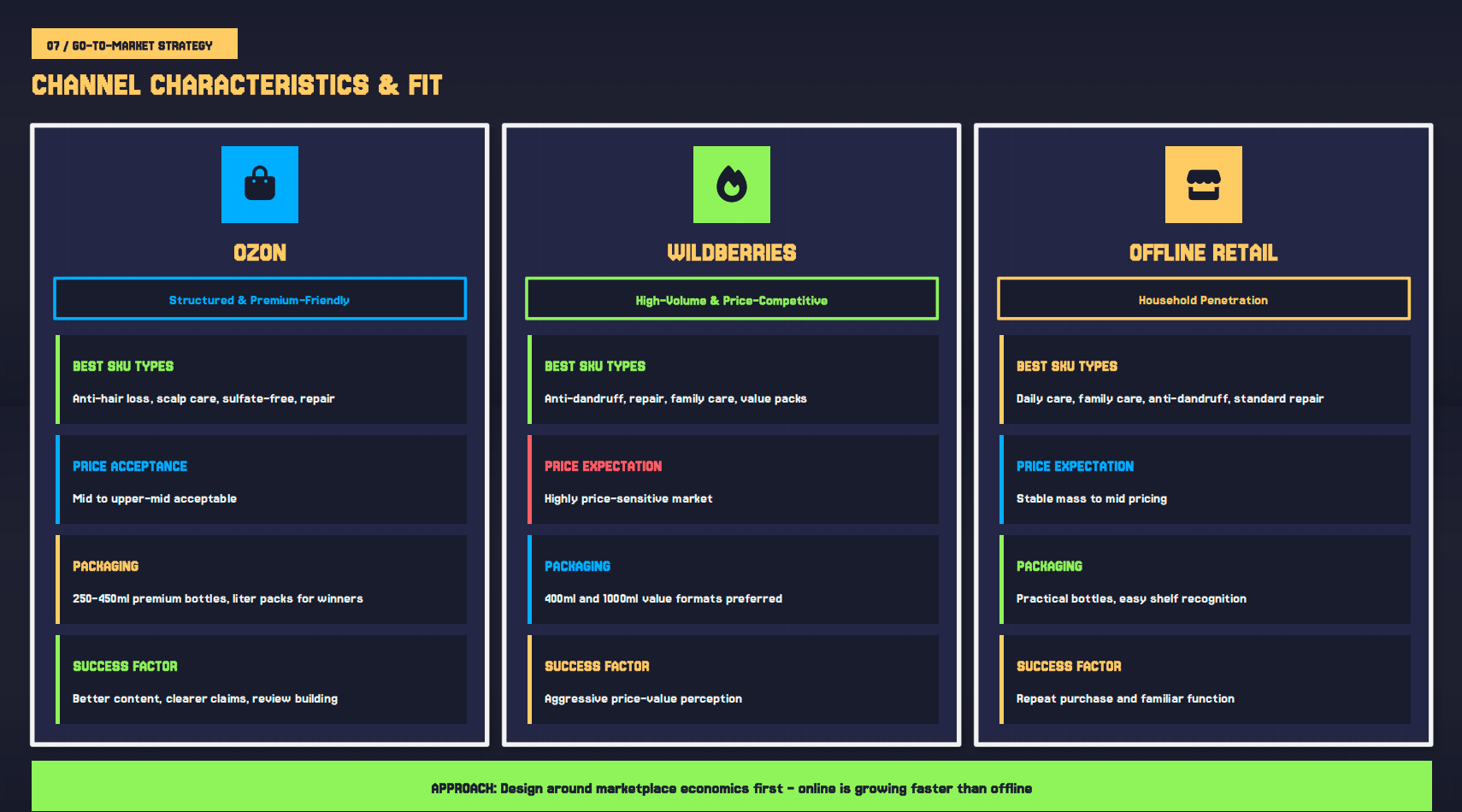
CHANNEL CHARACTERISTICS & FIT
Compliance and Product Development Priorities
Compliance and localization should be built into the project early.
For Russia, labeling should not be treated as a last-step design task. Russian-language labeling, ingredient disclosure, intended use, precautions, shelf life, manufacturer details, and other required product information should be prepared as part of the development plan.
Traceability and local market circulation requirements should also be considered early. Buyers should not assume these issues can be solved only after production is complete.
From a product-development perspective, claims should stay clearly within cosmetic-use boundaries. It is better to position products around stronger-looking hair, scalp comfort, reduced breakage, or balancing care than to imply medical outcomes.
Stability and packaging compatibility also matter. Cold-weather logistics, pump performance, viscosity behavior, fragrance stability, and bottle durability should be checked carefully, especially for large packs and pump bottles.
OEM / ODM Execution Logic
A Russia shampoo project moves faster when the commercial brief is clear from the beginning.
The most useful OEM brief should define:
- target retail price in RUB
- primary channel
- positioning tier
- core function
- ingredient direction
- pack size
- pump or standard closure
- packaging style
- launch timing
- expected documentation
Without these inputs, formula development often becomes too abstract and inefficient.
For first entry, a controlled MOQ across two or three focused SKUs is usually smarter than building a broad line immediately. Once platform reviews, reorder data, or distributor feedback validate the winners, it becomes easier to expand into larger sizes, bundles, or line extensions.
The most effective OEM strategy is not to optimize only for factory MOQ. It is to optimize for validation first, then scale.
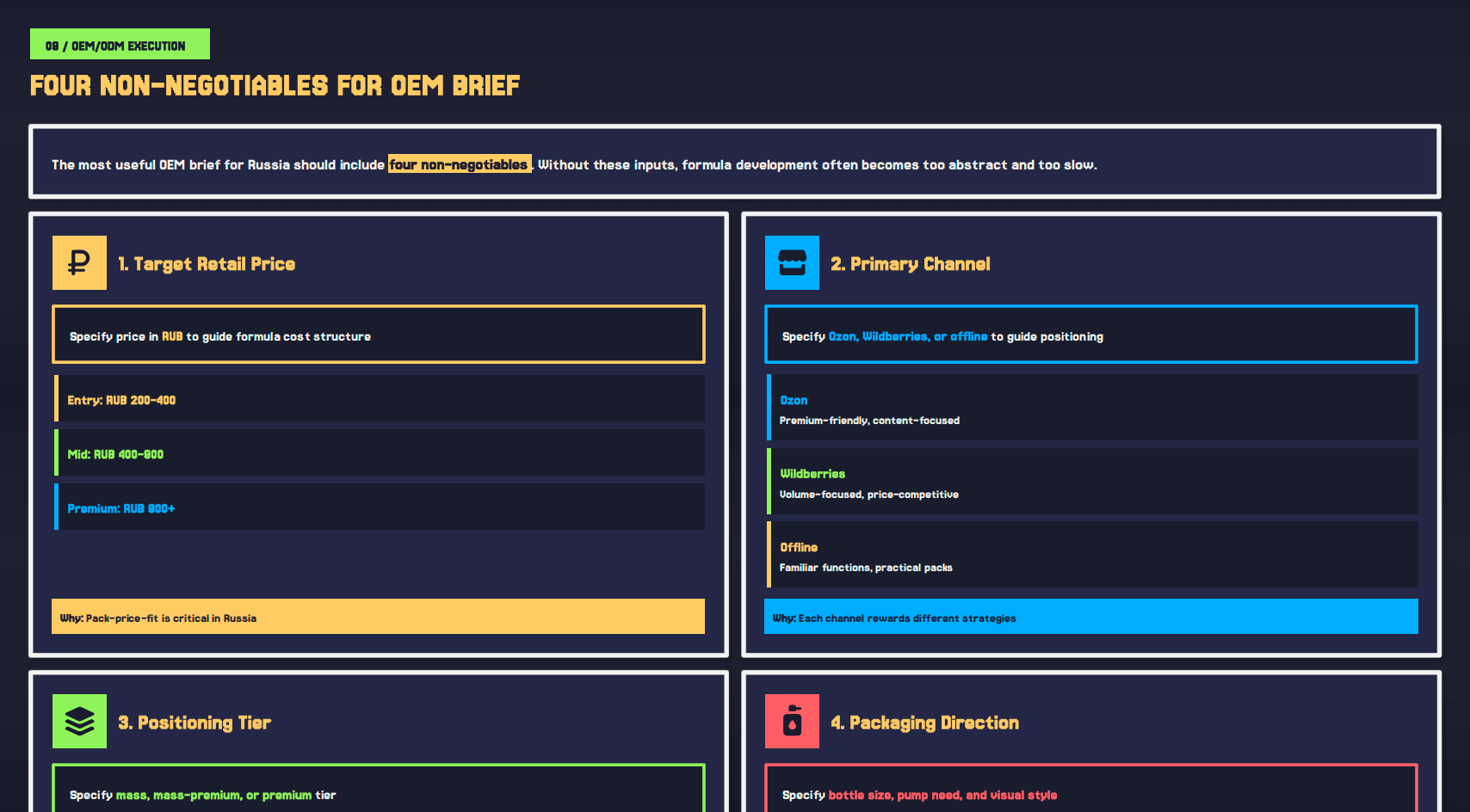
FOUR NON-NEGOTIABLES FOR OEM BRIEF
What Buyers Should Do Next
If your goal is fast market entry, start with three SKUs:
- one anti-dandruff traffic SKU
- one keratin repair core SKU
- one anti-hair loss or scalp-balance margin SKU
If your goal is long-term brand building, use shampoo as the entry anchor and then expand into conditioner, mask, scalp serum, or large refill formats after the first winning shampoos are proven.
If your goal is stronger margin, avoid competing only on low price. Use clearer functional storytelling, better pack logic, and a tighter assortment instead.
In Russia, commercial clarity usually beats concept complexity.
Final Takeaway
The Russia hair shampoo market in 2026 offers real opportunity, but it rewards execution more than trend-chasing.
The brands most likely to win are not the ones with the most creative concept deck. They are the ones that translate market demand into the right product brief, price band, pack size, and channel plan with greater speed and clarity.
If you are evaluating your next Russia shampoo launch, the strongest next step is to define your target segment, target price, and target channel first. Once those decisions are clear, product development becomes faster, more accurate, and more scalable.
Download the Full Report (PDF)
Tell us your target region, product category, and the decision you’re trying to make. We’ll suggest the closest existing report—or build a tailored version.