


Executive Summary
This report explores the Russia hair serum market in 2026, including repair, anti-frizz, gloss, heat protection, format strategy, packaging norms, compliance priorities, and OEM launch planning. It is designed to help brands, importers, distributors, and e-commerce sellers turn market insight into a more practical serum launch strategy.
Russia Hair Serum Market 2026: Best-Selling Claims, Product Formats, and OEM Launch Guide
The Russia hair serum market in 2026 offers a clearer opportunity than many broader hair care segments. Consumers are not simply looking for a traditional heavy oil. They are increasingly choosing lightweight, leave-in serum formats that help solve frizz, dryness, rough ends, static, dullness, and heat-styling damage without making the hair feel greasy.
For brands, importers, distributors, and e-commerce sellers, this creates a commercially attractive launch window. The most practical products are no longer purely botanical oil stories or salon-only treatments. The stronger opportunity sits in lightweight oil-serum, repair serum, gloss serum, and heat-protect serum formats that deliver visible performance in daily use.
This report translates the Russia hair serum opportunity into practical launch logic. It covers market fit, consumer pain points, product formats, price architecture, key claims, packaging norms, compliance considerations, and OEM planning for commercially viable serum launches.
Executive Summary
Russia’s hair care market is large enough to support focused serum development, but the winning path is not to treat serum as a niche add-on. In 2026, hair serum works best as a problem-solving leave-in step that fits into both treatment and styling routines.
The strongest opportunity is not a thick, greasy, old-style hair oil. It is a lightweight repair-led serum or hybrid oil-serum that improves smoothness, shine, manageability, and frizz control while remaining easy to use every day. This is especially relevant in a market where climate, heating, static, and roughness make smoothing and protective claims highly practical.
For most new entrants, the safest launch is a 100 ml core serum in a pump or treatment-bottle format, positioned around repair, anti-frizz, gloss, and heat protection. A commercially strong portfolio can then expand into one entry serum, one core repair serum, one premium repair concept, and one heat-protect add-on.
Market Opportunity Overview
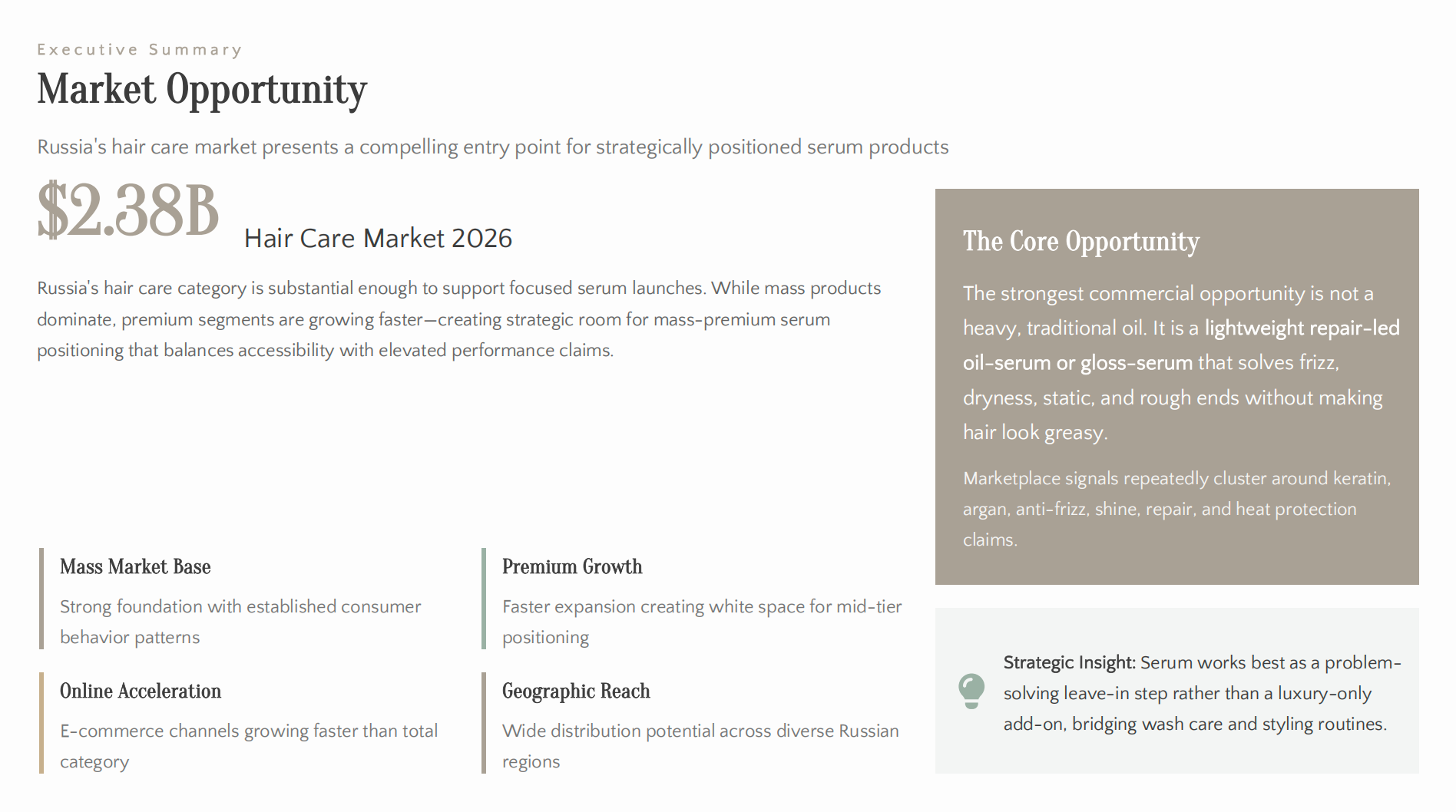
Russia’s hair care market remains large, mass-led, and commercially broad enough to support focused treatment formats. Within that environment, hair serum is especially attractive because it sits between daily care and styling, which gives it frequent-use potential rather than occasional-use limitation.
This matters for new product planning. A serum is easier to insert into an existing hair routine than a more complex salon-style treatment. It solves visible everyday problems such as frizz, roughness, flyaways, dry ends, shine loss, and post-styling finish. That makes it highly suitable for online retail, where practical benefits convert faster than abstract ingredient storytelling.
For most brands, the most investable segment is not ultra-premium luxury treatment. It is mass-premium serum positioning that balances visible performance, reasonable pricing, and repeat-use practicality.
Market Opportunity
Why Hair Serum Works in Russia
Hair serum fits the Russian market especially well because it responds to real environmental and usage conditions.
Cold weather, indoor heating, hat friction, and seasonal dryness all increase consumer concern around frizz, static, roughness, and brittle ends. These are not niche concerns. They are practical daily hair-management problems. That gives serum a stronger role than just being a beauty add-on.
The most commercially useful serum formats in this market are:
- anti-frizz smoothing serum
- repair-focused oil-serum
- shine and gloss serum
- heat-protect serum
- split-end finish serum
- lightweight leave-in treatment serum
This is why serum should be positioned as a visible-results product with real daily function, not just as an ingredient-led cosmetic extra.
Consumer Pain Points and Demand Signals
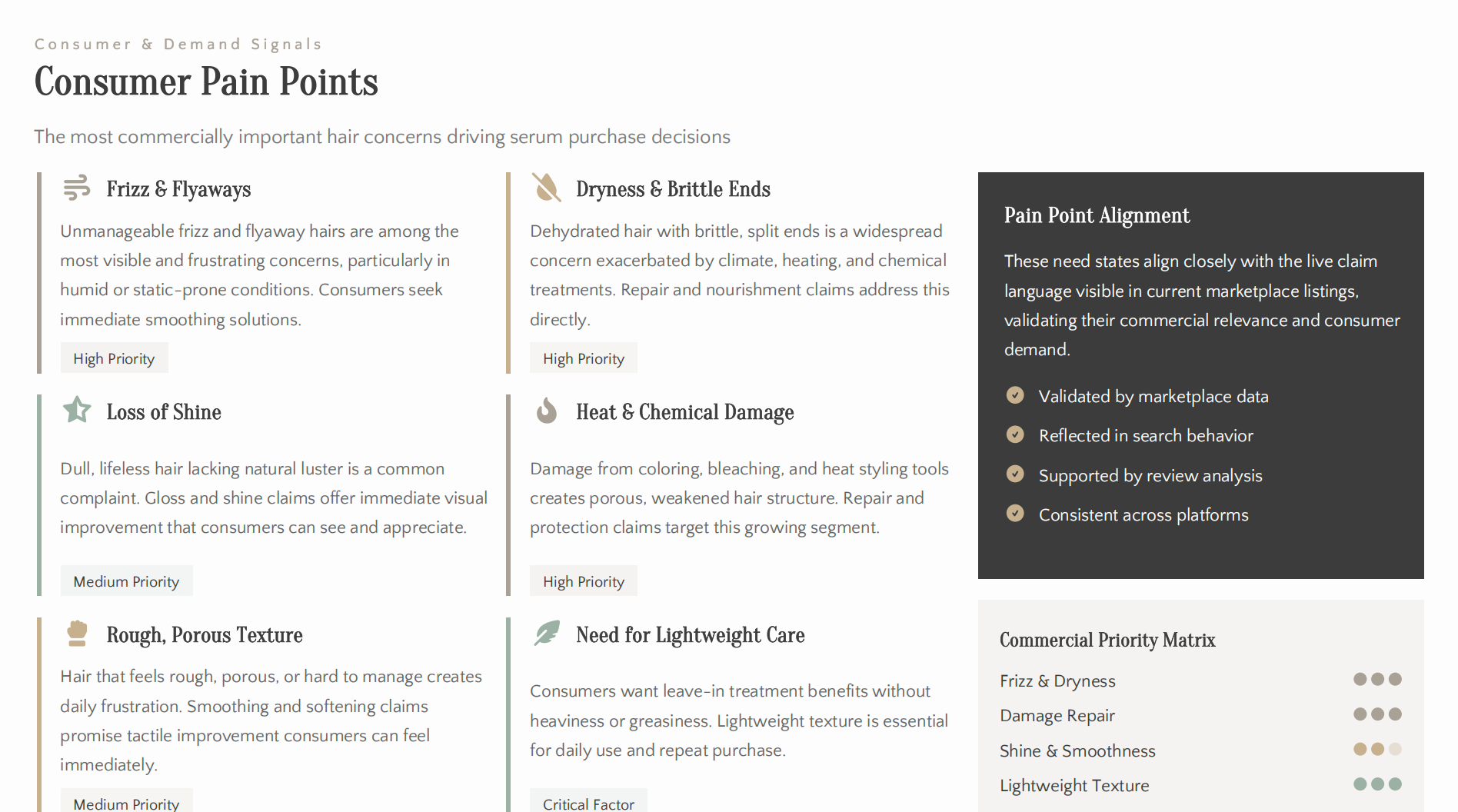
The most important consumer pain points in the Russia hair serum market are clear and practical.
They include:
- frizz and flyaways
- dry and rough ends
- static-prone hair
- visible dullness
- damage from coloring and heat styling
- hair that feels hard to comb or difficult to manage
- the need for leave-in care without heaviness
These pain points make visible results especially important. Consumers are not only buying a formula story. They are buying smoother hair, better shine, less puffiness, easier combing, and a cleaner finish.
That means the product page, package, and front-label communication should prioritize clear benefit language over vague beauty promises.
Consumer Pain Points
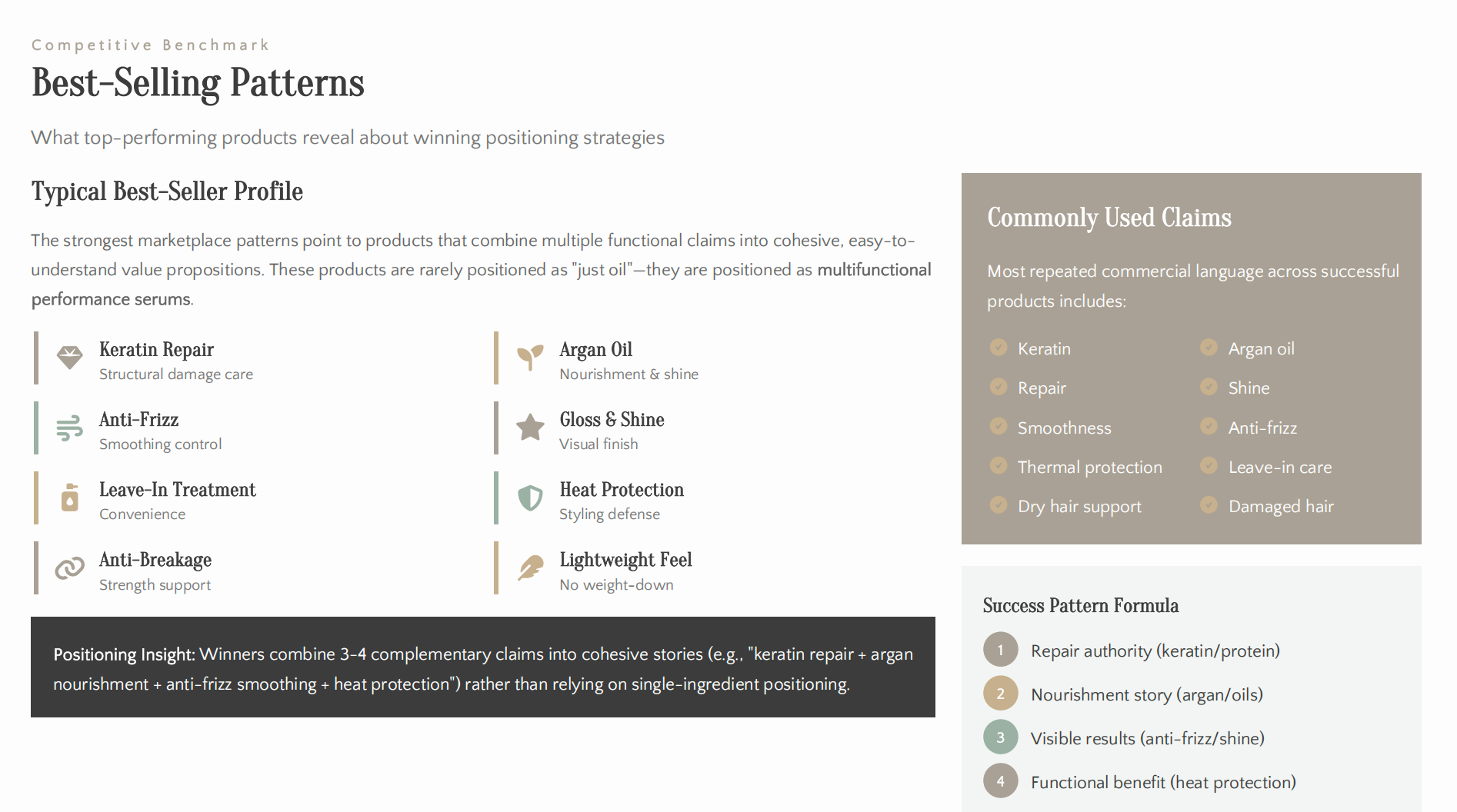
Best-Selling Claim Directions
The strongest claim logic for 2026 is performance-led and immediately understandable.
The most commercially relevant claim directions include:
- repair
- anti-frizz
- shine
- smoothness
- heat protection
- anti-static finish
- dry-end care
- lightweight leave-in treatment
- no weight-down
- gloss and softness
These claims work because they connect to quick visual outcomes. In e-commerce, fast comprehension matters. A serum that promises repair, gloss, and anti-frizz will usually convert more easily than one positioned mainly around botanical romance or generic “nourishment.”
Texture and Sensory Expectations
Texture is a critical make-or-break factor in this category.
The ideal serum for the Russian market should feel:
- lightweight
- non-greasy
- slip-enhancing
- easy to spread through mid-lengths and ends
- glossy but not wet-looking
- comfortable for repeat use
- easy to dose without over-application
This is why hybrid oil-serum systems and silicone-assisted gloss serums often make more commercial sense than heavy pure-oil formats. The market wants visible polish, but it does not want hair that looks overloaded.
For product development teams, greasy residue is often a bigger risk than having fewer “hero oils” on the front label.
Product Format Strategy
Not all serum formats play the same role in market entry.
A practical format hierarchy looks like this:
- classic oil: lower priority unless extremely lightweight
- serum: strong for repair and smoothing
- oil-serum hybrid: best overall balance
- cream-serum or treatment fluid: useful for damaged or porous hair
- heat-protect serum: strong secondary or add-on SKU
- split-end serum: simple and impulse-friendly
For most launches, the hybrid oil-serum format offers the best commercial flexibility because it supports both treatment claims and finishing claims at the same time.
Size and Packaging Strategy
Size plays an important role in both conversion and perceived value.
For a new launch, 80–100 ml is usually the strongest balance of:
- accessible retail pricing
- practical usage duration
- strong shelf and listing presence
- clear repeat-purchase logic
- easy positioning as a core daily serum
The most workable packaging formats are:
- pump bottle
- treatment bottle with controlled dispensing
- airless pump for premium positioning
Dropper formats can work for premium treatment concepts, but they are usually less practical for mass e-commerce because they add handling friction and reduce usage simplicity.
For most commercial launches, pump packaging is the safest option because it is easier to use, easier to explain, and easier to repurchase.
Price Band Strategy
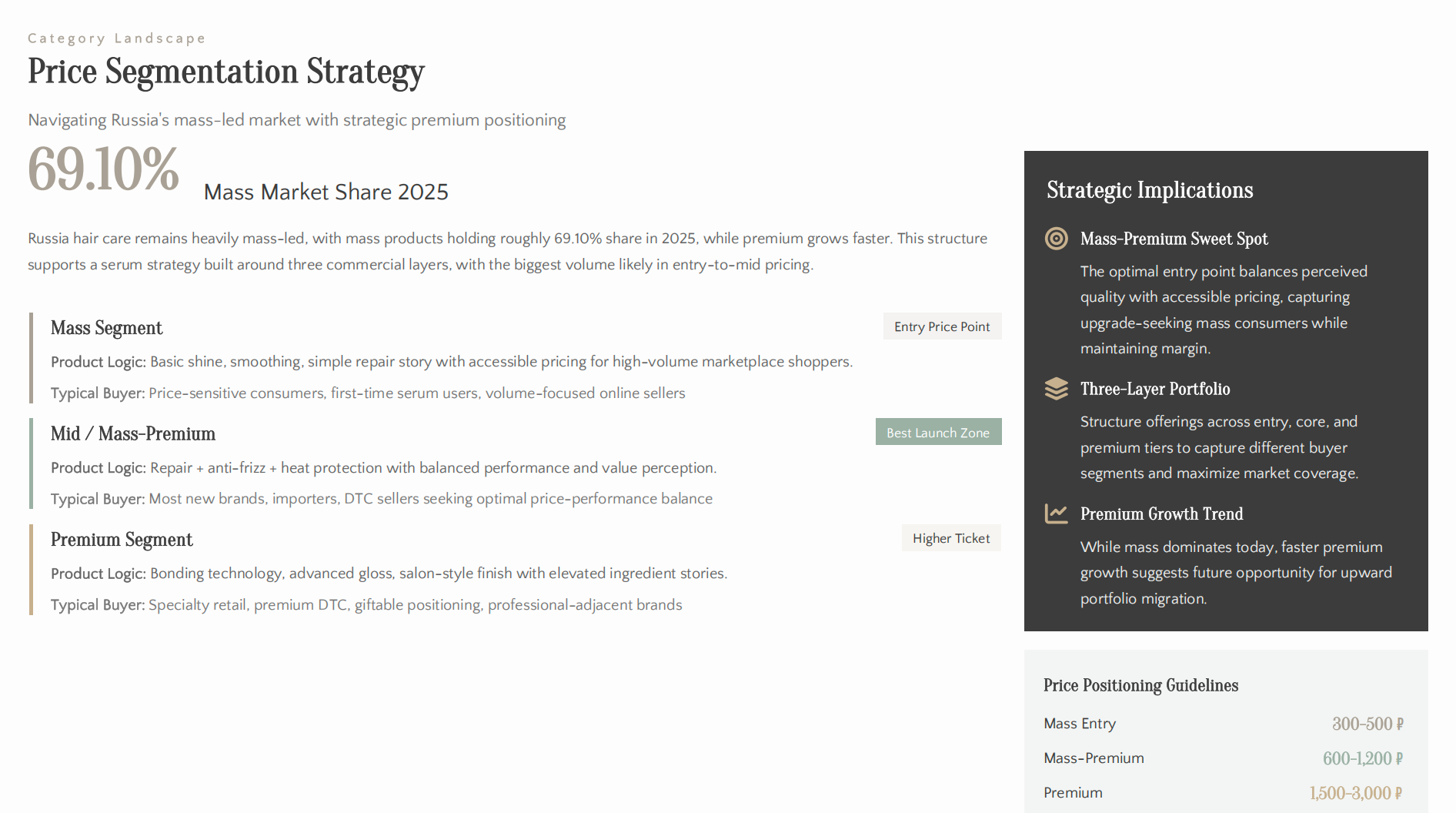
Russia hair care remains strongly mass-led, but premium is growing faster, which creates room for a well-structured serum ladder.
A useful three-level strategy looks like this:
Entry tier
Simple gloss or daily serum with shine and softness language.
Core tier
Repair plus anti-frizz plus heat protection in a lightweight serum base.
Premium tier
Bond-repair or advanced leave-in treatment serum with stronger margin and more technical storytelling.
For most new brands and importers, the best launch zone is mid or mass-premium. This gives enough room for a visible-performance formula, decent packaging, and stronger claim structure without overreaching on price.
Price Segmentation Strategyœ
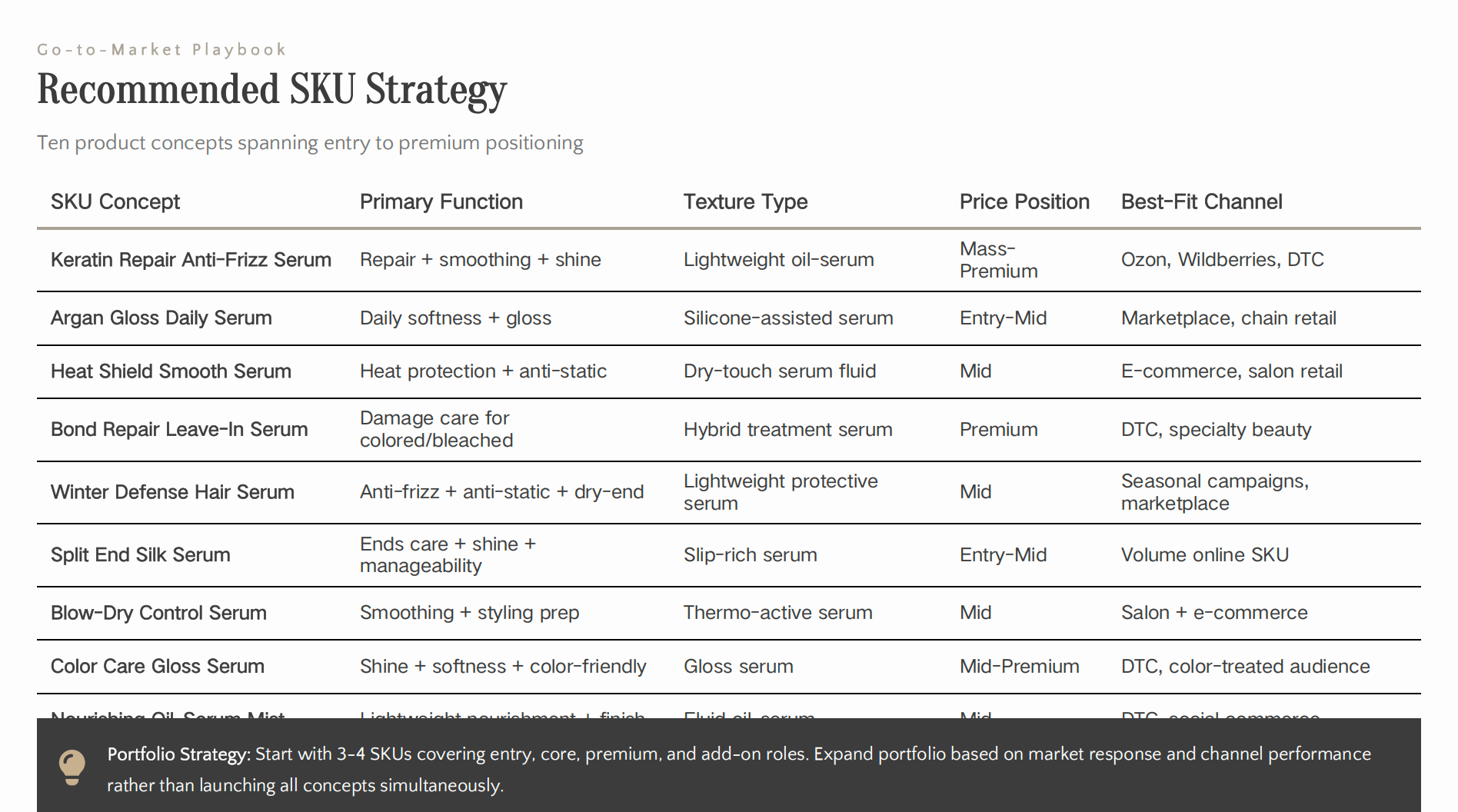
Recommended SKU Strategy
The clearest launch structure is a focused 4-SKU portfolio rather than too many variants at once.
A practical portfolio could include:
Entry SKU
Argan Gloss Daily Serum
A familiar, easy-to-sell shine and softness serum.
Core SKU
Keratin Repair Anti-Frizz Serum
The strongest commercial engine with the broadest need-state fit.
Premium SKU
Bond Repair Leave-In Serum
A higher-value treatment story for DTC, specialty, or premium distribution.
Add-On SKU
Heat Shield Smooth Serum
A natural cross-sell that supports styling-led routines and bundle logic.
This structure works because it gives you one high-volume entry point, one broad core engine, one margin-supporting premium step, and one routine-building add-on.
Most Commercially Viable Product Concepts
The strongest concepts for 2026 include:
1. Keratin Repair Anti-Frizz Serum
This is the safest first launch. It fits damaged, dry, porous, color-treated, and frizz-prone hair. It combines repair language with visible smoothness, which gives it the broadest market appeal.
2. Argan Gloss Daily Serum
This is a strong entry-friendly volume SKU. It is familiar, easy to understand, and useful for shine and softness positioning.
3. Heat Shield Smooth Serum
This works well as a second SKU or bundle add-on. It is easy to explain and connects serum directly to common styling behavior.
4. Bond Repair Leave-In Serum
This supports premium positioning. It is especially suitable for brands that want a more advanced treatment image.
5. Winter Defense Hair Serum
This is a strong Russia-specific angle. It makes anti-frizz, anti-static, and dry-end protection more locally relevant than generic oil language.
6. Split End Silk Serum
This is simple, practical, and impulse-friendly. It works especially well for online channels with fast benefit communication.
Best-Selling Patterns
Competitive White Space
The market already contains many repair, argan, and shine products, so generic positioning is not enough.
Overused patterns include:
- argan-only storytelling
- heavy Moroccan oil imitation
- broad “for all hair types” messaging
- thick formulas that risk greasiness
- ingredient-led positioning without visible-result logic
The more attractive white spaces include:
- anti-static plus anti-frizz winter finish
- repair plus heat protection in one serum
- lightweight bonding-style serum
- blow-dry smoothing serum
- mass-premium gloss serum with no-greasy-finish language
- duo logic with a core serum plus a premium finishing serum
This is where newer entrants can be more specific, more relevant, and easier to understand than many generic incumbents.
Go-to-Market Strategy
A Russia hair serum launch should be channel-aware from the beginning.
For marketplaces, the best-selling logic is usually a simple and visible claim combination:
- repair
- anti-frizz
- shine
- heat protection
- lightweight finish
For DTC and social commerce, the opportunity expands into ritual-building and bundling:
- day serum plus heat serum
- repair plus gloss duo
- winter-defense positioning
- color-care add-on
- before-and-after performance storytelling
For distributors and importers, the strongest commercial path is usually one hero 100 ml serum with the broadest need-state fit, supported by one or two adjacent SKUs for upsell and seasonal campaigns.
Recommended SKU Strategy
Launch Timeline
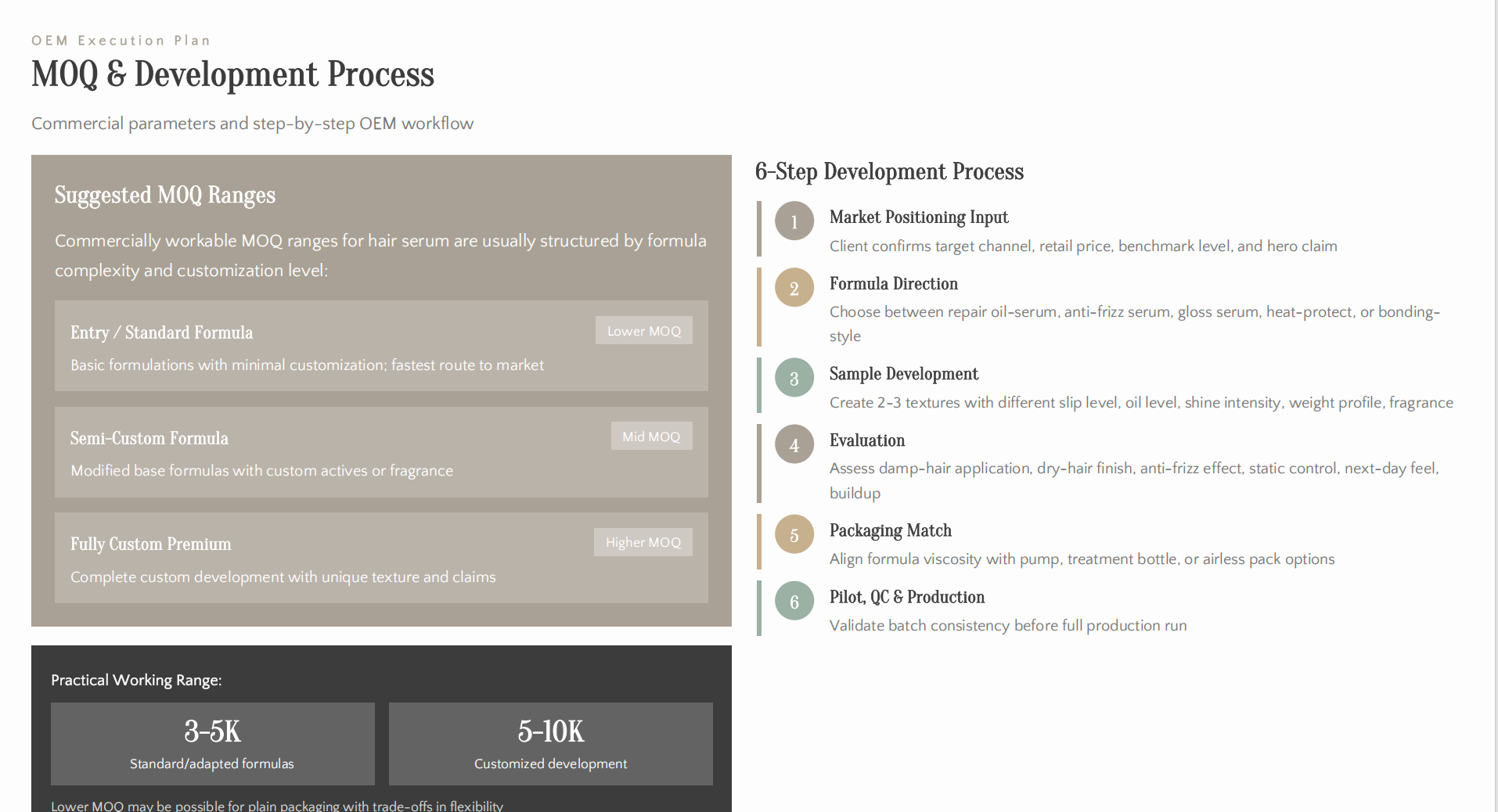
A realistic serum development process should not start with packaging design. It should start with commercial logic.
A practical launch sequence is:
- define target channel, price tier, and claim architecture
- choose format direction and texture profile
- build two to three formula routes
- compare performance on damp and dry hair
- review shine, weight, residue, combability, and next-day feel
- validate packaging compatibility
- prepare claims, labeling, and regulatory files
- move into production only after commercial and technical alignment
For most teams, the better the concept brief is at the start, the faster the project moves later.
Compliance and Quality Priorities
For Russia and the wider EAEU route, compliance and label planning should begin early, not after artwork is complete.
Key areas to review include:
- cosmetic leave-in product classification
- ingredient permissibility and restricted substances
- Russian-language labeling
- claim wording and support logic
- batch coding
- pack compatibility
- stability testing
- microbiological review
- performance support for anti-frizz, gloss, and heat-related claims
- documentation readiness for declaration and circulation support
A technically strong serum can still fail commercially if the packaging leaks, the pump does not match the viscosity, or the copy overclaims repair without support.
OEM Execution Strategy
The fastest way to improve OEM results is to give the supplier a better market brief.
A stronger client input should define:
- target market
- product concept
- target hair type
- format preference
- desired texture
- target retail price
- channel plan
- size and packaging preference
- benchmark products
- launch timeline
The more clearly these variables are aligned, the easier it is to create the right texture, choose the right package, control costs, and reduce wasted sample rounds.
A professional OEM output should include:
- product specification sheet
- INCI list
- SDS
- COA
- micro test report
- stability and compatibility review
- packaging guidance
- artwork support
- batch retention logic
- conformity support package as needed
MOQ & Development Process
What Buyers Should Do Next
If you are planning a Russia hair serum launch, the smartest next step is not to develop too many versions at once.
Start with:
- one core repair anti-frizz serum
- one entry gloss or daily serum
- one premium repair concept if margin allows
- one heat-protect add-on for routine building
Then align:
- price band
- texture profile
- package type
- claim hierarchy
- target channel
- compliance route
That structure will help you move faster from white paper insight to an actual serum project that is easier to quote, easier to manufacture, and easier to sell.
Final Takeaway
The Russia hair serum market in 2026 is attractive because it sits at the intersection of treatment, styling, climate protection, and daily-use convenience.
The strongest products are not heavy oils with vague nourishment stories. They are lightweight, visible-performance serums that help consumers solve frizz, dryness, roughness, and shine loss without adding weight.
For most new entrants, the clearest path is a mass-premium 80–100 ml serum portfolio led by one core repair anti-frizz SKU, supported by gloss and heat-protection extensions. That is the most practical way to turn this market opportunity into a commercially workable launch.
Download the Full Report (PDF)
Tell us your target region, product category, and the decision you’re trying to make. We’ll suggest the closest existing report—or build a tailored version.