


Executive Summary
This report explores the Russia hair oil market in 2026, including repair-led demand, climate-driven usage logic, product structure, pricing strategy, channel fit, packaging risk, compliance priorities, and OEM launch planning. It is designed to help brands, distributors, importers, and e-commerce sellers turn market insight into a more practical hair oil launch strategy.
Russia Hair Oil Market Report 2026: Repair Positioning, Product Structure, and OEM Strategy
The Russia hair oil market in 2026 is commercially attractive not because hair oil is the largest category in hair care, but because it sits at the intersection of three strong consumer needs: repair, dryness control, and visible finish improvement.
For brands, importers, distributors, private label buyers, and e-commerce sellers, hair oil is one of the most commercially useful subcategories for market entry. It is compact, easy to merchandise online, highly visual in before-and-after storytelling, and capable of delivering strong perceived value when texture and positioning are handled correctly.
This report translates the Russia hair oil opportunity into practical launch logic. It covers market demand, repair-led positioning, product architecture, pricing, format strategy, channel fit, packaging risk, compliance priorities, and OEM execution planning for 2026 launches.
Executive Summary
The Russia hair oil market is best approached as a treatment-performance segment rather than a traditional beauty ritual category. Consumers are not primarily looking for heavy oils or purely botanical storytelling. The strongest demand is centered on repair, smoothness, shine, anti-frizz effect, and visible improvement for dry, damaged, or styling-stressed hair.
This creates a clear commercial path for new entrants. The most scalable products are lightweight oils or oil-serums that provide softness, gloss, reduced flyaways, and improved finish without leaving hair greasy or heavy.
For most operators, the best launch direction is not a broad line with too many variants. It is a focused assortment led by one repair hero SKU, supported by one extension for either styling protection, split-end care, or scalp treatment. In Russia, marketplace fit, leakage control, and claim clarity often matter more than decorative branding.
Market Opportunity Overview
Hair oil in Russia should be understood as a specialist treatment format within the broader hair care market. It is not replacing shampoo, conditioner, or masks. Its role is more specific and more commercially focused.
Consumers use hair oil to:
- reduce dryness and roughness
- improve shine and softness
- smooth flyaways and frizz
- support heat styling
- improve the look of damaged ends
- create a salon-like finish at home
This makes hair oil especially attractive as an entry SKU. Compared with many other hair products, it is easier to explain, easier to compare online, and easier to justify as an add-on purchase. A successful hair oil is not a commodity. It is a visible-upgrade product.
Russia Hair Oil
Market 2026
Why Repair-Led Positioning Works Best
The strongest market entry point in Russia is repair-led positioning.
Consumers are not only buying nourishment. They are buying the visual result of better hair. They want smoother ends, more gloss, less frizz, less static, softer texture, and a stronger impression of healthy hair after styling or daily use.
That is why repair language performs better than abstract wellness language for mainstream market entry. Buyers want to know:
- what problem the product solves
- when to use it
- how fast the effect appears
- whether it will feel greasy
- whether it helps damaged, colored, or dry hair
A repair-led product is easier to merchandise, easier to localize, and easier to scale across marketplaces and distributor channels.
Climate and Seasonal Demand Logic
Russia’s climate creates strong commercial logic for dryness-control and protective hair care.
Long winters, cold outdoor weather, indoor heating, and sharp seasonal transitions increase the relevance of:
- dry ends
- brittle texture
- dull-looking hair
- static and flyaways
- roughness after winter exposure
- styling-related dryness
This makes hair oil especially suitable for seasonal merchandising. A strong product can be positioned around:
- winter rescue
- anti-static smoothing
- dry-end repair
- shine recovery
- post-color or post-bleach support
- heat-styling protection
For commercial planning, this is important because the product can be sold as both an everyday repair tool and a seasonal problem solver.
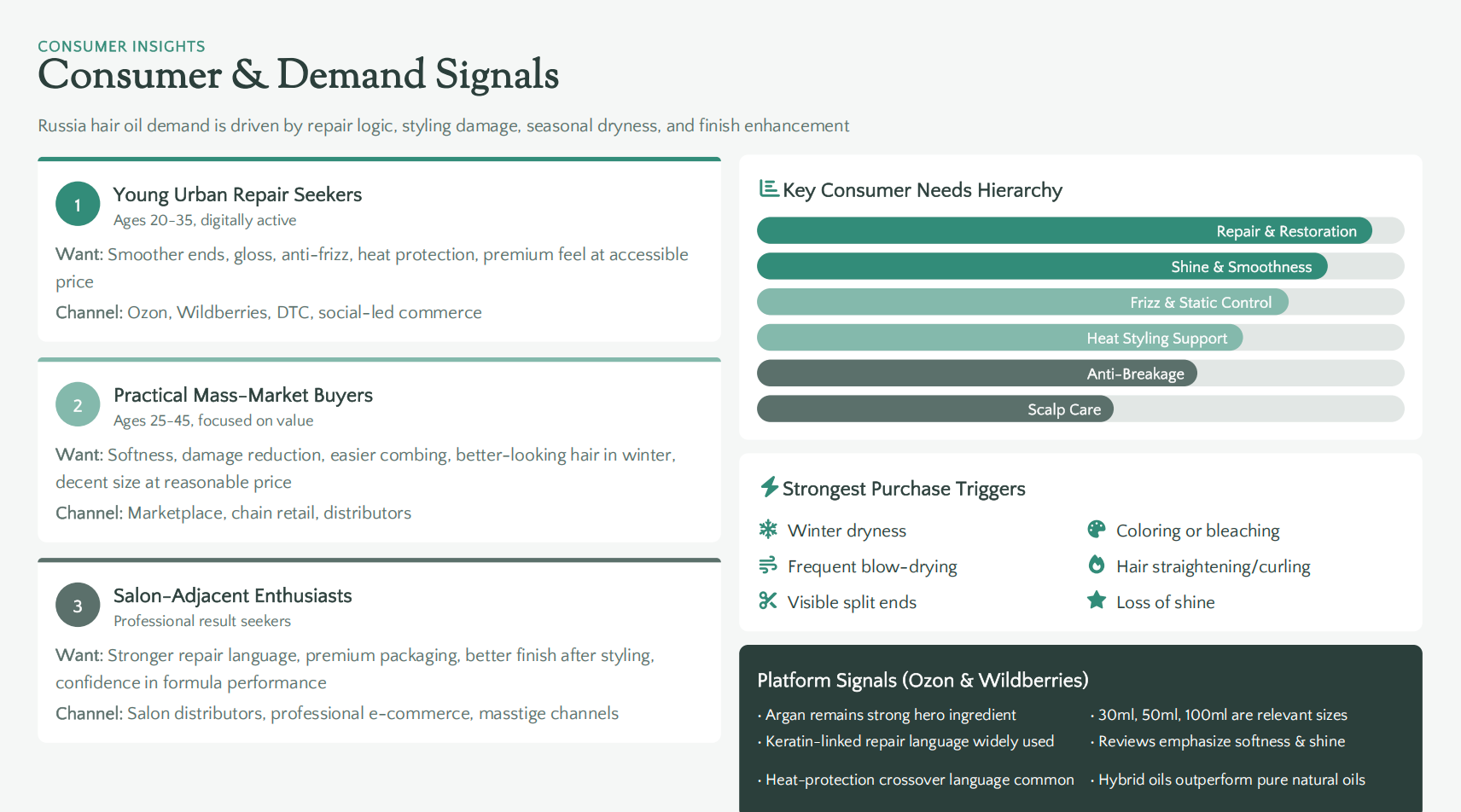
Consumer & Demand Signals
What Russian Consumers Are Looking For
Russia is not a classic heavy daily oiling market. The more scalable usage pattern is lightweight, controlled application on mid-lengths and ends, often before or after blow-drying or styling.
That means mainstream buyers generally prefer:
- non-greasy textures
- quick absorption
- visible softness
- smoother finish
- compact formats
- controlled dosage
- practical packaging
The most commercially relevant need states include:
- repair and restoration
- shine and softness
- anti-frizz control
- heat protection
- anti-breakage support
- split-end care
- lightweight daily smoothing
- scalp nourishment in smaller niche segments
This supports a launch strategy built around performance-led, easy-to-understand products rather than ritual-heavy or overly “pure oil” positioning.
Best Product Direction for 2026
The strongest practical direction for Russia in 2026 is a lightweight hair oil or oil-serum positioned around repair, shine, softness, and anti-frizz performance.
This type of product works because it combines:
- broad consumer relevance
- visible immediate payoff
- strong listing logic for marketplaces
- manageable pricing structure
- repeat purchase potential
The most commercially useful formula paths include:
- lightweight leave-in oil
- silicone-assisted repair oil
- oil-serum hybrid
- argan-keratin gloss oil
- blow-dry and styling support oil
- split-end repair oil
- scalp comfort oil as a secondary niche SKU
For broad market entry, the best hero product is usually not a pure natural oil. It is a hybrid formula that feels elegant, spreads easily, and improves the look of hair quickly.
Price Strategy and Product Structure
The Russia hair oil category works best when price, texture, format, and channel are aligned.
A practical market structure includes three main tiers:
Entry Tier
This tier is price-led and often built around smaller sizes or simpler benefit communication. It is useful for traffic and impulse conversion.
Mass Tier
This is the strongest commercial corridor for many launches. It balances accessibility with stronger quality perception and is especially suitable for 30ml to 50ml hero oils.
Premium or Masstige Tier
This tier works best when the formula texture, finish, packaging, and claim structure feel more salon-adjacent or performance-driven. It is suitable for focused hero products and selective distribution.
For many new entrants, the most attractive opportunity is upper-mass to masstige. This is where visible performance and accessible premium positioning can work together.
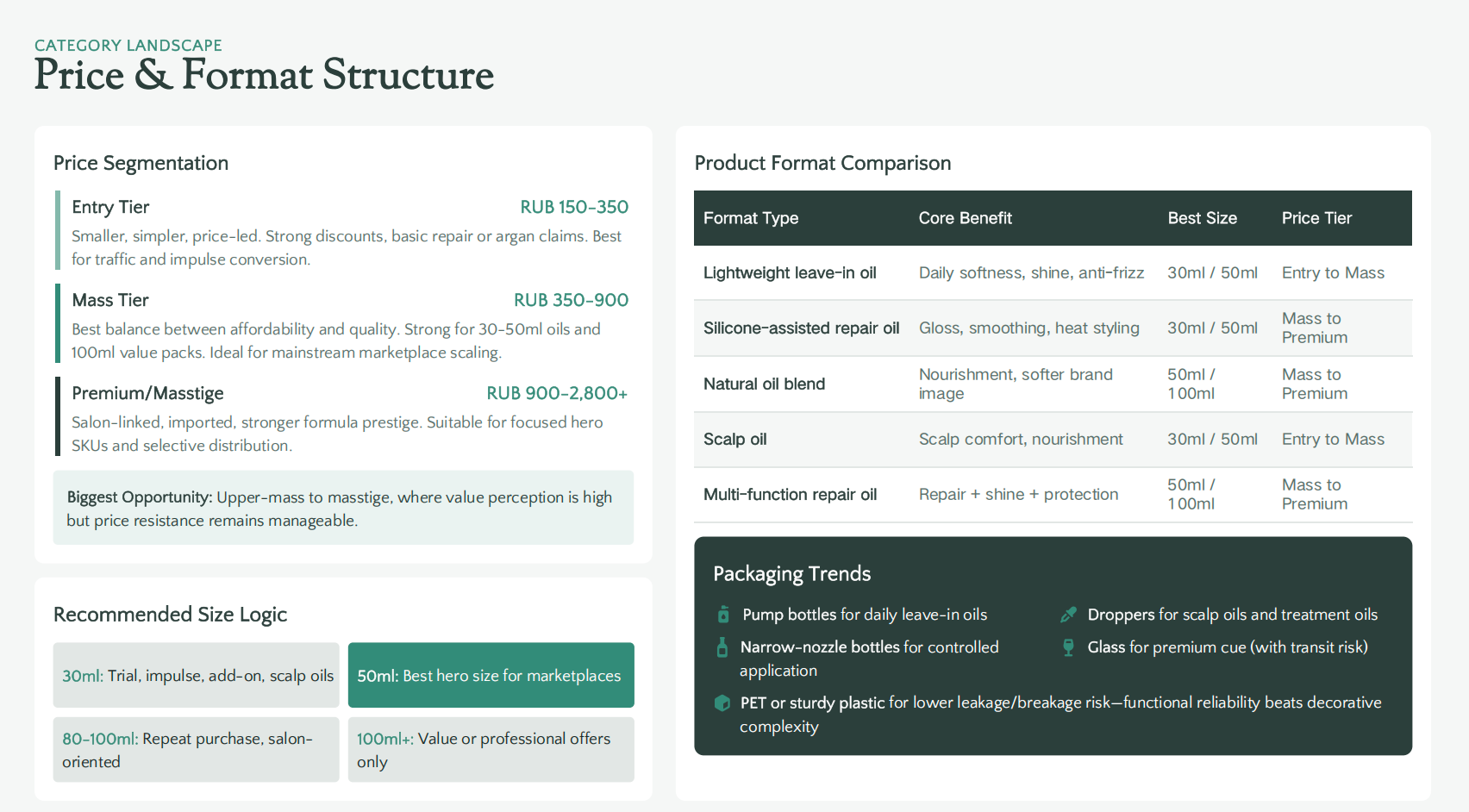
Price & Format Structure
Size and Packaging Logic
Format selection matters more than many brands expect.
The most practical size logic is:
- 30ml for trial, add-on sales, and focused treatment use
- 50ml as the best hero size for marketplaces
- 80ml to 100ml for repeat purchase and value-oriented users
- above 100ml only when the offer clearly targets value or professional channels
Packaging should be chosen for reliability, not visual complexity.
The most commercially useful options include:
- pump bottles for daily leave-in oils
- droppers for scalp oils and smaller treatment oils
- narrow-nozzle bottles for controlled application
- sturdy plastic or reliable PET for safer e-commerce
- carefully selected glass only when breakage and leakage risk are fully managed
In Russia, a well-sealed premium-looking plastic bottle often performs better in e-commerce than decorative glass with weak transit performance.
Channel Strategy
A Russia hair oil launch should be channel-aware from the beginning.
Marketplaces
Ozon and Wildberries are central to visibility, price comparison, review accumulation, and product testing. These channels reward products with:
- clear benefit titles
- review-friendly textures
- strong repair and shine language
- easy dosage communication
- reliable packaging
- manageable hero sizes
For marketplace launches, a 50ml hero SKU is often the best starting point.
Retail and Distributor Channels
Retail and distributor channels work best with a simpler structure:
- one hero repair oil
- one daily-use or softness extension
- one premium-looking salon-style upgrade
This keeps the assortment readable and easier for partners to carry.
DTC and Specialty Channels
These channels are more suitable for:
- scalp oil extensions
- bundle offers
- premium repair oils
- dual systems such as scalp plus ends care
- fragrance-controlled or giftable variants
The strongest strategy is not to force one product format across every channel. It is to adapt the assortment to how each channel drives conversion.
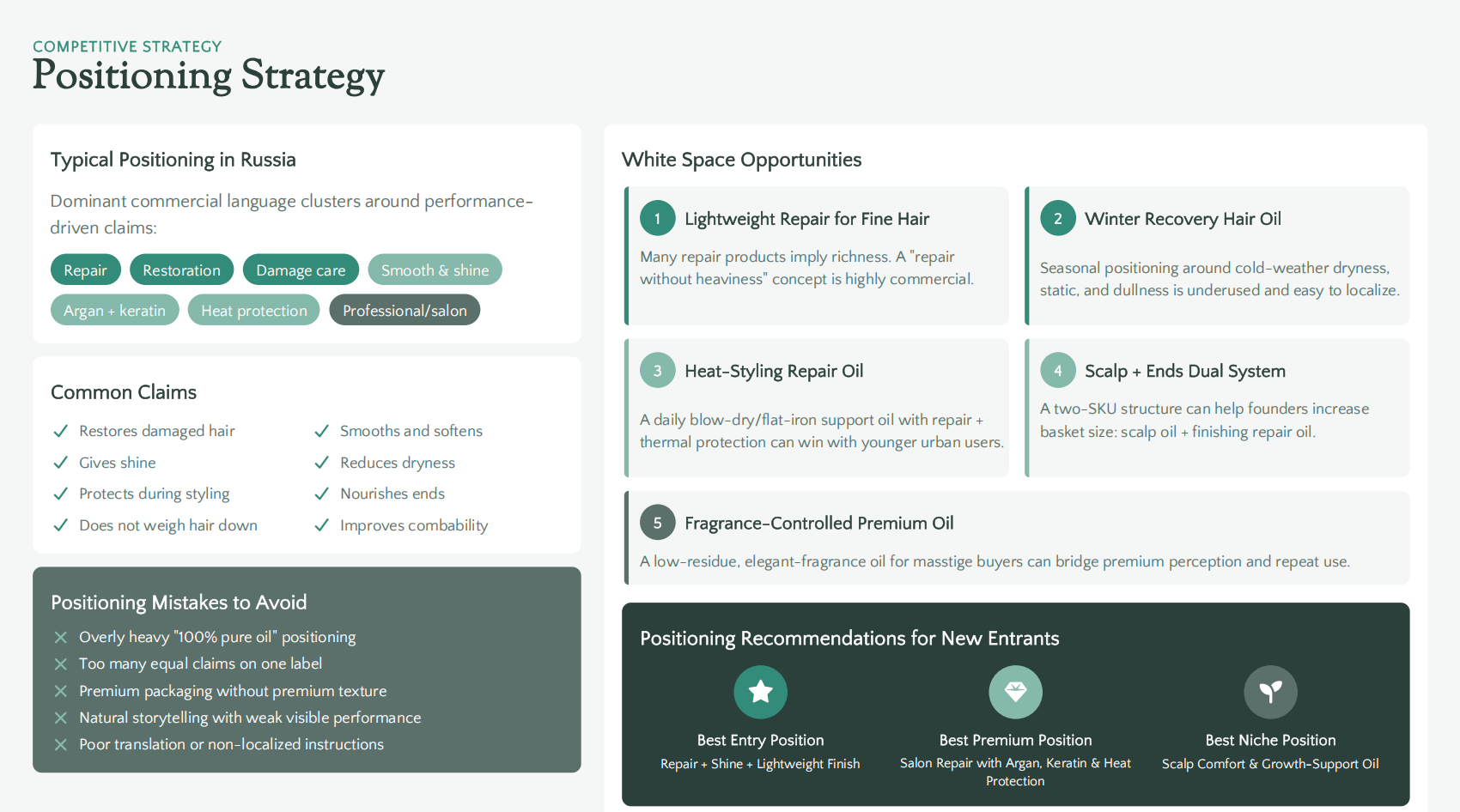
Competitive White Space
The Russia market does not need another vague “nourishing oil.” It rewards products that can be understood instantly.
The most attractive white-space directions include:
- lightweight repair for fine or easily weighed-down hair
- winter recovery hair oil
- blow-dry protection oil
- split-end focused repair oil
- scalp plus ends dual system
- premium salon-style repair oil with elegant finish
- low-residue gloss oil with controlled fragrance
For most new entrants, the best entry position is:
Repair + Shine + Lightweight Finish
This combination has the widest demand relevance, the strongest marketplace communication value, and the clearest before-and-after storytelling potential.
Positioning Strategy
Claims and Messaging Strategy
Hair oil works best in Russia when claims are simple, visible, and immediately understandable.
The most commercially effective claim language includes:
- repair
- restoration
- smoothness
- shine
- anti-frizz
- softness
- split-end care
- heat protection
- does not weigh hair down
- easier combing
The best listings do not overload one SKU with too many equal claims. They lead with one hero benefit and support it with two or three secondary benefits.
That makes the product more legible, more credible, and easier to compare online.
Compliance and Packaging Risk
A strong formula alone is not enough. Hair oil can fail commercially through labeling errors, packaging leakage, weak component compatibility, or transit damage before the customer even experiences the product.
For Russia launches, key priorities include:
- correct product classification
- importer-side market-entry readiness
- mandatory labeling workflow alignment
- accurate ingredient declaration
- usage instructions and warnings
- traceability details
- stability observation
- compatibility testing with pump, dropper, label, and carton
- transport simulation
- claims review
- oil resistance of packaging materials
The biggest practical risks are:
- leakage in transit
- pump or dropper failure
- label staining
- poor seal performance
- haze or appearance change under cold conditions
- greasy texture reviews
- overpromising claims
For e-commerce, even small leakage rates can quickly damage ratings and returns performance.
OEM and Product Development Strategy
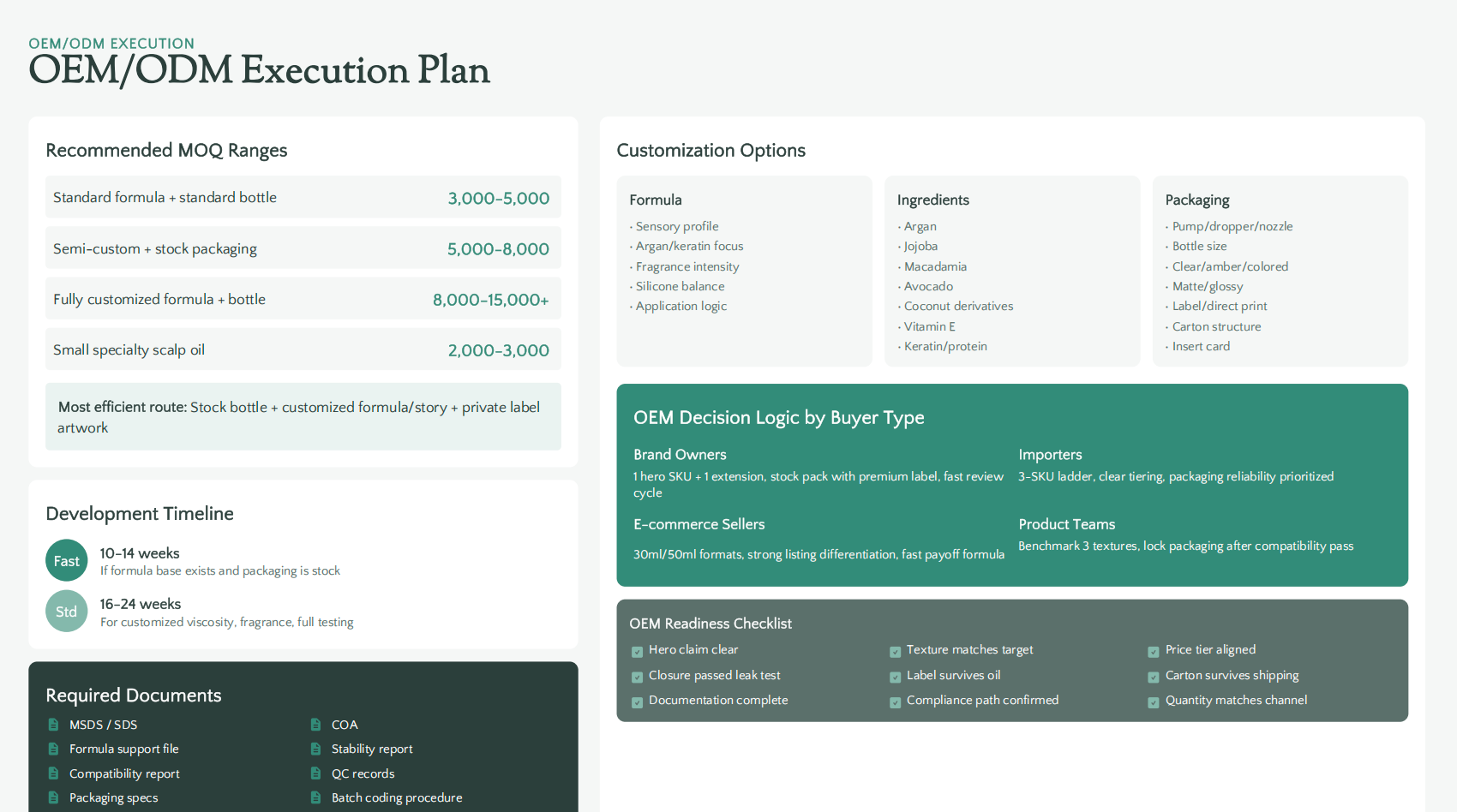
The best OEM path for a Russia hair oil project is usually not full customization from day one. The most efficient route is often:
- stock bottle
- customized formula or texture
- localized claim structure
- private label artwork
- fast validation of packaging reliability
A practical development framework includes:
- one hero repair oil
- one extension for styling or split ends
- optional scalp oil only after hero SKU logic is validated
A stronger RFQ should define:
- target market
- target channel
- hero claim
- texture direction
- target price band
- preferred size
- packaging format
- expected documentation
- testing requirements
- first order quantity
- launch timing
The more clearly these are defined, the easier it becomes to reduce sampling waste, control cost, and build a product that actually matches channel economics.
OEM/ODM Execution Plan
What Brands Should Do Next
If you are planning a Russia hair oil launch in 2026, the smartest next step is not to build a broad line immediately.
A better path is:
- choose one repair-led hero product
- define one core need state
- use 50ml as the marketplace hero size
- keep texture lightweight and non-greasy
- validate packaging integrity early
- simplify claims for fast comprehension
- build extensions only after the hero product logic is proven
That approach improves launch clarity, lowers operational risk, and gives the product a better chance to perform in review-driven channels.
Final Takeaway
Russia hair oil is not just a trend category. It is a practical treatment segment with strong commercial potential when product design, claim logic, packaging, and channel fit are aligned.
The brands most likely to win in 2026 are not the ones selling the heaviest oil or the most botanical story. They are the ones launching repair-positioned, lightweight, visibly effective hair oils with marketplace-friendly sizing, accessible pricing, and strong OEM execution.
If your team is evaluating a Russia hair oil launch, the strongest next move is to align product strategy, hero claim, package reliability, and OEM path before scaling the assortment.
Download the Full Report (PDF)
Tell us your target region, product category, and the decision you’re trying to make. We’ll suggest the closest existing report—or build a tailored version.