


Executive Summary
This report explores the Russia hair mask market in 2026, including repair demand, hydration trends, price tiers, product structure, marketplace channel strategy, packaging priorities, and OEM launch planning. It is designed to help brands, importers, distributors, and e-commerce sellers turn market opportunity into a more practical treatment-category launch strategy.
Russia Hair Mask Market Report 2026: Repair Demand, SKU Strategy, and Market Entry Guide
The Russia hair mask market in 2026 is commercially attractive because it sits at the intersection of three stable consumer needs: repair, hydration, and salon-like results at home. In a market where dryness, coloring damage, heat styling, and long-hair maintenance remain highly relevant, treatment-oriented categories continue to offer stronger storytelling and repeat-use potential than basic conditioner alone.
For brands, importers, distributors, and e-commerce sellers, the opportunity is not to launch one generic hair mask. The stronger opportunity is to build a repair-led treatment system with clear function, visible size value, and marketplace-ready positioning.
This report translates the Russia hair mask opportunity into practical launch logic. It covers demand drivers, consumer expectations, product structure, price tiers, competitive whitespace, packaging priorities, channel strategy, and OEM execution planning for a 2026 market entry.
Executive Summary
Hair mask is one of the most commercially workable treatment categories in Russia because it directly addresses visible and recurring consumer pain points. Dryness, breakage, frizz, dullness, rough lengths, and post-color damage are easy to understand and easy to merchandise. That makes the category more commercially scalable than highly technical niche treatments.
The strongest demand is concentrated around repair, hydration, smoothness, anti-breakage, and easier combing. Consumers are not primarily looking for abstract wellness positioning. They want stronger performance language, richer texture, and a result they can notice quickly.
For most new entrants, the best strategy is not to build one high-priced prestige mask. The better route is to launch a small treatment system built around one repair hero mask, one faster-treatment SKU, one hydration-repair variant, and one more premium trade-up option. This creates a better balance between conversion, replenishment, and margin.
In channel terms, Russia remains a marketplace-first environment for this category. Large-format jars, clear benefit language, and strong value optics matter more than minimal branding or prestige storytelling alone.
Market Opportunity Overview
The Russia hair mask market should be treated as a mid-sized but scalable treatment opportunity inside the broader hair care category. It works especially well because the category solves practical consumer problems while still allowing enough room for visible differentiation in size, texture, and claims.
Consumers in Russia regularly face hair stress from cold weather, indoor heating, coloring, bleaching, blow-drying, and routine damage across the lengths. That makes repair and hydration more than occasional beauty concerns. They are repeat-use drivers.
This is why hair mask performs better than a simple add-on treatment. It is easy to insert into routine care, easy to cross-sell with shampoo and leave-in products, and easy for consumers to evaluate after the first few uses.
For suppliers and brand owners, this creates a category with stronger conversion logic than standard conditioner and lower complexity than more technical scalp-care formats.
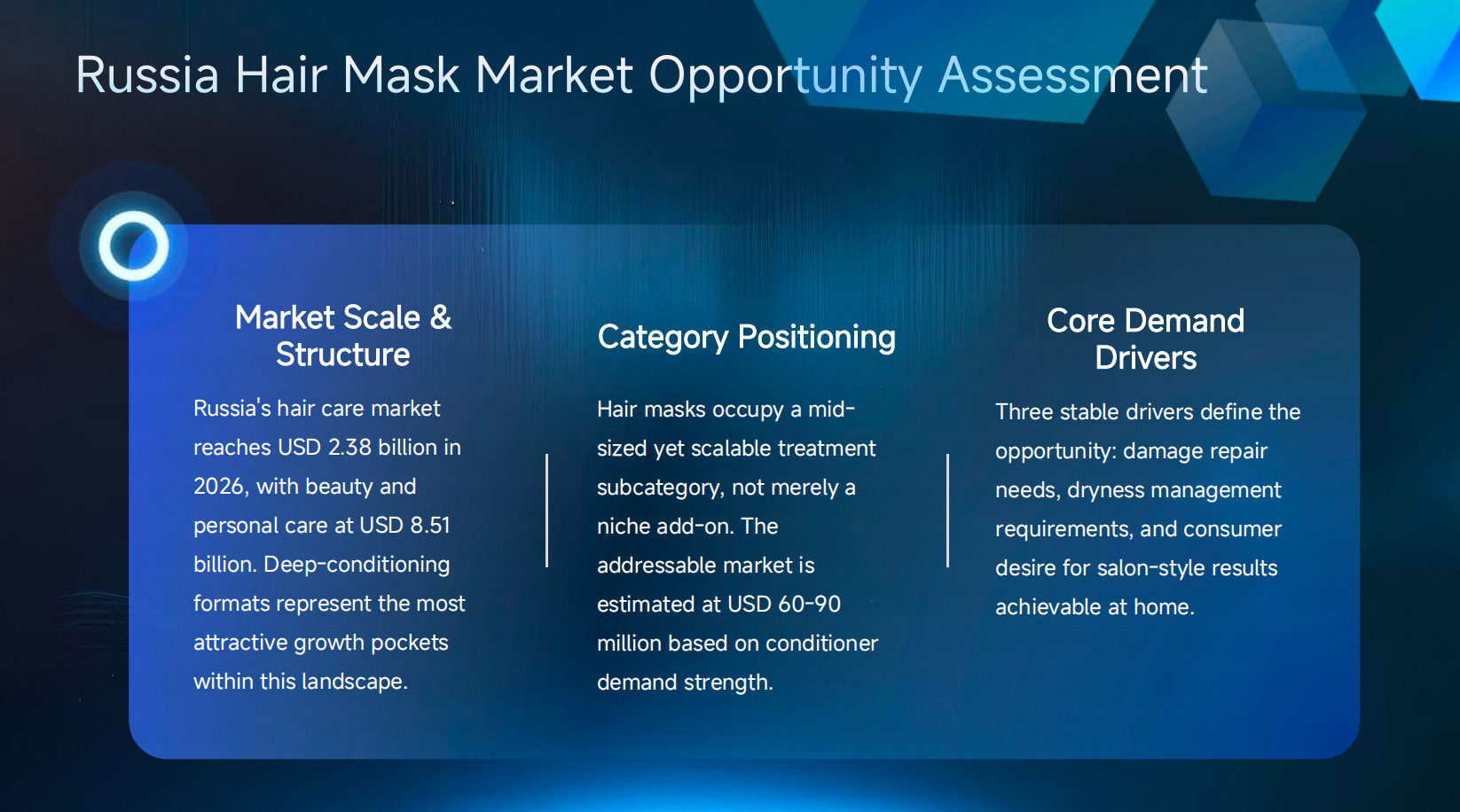
Russia Hair Mask Market Opportunity Assessment
Why the Category Works in Russia
Russia is a favorable market for hair masks because the need state is highly visible. Consumers can immediately understand what a repair mask is for and whether it is relevant to their hair condition.
The strongest trigger conditions include:
- dry hair
- damaged or bleached hair
- brittle ends
- frizz and rough texture
- dullness
- post-color stress
- the desire for softer, smoother, more manageable hair at home
This creates a straightforward demand environment where repair and hydration claims can convert well when the texture, size, and benefit language all feel credible.
Consumers are not only buying ingredients. They are buying the promise of restored softness, easier detangling, reduced breakage, and more salon-like hair feel without salon-level cost.
Consumer Demand Signals
The Russia hair mask market is driven more by visible performance than by abstract brand philosophy. Buyers respond well to products that clearly communicate what they do and for whom they are made.
The most commercially relevant demand signals include:
- repair for dry and damaged hair
- hydration for winter dryness and dull lengths
- anti-breakage support
- anti-frizz and smoothness
- keratin-style restoration
- quick treatment formats with visible softness
- salon-style quantity and value
Russian consumers are also highly sensitive to price-to-size logic. A hair mask does not have to be cheap, but it does have to look worth the money. Large jars, legible benefits, and strong first-use sensorial performance all contribute to that perception.
This is especially important in marketplaces, where consumers compare multiple listings quickly and make decisions based on visible value, reviews, and clarity of promise.
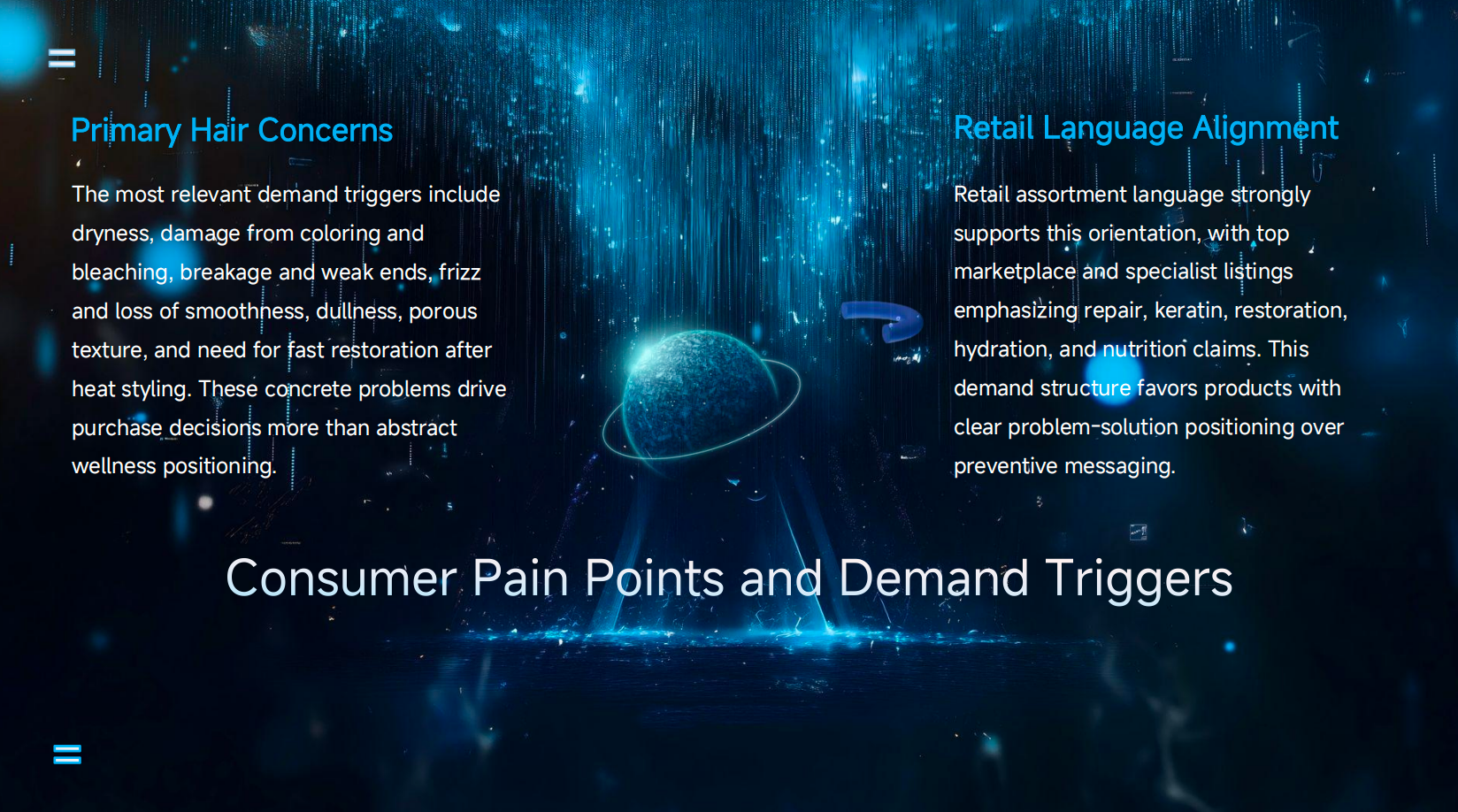
Consumer Insights &Demand Signals
Key Consumer Groups
A useful way to approach the category is through four consumer groups.
The first is the female mass-market user. This is the main volume driver. She is looking for practical repair, softness, and smoothness at an affordable but not low-trust price.
The second is the salon-influenced user. She is more willing to respond to keratin, intense repair, professional care, and larger treatment formats that feel closer to salon usage.
The third is the marketplace comparison shopper. She reads reviews, compares size and function across listings, and expects the benefit to be clearly visible from the pack and the first product image.
The fourth is the modern imported-beauty buyer. This user is open to alternative-origin brands, especially when the product looks formula-modern, affordable, and more advanced than standard local mass offerings.
The winning assortment should be built for these real shopping behaviors, not for overly narrow prestige positioning.
Product Structure and Category Logic
The Russia hair mask market is best understood as a value-heavy category with visible masstige layering. Consumers do not need highly technical segmentation to buy. They need clear recognition of benefit, size, and treatment role.
The strongest structure usually includes:
- one hero repair mask
- one keratin or anti-frizz recovery mask
- one hydration-repair mask
- one express 3–5 minute mask
- one more advanced premium-masstige repair option
This type of architecture works because it creates a clear line-up without fragmenting the inventory too early. Each SKU has a defined commercial role, and the whole range still looks easy to understand in marketplace environments.
A strong launch should feel like a treatment family, not a random collection of hair masks.
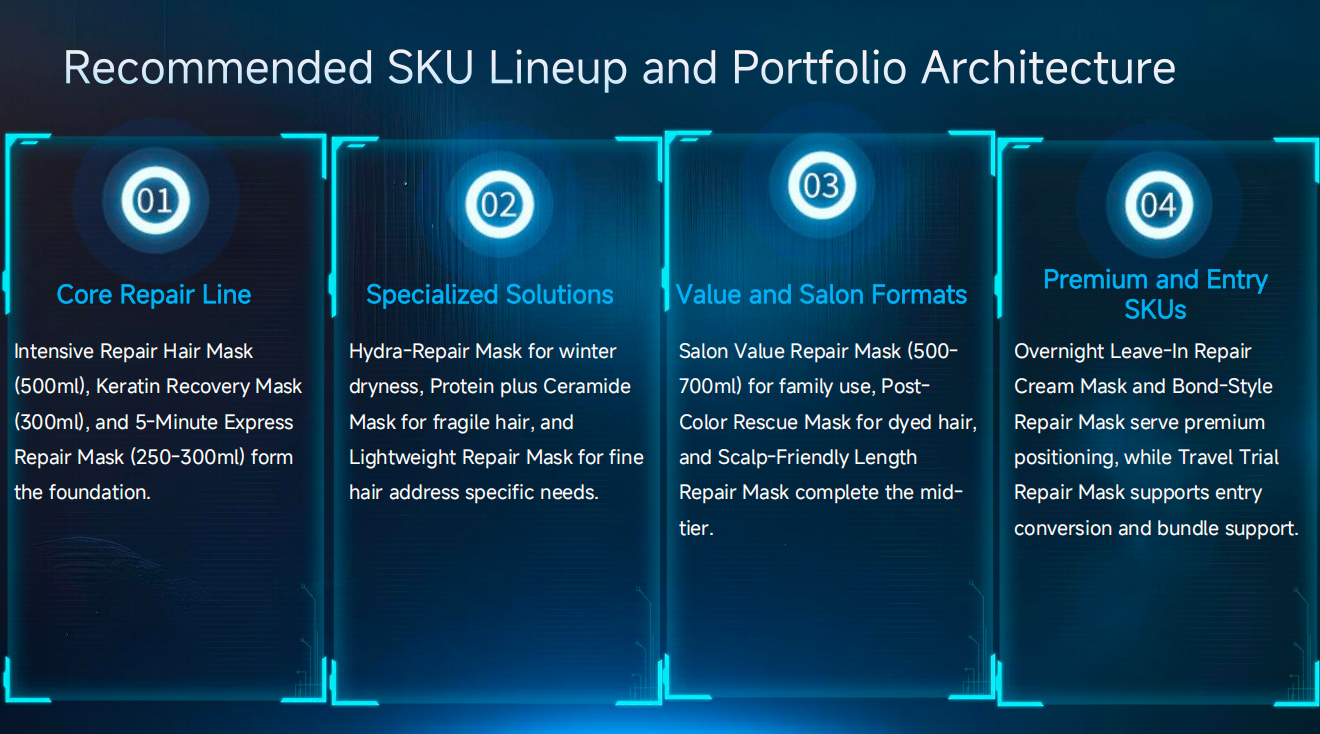
Recommended SKU Lineup and Portfolio Architecture
Recommended Product Directions
The most viable product directions for 2026 are:
- intensive repair hair mask for dry and damaged hair
- keratin recovery mask for smoothness, anti-frizz, and shine
- hydration-repair mask for winter dryness and long hair
- 3–5 minute express repair mask for routine users
- protein plus ceramide mask for brittle or porous hair
- lightweight repair mask for fine hair
- post-color rescue mask for dyed or bleached hair
- large-format salon-style repair mask for heavy-use households
These directions work because they convert common pain points into recognizable and commercially legible solutions.
Instead of trying to invent a totally new subcategory, a stronger strategy is to make repair more specific, more routine-compatible, and more value-clear than the average market offer.
Price Strategy and Size Logic
Russia remains a price-aware beauty market, so the right entry point is usually upper mass to low masstige rather than prestige-first.
A practical pricing ladder should look like this:
- mass for volume-driving repair and large-format replenishment
- masstige for keratin, post-color, or more specialized treatment claims
- premium-masstige for advanced or bond-style repair positioning
Size matters just as much as price. In this category, 250 ml to 500 ml is the most commercially workable range. Smaller packs can support entry and trial, but the strongest conversion often comes from jars that look substantial enough for repeated use.
Large sizes communicate:
- stronger value
- salon quantity
- family-use practicality
- repeat-use economics
- more visible treatment seriousness
That is why 500 ml formats are especially useful as hero SKUs for marketplace-led launch strategies.
Texture, Sensorial Delivery, and Packaging Expectations
A repair hair mask in Russia needs to feel credible from the first use. Texture and sensorial delivery are not secondary details. They are central to repeat purchase.
Consumers generally expect:
- rich cream texture
- strong slip during application
- easy detangling
- visible softness after rinsing
- hair that feels smoother and less frizzy
- pleasant scent without harshness
- a non-watery, treatment-like appearance
For hero repair masks, a thin texture can weaken the perception of effectiveness. The formula should feel nourishing and substantial without becoming greasy or heavy on the hair.
Packaging should also support commercial clarity. The strongest packaging directions include:
- wide-mouth jars or tubs
- clear front-panel claims
- color coding by function
- premium-looking but value-legible design
- pack language that immediately explains the target problem and benefit
This is not a category where minimal packaging usually wins. The product needs to tell the consumer exactly what it does.
Competitive White Space
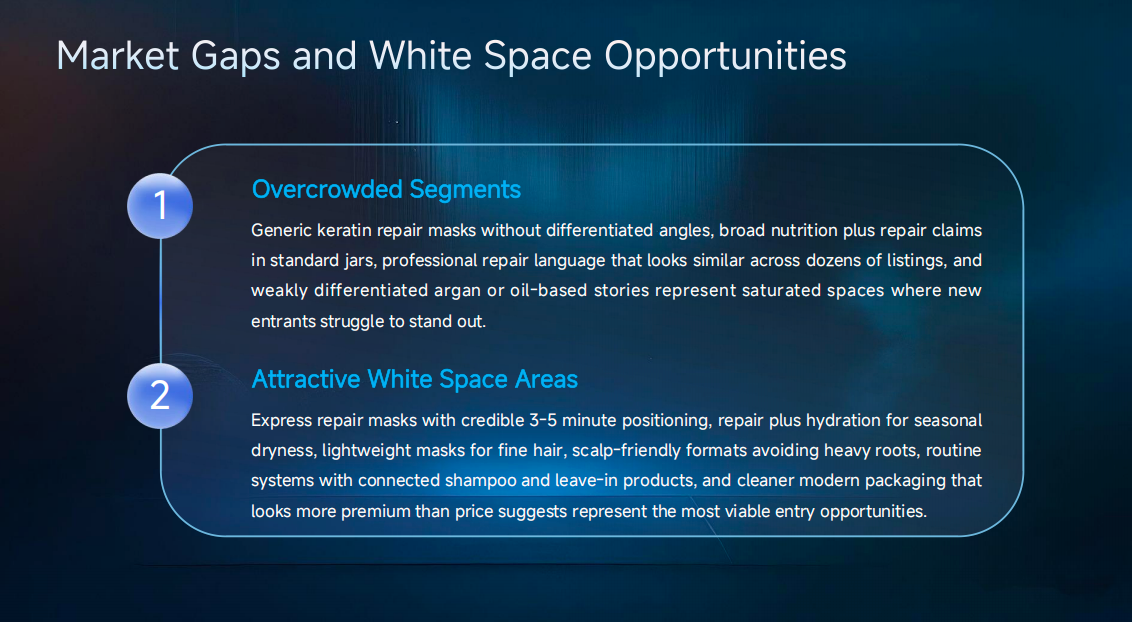
The market is active, but most offers cluster around the same claim language. This creates both crowding and opportunity.
The most crowded areas include:
- generic keratin repair masks
- broad nourishment and repair language
- standard argan or oil-based repair stories
- “professional” masks that look visually similar across many listings
The better white-space areas include:
- express repair masks with credible fast-action positioning
- hydration-repair masks for seasonal dryness
- lightweight repair masks for fine hair
- scalp-friendly length-care masks
- modern routine systems with shampoo, mask, and leave-in logic
- cleaner premium-looking packaging at accessible price bands
A new entrant does not need to reinvent the category. It needs to segment it more clearly and execute more cleanly.
Market Gaps and White Space Opportunities
Recommended Launch SKU Strategy
For a new market entry, the smartest starting point is a focused 4-SKU launch.
A strong first-line setup includes:
- Intensive Repair Hair Mask
- 5-Minute Express Repair Mask
- Hydra-Repair Mask
- Post-Color Rescue Mask
This lineup gives you:
- one volume driver
- one faster-conversion routine SKU
- one seasonal or dryness-led SKU
- one higher-value targeted variant
Within this structure, the hero should be the 500 ml intensive repair mask. It gives the clearest value optics, strongest review potential, and easiest conversion path for a new brand.
The express mask can function as a conversion SKU. The hydration-repair variant can support replenishment and seasonal usage. The post-color or keratin-led option can act as a stronger masstige trade-up.
Channel Strategy
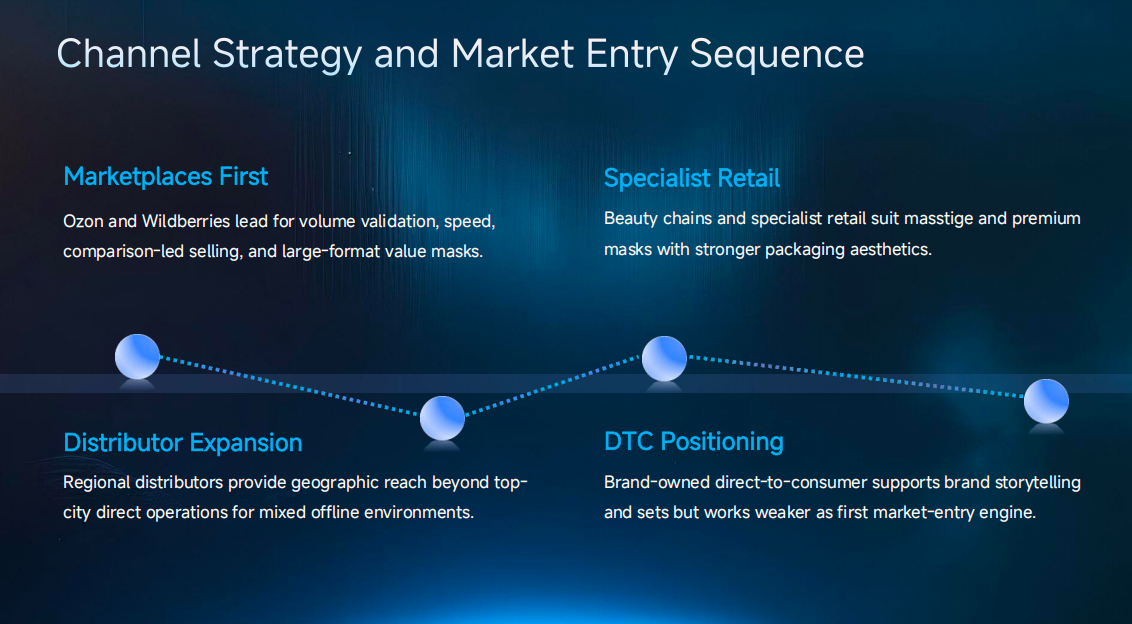
The best first channel for a Russia hair mask launch is e-commerce, especially large marketplaces, followed by distributor-led expansion and selective beauty retail.
A practical channel priority is:
- marketplaces first
- regional distributors second
- beauty chains and specialist retail third
- brand-owned DTC later
This order works because the category is highly review-driven and comparison-driven. Marketplaces allow faster product validation, faster price testing, and clearer visibility into which SKU actually wins.
For foreign brands, the strongest entry route is not Western prestige storytelling. The better route is:
- lead with functional repair
- keep claims highly legible
- compete in upper mass or low masstige
- use strong size-value logic
- adapt fragrance, texture, and packaging to local expectations
Country of origin can help, but only when it reinforces quality and affordability rather than pushing the product too far into prestige territory.
Channel Strategy and Market Entry Sequence
Bundling and Routine Strategy
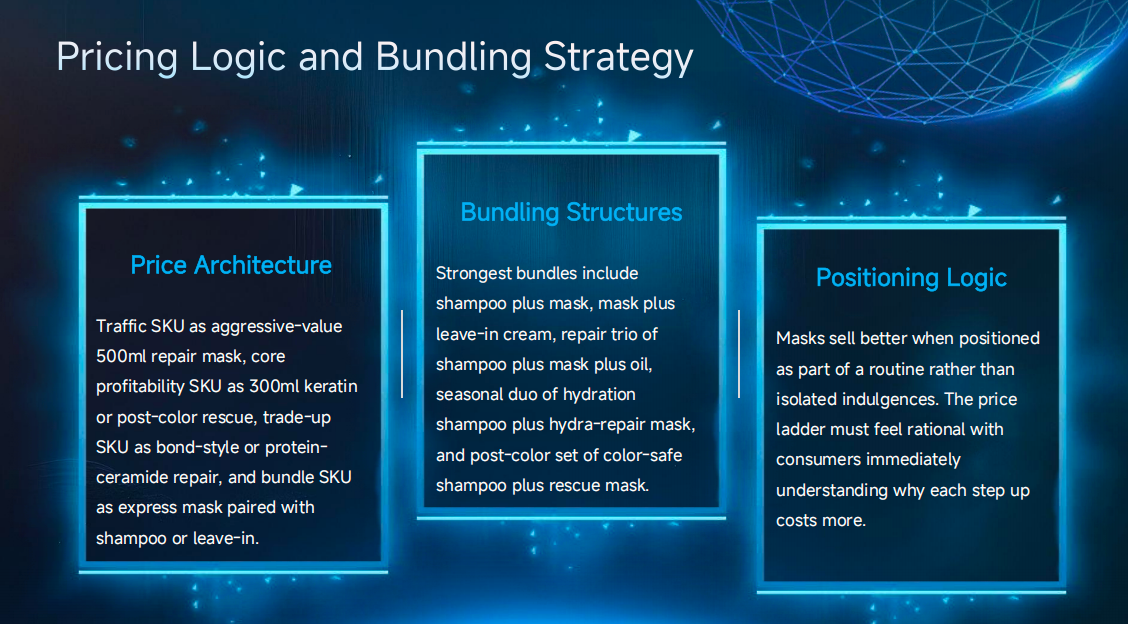
Hair masks are stronger when positioned as part of a routine rather than as isolated products.
The most commercially useful bundles include:
- shampoo plus mask
- mask plus leave-in cream or serum
- repair trio with shampoo, mask, and oil
- seasonal hydration duo
- post-color set with gentle shampoo and rescue mask
This helps in two ways. It increases average order value, and it makes the brand easier to understand as a treatment system rather than a one-product offer.
Routine logic also strengthens repeat purchase. A consumer who buys into a system is more likely to reorder than a consumer who buys one isolated jar.
Compliance and Quality Priorities
Hair masks are not hard to formulate, but they are easy to commercialize badly if the operational details are weak.
Before launch, the product should be validated for:
- formula stability
- viscosity consistency
- fragrance stability
- compatibility with jar and closure system
- leakage resistance
- transport stability
- clear and accurate labeling
- local-language pack readiness
- batch and shelf-life coding
- supportable claim language
The most common failure points are leakage, phase separation, thin texture, poor rinse feel, overly heavy residue, and claims that promise more than the product can visibly deliver.
A strong repair mask has to feel rich but not waxy, nourishing but not greasy, and effective from the first few uses.
OEM and Product Development Execution
A Russia-focused hair mask project can move relatively quickly when the brief is commercially clear. Most delays come from vague positioning rather than real technical difficulty.
Before sending an RFQ, buyers should define:
- target market inside Russia
- preferred channel
- target retail price
- target pack size
- texture preference
- key claim direction
- target hair type
- fragrance direction
- benchmark products
- launch timeline
- packaging flexibility
The most efficient development model is usually:
- one hero base
- three to four market-facing variants
- one shared packaging family
- differentiated fragrance, claim, or actives by SKU
This reduces unnecessary complexity while still giving the range enough commercial depth to feel market-ready.
Pricing Logic and Bundling Strategy
What Brands Should Do Next
If you are evaluating a Russia hair mask launch, the smartest next move is not to start with a vague “repair mask” request.
Instead:
- choose the right value band
- define the hero format
- decide whether repair, hydration, keratin, or post-color should lead
- clarify your target channel
- align texture expectations with claim direction
- design the range as a small treatment system
That approach leads to faster development, stronger quotes, better packaging decisions, and clearer market positioning.
Final Takeaway
The Russia hair mask market in 2026 is attractive because it sits inside a stable, problem-solving treatment need state. Consumers know why they buy hair masks, they use them repeatedly, and they compare them through highly legible value and performance signals.
The brands most likely to win are not the ones launching the most luxurious product. They are the ones delivering the clearest system: one strong repair hero, one visible size-value story, one or two sharp treatment extensions, and packaging that makes the product easy to trust in a review-driven marketplace environment.
If your team is planning a Russia hair mask launch, the strongest next step is to align repair logic, format structure, price band, and OEM execution before sampling begins.
Download the Full Report (PDF)
Tell us your target region, product category, and the decision you’re trying to make. We’ll suggest the closest existing report—or build a tailored version.