


Executive Summary
This report explores the Russia hair growth and anti hair loss market in 2026, including scalp care demand, product formats, ingredient directions, marketplace opportunities, pricing logic, compliance awareness, and OEM launch planning. It is designed to help brands, distributors, importers, and e-commerce sellers turn market insight into a more practical scalp-care launch strategy.
Russia Hair Growth and Anti Hair Loss Market 2026: Trends, Scalp Care Opportunities, and Launch Strategy
The Russia hair growth and anti hair loss market in 2026 is commercially attractive, but the winning opportunity is not a single miracle-growth SKU. The stronger path is a routine-based scalp and thinning-hair system built around one hero leave-on treatment, one credibility shampoo, and several supporting scalp-care or densifying products.
For brands, importers, distributors, and e-commerce sellers, the market is not only about male baldness. It also includes female thinning, stress shedding, postpartum recovery, seasonal fallout, oily scalp, flakes, and scalp discomfort. That gives scalp care a much bigger commercial role than simple anti hair loss shampoo positioning.
This report turns market signals into practical launch logic. It covers consumer demand, product formats, ingredient directions, channel fit, marketplace strategy, compliance awareness, and OEM-ready SKU planning for entering the Russia hair growth and anti hair loss category.
Executive Summary
Russia’s hair growth and anti hair loss opportunity in 2026 is best approached as a scalp-first functional cosmetic category rather than a narrow regrowth niche. Consumers are increasingly responding to product systems that combine shedding support, scalp comfort, oil balance, breakage reduction, and fuller-looking density.
The strongest products are not usually shampoo-only offers. Shampoos remain important for routine entry and traffic generation, but the hero commercial role is more often held by scalp serums, tonics, sprays, and ampoules. These formats create stronger perceived efficacy, stronger bundle logic, and better repeat value on marketplaces.
For most new entrants, the most practical launch path is a 6–8 SKU range positioned as functional cosmetic scalp care for stronger, fuller-looking hair and reduced shedding. The most effective structure starts with one hero leave-in scalp serum, one caffeine shampoo, one concentrated booster treatment, and one scalp-balancing support product.
Market Opportunity Overview
The Russia hair care market provides a strong commercial base for hair growth and anti hair loss products, especially within the broader segment of scalp treatments, anti-shedding shampoos, leave-on products, and functional daily care.
What makes this category attractive is that consumer demand is already established. The opportunity is not to create a completely new habit, but to upgrade an existing behavior. Shoppers are already looking for caffeine shampoos, scalp serums, root sprays, ampoules, rosemary-led products, and densifying solutions. The commercial gap is in better-structured systems rather than in isolated single products.
Russia is especially favorable to hybrid positioning:
- derma-cosmetic but still accessible
- functional but not overly clinical
- ingredient-led but still cosmetically wearable
- problem-solution oriented without looking like prescription treatment
This gives brands room to build stronger scalp-care-led product systems without moving into unrealistic claim territory.
Russia Hair Growth &
Anti Hair Loss
Market 2026
What Is Driving Demand in 2026
Several overlapping drivers are shaping demand.
The first is broader consumer concern around thinning and shedding. In Russia, the category is not limited to male pattern baldness. Women dealing with stress, breakage, postpartum recovery, seasonal fallout, and scalp discomfort also create major demand.
The second is the growing connection between scalp condition and hair fall. Consumers increasingly believe that oiliness, flakes, irritation, dryness, or buildup contribute to weak roots and visible shedding. This is why scalp care is becoming one of the most important commercial bridges inside the category.
The third is marketplace behavior. On Ozon and Wildberries, consumers compare products quickly, respond strongly to visible actives, and prefer easy-to-understand routines. That makes ingredient storytelling, bundle logic, and role clarity more important than abstract branding.
The fourth is affordability with efficacy. Russia remains especially favorable to functional cosmetic positioning in accessible mass and masstige pricing, rather than ultra-premium hair growth lines.
Core Consumer Segments
The highest-potential target groups include:
- men concerned with receding hairline, crown thinning, and everyday shedding
- women dealing with thinning, breakage, or density loss
- postpartum and post-stress recovery users
- consumers with oily, flaky, or sensitive scalp linked to fallout
- marketplace shoppers looking for visible actives and simple daily routines
These users do not all buy the same way. Men often respond to root support, density, everyday prevention, and fresh non-greasy textures. Women respond more strongly to reduced shedding, fuller-looking density, scalp comfort, recovery, and elegant daily-use formulas.
That means product lines should not rely on one flat message. The strongest launches translate one technical formula system into several consumer-friendly roles.
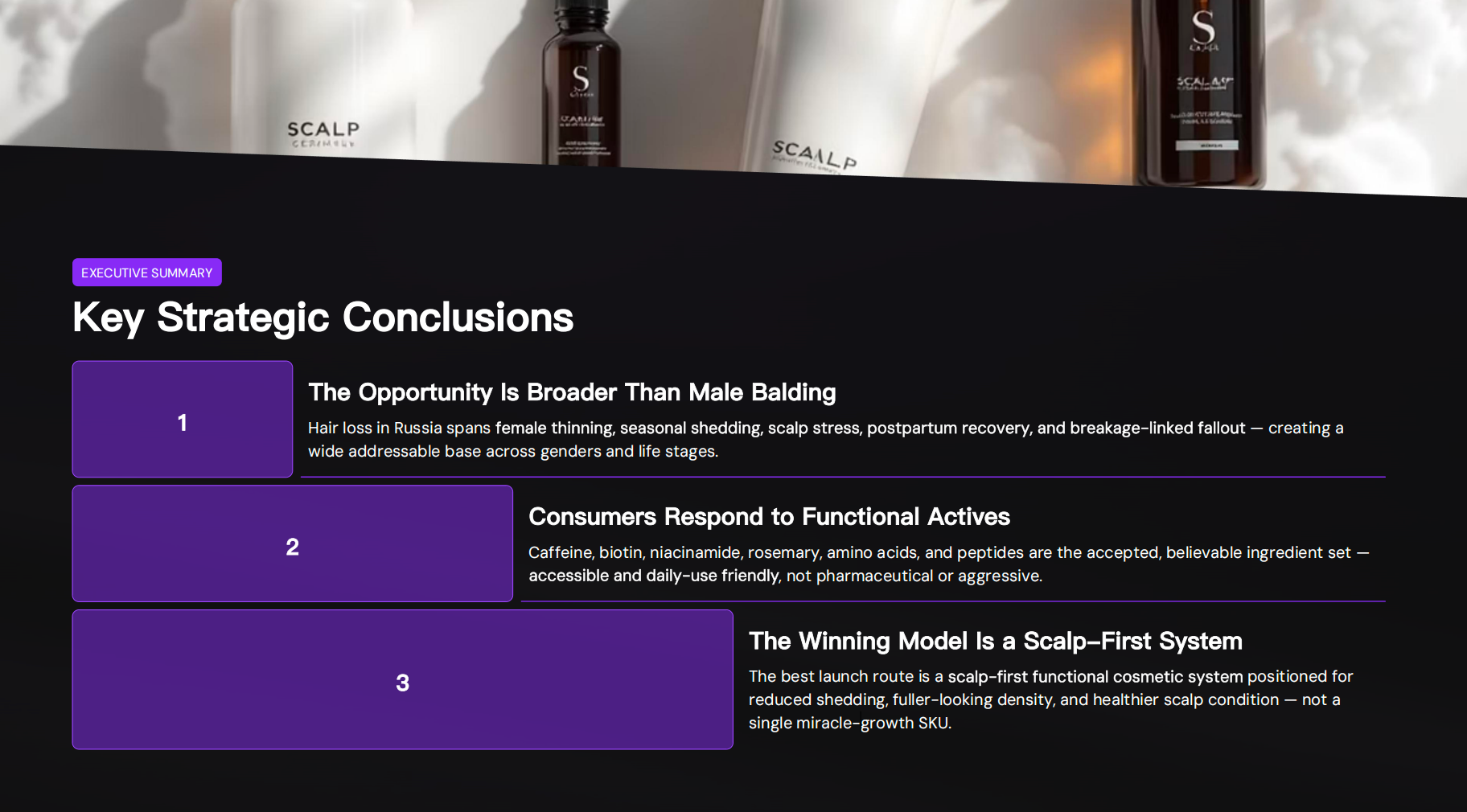
Key Strategic Conclusions
Consumer Motivations and Buying Triggers
The category is driven by both function and emotion.
The strongest motivations include:
- anxiety about visible shedding during washing or brushing
- fear of widening part lines or weaker density
- desire for thicker-looking, fuller-looking hair
- desire for a healthier scalp as the base for stronger hair
- desire for simple non-prescription daily solutions
The strongest purchase triggers include:
- noticeable shedding after stress, illness, or seasonal change
- postpartum fallout
- oily scalp plus hair fall
- dry or irritated scalp plus breakage
- review density and before-after style product storytelling
- marketplace bundles that make routines easy to understand
This is one reason why leave-on products matter so much. Consumers often see shampoo as supportive, but serum, tonic, spray, and ampoule formats are where the “real action” happens.
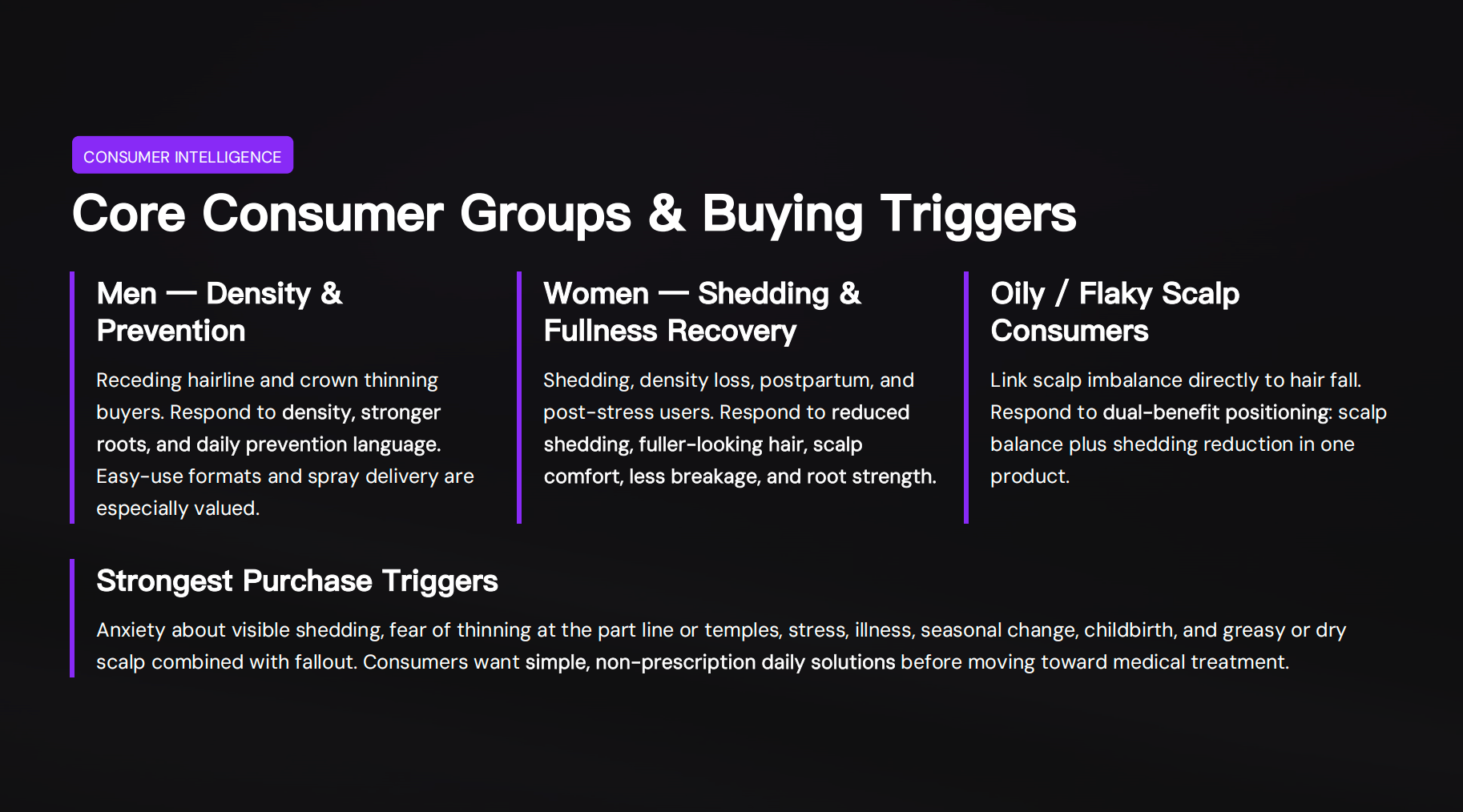
Core Consumer Groups & Buying Triggers
Ingredient Directions with the Strongest Commercial Potential
Russia’s market responds especially well to ingredient-recognition logic. Consumers are already familiar with and actively shopping for ingredients associated with hair fall support, scalp stimulation, or densifying care.
The most commercially relevant actives include:
- caffeine
- biotin
- niacinamide
- rosemary
- amino acids
- peptides
- zinc PCA
- panthenol
- salicylic-acid-based scalp balance systems
- soothing botanical support for scalp comfort
The strongest product stories usually combine visible actives with practical scalp use. In other words, the market responds better to “daily scalp serum for reduced shedding and stronger-looking roots” than to vague promises of magical regrowth.
Format Strategy: Which Product Types Matter Most
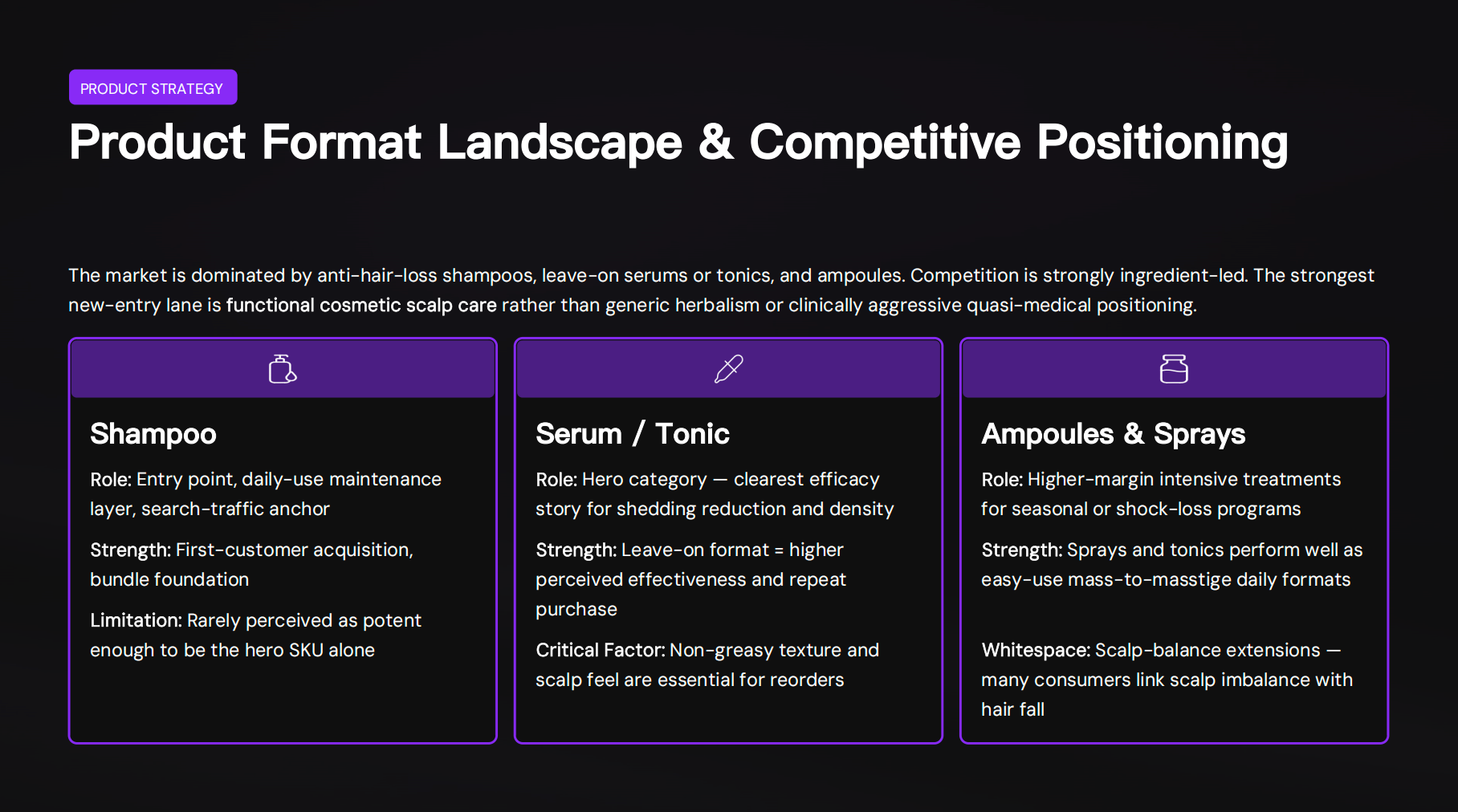
A Russia-ready anti hair loss launch should not begin with too many overlapping formats. It should use a clear product hierarchy.
Shampoo
Shampoo is the most familiar entry point and a strong traffic driver. It supports bundle logic and repeat purchase, but it is rarely enough to serve as the hero efficacy product on its own.
Serum or Tonic
This is usually the strongest hero category. Serums and tonics fit daily-use routines, create stronger efficacy perception, and support higher-value repeat behavior.
Ampoule or Intensive Treatment
Ampoules work well as course-based treatment products for seasonal shedding, high-fall episodes, or stronger treatment perception. They are also useful as higher-margin support SKUs.
Leave-In Spray
Leave-in sprays are especially useful for convenience, male targeting, gym-active users, and entry-level daily scalp care. They can also bridge scalp comfort and anti-shedding messaging.
Scalp Care Extensions
Scalp balancing tonics, exfoliating scalp treatments, anti-flake support, and pre-wash scalp care are among the most valuable opportunities in the market because many users connect hair fall with scalp imbalance.
Product Format Landscape & Competitive Positioning
The Most Practical Launch SKU Structure
For most brands, the strongest launch is not a wide assortment. It is a system with clear role separation.
A practical first portfolio usually includes:
- one hero daily scalp density serum
- one caffeine scalp shampoo
- one intensive ampoule booster
- one easy-use root refresh spray
- one scalp balance tonic for oily or flaky scalp
- one anti-breakage conditioner or mask
- one premium-light peptide densifying essence
- one concern-specific extension such as postpartum or seasonal recovery support
This type of architecture works because it creates:
- one authority SKU
- one accessible entry SKU
- one higher-margin treatment SKU
- one strong bundle base
- one repeat-purchase support path
- room for future expansion without launching too many products at once
Best Product Opportunities for 2026
The strongest product directions in this category include:
Daily Anti Hair Loss Scalp Serum
A leave-on serum with caffeine, niacinamide, biotin, and scalp-support ingredients is one of the clearest hero opportunities for Russia. It fits daily use, marketplace conversion, and strong efficacy perception.
Caffeine and Scalp Balance Shampoo
This works especially well as an entry product for oily scalp, everyday prevention, and bundle-building. It should support the serum rather than try to replace it.
Intensive Ampoule Course Treatment
Ampoules are highly effective as a treatment-style booster for seasonal shedding, postpartum recovery, or “shock loss” periods. They also create stronger treatment positioning for the line.
Rosemary and Peptide Root Spray
This format is especially attractive for consumers who want a natural-modern crossover story with faster daily application.
Peptide Densifying Scalp Essence
This is a strong women-focused or pharmacy-adjacent option because it shifts the conversation from balding to density, quality, and fuller-looking hair.
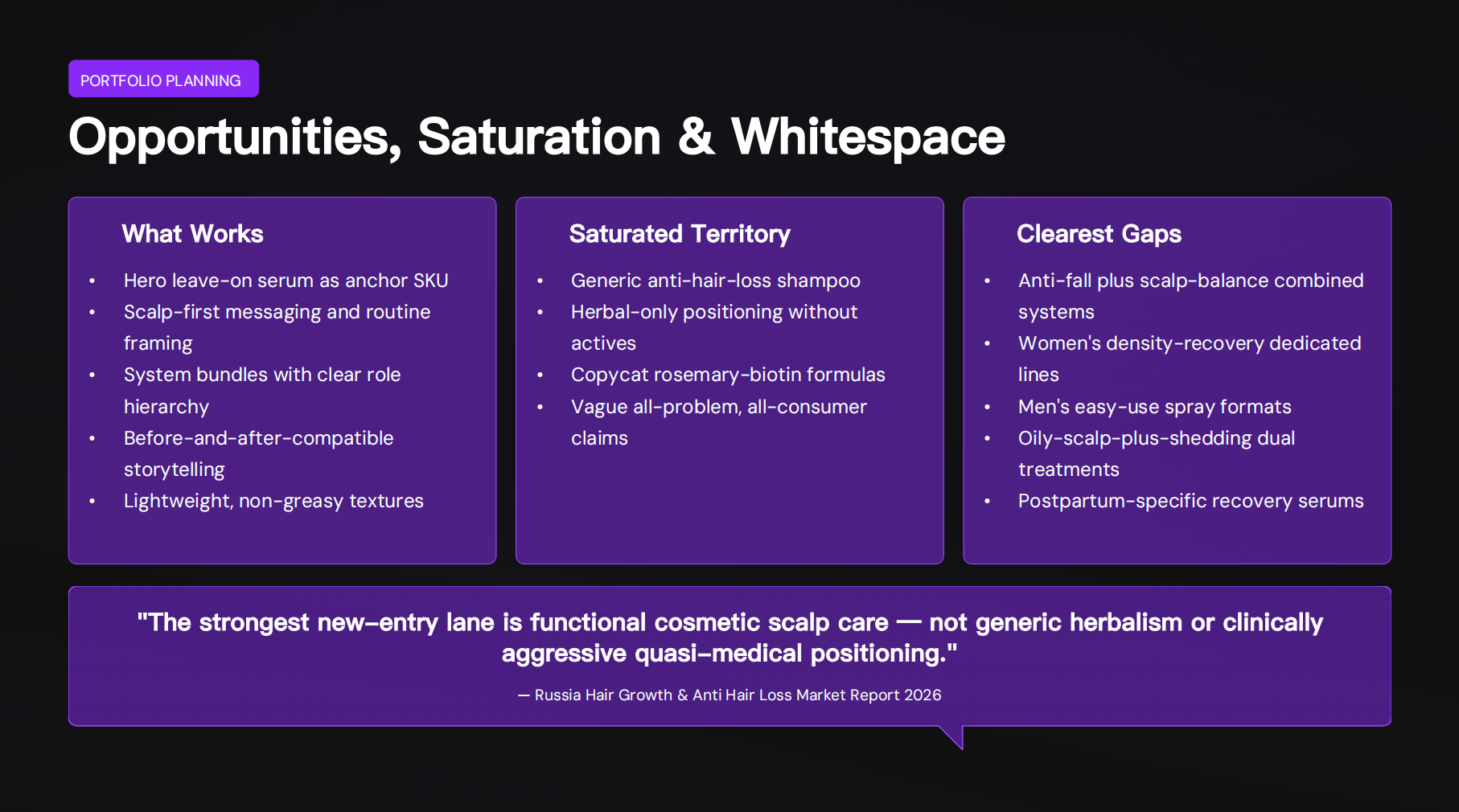
Oily Scalp and Shedding Dual-Control Treatment
This is one of the most commercially valuable white spaces because many consumers experience scalp imbalance and fallout together.
Opportunities, Saturation & Whitespace
Channel Strategy
A Russia launch should be channel-aware from the beginning.
Ozon
Best for structured product pages, ingredient storytelling, stronger bundle logic, and masstige systems. A hero serum can perform especially well here when the page makes the routine easy to understand.
Wildberries
Better for faster price competition, entry products, trial bundles, shampoos, sprays, and mass-to-masstige traffic.
Pharmacies
Useful for derma-cosmetic, functional, and trust-heavy positioning. A stronger claims discipline and cleaner support architecture are especially important here.
Specialty Stores
Best for selective, premium-light, or curated scalp systems. They can help with credibility, though marketplaces usually remain the first scale channel.
The strongest strategy is not to push the same assortment everywhere. It is to adapt entry SKU, bundle logic, and story structure to the channel’s buying behavior.
Pricing Strategy
The strongest commercial entry point is usually accessible masstige.
That means:
- shampoo should feel affordable enough for routine use
- serum should feel credible but still reachable
- ampoules can carry stronger price lift
- bundles should create value without destroying standalone pricing logic
A practical pricing structure often includes:
- one entry trial SKU
- one hero efficacy SKU
- one higher-margin treatment SKU
- one refill-friendly or repeat-purchase support SKU
This gives the line better conversion flexibility and stronger long-term economics.
Bundle Logic
Bundles are especially important in this category because they make the routine feel more complete and credible.
The strongest bundle directions include:
- shampoo plus serum
- shampoo plus serum plus ampoule booster
- serum plus scalp spray
- men’s anti hair loss duo
- women’s density recovery trio
- oily scalp plus fallout control set
Bundle messaging should emphasize routine completion, not just discount. The stronger the system logic, the more believable the line becomes.
Compliance and Product-Risk Awareness
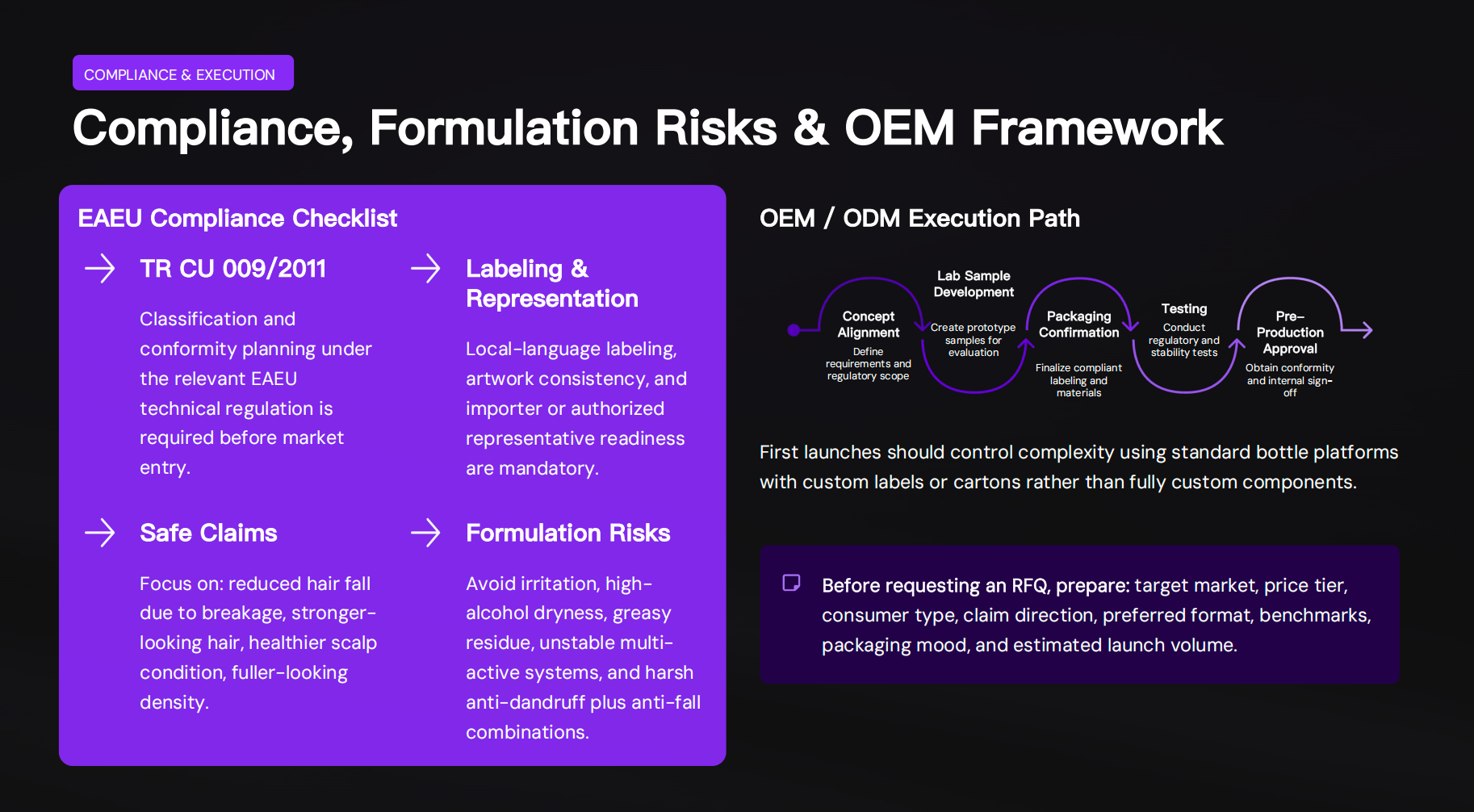
Hair growth and anti hair loss is a category where compliance awareness matters from the beginning.
Safer cosmetic language includes:
- helps reduce hair fall due to breakage
- supports stronger-looking hair
- helps improve scalp condition
- promotes fuller-looking density
- supports healthier-looking roots and scalp
Higher-risk language includes:
- treats alopecia
- restores hair growth
- clinically regrows hair
- hormonal or DHT-blocking claims on a cosmetic product
In this category, the biggest formula and product risks often include:
- greasy or sticky leave-on textures
- scalp irritation from overbuilt active systems
- harsh anti-dandruff plus anti hair loss combinations
- unstable botanical-heavy tonics
- over-fragranced scalp products
- complicated formulas that sound impressive but are harder to stabilize and scale
A Russia-ready formula must not only sound effective. It must feel good in daily use, survive shipping and storage, and support repeat purchase.
OEM Launch Strategy
The fastest way to improve speed and reduce error is to send manufacturers a better brief.
A stronger RFQ should define:
- target market
- target channel
- consumer type
- hero product format
- ingredient direction
- price target
- packaging route
- benchmark products
- expected launch volume
- timeline
- whether development is stock, semi-custom, or full custom
- required documentation and testing pathway
The better the brief, the easier it becomes to get usable samples, accurate quotes, and a launch structure that matches the real market.
For this category, the strongest OEM partners are not just bottle fillers. They help structure the hero SKU, the support system, the bundle logic, the claims boundary, and the packaging path.
Compliance, Formulation Risks & OEM Framework
What Brands Should Do Next
If you are planning to enter the Russia hair growth and anti hair loss market, the smartest next step is not to launch a generic shampoo-only line.
Instead:
- choose one clear hero serum direction
- build one shampoo that supports routine credibility
- add one stronger treatment or ampoule product
- decide whether scalp balance is your key differentiator
- align your claims with cosmetic-safe language
- use bundles to increase authority and repeat value
- start with a focused 4–6 SKU system before expanding
This approach creates a stronger launch structure, clearer merchandising, and faster decision-making across marketplaces and distributors.
Final Takeaway
The Russia hair growth and anti hair loss opportunity in 2026 is real, but the strongest commercial space is not in vague miracle claims. It is in functional cosmetic scalp care for thinning hair and shedding.
The brands most likely to win are the ones that combine believable daily-use formats, familiar ingredient logic, clear routine structure, and marketplace-ready execution. A serum-led system gives stronger authority, stronger bundle potential, and stronger repeat behavior than a shampoo-only approach.
If your team is evaluating a Russia anti hair loss launch, the best next move is to align hero format, ingredient story, scalp-care angle, bundle structure, and OEM execution path first, then move into sampling with a much clearer product brief.
Download the Full Report (PDF)
Tell us your target region, product category, and the decision you’re trying to make. We’ll suggest the closest existing report—or build a tailored version.