


Executive Summary
This report explores the Russia hair conditioner market in 2026, including consumer demand, climate-driven hair concerns, product format strategy, pricing logic, marketplace entry, compliance priorities, and OEM launch planning. It is designed to help brands, importers, distributors, and e-commerce sellers turn market insight into a more practical conditioner launch strategy.
Russia Conditioner Market 2026: Consumer Trends, Product Opportunities, and OEM Launch Strategy
The Russia hair conditioner market in 2026 is attractive for focused entry, but the opportunity is not in generic low-price basics. The stronger path is to build a compact portfolio around visible performance needs such as moisture repair, winter protection, damage recovery, anti-frizz control, and lightweight leave-in support.
For brands, distributors, importers, and e-commerce sellers, conditioner should not be treated as a secondary SKU behind shampoo. It is one of the most practical and scalable ways to monetize repair, hydration, softness, color care, and treatment-led claims while increasing basket value and repeat purchase potential.
This report turns Russia hair care demand into practical launch logic. It covers market opportunity, consumer need states, product formats, pricing, marketplace strategy, compliance priorities, and OEM planning for conditioner-led launches in 2026.
Executive Summary
Russia’s hair care market in 2026 is best approached as a stable, necessity-driven category with strong digital influence. Growth is steady rather than explosive, and online channels continue to expand faster than traditional offline distribution. This creates favorable conditions for conditioner-focused launches that are easy to understand online, clearly positioned by benefit, and supported by disciplined pricing.
The best opportunities are not spread across a large assortment. They are concentrated in a few high-clarity formats. A rinse-off repair conditioner can anchor daily volume. A treatment mask can lift average selling price and authority. A lightweight leave-in spray can improve differentiation, convenience, and e-commerce merchandising.
For most new entrants, the lowest-risk launch path is a three-product system: one hero daily conditioner, one treatment mask, and one leave-in spray. This structure covers replenishment, treatment, and visible-performance needs without overcomplicating the first launch.
Market Opportunity Overview
Russia’s hair care market remains resilient because hair care is part of everyday maintenance rather than discretionary novelty. Consumers may trade down in some categories, but they still continue to buy products that solve clear problems such as dryness, roughness, damage, and frizz.
Within this market, conditioner has strong commercial value because it sits between basic care and treatment. Shampoo may drive the initial category entry, but conditioner creates better opportunities for benefit-led trade-up. It supports visible claims such as softness, repair, easy combing, anti-static control, and smoother texture, all of which are easier for consumers to understand and repurchase.
For buyers entering Russia, this means conditioner should be seen as a profit architecture, not a support item. It is one of the clearest product types for moving from mass basics into affordable-performance care.
Russia
Hair Care
2026
What Is Driving Demand in 2026
Several forces shape conditioner demand in Russia.
The first is climate. Long cold seasons, dry winter air, and heated indoor environments create real demand for hydration, repair, anti-static performance, and scalp comfort.
The second is digital shopping behavior. Marketplaces such as Wildberries and Ozon make the category highly comparison-driven. Shoppers compare price, claims, size, reviews, and packaging clarity quickly, so products need strong front-facing benefit communication.
The third is treatment-led usage. Russian consumers increasingly buy not just one conditioner, but a small system of products that may include a daily conditioner, a deeper mask, and a leave-in support format.
The fourth is local competition. Local and regional brands have become stronger, which means foreign OEM projects must compete on execution quality, value, speed, and packaging clarity rather than imported identity alone.
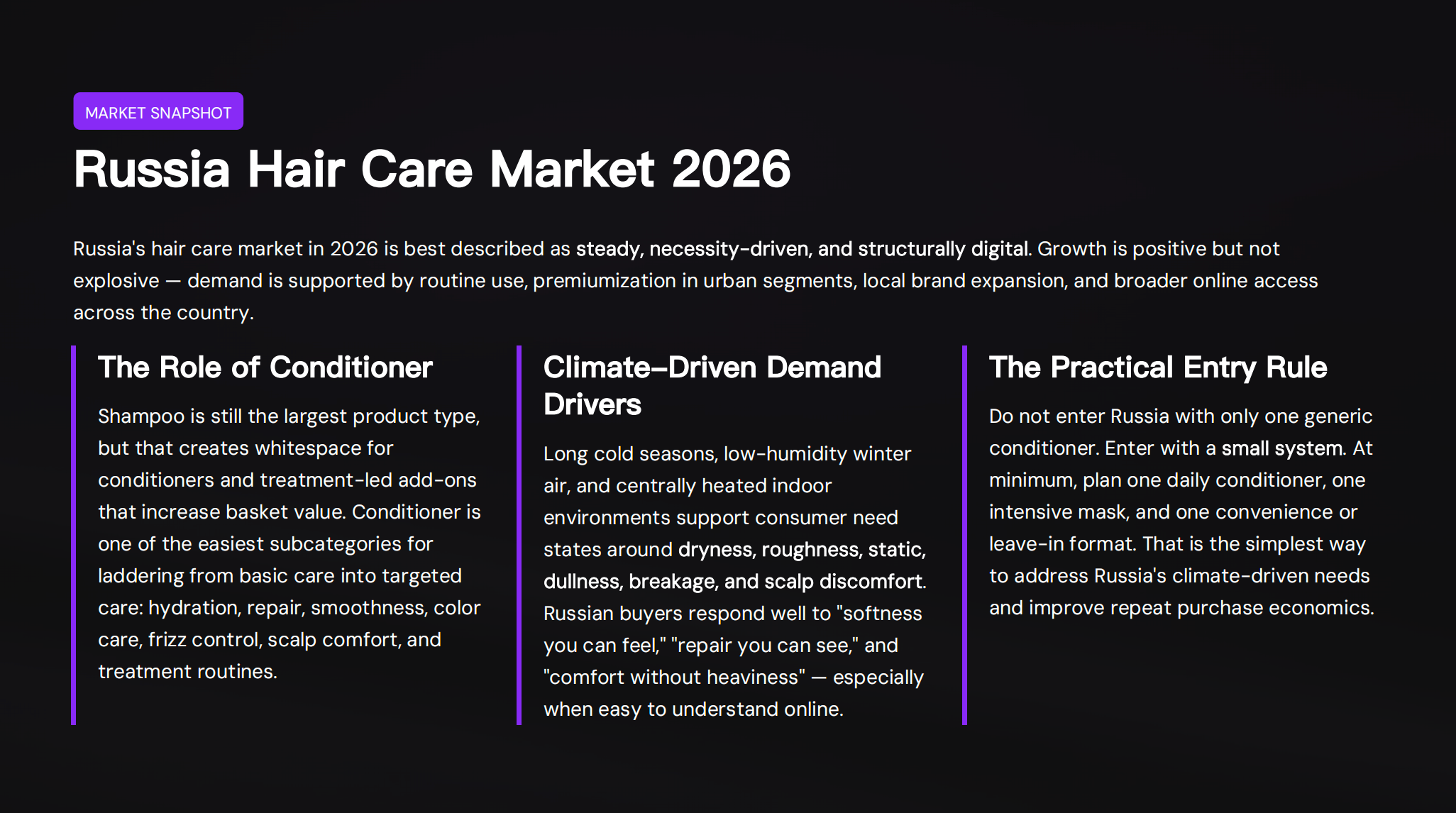
Russia Hair Care Market 2026
Consumer Demand Signals
The most commercially important demand signals in Russia center on practical hair concerns rather than abstract beauty language.
Consumers are most responsive to:
- dryness and rough texture
- damaged or color-treated hair
- frizz and static in cold seasons
- dullness and softness loss
- split ends and brittle lengths
- scalp discomfort without wanting greasy roots
- lightweight hydration that does not flatten the hair
This makes hydration-plus-repair a safer entry positioning than generic nourishment language alone. The market responds better to product concepts that solve a problem clearly and visibly.
A successful conditioner launch should therefore focus on tangible outcomes: softer lengths, smoother texture, easier combing, less static, and more comfortable hair through winter and everyday styling.
Conditioner Formats That Matter Most
The commercially relevant conditioner landscape in Russia is broader than classic rinse-off products alone. The most useful format stack includes:
- rinse-off daily conditioner
- deep conditioning hair mask
- leave-in spray conditioner
- two-phase detangling spray
- conditioner-treatment hybrid
- scalp-comfort conditioner
- color-care conditioner
Among these, rinse-off conditioner and hair mask are the most reliable anchors. Leave-in sprays are especially attractive for e-commerce because they are easy to demonstrate, visually clear, and useful for winter static and convenience-led care.
For most new launches, the strongest structure is not to choose only one format. It is to launch a compact system that covers daily use, treatment, and quick support.
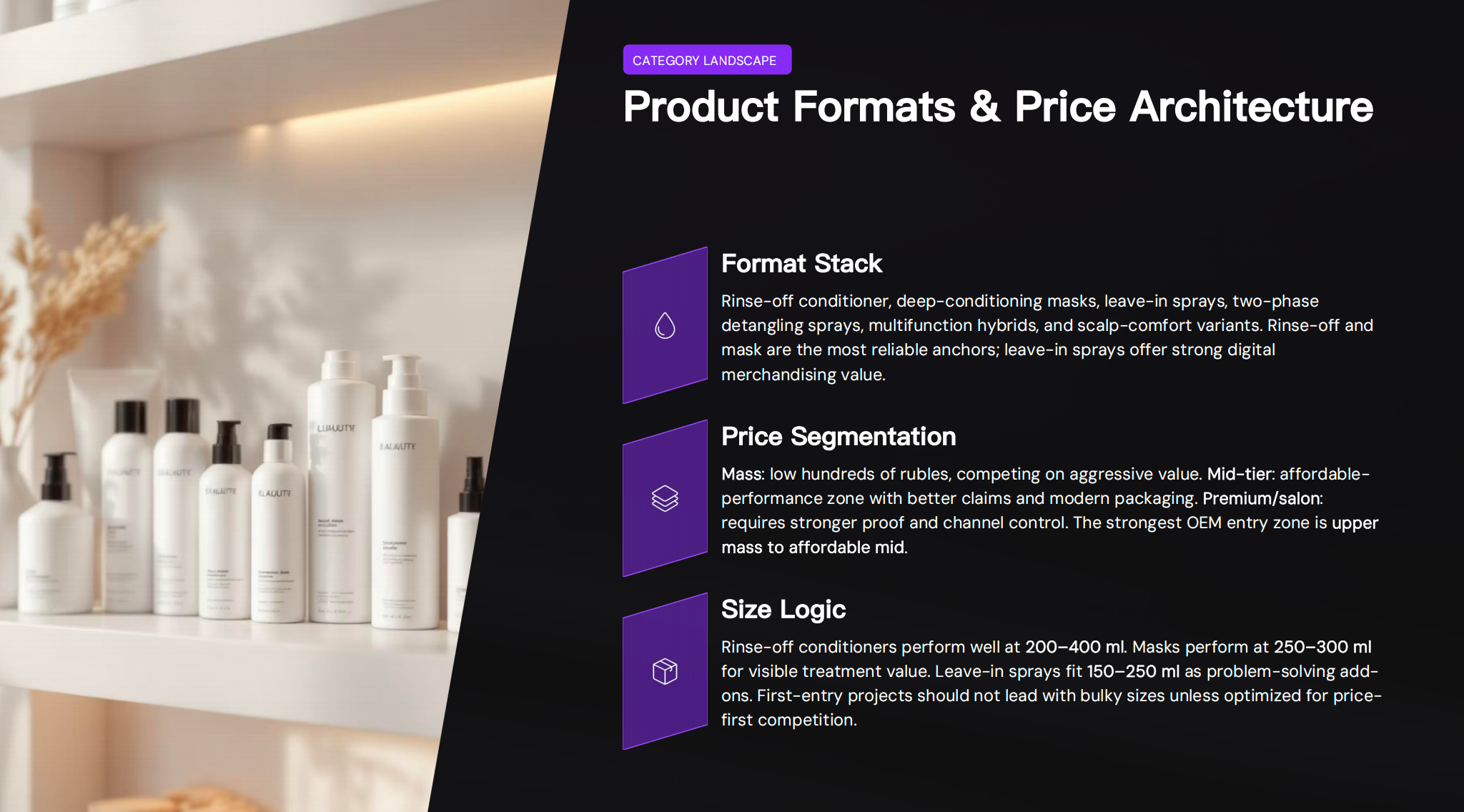
Product Formats & Price Architecture
Best Product Opportunities for 2026
The most practical opportunity set for the Russian market is clear.
The first is an everyday repair conditioner for dry and damaged hair. This should be the hero SKU because it addresses the broadest need state and works naturally with matching shampoo bundles.
The second is a winter recovery hair mask. This is valuable because cold weather, indoor heating, and color or heat damage create natural demand for deeper hydration and anti-frizz treatment.
The third is a lightweight leave-in spray conditioner. This is especially useful for younger digital shoppers and users who want detangling, softness, anti-static control, and shine without heaviness.
The fourth is a scalp-comfort conditioner for sensitive scalps and dry lengths. This fills a meaningful gap for consumers who want hydration and comfort without residue-heavy formulas.
The fifth is a 2-in-1 conditioner mask for value-conscious households. This can work well in marketplaces and distributor channels where simplicity and multifunction value support conversion.
Suggested Launch Portfolio
A practical staged portfolio for 2026 should begin with only a few focused SKUs.
Recommended first-wave launch:
- one repair conditioner at 250–300 ml
- one hair mask at 250–300 ml
- one leave-in spray at 150–200 ml
Recommended second-wave expansion after traction:
- one hydration conditioner
- one scalp-comfort conditioner
- one color-care conditioner
Recommended later extensions:
- one 2-in-1 conditioner mask
- one intensive repair mask
- one volume conditioner
- one men’s scalp-and-softness conditioner
The logic is simple: start with the highest-probability demand clusters, validate reviews and reorder behavior, then extend only after marketplace traction is proven.
Price Strategy
The strongest entry zone for new conditioner launches in Russia is usually upper mass to affordable mid-tier.
At the low end, price competition becomes intense and margin can collapse quickly. At the premium end, proof requirements are higher and conversion becomes more difficult without strong channel support. The best balance for many new OEM projects sits in the affordable-performance range, where consumers are willing to pay more for visible repair, softness, anti-frizz support, and better packaging clarity.
A useful pricing ladder is:
- hero rinse-off conditioner as the daily-use core
- mask as the treatment-led step-up
- leave-in spray as the convenience-led add-on
This creates a clearer product hierarchy and protects average selling price without pushing the line too high too early.
Channel Strategy & Launch Timeline
Channel Strategy: Wildberries, Ozon, and Beyond
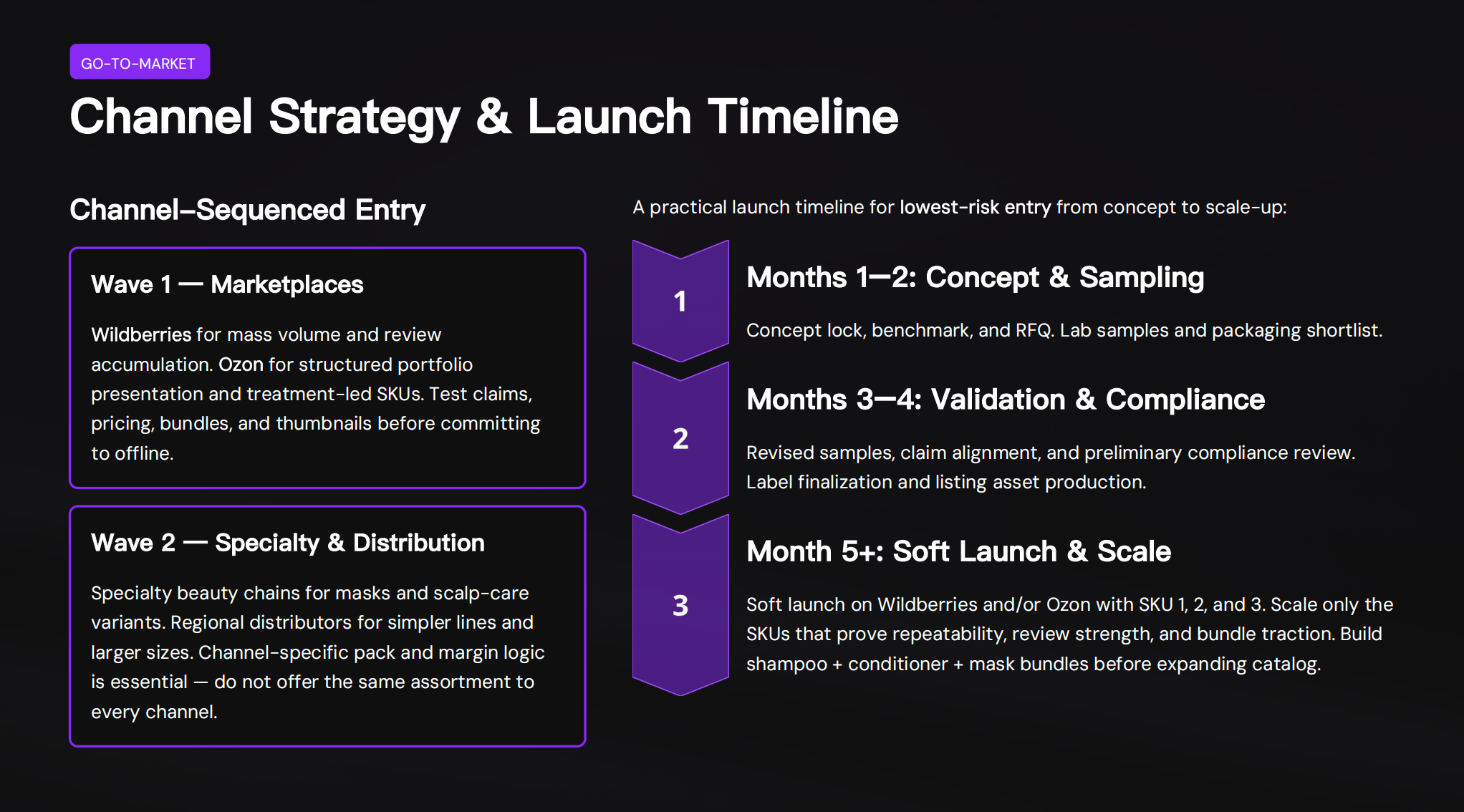
Russia should be approached as a channel-sequenced market, not a channel-equal market.
The first wave should focus on marketplaces because online retail remains structurally important and allows faster testing of claims, pricing, reviews, thumbnails, and bundle logic.
Wildberries is better suited to scale, mass-volume visibility, and hero SKUs with broad everyday appeal. Ozon can be stronger for more structured portfolio presentation, treatment-led assortments, and higher-value basket building.
Offline and distributor channels should usually come after digital proof unless the brand already has local relationships. Specialty beauty and salon-adjacent channels are better for masks, scalp-care variants, and more treatment-heavy products. Regional retail can favor simpler lines, stronger value logic, and more practical pack architecture.
The strongest strategy is not to push the same assortment everywhere. It is to match the right SKU mix to the right channel role.
Bundle Strategy
Bundle planning should begin before launch, not after.
The most useful bundle structures are:
- shampoo plus conditioner as the core entry pair
- shampoo plus conditioner plus mask for treatment-led users
- conditioner plus leave-in spray for convenience-led users
- winter care set built around repair plus anti-static support
- value-focused family bundle for larger repeat-purchase needs
Bundle logic matters because marketplaces reward clear value architecture. It also helps protect average selling price in a category where discounting pressure can otherwise erode margin.
Competitive White Space
The Russian conditioner market is crowded, but the clearest commercial openings are still available.
There is room for:
- better lightweight winter hydration systems
- better scalp-comfort conditioners that do not feel medicinal
- better anti-static leave-in products for cold seasons
- better mask formulas that feel rich but not heavy
- better marketplace-ready portfolios built around 3 to 5 hero concepts rather than bloated assortments
New entrants should not try to out-global the global brands or simply copy local value players. The stronger play is to offer a clearer answer to common consumer problems with better price-performance logic and cleaner portfolio structure.
Packaging and Merchandising
The Russian market rewards clarity. Packaging should communicate one main job immediately: repair, hydration, anti-frizz, color care, scalp comfort, or volume.
Useful packaging cues include:
- clean, easy-to-read front claims
- modern and high-contrast labeling
- strong color-coding by benefit
- visible differentiation between conditioner, mask, and leave-in formats
- pack sizes that match channel logic
- marketplace-friendly thumbnail visibility
For online channels especially, packaging needs to work as a digital merchandising tool, not just a physical container.
Compliance and Quality Priorities
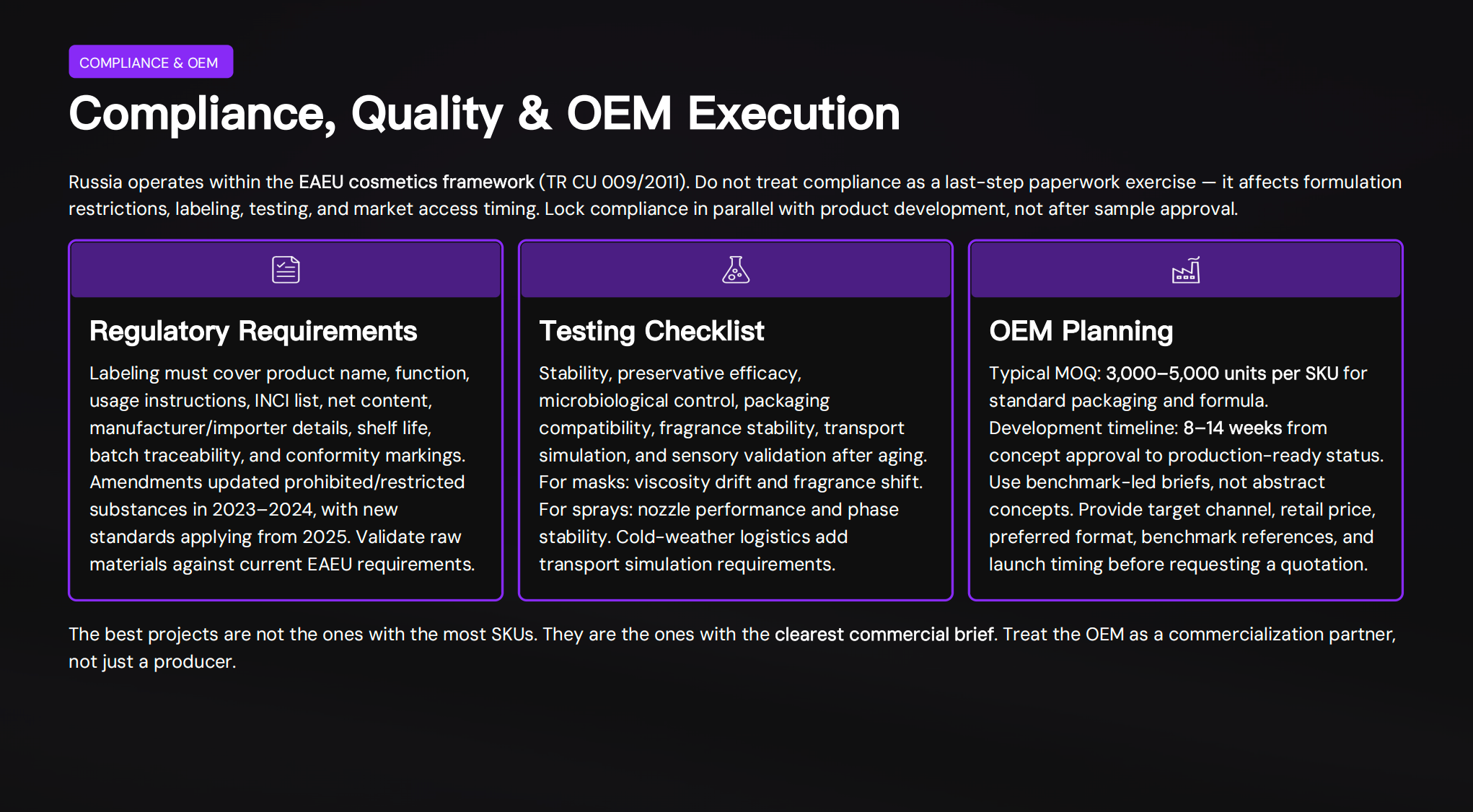
Compliance should be planned in parallel with development, not after sample approval.
Key priorities include:
- ingredient compliance under EAEU cosmetic rules
- labeling accuracy and importer information
- traceable batch information
- claim discipline and avoidance of quasi-medical language
- stability and packaging compatibility testing
- microbiological control where relevant
- fragrance stability and transport resilience
- nozzle performance for spray formats
- viscosity stability for masks and heavier conditioners
For Russia-focused launches, the most common mistakes are late compliance preparation, weak translation accuracy, unsupported claims, and packaging issues discovered too close to launch.
OEM Launch Strategy
The fastest way to improve execution is to give the OEM a more commercial brief from the beginning.
A stronger RFQ should define:
- target channel
- target retail price
- preferred format
- benchmark references
- hero benefit claim
- packaging level
- target launch timing
- expected documentation
- test requirements
- first order quantity
- future scale forecast
Instead of saying “premium nourishing conditioner,” a better brief would be “repair conditioner for dry colored hair, creamy but not heavy, winter-friendly, affordable-mid pricing, built for Russian marketplaces.”
That type of brief improves sample accuracy, shortens revision cycles, and reduces wasted development time.
Compliance, Quality & OEM Execution
What Brands Should Do Next
If you are planning a Russia conditioner launch in 2026, the smartest next step is not to build a large catalog.
Instead:
- start with one hero rinse-off conditioner
- support it with one treatment mask
- add one leave-in spray for convenience and cross-sell
- build bundle logic before launch
- validate compliance in parallel with formulation
- scale only after review and reorder signals are proven
This is the lowest-risk route to building a conditioner line that is commercially usable, channel-fit, and easier to expand later.
Final Takeaway
The Russia hair conditioner market in 2026 is attractive because it combines stable demand, clear climate-driven need states, and strong marketplace-led distribution. The market does not reward generic basics as easily as before. It rewards clearer product roles, visible performance, cleaner portfolio structure, and better execution.
The brands most likely to win are not the ones launching the most SKUs. They are the ones building the most disciplined system: one daily hero, one treatment authority SKU, one convenience extension, and a launch path designed around pricing, reviews, bundles, and compliance.
If your team is evaluating a Russia hair care launch, the strongest next step is to align format, price band, benefit claim, and OEM path first, then move into sampling with a much clearer brief.
Download the Full Report (PDF)
Tell us your target region, product category, and the decision you’re trying to make. We’ll suggest the closest existing report—or build a tailored version.