


Executive Summary
This report explores the EU hair loss and hair density market in 2026, including scalp-led demand trends, product formats, ingredient strategy, claims boundaries, channel fit, compliance priorities, and OEM launch planning. It is designed to help brands, distributors, importers, and e-commerce sellers turn market insight into a more practical scalp-care product strategy.
EU Hair Loss and Hair Density Market 2026: Trends, Product Strategy, Scalp Science, and OEM Opportunities
The EU hair loss and hair density market in 2026 is no longer a narrow anti-hair fall niche. It is evolving into a broader scalp-led performance category shaped by thinning-hair anxiety, preventive buying, skincare-style routines, and demand for visibly healthier-looking density.
For brands, distributors, importers, and e-commerce sellers, this shift creates a more commercially attractive opportunity than the old shampoo-only model. The market is moving toward leave-on scalp serums, treatment tonics, exfoliating scalp products, anti-breakage support formats, and multi-step routines that feel more like scalp skincare than traditional haircare.
This report translates that market shift into a practical launch roadmap. It covers demand trends, consumer triggers, product segmentation, scalp science positioning, claims boundaries, packaging logic, channel fit, and OEM execution strategy for companies entering or expanding in the EU hair density category.
Executive Summary
The EU hair loss and hair density market is becoming more structured, more premium, and more routine-driven. Consumers are no longer only looking for an “anti-hair loss shampoo.” They are increasingly looking for products that support fuller-looking roots, healthier scalp condition, reduced fall due to breakage, stronger-feeling strands, and a clearer sense of prevention.
This is commercially important because it expands the category beyond one hero format. The strongest opportunity is no longer limited to shampoo. It now includes serums, scalp tonics, exfoliating pre-treatments, ampoules, anti-breakage support products, and bundled systems built around scalp care.
For most new launches, the best entry path is not a single SKU. It is a scalp-led system that combines one visible hero product with one or two support products, giving the brand stronger credibility, better bundling logic, and safer positioning within cosmetic territory.
Market Opportunity Overview
The EU market is attractive because the demand base is broad and emotionally relevant. Hair thinning concerns now extend beyond severe hair loss. Consumers are entering the category earlier, often when they first notice widened parting, sparse-feeling roots, more hair in the shower, or a weaker overall sense of density.
That means the category now serves both long-term thinning concerns and shorter-term stress-linked or lifestyle-linked shedding concerns. It also means that “support,” “fortify,” “density,” “scalp balance,” and “fuller-looking hair” are commercially stronger and safer entry points than aggressive restoration language.
For brands, the most important takeaway is this: the category is growing because it feels preventative, routine-based, and emotionally relevant, not because consumers are only searching for a miracle cure.
Consumer Segments That Matter Most
Why the Category Is Shifting Toward Scalp-Led Products
The biggest structural change in 2026 is that the category is increasingly behaving like skincare for the scalp.
Consumers are now more receptive to:
- scalp serums
- leave-on tonics
- exfoliating pre-treatments
- peptide or caffeine-led formulas
- barrier-friendly or sensitive-scalp positioning
- routine systems with clearer usage logic
This matters because scalp care gives the brand a more modern and more credible way to explain product performance. Instead of sounding medicinal, brands can talk about scalp environment, buildup management, comfort, balance, breakage reduction, and support for fuller-looking density.
That creates better room for repeat purchase, better storytelling, and better channel expansion.
Consumer Demand Signals
The buyer base now includes several high-potential groups.
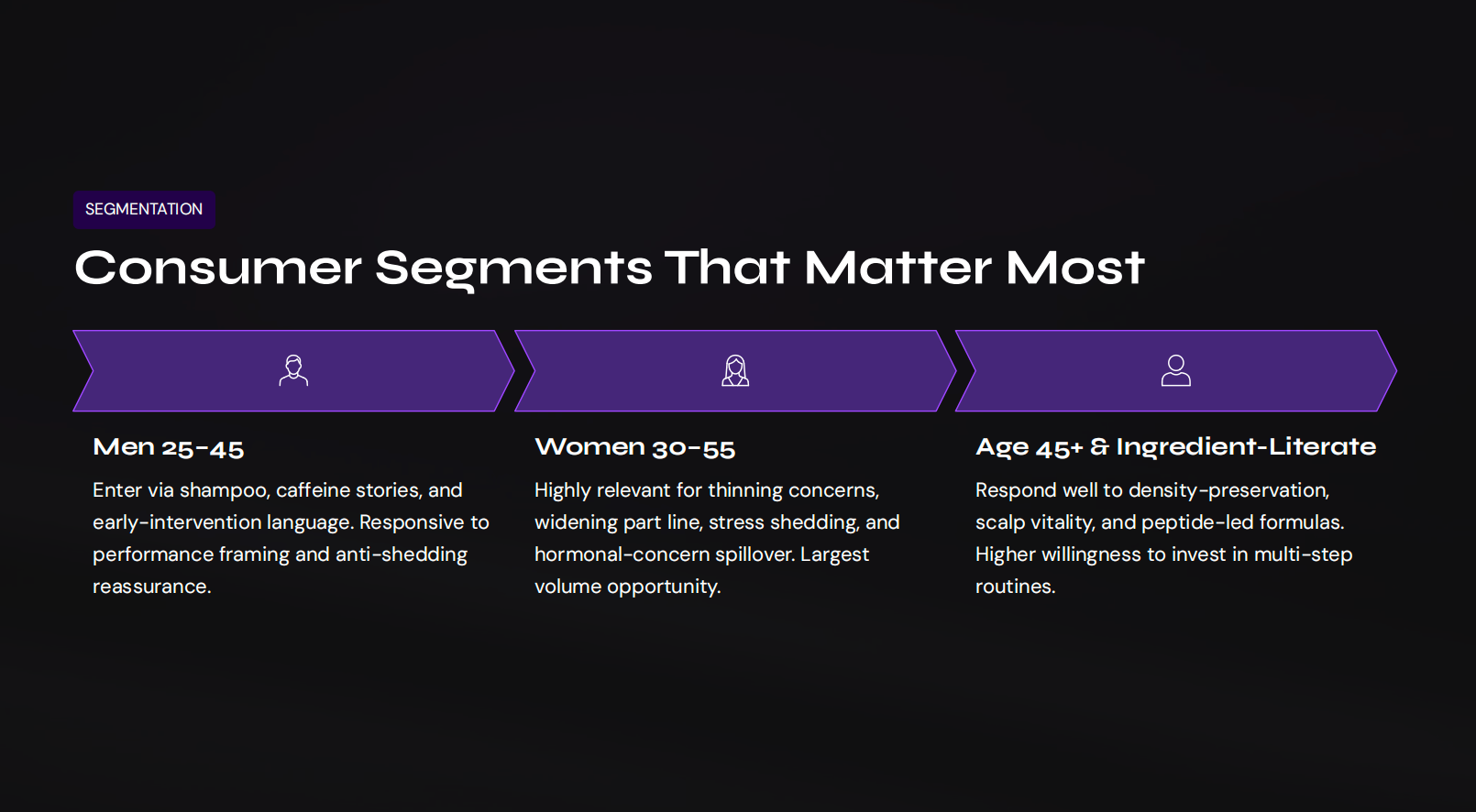
Men in the early-thinning stage often enter through caffeine-led shampoos or daily-use tonics. Women in the 30 to 55 age group are increasingly important because they are shopping for density preservation, stress-related shedding support, widening part line concerns, and scalp-comfort routines. Consumers aged 45 and above are also a major demand driver because they are more likely to seek age-linked density maintenance. Meanwhile, ingredient-aware beauty consumers are opening space for peptide, niacinamide, scalp-barrier, and microbiome-friendly positioning.
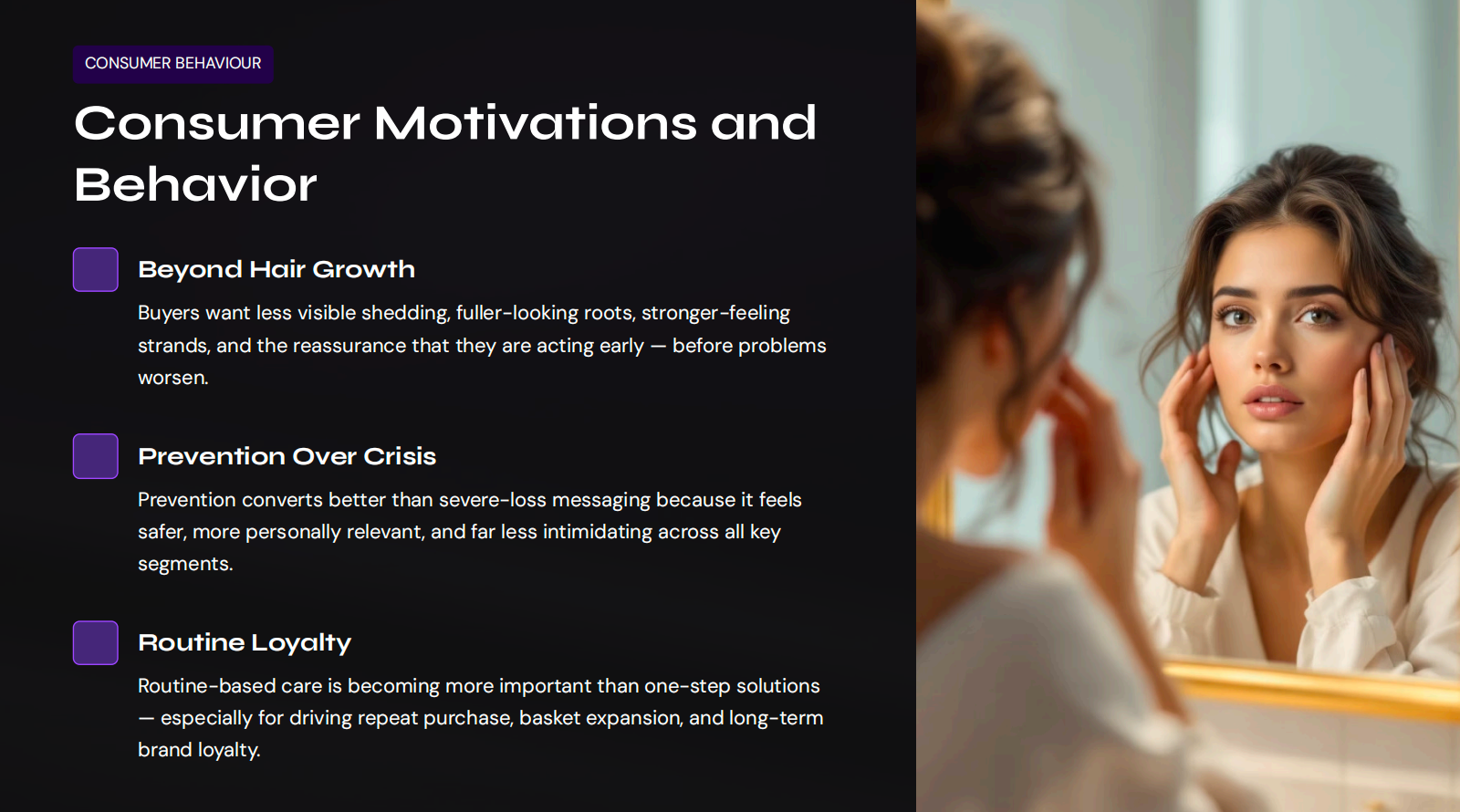
Across these groups, the most important motivation is not always “hair growth.” More often, consumers are looking for:
- less visible shedding
- stronger-feeling hair
- fuller-looking roots
- better scalp condition
- a routine that feels proactive and reassuring
- a product that looks credible without sounding like a drug
This is why prevention and maintenance messaging often converts better than severe-loss messaging in cosmetic channels.
Consumer Motivations and
Behavior
The Product Formats with the Strongest Commercial Logic
The market is no longer driven by shampoo alone. In 2026, the hierarchy of high-opportunity formats is much broader.
The strongest product roles are:
- leave-on scalp serum for efficacy perception
- scalp tonic or spray for daily-use maintenance
- density shampoo for entry price and high frequency
- anti-breakage conditioner or mask for support and completeness
- weekly scalp exfoliating treatment for innovation and routine logic
- intensive ampoules for protocol-style or pharmacy-positioned use
- bundled systems for higher AOV and stronger regimen compliance
Among these, the leave-on hero remains the most important. It is the product that makes the brand feel serious, premium, and treatment-oriented.
A shampoo may bring traffic, but the serum is what usually creates real category credibility.
Product Positioning Strategy
One of the most important strategic decisions in this category is wording. The market is highly responsive to performance language, but the operational risk rises quickly when the product starts sounding medicinal.
For most cosmetic launches, the strongest positioning territory is:
- fuller-looking hair
- density support
- scalp balance
- fortifying weak hair
- reduced fall due to breakage
- strengthening from root to fiber
- healthier-looking scalp and roots
This positioning works because it gives the consumer a clear benefit while keeping the product aligned with cosmetic expectations. It also gives brands more freedom to sell across e-commerce, retail, and dermocosmetic-adjacent channels.
The most investable route is not to promise too much. It is to sound serious, believable, and routine-friendly.
Ingredient Strategy: What Actually Converts
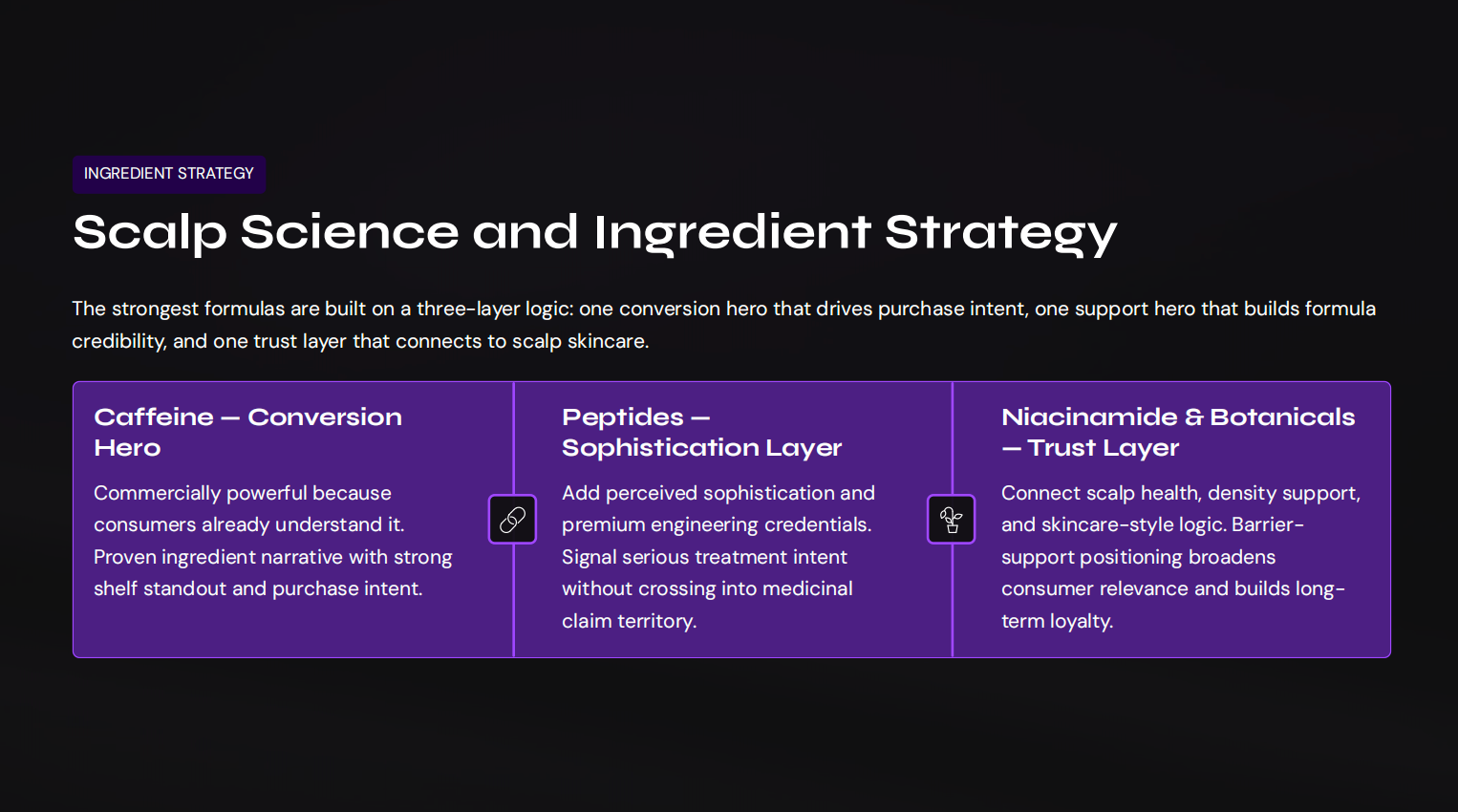
The most effective formulas in this category usually combine one strong conversion cue, one support cue, and one trust layer.
A strong conversion cue is something the shopper understands quickly, such as caffeine or a peptide complex. A support cue is something that reinforces the broader routine, such as niacinamide or a strengthening botanical complex. A trust layer is what makes the formula feel more scalp-aware and better tolerated, such as scalp comfort positioning, fragrance discipline, or barrier-friendly logic.
Ingredient directions with strong commercial value include:
- caffeine
- peptides
- niacinamide
- biotin as a supporting cue
- botanical strengthening stories
- scalp barrier support
- microbiome-aware positioning
- anti-breakage support
The strongest route for many brands is not fully clinical and not purely natural. It is a hybrid approach that combines familiar actives with a modern scalp-science narrative.
Scalp Science and Ingredient Strategy
Price Tier and Product Architecture
The EU market breaks into several practical pricing lanes, but the most commercially attractive launch zone for many new brands is masstige.
Mass products still move on accessibility, but often lack strong differentiation. Premium products can justify higher margins, but they require stronger packaging and distribution support. Dermocosmetic and pharmacy formats can work well, but they demand stricter presentation discipline and a more treatment-like routine.
Masstige offers the best balance for many new entrants because it allows:
- better textures
- stronger ingredient storytelling
- more premium packaging
- more flexible channel fit
- a credible serum-led product system
A strong launch structure usually includes:
- one hero scalp serum or tonic
- one density shampoo
- one anti-breakage support product
- one exfoliating or intensive treatment format
- one system kit or bundle path
This creates a cleaner path from first purchase to repeat routine.
Channel Strategy
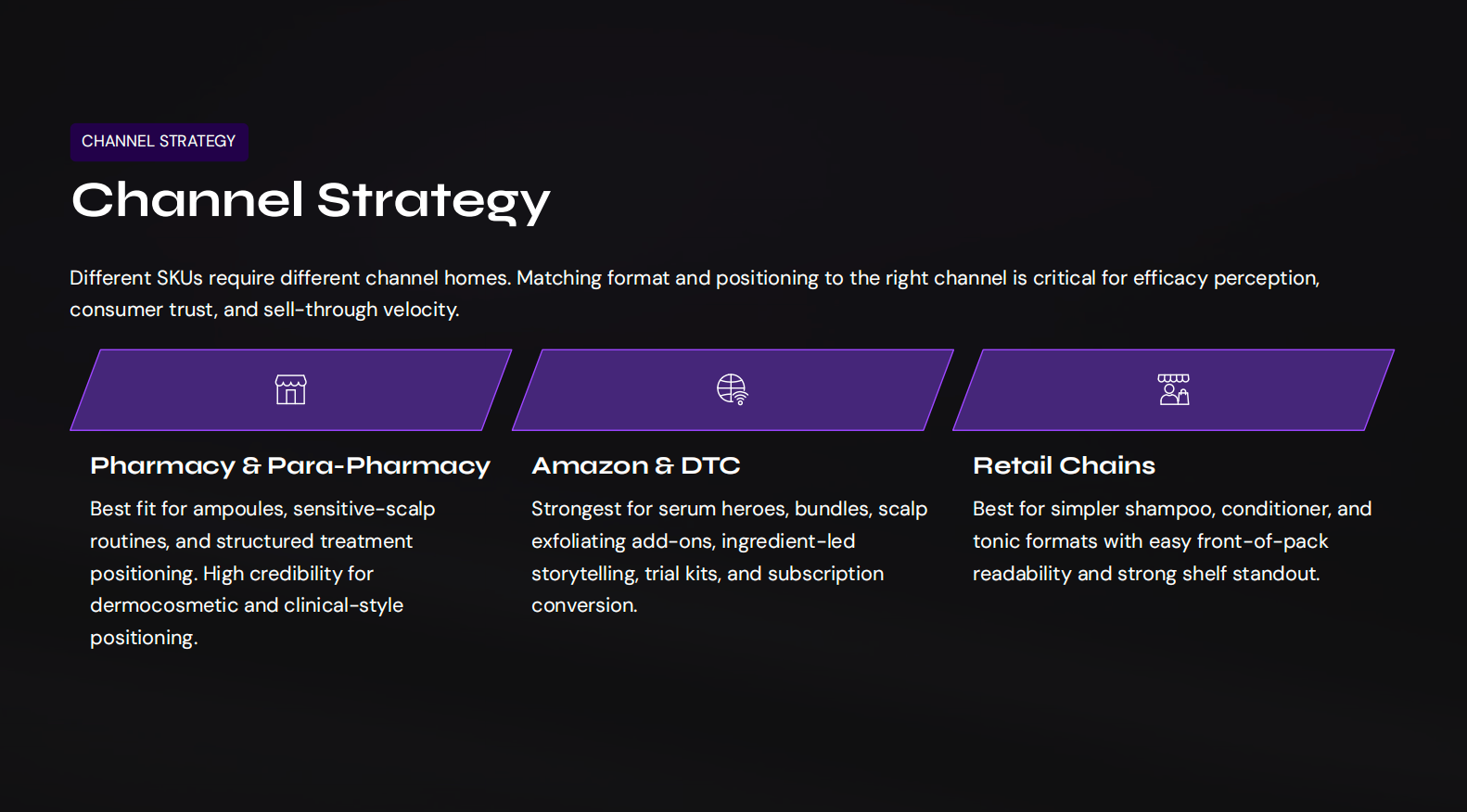
A hair density launch should be channel-native from the beginning.
For pharmacy and dermocosmetic channels, structured routines, ampoules, sensitive-scalp variants, and disciplined packaging language perform best. These channels reward trust, protocol, and visible dosage logic.
For Amazon and DTC, serum hero products, bundles, exfoliating add-ons, and ingredient-led storytelling work especially well. Online conversion depends on fast understanding, strong texture cues, visible routine education, and easy-to-read claims.
For retail chains, simpler product logic works better. Density shampoos, conditioners, and scalp sprays with recognizable actives and easy consumer language usually have the strongest shelf potential.
The strongest expansion path is not to push the same product story everywhere. It is to adapt the same product system to the way each channel sells.
Channel Strategy
Competitive White Space
The market already contains strong dermocosmetic players, natural strengthening brands, and ingredient-led serum brands. That means copying existing pharmacy leaders too closely is not usually the smartest move for a new OEM-driven project.
The better opportunity often sits between clean beauty and clinical credibility.
That white space includes:
- female-first density systems that do not look overly medical
- scalp exfoliation paired with density support
- microbiome-friendly or barrier-aware scalp care
- masstige hybrid lines that feel more credible than natural-only products and more modern than classic pharmacy ranges
- conditioner and mask formats for thinning-looking hair
- six-week routines and bundle kits designed for trial and repeat purchase
This is where new brands have room to feel differentiated without entering the highest regulatory-risk territory.
Compliance and Claims Priorities
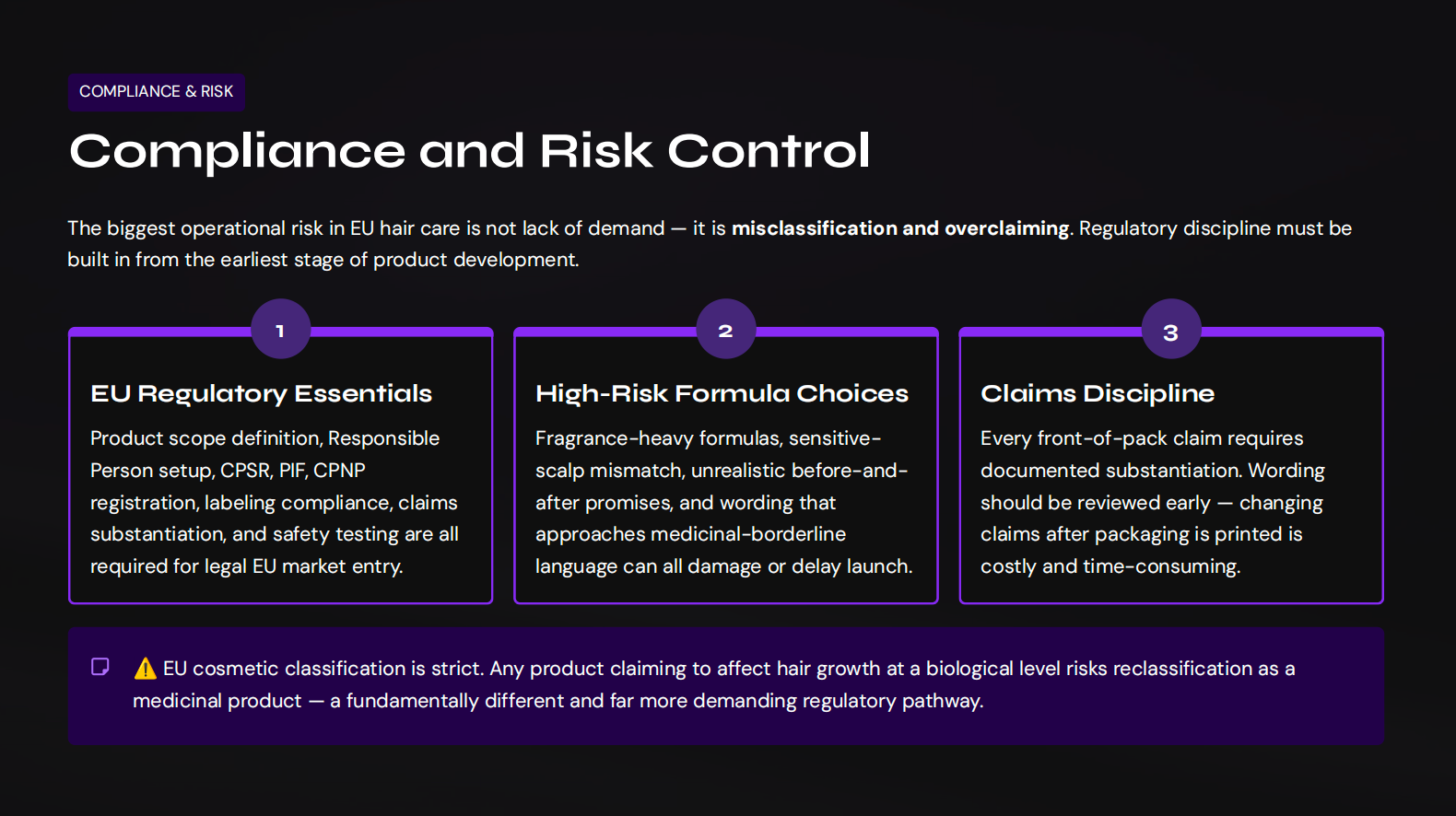
This category is commercially attractive, but it is also highly sensitive from a claims standpoint. That is why the safest and smartest product planning starts with scope discipline.
The product should clearly stay within cosmetic territory. The stronger route is to focus on support, appearance improvement, scalp condition, and breakage reduction rather than direct hair regrowth or medicinal restoration wording.
Key compliance priorities include:
- product classification review
- responsible person and market-entry planning
- label readiness in target languages
- claims substantiation alignment
- stability and compatibility testing
- microbiological robustness
- ingredient screening
- consistent packaging and e-commerce wording
The most important practical rule is simple: write claims after the formula concept and testing plan are clear, not before.
Compliance and Risk Control
The biggest operational risk in EU hair care is not lack of demand 4 it is misclassi
OEM Launch Strategy
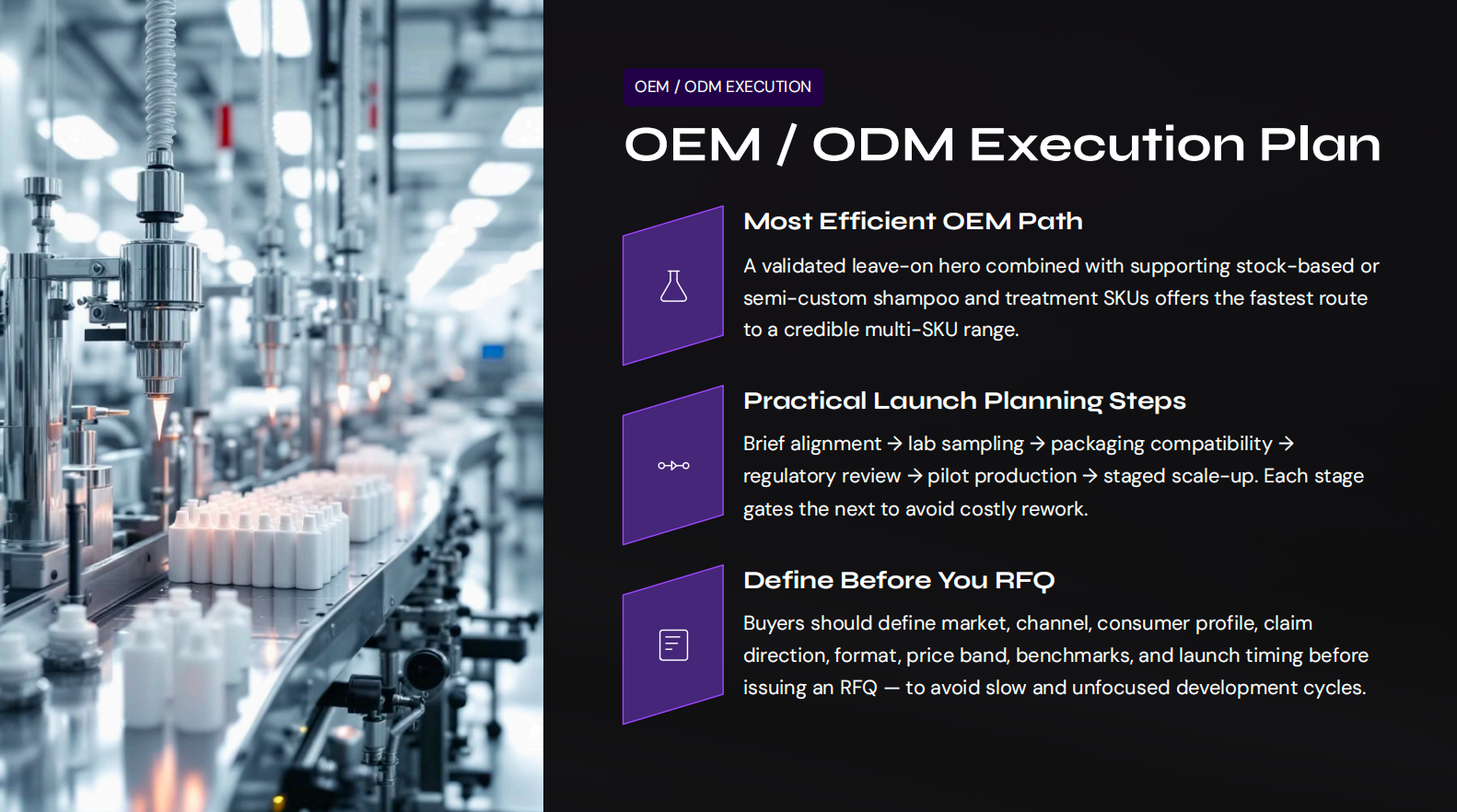
For OEM and ODM projects, the best outcomes come from a clean product brief and a focused launch architecture.
A stronger RFQ should define:
- target market
- target channel
- key thinning or scalp concern being addressed
- hero active story
- price tier
- preferred packaging format
- claims direction
- testing expectations
- bundle logic
- launch timeline
- first order quantity
- future expansion plan
The most practical first-launch model for many brands is:
- one hero leave-on serum
- one supporting shampoo
- one support or add-on treatment
- one kit or bundle version for AOV and routine building
That structure improves speed, reduces development waste, and creates a more convincing commercial story.
If budget is limited, the formula-development priority should go into the leave-on hero first. That is the product that decides whether the line looks serious or generic.
OEM / ODM Execution Plan
Recommended Entry Models
A strong Amazon or DTC launch usually starts with a serum-led system: one scalp serum, one density shampoo, and one exfoliating scalp reset. This works well because online shoppers respond strongly to visible actives, treatment logic, and before-and-after routine narratives.
A pharmacy or dermocosmetic launch is stronger when it starts with an intensive ampoule course, a supporting shampoo, and a sensitive-scalp tonic. This route performs best when trust, dosage, and disciplined routine structure are central to the story.
A retail-chain launch is usually more effective when it begins with a density shampoo, an anti-breakage conditioner, and a root-lift tonic spray. Simpler product logic improves first-trial conversion on shelf.
For most international B2B buyers, the best overall entry path is a masstige scalp-serum-led system with a supporting shampoo and a bundle-ready routine.
Final Takeaway
The EU hair loss and hair density market in 2026 is not about promising a miracle cure. It is about building a believable, compliant, scalp-first cosmetic routine that helps the consumer feel more in control of thinning, shedding, and reduced density.
The strongest commercial path is clear:
- lead with a leave-on scalp hero
- support it with one or two routine products
- use density, strengthening, scalp-balance, and breakage-reduction language
- avoid regulatory overreach
- make packaging and usage ritual part of the efficacy story
For OEM and ODM execution, the winners will be the buyers who turn market insight into a clean SKU structure, a realistic claims set, and a development plan that can actually launch on time.
Download the Full Report (PDF)
Tell us your target region, product category, and the decision you’re trying to make. We’ll suggest the closest existing report—or build a tailored version.