


Executive Summary
This report explores the EU hair conditioner market in 2026, including demand segments, repair and hydration trends, formulation directions, packaging strategy, channel fit, compliance priorities, and OEM launch opportunities. It is designed to help brands, distributors, importers, and e-commerce sellers turn market insight into a more practical conditioner launch strategy.
EU Hair Conditioner Market 2026: Trends, Product Strategy, Formulation, and OEM Opportunities
The EU hair conditioner market in 2026 is no longer driven by basic conditioning alone. Growth is increasingly concentrated in problem-solving conditioners that combine repair, hydration, scalp compatibility, and premium sensorial performance.
For brands, importers, distributors, and e-commerce sellers, the strongest commercial opportunity is not a generic all-purpose conditioner. It is a clearly positioned range built around specific hair needs, texture expectations, and channel logic.
This report translates market trends into product strategy. It explores the most commercially attractive conditioner segments in Europe, the formulation directions shaping 2026 launches, the packaging and channel structures that improve sell-through, and the OEM opportunities for brands preparing new product development.
Executive Summary
Hair conditioner remains a stable and strategically important category within EU hair care. It is a repeat-purchase product, a visible performance step in the consumer routine, and often the category that determines softness perception, detangling satisfaction, and repurchase intent.
What is changing in 2026 is the reason people buy it. Consumers no longer want basic smoothing alone. They want products that solve a defined problem while still delivering a premium feel during use. Repair, hydration, lightweight conditioning, anti-frizz control, and scalp-friendly softness are becoming more commercially relevant than broad, generic benefit claims.
This creates a strong opportunity for brands willing to launch with a narrow and deliberate architecture. Instead of building a large conditioner range from the start, the smarter approach is to focus on a few well-defined hero SKUs, each with a clear texture profile, claim hierarchy, and channel fit.
Market Opportunity Overview
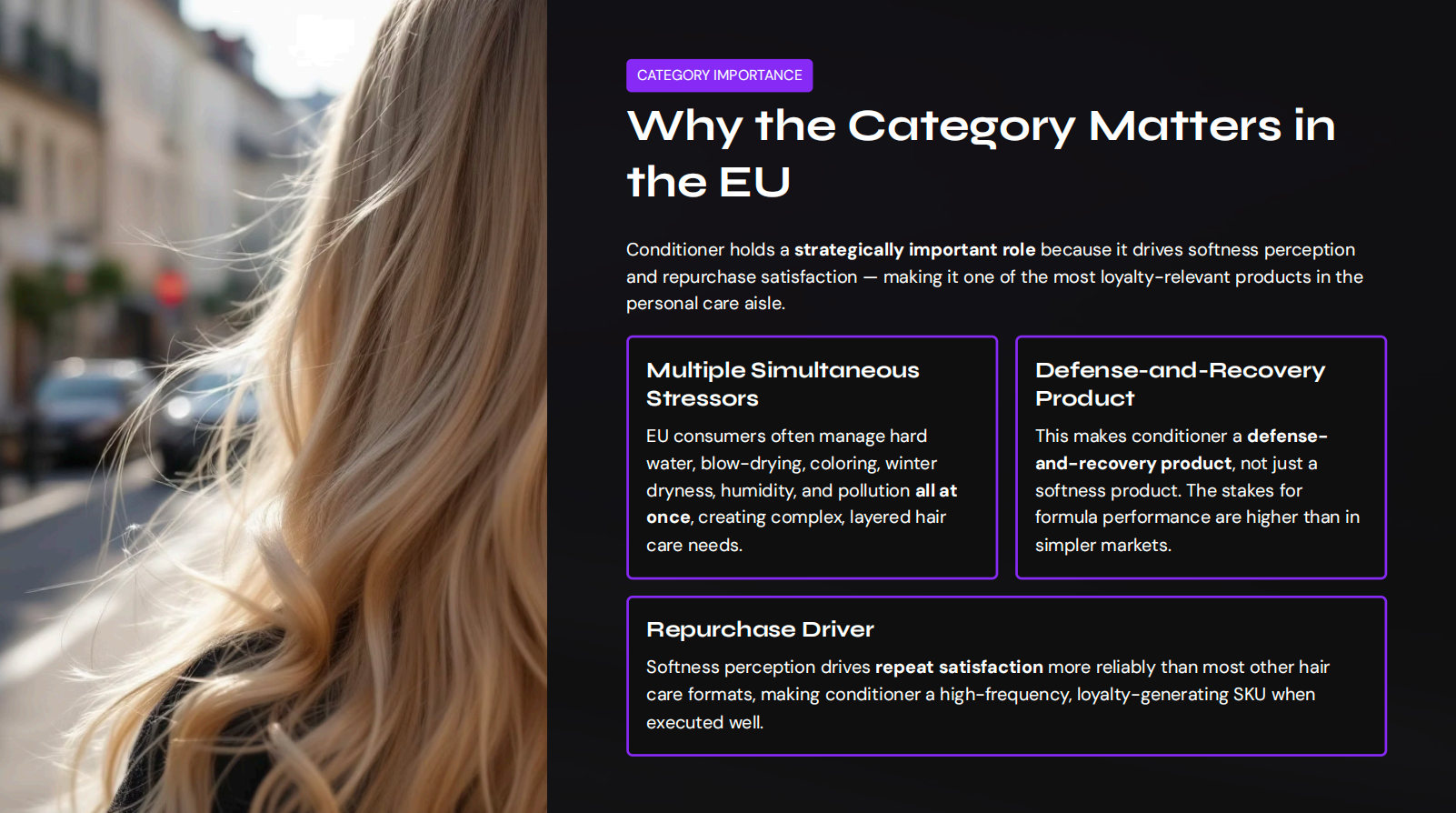
The EU conditioner category plays a key role inside the broader hair care market because it bridges cleansing and treatment. Shampoo may drive initial trial, but conditioner often drives satisfaction, softness, and repeat purchase.
That makes it commercially important for both new entrants and existing brands looking to improve margin, build treatment extensions, or create stronger cross-sell potential into masks, leave-ins, and scalp care.
In 2026, the category is especially attractive because consumer hair routines have become more problem-led. Hard water, winter dryness, color damage, styling heat, humidity, and scalp discomfort all create recurring need states that conditioner can address in a commercially scalable way.
The opportunity is strongest when the product is built around one or two clear needs rather than trying to serve every hair type at once.
What Is Driving Demand in 2026
Several forces are shaping the EU conditioner market.
The first is performance expectation. Consumers increasingly expect visible softness, easy detangling, reduced frizz appearance, and smoother feel without residue.
The second is routine simplification. Buyers want fewer products that do more, which is why hybrid conditioner-mask formats and dual-benefit conditioners are gaining traction.
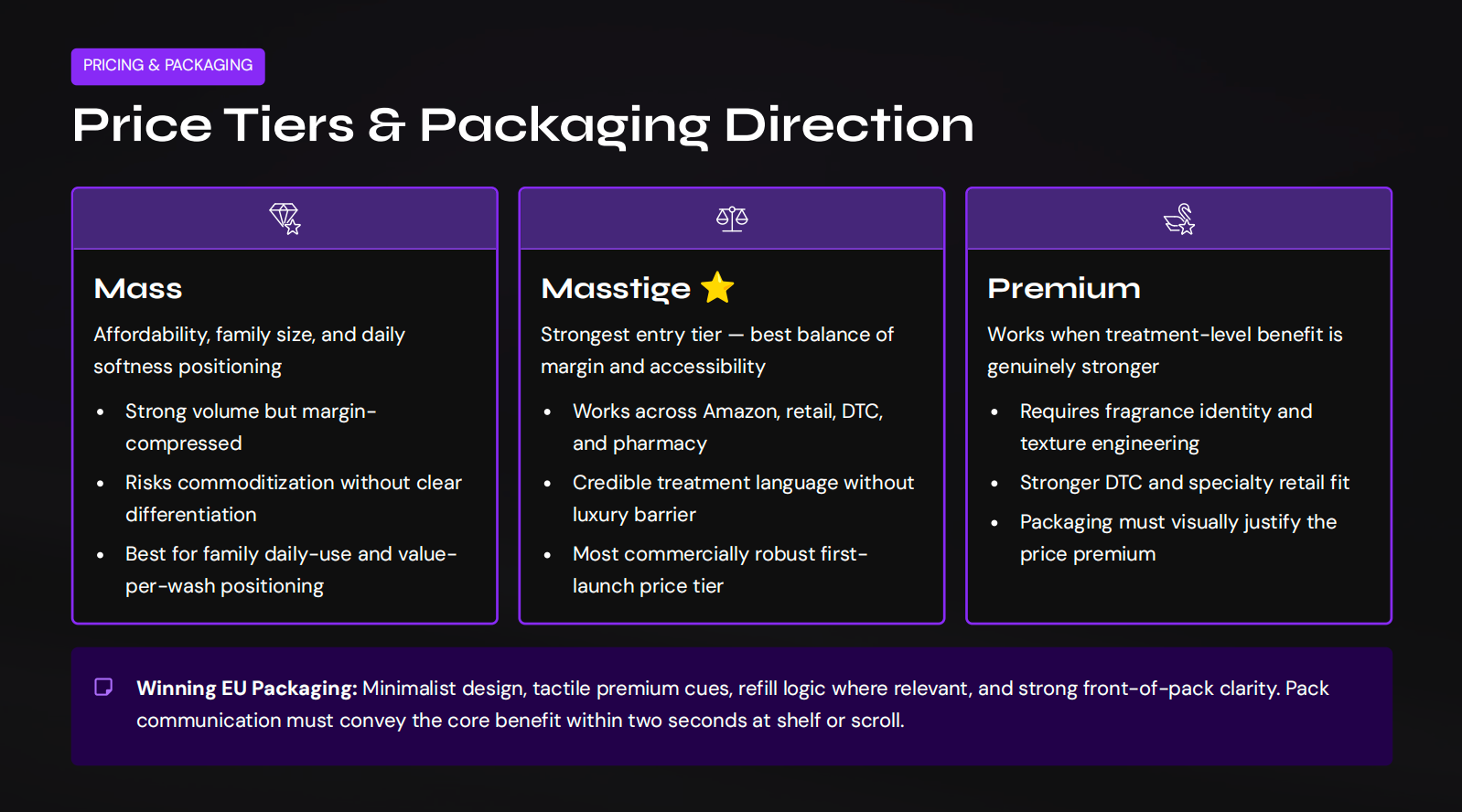
The third is premiumization with caution. Consumers are still willing to pay more, but only when the formula, sensorial experience, packaging, and claims all feel justified.
The fourth is ingredient and compliance awareness. EU buyers are label-conscious and respond to signals such as vegan-friendly, silicone-smart, dermatologically tested, refill-ready, or scalp-compatible positioning.
The fifth is channel differentiation. What works on Amazon is not always what works in pharmacy or retail chains. A strong conditioner launch now has to be built around both market demand and route-to-market logic.
Why the Category Matters in
the EU
The Strongest Demand Segments
The most commercially relevant conditioner opportunities in Europe are concentrated in a few specific need states.
Repair Conditioner
Repair remains the most dependable entry point for many brands. Consumers with heat-styled, bleached, colored, or chemically processed hair want visible softness, reduced roughness, and a smoother feel without heaviness.
Lightweight Hydration for Fine Hair
This is one of the most attractive underexploited segments. Many fine-hair consumers either avoid conditioner entirely or use it reluctantly because they fear flatness and greasy after-feel. A lightweight hydration SKU can solve a very clear frustration point.
Scalp-Compatible Conditioner
Scalp care has become more mainstream, but many scalp-focused routines are still shampoo-led. Conditioner that offers softness, easy rinse, and scalp comfort without heaviness has a clear opportunity, especially in pharmacy, DTC, and Amazon.
Anti-Frizz and Humidity Defense
In Southern and humid EU markets, anti-frizz remains commercially relevant, but consumers increasingly want polished softness without a coated finish.
Curl and Texture Support
Texture-specific conditioning remains under-served in parts of the EU outside specialist channels. Slip, moisture retention, frizz control, and softness continue to matter for curly and textured hair consumers.
Family and Daily-Use Value Packs
Broader household-use conditioners still matter, especially where value and larger pack economics remain important. The opportunity here is to combine affordability with slightly more premium sensorial cues.
Product Strategy: The Right SKU Architecture
The biggest mistake many brands make is launching too many similar conditioners at once. In this category, narrow architecture usually performs better than broad assortment.
A strong 2026 conditioner line can start with:
- one repair hero conditioner
- one lightweight hydration conditioner
- one scalp-compatible or anti-frizz support SKU
- one higher-margin hybrid such as a conditioner-mask or leave-in milk
- one entry-level or family-use conditioner if broader retail expansion is part of the plan
This structure works because each product has a clear job:
- the hero drives acquisition
- the support SKU creates channel-specific differentiation
- the hybrid or leave-in improves margin
- the entry SKU supports scale or distributor penetration
The product range becomes easier to market, easier to explain, and easier to review online.
Formulation Trends Shaping 2026
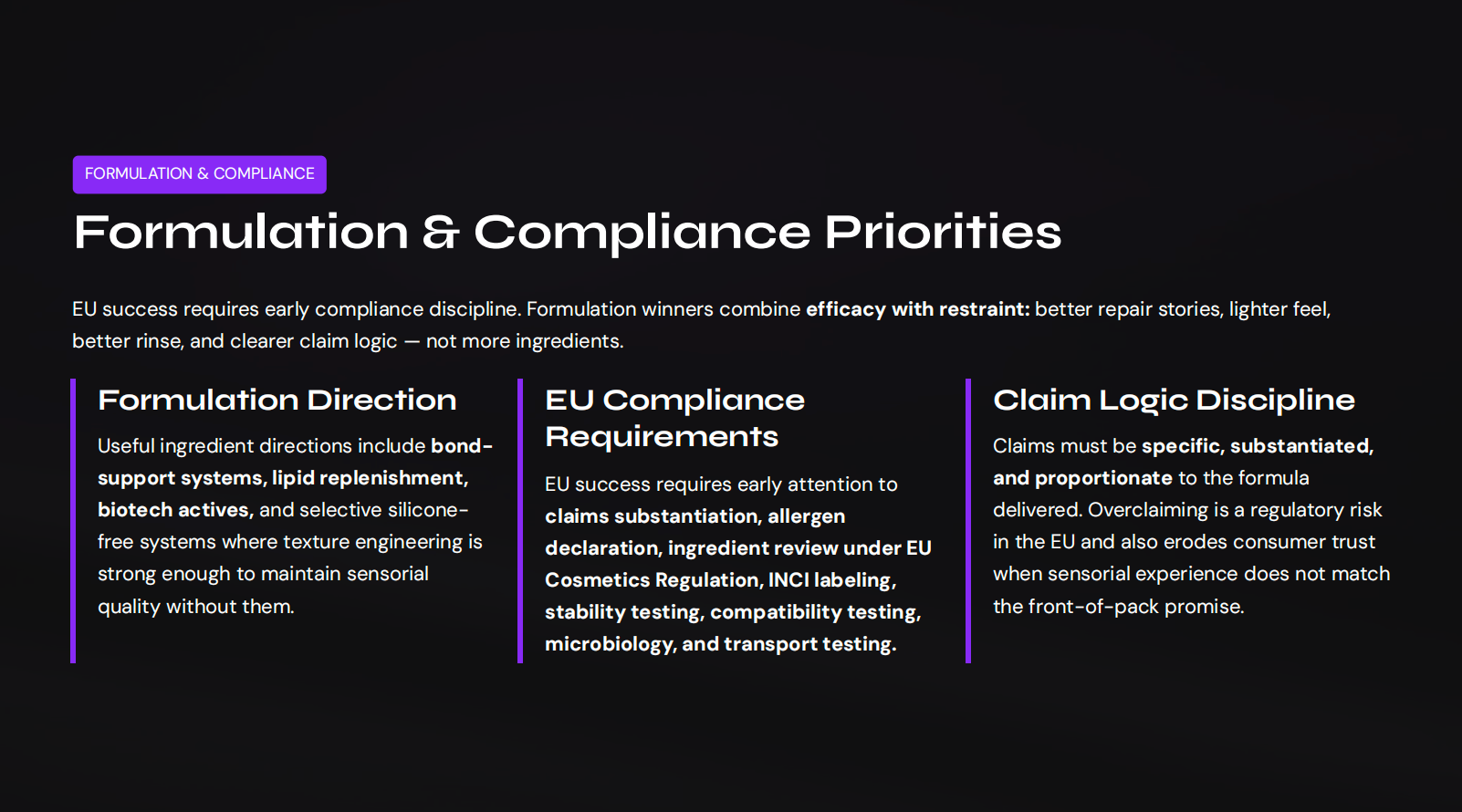
The most important formulation trend is performance with restraint. Buyers want formulas that feel effective but not overloaded, premium but not greasy, modern but still easy to understand.
Repair and Structure Support
Repair continues to be a strong commercial anchor, especially when linked to visible softness and reduced roughness rather than only technical lab language.
Lipid Replenishment and Nourishment
Plant oils and balanced lipid systems remain relevant, especially for dry, frizzy, and textured hair, but the winning direction is not heavy saturation. It is controlled nourishment with a clean rinse feel.
Biotech and Modern Actives
Biotech positioning is becoming more attractive because it gives brands a way to bridge innovation, performance, and sustainability.
Silicone-Smart or Silicone-Free Systems
Silicone-free still matters in parts of the market, especially where scalp-friendly or natural-performance positioning is relevant. But a universal silicone-free rule is not always commercially wise. Some segments still strongly respond to elegant, high-slip sensorial payoff.
Texture Engineering
Texture is one of the most important strategic variables in this category. A conditioner can have the right claims and still fail if the rinse feel, weight after drying, or next-day softness do not meet consumer expectations.
Formulation & Compliance Priorities
Texture and Sensorial Expectations
In the EU, conditioner performance is judged heavily through sensorial experience.
Consumers notice:
- spreadability on wet hair
- immediate slip
- rinse feel
- hair softness after drying
- weight on the lengths
- fragrance character and persistence
- next-day after-feel
Different segments need different textures:
- fine hair usually prefers a light cream or gel-cream
- damaged hair responds better to richer cushiony emulsions
- curl users often prefer denser but still rinseable systems
- scalp-sensitive users want clean, low-residue, softer-fragrance formats
A commercially strong formula is one that matches both the claim and the expected texture profile.
Packaging and Product Design Trends
Packaging matters almost as much as formula in this category because conditioner is bought both through visual browsing and repeat habit.
The strongest packaging directions in 2026 include:
- minimalist EU-inspired design
- restrained color systems
- clear front-of-pack benefit hierarchy
- tactile premium cues such as matte or soft-touch finishes
- shower-friendly shapes
- refill logic where commercially relevant
- pack distinction that is easy to understand within two seconds
Conditioner packaging needs to work in multiple ways. It must look premium enough for the price tier, clear enough for shelf navigation, and durable enough for e-commerce logistics.
Price Tiers & Packaging Direction
Channel Strategy
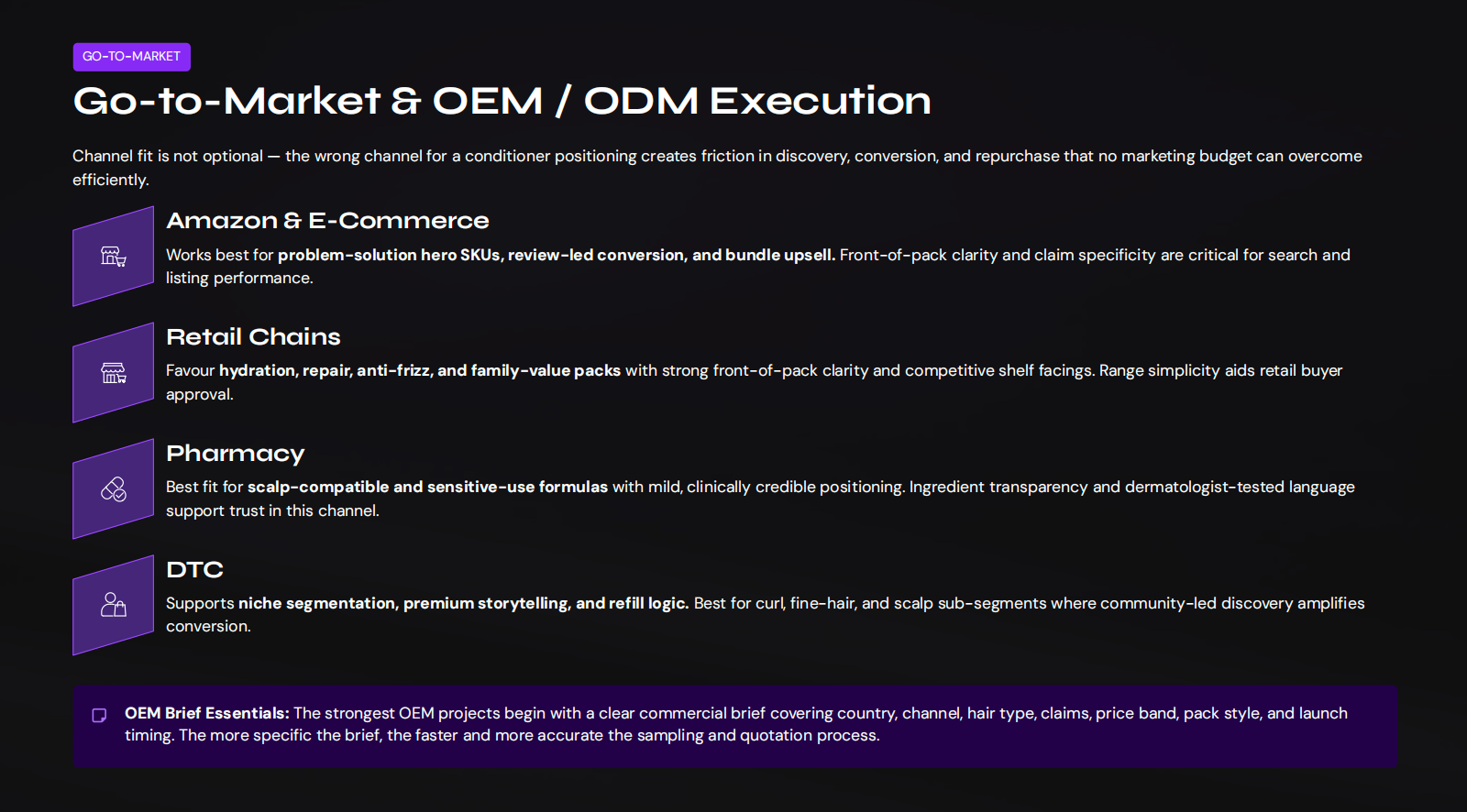
A conditioner launch should be built for channel fit from the start.
Amazon
Amazon works best for problem-solution products with sharp claim clarity. Repair, lightweight hydration, anti-frizz, curl moisture, and scalp-compatible SKUs all have strong potential when supported by clear images, review generation, and a tight assortment.
Retail Chains
Retail is more favorable for broad repeat-use heroes such as repair, hydration, anti-frizz, and family-value packs. Shelf clarity, simple claim hierarchy, and clean price ladders matter more here.
Pharmacy and Para-pharmacy
This channel is well suited to scalp-compatible, mild, dermatology-adjacent, and low-residue formulas. Trust and clarity matter more than exaggerated benefit language.
DTC
DTC is ideal for routine building, premium storytelling, diagnostic selling, refill logic, and bundle economics. It is a strong route for niche segmentation and margin-building formats such as leave-ins or hybrid conditioners.
The strongest strategy is not to launch the same conditioner lineup everywhere. It is to align SKU roles with the way each channel converts.
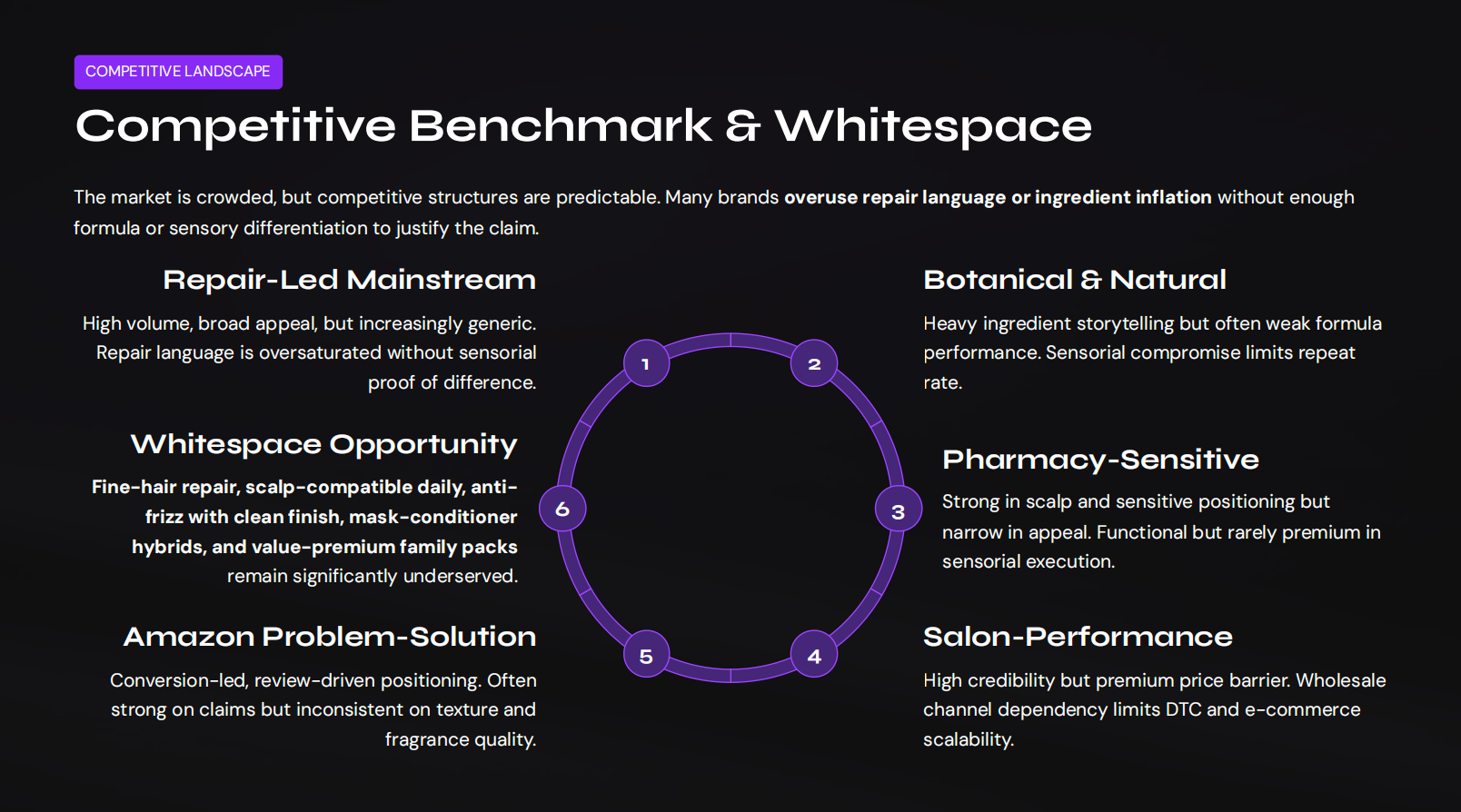
Competitive White Space
Even though the market is crowded, there is still meaningful room for brands that avoid me-too positioning.
Some of the clearest whitespace opportunities include:
- lightweight repair for fine hair
- scalp-compatible daily conditioner
- hybrid conditioner-mask formats
- anti-frizz with a clean finish
- value-premium family pack with elevated sensorial cues
The gap in the market is usually not “no products exist.” The gap is that many existing products are too broad, too heavy, too generic, or too weak in texture differentiation.
That is why product specificity matters more than range size.
Formulation & Compliance Priorities
Compliance and Quality Priorities
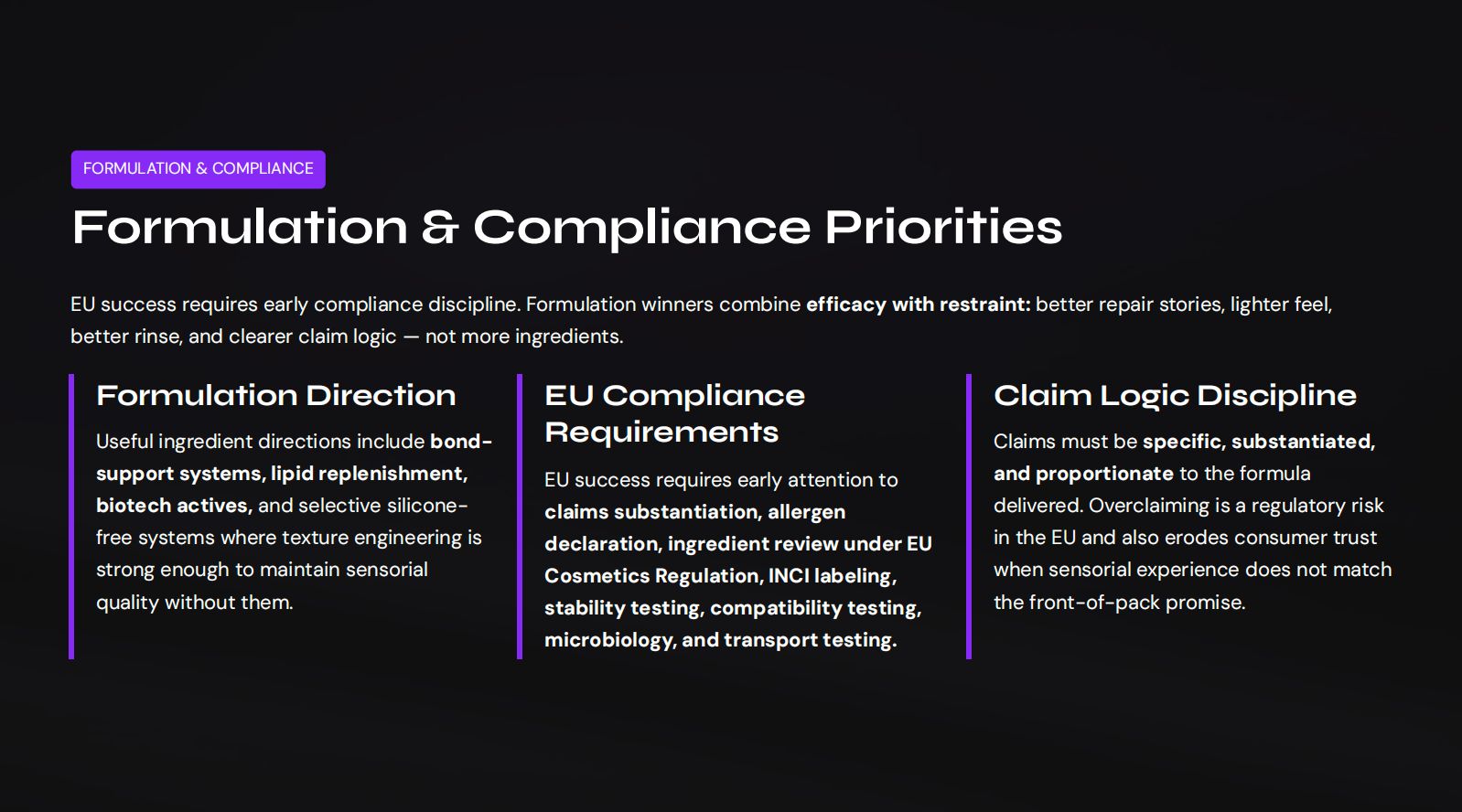
Compliance must be integrated into development from the beginning.
Key priorities include:
- correct INCI logic
- supportable claims
- fragrance allergen readiness where applicable
- packaging and artwork review before release
- stability testing
- compatibility testing
- microbiological and preservation robustness
- transport testing for e-commerce or cross-border shipping
- correct documentation and responsible market-entry workflow
In the EU, brands that delay compliance thinking often end up with slower launches, rework costs, packaging corrections, or reduced retailer confidence.
Formulation & Compliance Priorities
OEM / ODM Opportunity and Execution Strategy
For OEM and ODM projects, the strongest results come from a focused commercial brief rather than a vague request for “premium conditioner.”
A stronger RFQ should define:
- target countries
- target channel
- hair type and need state
- benchmark sensorial direction
- claims priorities
- target retail price
- expected ex-factory range
- pack size and pack format
- formula direction
- launch timing
- refill or sustainability expectations
For most new entrants, the smartest route is not to over-customize both formula and packaging at the same time. A better first launch often combines a more controlled formula path with commercially efficient pack decisions, then adds deeper customization once demand is proven.
The strongest OEM opportunity in this market is not volume without structure. It is helping buyers develop fewer, better-positioned products with stronger repeat potential.
Go-to-Market & OEM / ODM Execution
What Brands Should Do Next
If you are evaluating an EU hair conditioner launch for 2026, the best next step is to define the commercial logic before the sample request.
Start by deciding:
- which need state you want to own
- which channel you are building for
- what texture profile your buyer expects
- which price tier is realistic
- whether your first wave should emphasize repair, hydration, scalp comfort, or anti-frizz
- which supporting SKU can increase margin without adding too much complexity
This approach improves development speed, reduces unnecessary sampling rounds, and results in a more commercially usable line.
Final Takeaway
The EU conditioner category in 2026 rewards specificity, sensorial excellence, and launch discipline.
The products most likely to win are not the ones with the longest ingredient lists or the broadest claim sets. They are the ones that solve a clearly defined hair problem, feel premium during use, and match the economics and expectations of the target channel.
For most buyers, the smartest route is to launch with one credible hero SKU supported by one or two strategically differentiated companions. That creates better focus, lower complexity, stronger sell-through, and better leverage with OEM partners.
Download the Full Report (PDF)
Tell us your target region, product category, and the decision you’re trying to make. We’ll suggest the closest existing report—or build a tailored version.