


Executive Summary
The U.S. Unisex Perfume Market Report 2026 translates fragrance market signals into launch logic. Covering consumer demand, format strategy, pricing ladders, channel structure, compliance, and OEM planning, it supports better decision-making for buyers entering or expanding in the unisex fragrance category.
U.S. Unisex Perfume Market 2026: Trends, Size, Pricing, and Launch Strategy
The U.S. unisex perfume market in 2026 is no longer a niche defined by novelty. It is becoming a meaningful commercial segment shaped by gender-neutral positioning, self-expression, skin-scent demand, layering habits, travel formats, and discovery-led buying behavior.
For brands, importers, distributors, private label buyers, and Amazon sellers, the real opportunity is not simply to label a fragrance as unisex. The real opportunity is to build a portfolio that feels modern, wearable, giftable, and channel-ready across DTC, Amazon, specialty retail, and seasonal gifting.
This report turns the unisex fragrance opportunity into a practical launch roadmap. It covers market size, demand drivers, scent direction, pricing logic, format strategy, channel fit, compliance priorities, and an OEM-ready path for turning product ideas into a commercially structured launch.
Executive Summary
The U.S. fragrance market remains large and resilient, and unisex perfume is one of the strongest sub-segments benefiting from broader shifts in consumer identity and shopping behavior. Younger consumers increasingly view fragrance as personal expression rather than a product defined by male or female categories alone.
This creates favorable conditions for unisex launches in 2026. Consumers are responding to skin-musk scents, clean amber profiles, citrus-wood freshness, discovery sets, travel formats, layering routines, and social-led product discovery. The most successful brands are not selling “neutrality” in an abstract way. They are selling a fragrance role: everyday signature, cozy clean scent, date-night warmth, travel-friendly versatility, or giftable discovery.
For most operators, the strongest path is not a single hero SKU alone. It is a structured portfolio that combines a hero EDP, a smaller trial format, a discovery or giftable set, and at least one entry-point product that lowers friction for first purchase.
Market Opportunity Overview
The U.S. unisex perfume market sits inside the broader fragrance category, but it behaves like a distinct commercial opportunity. Consumers are no longer looking only for clearly masculine or clearly feminine fragrance identities. They are increasingly drawn to scents that feel personal, flexible, and wearable across situations.
This makes unisex perfume especially attractive for brands entering a crowded market. A well-positioned unisex fragrance can serve broader audience groups, perform better in gifting, and reduce the need for separate his-and-hers product structures at launch.
What matters in 2026 is not simply calling a fragrance unisex. What matters is whether the scent profile, pack design, format mix, and product story actually support that promise in a believable way.
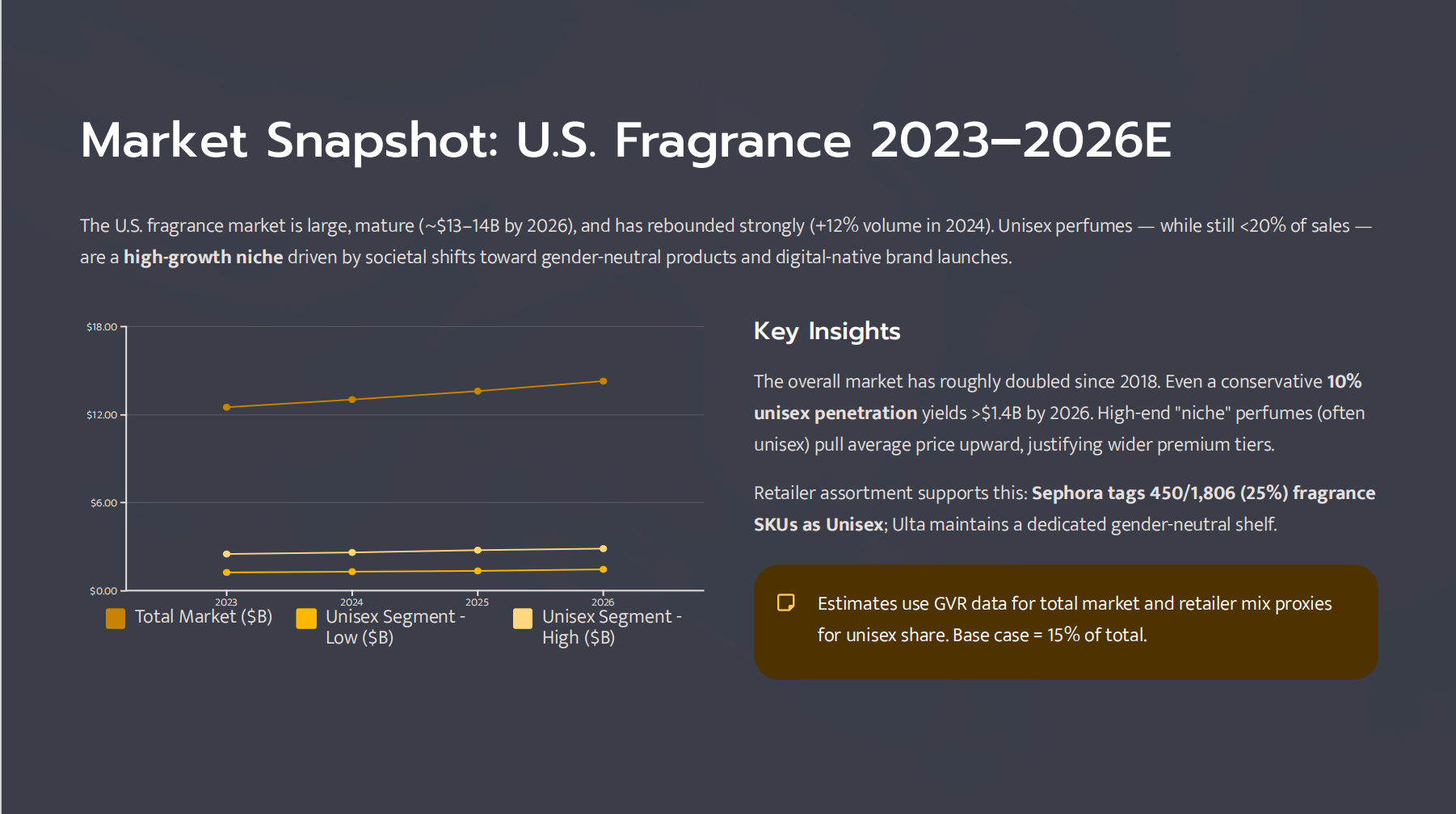
Market Snapshot: U.S. Fragrance 2023–2026E
What Is Driving Demand
Several structural shifts are supporting unisex perfume growth in the U.S. market.
The first is generational change. Younger consumers tend to reject rigid fragrance categories and are more comfortable choosing scents based on mood, identity, and personal style.
The second is the rise of scent wardrobes. Instead of owning one fragrance, many consumers now buy multiple scents or formats for different moments, such as daily wear, travel, layering, date night, or gifting.
The third is discovery behavior. Discovery sets, travel sprays, and smaller formats reduce blind-buy risk and support online-first conversion in a category where customers often purchase before smelling.
The fourth is social influence. TikTok, short-form reviews, and creator-led fragrance content continue to make unisex scents more visible, especially when positioned around wearable notes, clean-skin appeal, and signature-scent storytelling.
The category is growing because it matches how consumers now want to buy fragrance: more personally, more flexibly, and with lower-risk entry points.
Consumer Demand Signals
The most commercially useful consumer signals in the unisex space point to a few recurring patterns.
Consumers are showing strong interest in:
-
skin-scent and clean-musk profiles
-
subtle amber woods and fresh citrus-woody blends
-
discovery sets and travel-size perfumes
-
oil-based perfume formats and roll-ons
-
layering routines that combine multiple scent products
-
giftable fragrance sets that feel easier to buy for another person
This matters because unisex perfume is not being driven only by one fragrance family. It is being driven by versatility. Shoppers want products that feel wearable across situations and easy to integrate into daily routines.
That gives brands a clear direction: focus less on abstract gender neutrality and more on practical scent roles, such as everyday signature, fresh daytime wear, cozy intimacy, or travel-friendly discovery.
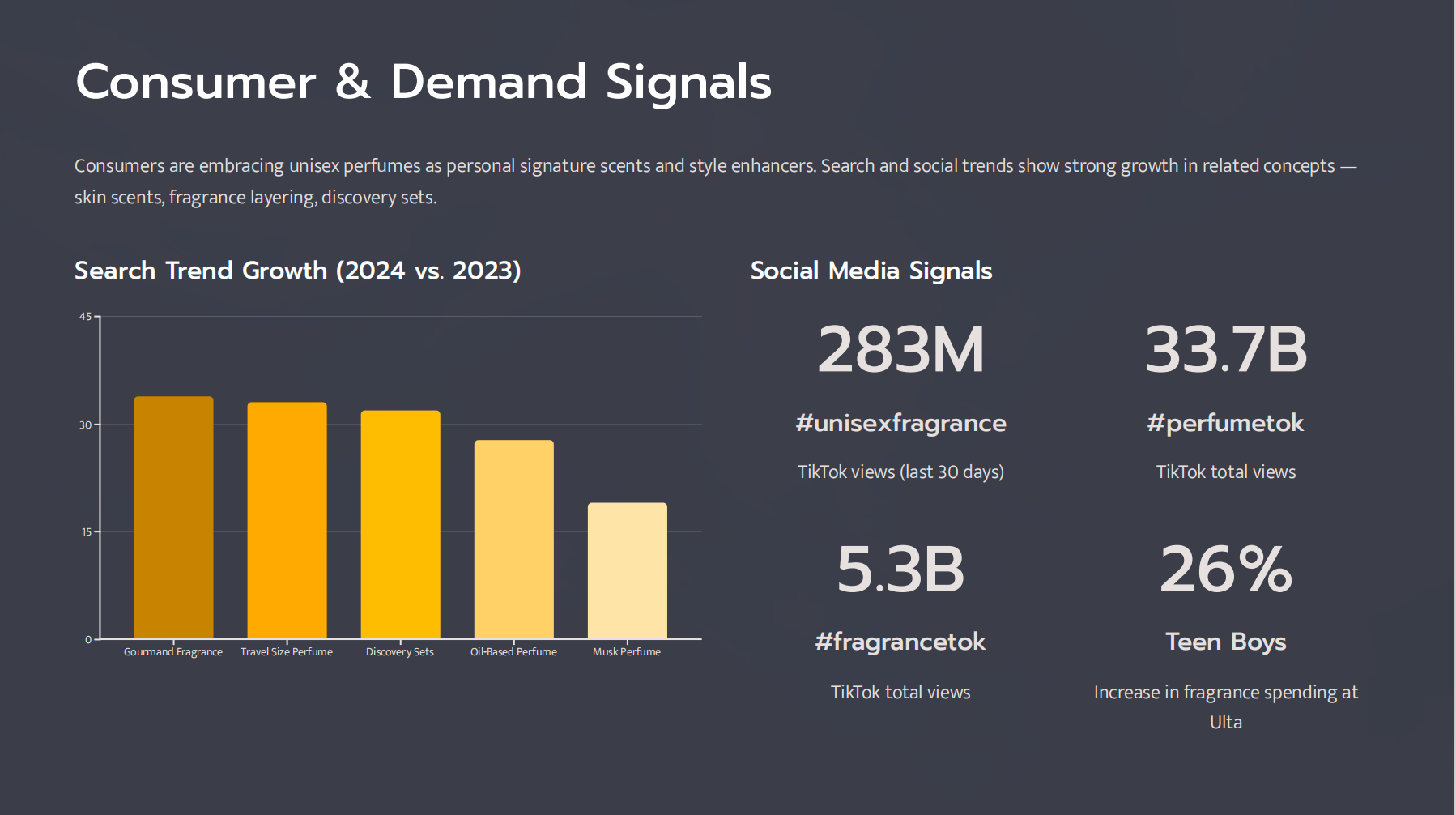
Consumer & Demand Signals
Scent Directions with the Strongest Commercial Potential
A successful unisex fragrance portfolio in 2026 should not be built around generic “clean” language alone. The stronger path is to translate wearability into distinct scent territories that still feel broadly accessible.
The most commercially promising directions include:
-
clean musk and second-skin scents
-
citrus woods with airy freshness
-
amber woods with soft warmthq
-
subtle gourmand notes for broader appeal
-
sandalwood-led blends with a modern unisex profile
-
layering-friendly fragrances that feel light but memorable
The strongest launches usually combine at least two scent roles. One should feel easy and everyday. Another can feel warmer, more distinctive, or more evening-oriented. That contrast helps brands create a usable assortment instead of a flat fragrance line.
Pricing Strategy and Portfolio Structure
The U.S. unisex perfume category spans mass, mid-tier, and premium price bands, but not every tier works the same way.
Entry-level formats such as body mists, roll-ons, and small travel sprays help reduce friction and expand trial. Mid-tier EDPs are often the most commercially balanced place to launch because they support better packaging, better storytelling, and healthier margins without entering ultra-premium territory too early. Premium niche-positioned perfumes can succeed, but they require stronger branding, stronger packaging, and stronger channel support.
For most new entrants, a better launch structure includes:
-
one mid-tier hero EDP
-
one smaller travel or mini version
-
one oil or roll-on for portability and entry price
-
one discovery or giftable set for trial and Q4 conversion
-
one supporting scent direction for layering or occasion-based use
This structure creates a clearer price ladder and makes the collection easier to sell across Amazon, DTC, and specialty channels.
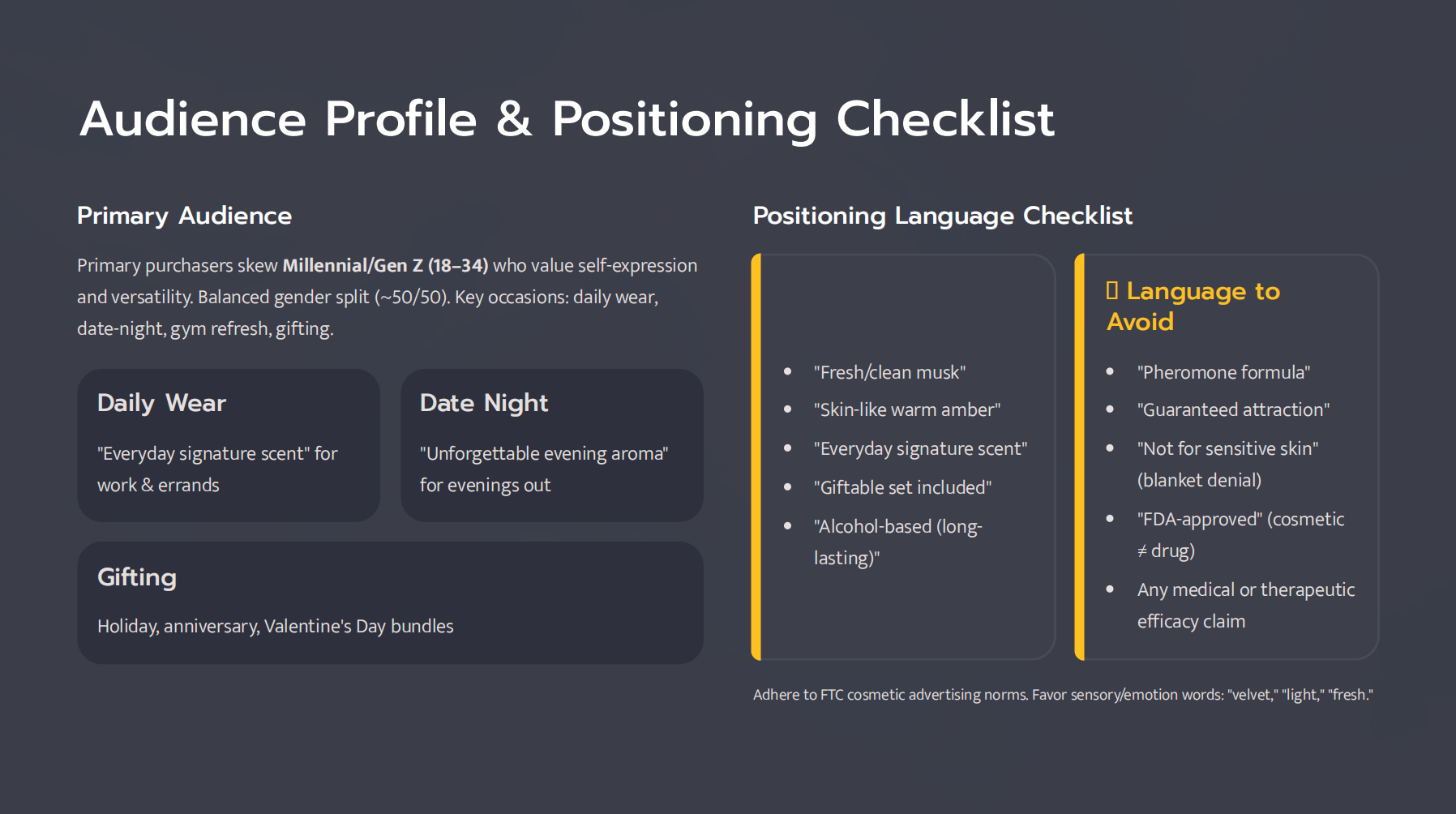
Audience Profile & Positioning Checklist
Format Strategy: Why Smaller Packs Matter
One of the clearest commercial signals in the unisex space is the importance of format diversity. Consumers increasingly want to try before they commit, gift without overthinking, and carry fragrance across different routines.
That is why smaller packs matter. Travel sprays, discovery sets, mini bundles, and roll-ons are not just add-ons. They are a core part of conversion strategy.
These formats help in several ways:
-
they reduce blind-buy hesitation
-
they improve gifting suitability
-
they support higher trial rates online
-
they create natural bundle opportunities
-
they make social-led product discovery easier to monetize
For Amazon sellers and DTC brands in particular, format strategy is often just as important as scent strategy.
Channel Strategy
A strong unisex perfume launch should be channel-aware from the start.
For Amazon, the opportunity lies in accessible price points, clear scent language, travel kits, and entry formats that help lower purchase hesitation. Packaging must also be operationally ready for shipping, leakage prevention, and platform requirements.
For DTC, the opportunity is broader. Discovery sets, personality-based scent matching, gifting logic, layering stories, and email-led follow-up all work well in direct channels.
For prestige or specialty retail, packaging and presentation matter more. Unisex fragrance can perform well in these channels when it looks premium, feels giftable, and offers a clear scent identity without relying on overly gendered cues.
The strongest strategy is not to sell the exact same SKU mix everywhere. It is to adapt the assortment to the way each channel drives conversion.
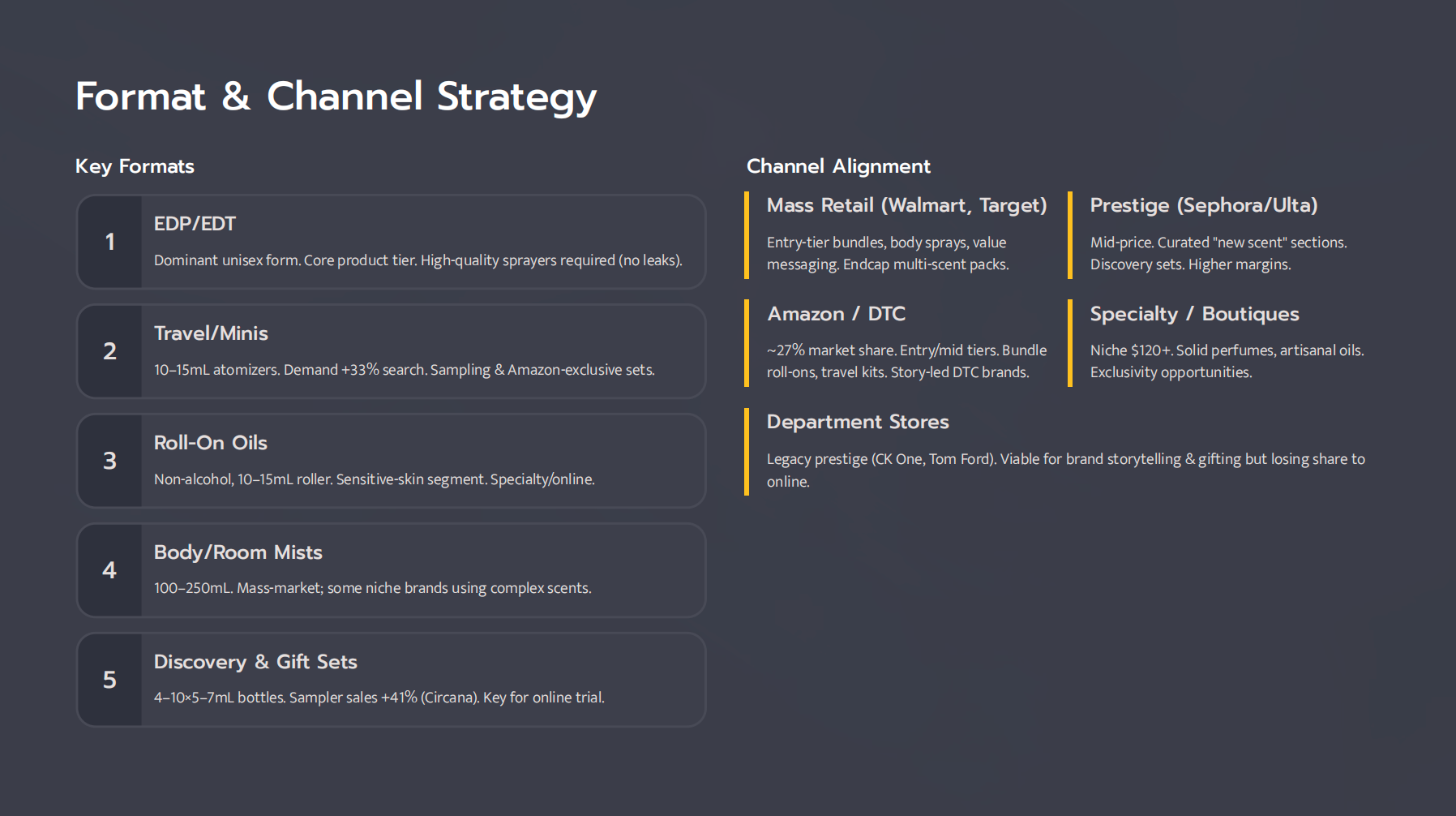
Format & Channel Strategy
Competitive Positioning
The unisex perfume category is already crowded, which means generic positioning is unlikely to work. Simply calling a scent “clean” or “gender-neutral” is not enough.
Winning brands tend to do three things well:
-
they define a specific emotional or lifestyle role for the fragrance
-
they align packaging and price with that positioning
-
they create a set of supporting formats that increase trial and repeat purchase
There is still room in the market, but the whitespace is not in vague neutrality. It is in well-structured, wearable, giftable, and socially understandable scent concepts that feel current without becoming copycat launches.
Compliance and Risk Control
Unisex fragrance launches still need to follow the same operational discipline as the rest of the fragrance category. Strong storytelling should not turn into risky claims.
The safer approach is to use sensory and mood-based language such as:
-
clean
-
fresh
-
warm
-
skin-like
-
everyday signature
-
layering-friendly
-
giftable
-
confidence-boosting
It is better to avoid exaggerated language that implies medical, hormonal, or guaranteed personal effects. Brands should also pay attention to ingredient presentation, allergen transparency where appropriate, labeling accuracy, shipping restrictions for alcohol-based perfumes, and platform-specific content rules.
For U.S. launches, compliance should be treated as part of the go-to-market strategy, not as a final step before shipping.
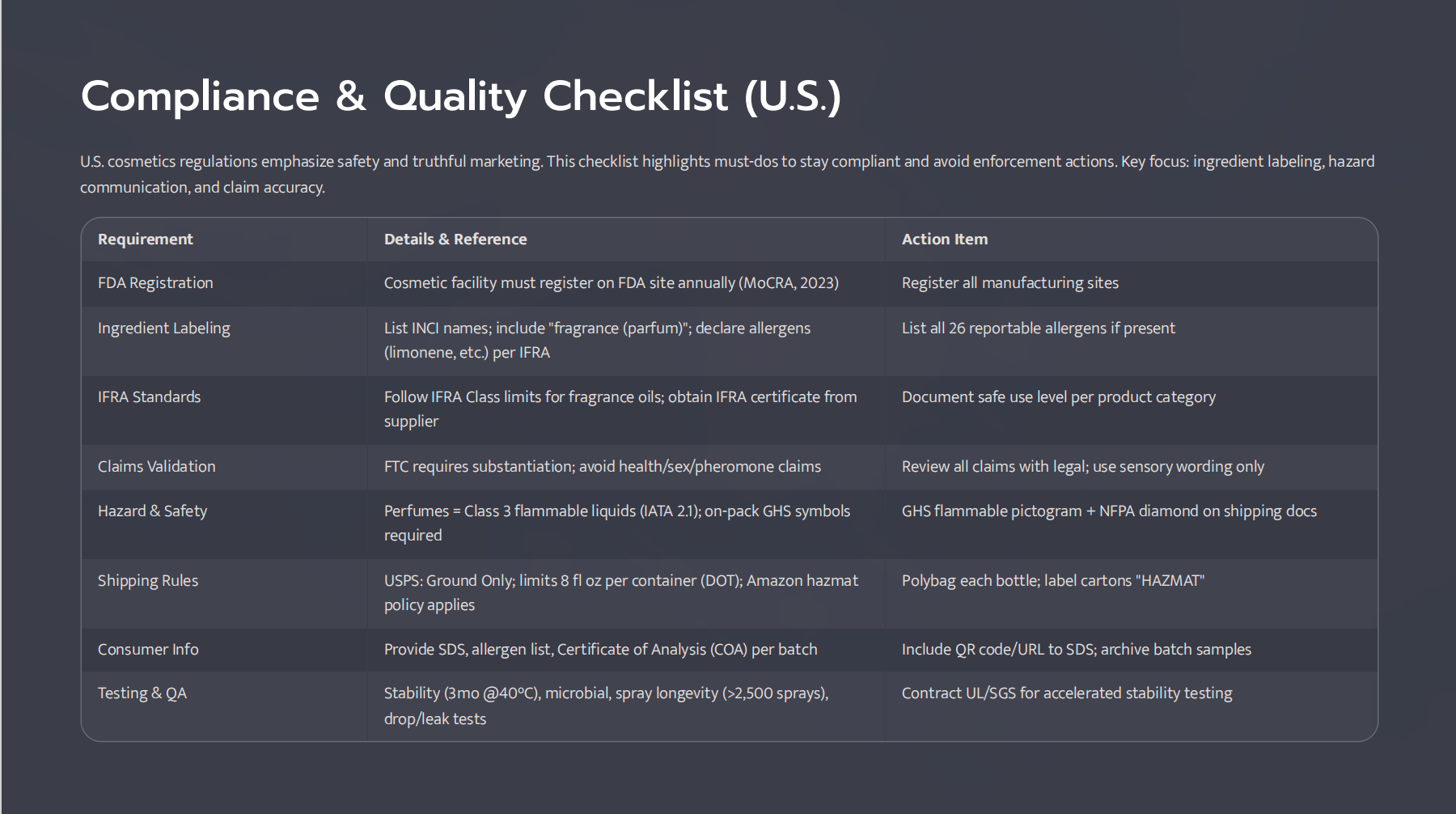
Compliance & Quality Checklist (U.S.)
Packaging and Merchandising
Unisex perfume works best when the packaging feels inclusive, modern, and intentional rather than vague. Strong packaging should signal versatility without becoming visually bland.
Useful packaging cues include:
-
clean typography
-
neutral or softly contrasted color systems
-
premium bottle proportions
-
travel-friendly formats
-
coordinated visual structure across hero, mini, and discovery products
-
holiday-ready giftable configurations for Q4
Packaging should help communicate the collection logic. If the assortment includes an everyday scent, a warmer evening scent, and a discovery format, the visual system should make those roles easy to understand.
That clarity helps in both online merchandising and offline shelf presentation.
OEM Launch Logic
For buyers planning an OEM or private label launch, the fastest way to improve the result is to provide a clearer brief from the beginning.
A stronger RFQ should include:
-
target market
-
primary channel
-
target price band
-
scent direction
-
preferred product formats
-
pack sizes
-
quantity forecast
-
packaging expectations
-
claims boundary
-
required documents
-
timeline
-
seasonal or gifting priorities
The better these elements are defined upfront, the easier it becomes to build a commercially realistic quote, reduce unnecessary revisions, and move faster from concept to production.
A capable supplier should not only fill fragrance. It should help structure the assortment, packaging path, testing plan, and launch sequence.
Final Takeaway
The U.S. unisex perfume market in 2026 is attractive because it aligns with broader consumer shifts toward self-expression, flexible usage, gifting, and lower-risk format exploration.
The brands most likely to win are not the ones using the broadest “for everyone” messaging. They are the ones creating the clearest product system: a defined scent role, a believable unisex identity, a strong price ladder, smaller formats for trial, and packaging that supports both online and offline conversion.
If you are planning a U.S. unisex fragrance launch, the smartest next step is to align your market, channel, price band, and format strategy first, then build the right SKU path from there.
Download the Full Report (PDF)
Tell us your target region, product category, and the decision you’re trying to make. We’ll suggest the closest existing report—or build a tailored version.