


Executive Summary
This report explores the UK women’s fragrance market in 2026, including demand trends, price tiers, gifting behavior, travel and discovery formats, compliance priorities, and private label opportunities. It is designed to help brands, distributors, importers, Amazon sellers, and e-commerce operators turn market insight into a more practical launch strategy.
UK Women’s Fragrance Market 2026: Trends, Price Tiers, and Private Label Opportunities
The UK women’s fragrance market in 2026 remains commercially attractive, but it is no longer a simple volume game. It is a mature, brand-led category where growth is increasingly shaped by premiumisation, gifting, mini formats, discovery-led trial, and stronger demand for fragrances with clear emotional and lifestyle positioning.
For private label brands, importers, distributors, Amazon sellers, and e-commerce operators, the opportunity is not in launching another generic floral perfume. The real opportunity is in building a more structured product system: one hero women’s Eau de Parfum, one travel or trial format, and one giftable or discovery configuration designed around real buying behavior.
This report translates market signals into launch logic. It covers the UK women’s fragrance market from demand trends and format shifts to price tiers, channel strategy, product opportunity mapping, compliance priorities, and private label execution planning.
Executive Summary
The UK women’s fragrance market remains one of the most commercially important beauty categories in Europe. It is mature, competitive, and highly promotional, yet still open to newness when that newness is clearly positioned, commercially usable, and easy to buy.
What is changing in 2026 is not only how consumers shop, but what they expect from fragrance. Women are increasingly buying scent not only for special occasions, but for daily identity, self-reward, gifting, mood, and routine-based use. That means the strongest fragrance launches are no longer just about the note pyramid. They are about wearability, format architecture, giftability, and price logic.
For most first-time private label entrants, the smartest route is not to launch a wide range. It is to launch one scalable hero SKU in a commercially realistic price band, then support it with a travel or mini format and a gift or discovery extension.
Market Opportunity Overview
The UK fragrance market remains large enough to support both established and emerging players, but women’s fragrance continues to hold the strongest commercial weight in mainstream and prestige retail. It is the most visible, most gifted, and most actively merchandised segment in many fragrance environments.
For 2026 planning, the UK women’s fragrance market should be approached as a value-driven premium category rather than a low-end mass race. Consumers are still spending, but they are becoming more selective. They want fragrances that feel worth the money, fit their routines, and communicate a clear emotional role.
This creates stronger opportunities for private label brands that can deliver:
- a clear fragrance identity
- everyday wearability
- more accessible premium pricing
- travel and discovery formats
- gifting logic
- compliance-ready execution
The market is attractive, but only for launches with structure.
Market Overview: UK Women's
Fragrance
What Is Driving Demand in 2026
Several shifts are shaping the category.
The first is premiumisation. UK shoppers continue to prefer stronger concentration formats and products that feel more elevated, even when they remain price-aware.
The second is selective indulgence. Consumers may be more cautious overall, but fragrance still performs as an affordable luxury purchase and a self-reward category.
The third is gifting. Women’s fragrance continues to benefit from Christmas, Mother’s Day, seasonal promotions, and value-rich set merchandising.
The fourth is format innovation. Minis, travel sprays, and discovery sets are no longer secondary. They now play a central role in trial, gifting, customer acquisition, and e-commerce conversion.
The fifth is scent differentiation. Generic launches are harder to scale. Clear positioning matters more than ever, especially in a market crowded by designer, celebrity, and promotional fragrance offers.
Consumer & Demand Insights
The UK women’s fragrance market cannot be treated as one uniform audience.
Younger buyers tend to be more open to experimentation, more influenced by TikTok and peer discovery, and more comfortable buying multiple smaller formats instead of one signature bottle. They are highly responsive to travel sprays, minis, and discovery-led entry.
Women in the 25–34 range represent one of the strongest opportunities for masstige EDP launches. This group is looking for sophistication, wearability, and better perceived value without always trading up into full prestige pricing.
Women aged 35–49 are often stronger repeat buyers, with higher acceptance of premium price points and stronger gifting and self-reward behavior.
Older fragrance users remain highly relevant, but they generally respond better to elegant, wearable, familiar scent structures and more polished gift-ready formats.
Across these groups, one principle holds: use cases matter more than abstract fragrance language. Buyers increasingly respond to concepts such as everyday confidence, clean skin luxury, vanilla floral night, soft feminine signature, and giftable modern classic.
Consumer & Demand Insights
Best Product Directions for 2026
The most commercially useful scent directions for the UK women’s fragrance market in 2026 include:
- clean skin musk
- modern floral amber
- vanilla floral evening scents
- soft rose-fruit femininity
- fresh floral with airy woody base
- intimate musks and second-skin profiles
- warm evening amber with broad gifting appeal
What matters most is not simply whether a scent is floral, musky, or gourmand. What matters is whether it maps clearly to a use moment.
A stronger fragrance brief is built around roles such as:
- everyday wear
- workday confidence
- clean personal luxury
- social evening scent
- travel-friendly rotation
- giftable feminine trio
This makes the product easier to sell online, easier to explain in retail, and easier to convert into repeat purchase.
Price Band Strategy
The UK women’s fragrance market is clearly segmented.
Mass price tiers remain highly promotional and difficult to differentiate. Premium and prestige tiers can offer strong margins, but they are harder to enter without established brand equity. For many private label brands, the most commercially attractive zone is masstige.
This zone creates a better balance between:
- premium look and feel
- accessible price point
- repeat-purchase potential
- stronger perceived value
- easier gifting logic
- better private-label competitiveness
A more realistic entry strategy is to avoid trying to imitate prestige pricing too early. Instead, launch with a modern, giftable, everyday EDP positioned as a smart premium trade-up.
Why Travel Sizes and Discovery Formats Matter
Travel spray and discovery formats are no longer just supporting extras. They are now core commercial tools.
They matter because they:
- reduce first-purchase hesitation
- fit online buying behavior
- improve gifting conversion
- make trial easier for younger shoppers
- support content-led and social-led customer acquisition
- help brands enter marketplaces with less risk
For many new launches, the entry format is just as important as the hero bottle. A strong 10ml or mini trio can often do more for customer acquisition than a second full-size fragrance launched too early.
Product Architecture for Private Label Brands
A stronger private label launch in the UK should usually follow a simple three-part structure.
1. Hero SKU
One 30ml or 50ml women’s EDP with the clearest commercial identity.
2. Entry SKU
One 10ml travel spray or mini designed for lower-risk trial and online conversion.
3. Bundle or Gift SKU
One discovery trio, mini gift set, or paired format that supports gifting and seasonal sell-through.
This structure works because it creates:
- one core revenue driver
- one lower-risk acquisition tool
- one value-rich gifting format
It is much stronger than launching multiple unrelated perfumes with no clear role.
Top Opportunity Areas for Private Label Brands
The most attractive product opportunities in 2026 include:
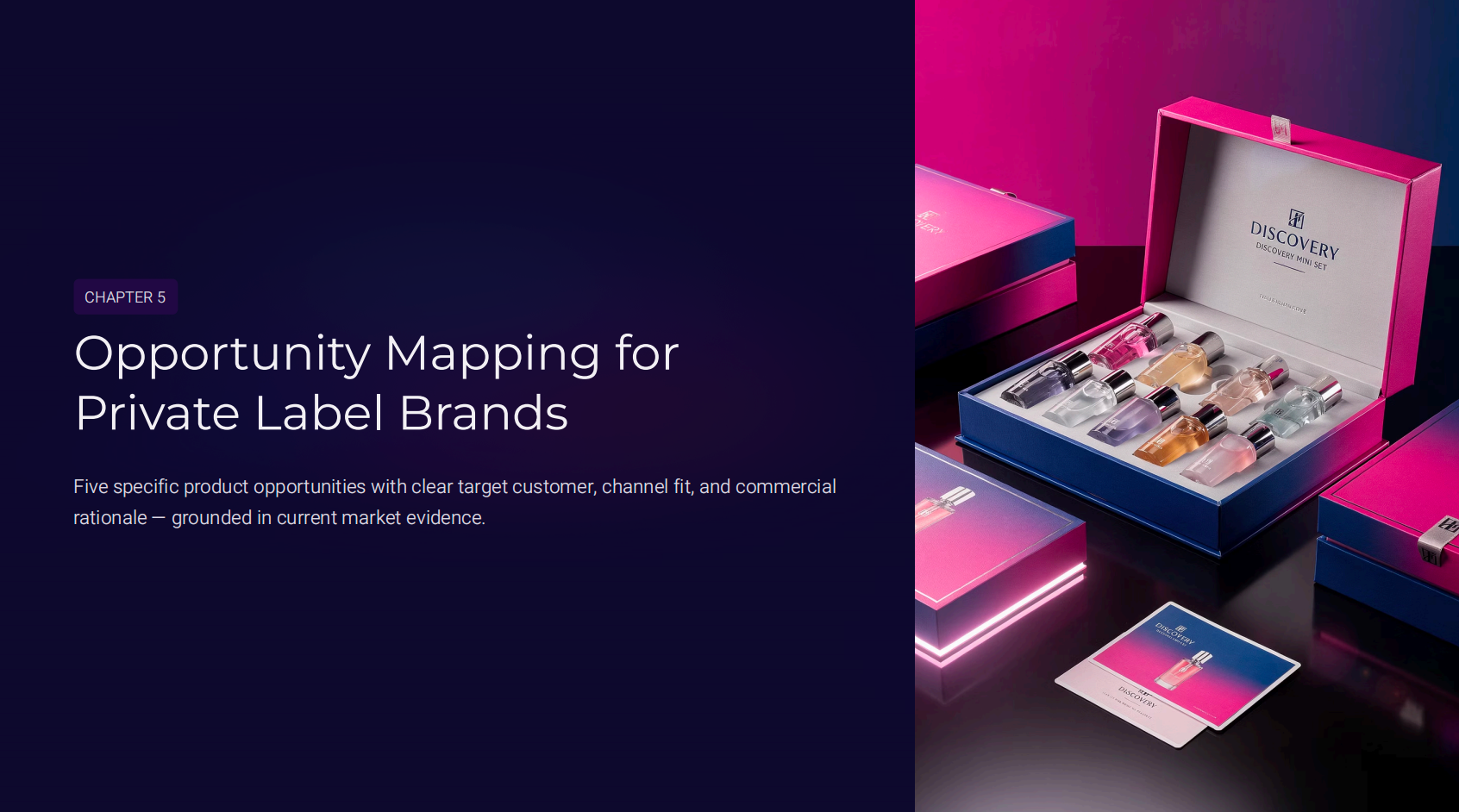
Opportunity Mapping for
Private Label Brands
Clean Skin Musk EDP
A soft, wearable, intimate women’s EDP positioned for everyday use and repeat purchase.
Vanilla Floral Night EDP
A more sensual evening fragrance designed for younger women and gifting-friendly channels.
Travel Spray Trio
A three-scent format built for trial, portability, gifting, and customer acquisition.
EDP + Body Mist Layering Duo
A coordinated scent system that turns one hero accord into a stronger routine-based proposition.
Giftable Mini Set
A format-led seasonal offer that creates higher perceived value without requiring prestige brand spend.
These opportunities work because they solve real commercial needs: easier sampling, easier gifting, stronger use-case positioning, and more channel flexibility.
Channel Strategy
A UK women’s fragrance launch should be built around channel fit, not just one generic SKU plan.
Amazon
Best suited for travel sprays, 30ml hero EDPs, discovery sets, and value-led bundles. Clear scent naming, strong imagery, and simple consumer-friendly positioning work best.
DTC
Best suited for storytelling, discovery sets, layering formats, and customer acquisition systems. This is the strongest environment for building emotional brand logic and bundle behavior.
Retail and Boutique
Best suited for hero EDPs, giftable sets, and visually strong packaging. Shelf impact matters more here, so the assortment should remain simple and easy to understand.
Seasonal Gifting
Best suited for mini sets, EDP plus companion bundles, and ready-to-merchandise value formats. Strong packaging structure and clean price architecture are critical.
The strongest brands do not force the same pack logic into every channel. They adapt their assortment to how the customer actually buys.
Competitive White Space
The UK women’s fragrance category is crowded, especially in the designer middle. That means generic launches without a defined proposition are difficult to scale.
Private label brands should avoid:
- prestige lookalikes with no clear value advantage
- one-SKU launches with no discovery support
- overly generic floral-amber concepts
- dupe-style strategies without stronger brand positioning
Instead, the better opportunity is in:
- high-wearability everyday EDPs
- travel-first acquisition formats
- clean and modern feminine scent identities
- value-rich gift architecture
- simple but premium-looking packaging
- better price-to-perception balance
This is where structured private label brands can compete most effectively.

Competitive Benchmarking
Compliance and Risk Considerations
Compliance should be treated as a commercial gate, not a technical afterthought.
Key priorities include:
- fragrance allergen labeling
- Responsible Person setup
- correct market notification route
- clear ingredient declaration
- dual-market planning where relevant
- packaging compatibility and stability
- pump, crimp, leakage, and carton performance
- realistic claims language
The biggest mistakes usually happen when brands delay compliance decisions until after scent and packaging are already too far advanced. That creates unnecessary rework, delay, and cost.
For UK launches, compliance planning should begin at concept stage, especially if the product may later move into EU-related channels as well.
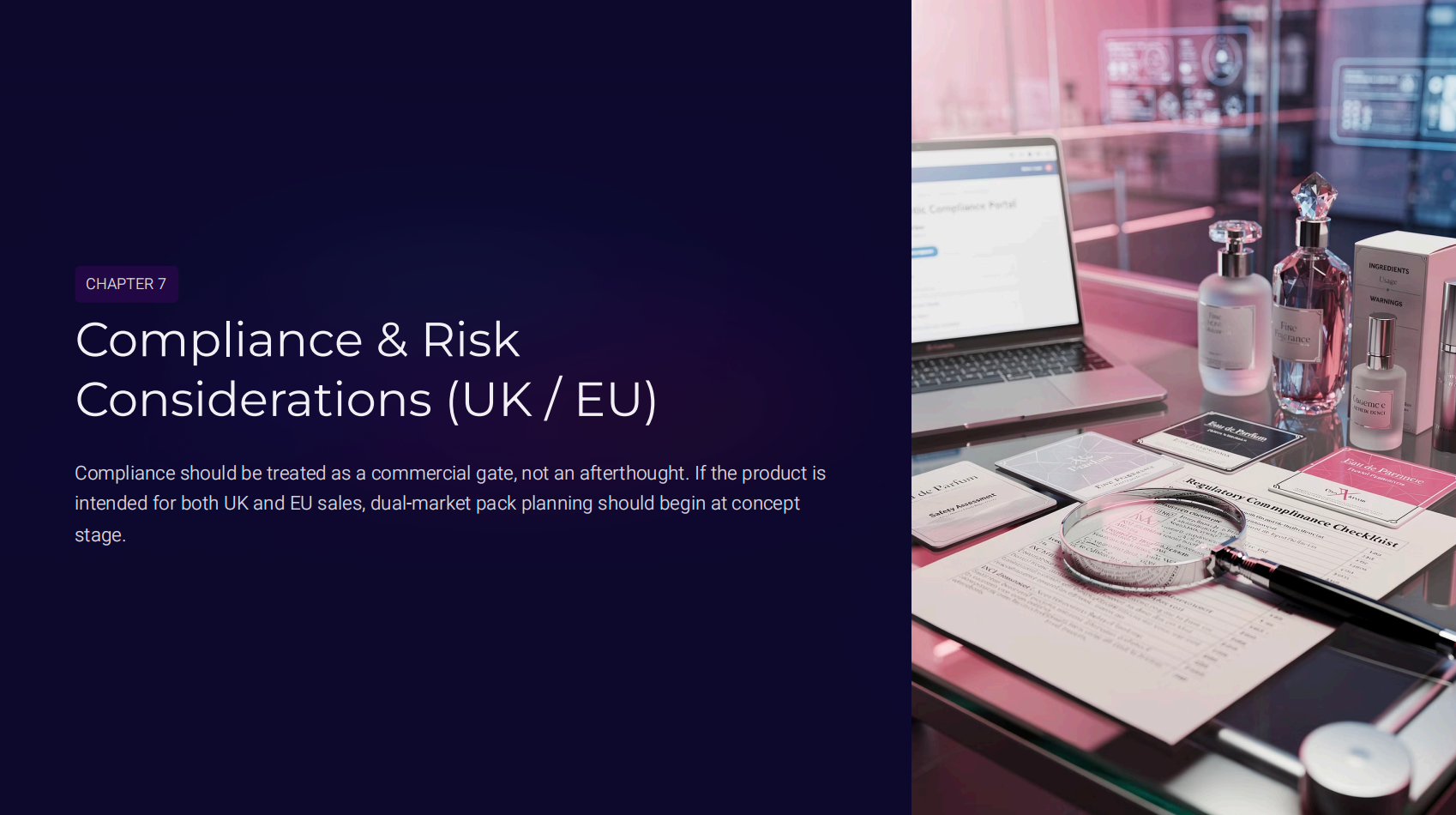
Compliance & Risk
Considerations (UK / EU)
OEM/ODM Execution Framework
A stronger OEM project begins with a stronger buyer brief.
Before approaching a manufacturer, buyers should define:
- target market
- target customer
- hero scent direction
- concentration
- fill size
- packaging route
- retail price architecture
- target channel
- launch month
- expected MOQ
- compliance scope
- benchmark products
For most first launches, stock packaging with a customized fragrance direction is usually the more practical route than fully bespoke bottle development.
This reduces risk, speeds up sampling, and makes first-order economics easier to control.
A good OEM partner should not only quote fragrance filling. It should help structure the full commercial route: fragrance direction, SKU system, packaging choice, compliance planning, and channel fit.

OEM/ODM Execution
Framework
What Brands Should Do Next
If you are planning a UK women’s fragrance launch for 2026, the smartest next step is not to ask for five unrelated fragrance samples.
Instead:
- define one hero scent role
- pick one core price zone
- choose one entry format
- decide one giftable extension
- confirm compliance scope early
- build around one scalable product family
This creates a cleaner launch path, better quoting, stronger merchandising, and more realistic repeat-purchase potential.
Final Takeaway
The UK women’s fragrance market in 2026 is attractive for private label brands, but only when entered with discipline.
The strongest whitespace is not in trying to out-prestige prestige brands. It is in creating fragrance lines that are easier to buy, easier to understand, easier to gift, and easier to repurchase.
For most brands, the best first move is a three-SKU architecture:
- one hero feminine EDP
- one travel or mini acquisition SKU
- one gift or discovery format
That structure creates stronger commercial flexibility across Amazon, DTC, gifting, and selective retail without overstretching development cost or inventory complexity.
Download the Full Report (PDF)
Tell us your target region, product category, and the decision you’re trying to make. We’ll suggest the closest existing report—or build a tailored version.