


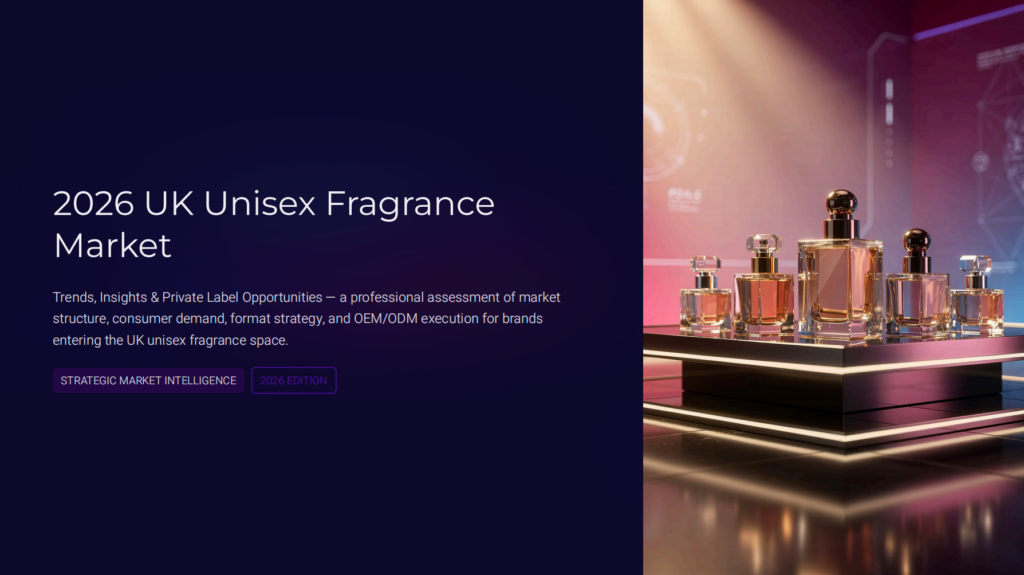
Executive Summary
This report explores the UK unisex fragrance market in 2026, including scent trends, price architecture, format strategy, gifting, layering, compliance priorities, and private label launch planning. It is designed to help brand owners, importers, distributors, Amazon sellers, and product teams turn market insight into a more practical fragrance launch strategy.
2026 UK Unisex Fragrance Market: Scent Trends, Price Ladders, and OEM Launch Opportunities
The UK unisex fragrance market in 2026 is no longer a niche driven by image alone. It is becoming a practical commercial category shaped by premium fragrance resilience, affordable discovery formats, gifting behavior, layering habits, and the growing appeal of shared, gender-flexible scent identities.
For brands, importers, distributors, Amazon sellers, and product development teams, the key opportunity is not to launch a broad fragrance range from day one. The stronger route is to build a tightly edited scent system: one hero Eau de Parfum, one lower-barrier discovery format, and one gifting or layering product that improves trial, repeat purchase, and basket size.
This report turns market trends into launch logic. It covers demand drivers, price architecture, format strategy, competitive white space, compliance priorities, and practical OEM and private label pathways for entering the UK unisex fragrance category.
Executive Summary
The UK fragrance market remains commercially attractive, with premium fragrance showing resilience while more accessible formats continue to widen the entry funnel. In practical terms, that means the market is rewarding both prestige signaling and easier trial mechanics.
Unisex fragrance is gaining traction because consumers increasingly buy scent for versatility, mood, daily wear, gifting, and identity expression rather than rigid gender coding. This makes unisex fragrance especially attractive for new brands because one SKU can serve more use cases across DTC, Amazon, boutiques, and gift channels.
For most new entrants, the strongest launch structure is not a full range of separate fragrances. It is a compact scent system built around a hero unisex EDP, a discovery or travel entry product, and a gifting or layering format that helps turn one-time interest into repeat behavior.
Market Opportunity Overview
The UK is one of Europe’s most commercially important fragrance markets, but the real opportunity is not only about total market size. It is about how fragrance is being bought.
Premium fragrance remains strong, yet the category is increasingly supported by more accessible entry formats such as mini sizes, travel sprays, mists, and giftable sets. This creates a favorable environment for private-label brands that do not yet have the heritage equity of established designer or niche houses.
For new entrants, this is especially valuable. Instead of trying to compete immediately through wide assortment or prestige-only pricing, brands can build relevance through better format architecture, sharper scent direction, and clearer channel fit.
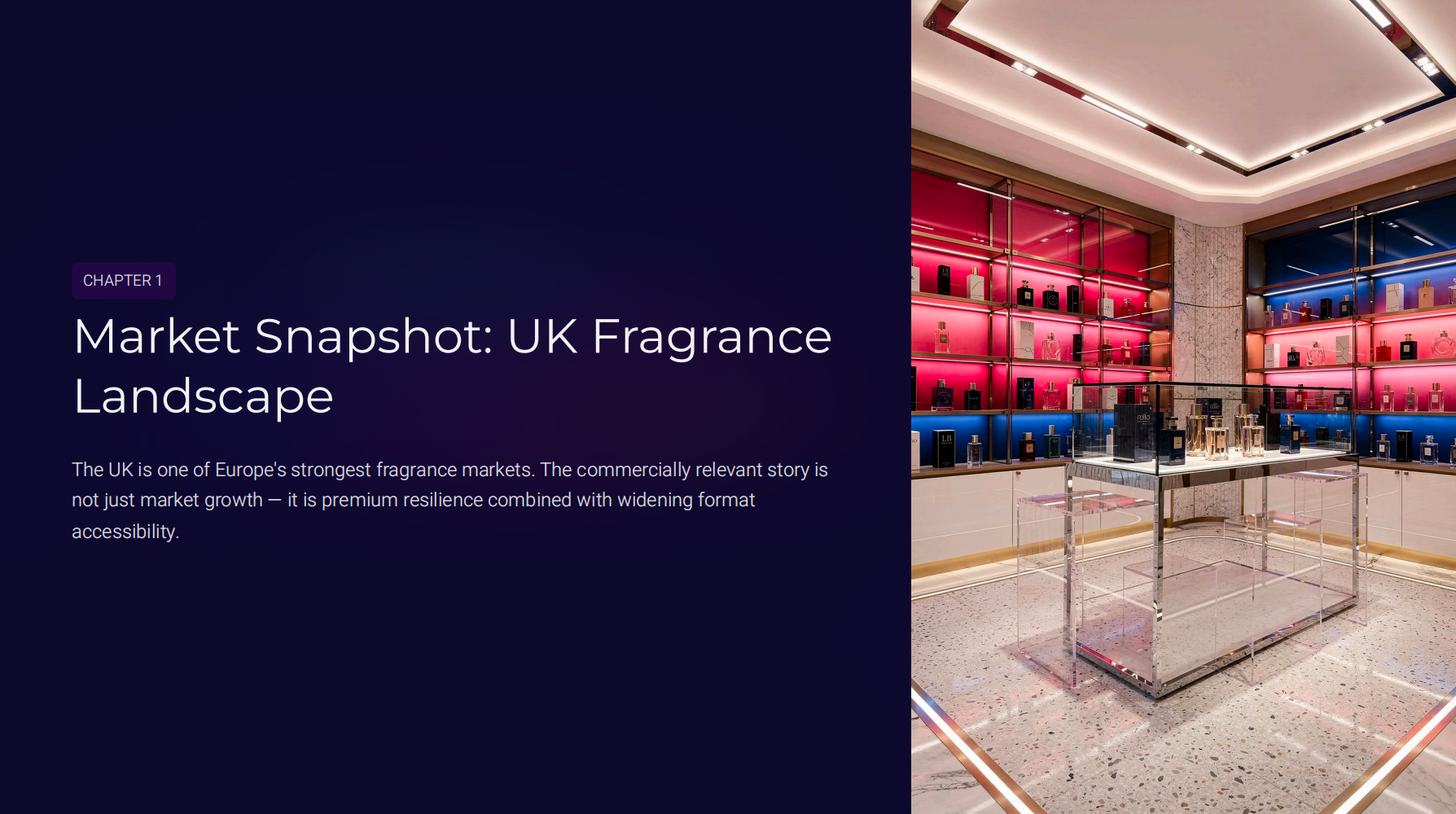
Market Snapshot: UK Fragrance
Landscape
Why Unisex Fragrance Is Rising
Unisex fragrance is growing because it offers more real-world flexibility than traditional his-and-hers fragrance structures. A well-positioned unisex scent can work across self-purchase, gifting, partner sharing, travel, daily wear, and online blind-buy scenarios.
This matters because shoppers increasingly want fragrance that feels personal without being restrictive. They are buying for mood, lifestyle, wardrobe use, and wearable identity rather than for category labels alone.
For brands, unisex is commercially useful because it simplifies assortment logic while broadening relevance. Instead of splitting development into separate male and female programs too early, a unisex launch can create stronger SKU productivity and cleaner first-wave positioning.
Consumer Demand Signals
The strongest demand signals in the UK unisex fragrance market are behavioral rather than demographic.
Consumers are increasingly responding to:
- identity expression through scent
- affordable luxury and elevated everyday wear
- travel-friendly and giftable formats
- layering and scent-wardrobe behavior
- premium but wearable olfactive styles
- clearer product systems rather than isolated hero bottles
This means brands should build around use occasions and purchase pathways. The question is no longer just “what notes are trending?” The more useful question is “how will this scent be worn, bought, gifted, layered, and re-purchased?”
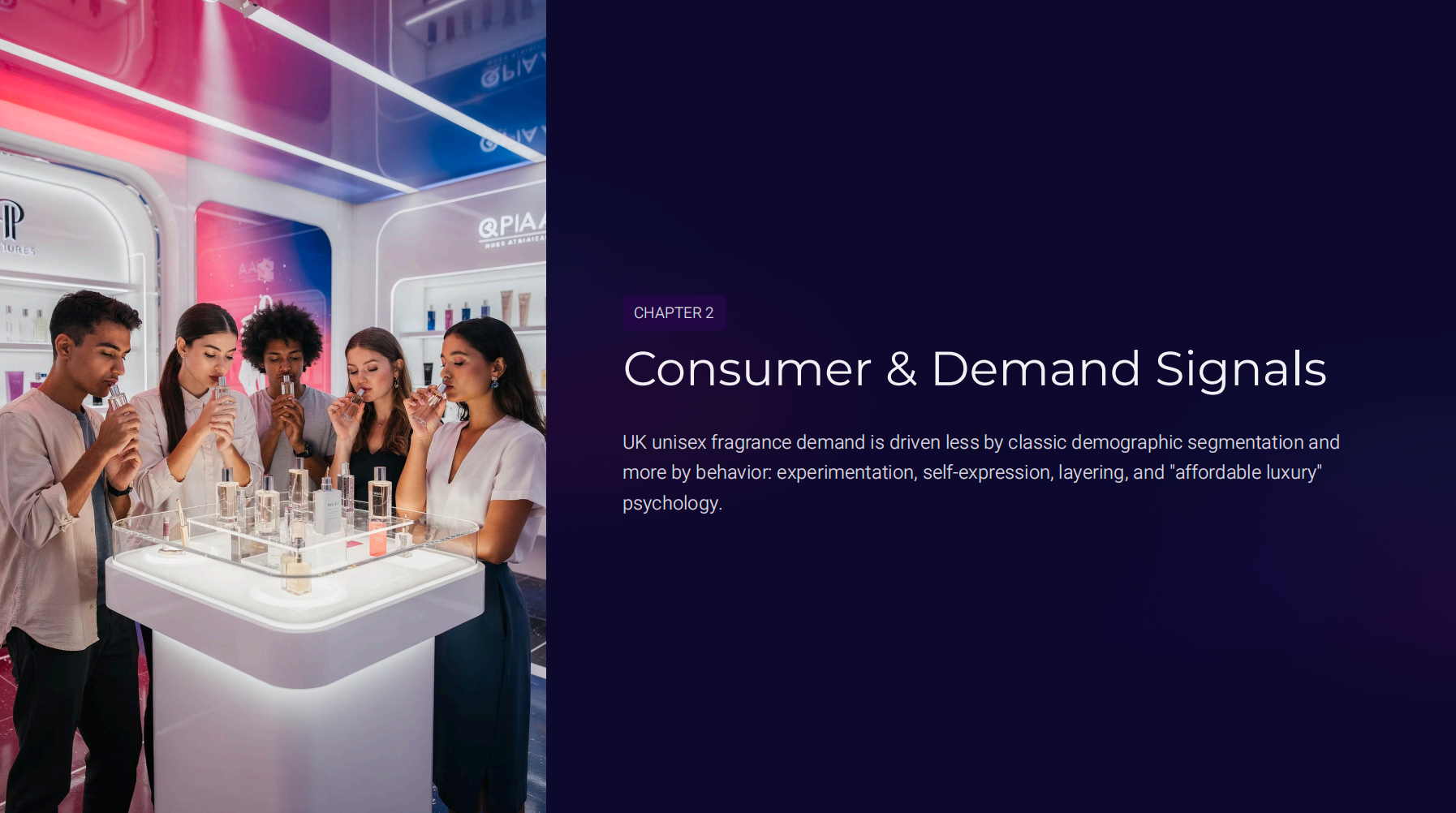
Consumer & Demand Signals
Consumer Segments That Matter
Gen Z is an important discovery engine. This group responds strongly to travel sprays, mists, mini sets, lower-risk trial formats, and social-friendly scent language. They help accelerate visibility, review generation, and community discussion.
Millennials are often the more commercially stable bridge segment. They are more likely to trade up from discovery to full-size purchase, especially when the brand feels elevated, wearable, and giftable rather than overly experimental.
Niche-minded consumers also matter, even when they are smaller in total volume. They influence how trend language spreads through the market, especially around musks, woods, tea notes, skin scents, and quiet-luxury positioning. For private label, the goal is not to mimic niche extremity, but to borrow selective niche cues while keeping the product more wearable and commercially accessible.
Scent Directions with the Strongest Commercial Potential
The most commercially useful unisex scent directions in the UK market are not the most polarizing ones. They are the scents that feel refined, versatile, and distinctive without becoming difficult to wear.
The strongest directions include:
- clean skin musks
- woody amber structures
- bergamot and tea-mineral freshness
- cedarwood with soft musks
- modern citrus woods
- warm amber with dry woods
- fresh but intimate “quiet luxury” scent profiles
These directions work well because they can move across work, travel, gifting, layering, and shared wear. They are also easier to commercialize across multiple formats such as EDP, mist, travel spray, and discovery sets.
Price Tier and Format Strategy
The UK unisex fragrance market works best when approached as a price ladder rather than a single hero-bottle play.
A useful structure is:
- entry tier through mists, travel sizes, or mini discovery products
- mid-tier through 30ml to 50ml EDPs
- premium tier through curated sets, bundles, or selective higher-priced hero products
For most new private-label brands, the mid-tier zone is the strongest commercial battleground. It offers enough pricing room to signal quality while remaining accessible enough for discovery-led buying.
The biggest mistake many new brands make is launching only a 50ml or 100ml EDP. That creates too much purchase friction too early. A hero EDP should be supported by at least one easier entry format.
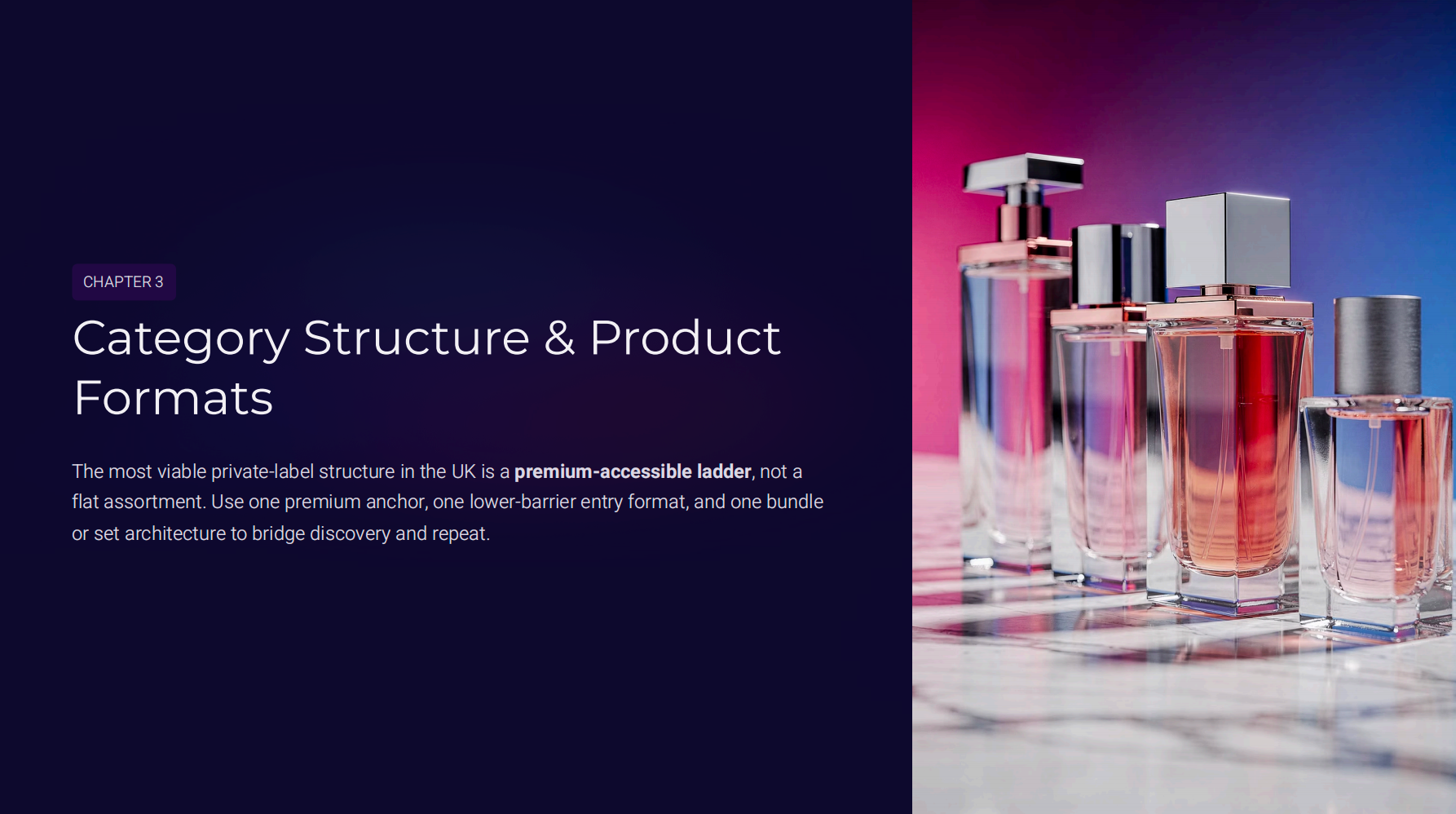
Category Structure & Product
Formats
Why EDP Should Usually Be the Hero
In the current market, EDP has become the most commercially useful flagship format for many launches. It better supports perceived value, scent longevity expectations, gifting logic, and premium positioning.
EDT still has a place when the strategy is explicitly freshness-led, office-safe, price-sensitive, or summer-focused. But for most unisex brands entering the UK market, EDP is the stronger center of gravity.
That is why a 50ml EDP hero often makes more sense than starting with a lighter structure that may be perceived as less substantial in value.
The Most Viable Private-Label Format Ladder
For a new entrant, the most practical first-wave structure is usually:
- one 50ml hero unisex EDP
- one 10ml travel spray
- one 100ml hair and body mist
- one 3-piece discovery set or mini set
- one giftable duo or seasonal bundle
This structure works because it creates a complete but still manageable scent system. The full-size EDP establishes brand legitimacy. The travel spray lowers trial friction. The mist builds layering and repeat-purchase logic. The set creates gifting and discovery value.
Gifting and Layering as Commercial Drivers
Gifting should not be treated as an afterthought. In the UK fragrance market, gifting is a core commercial behavior, especially in Q4 and other seasonal moments.
At the same time, layering is one of the most practical ways to increase repeat purchase without relying only on full-size rebuy cycles. A mist, lotion, shower format, or matching travel spray can turn one fragrance into a broader routine.
For private label buyers, this is one of the strongest ways to build a brand ecosystem without over-expanding the assortment.
Competitive White Space
The market is crowded, but the real opportunity is not to compete with every fragrance brand at once. It is to choose a sharper commercial position.
There is still white space in:
- premium-accessible unisex systems
- layering-first brands that remain easy to understand
- Amazon-friendly premium fragrance concepts
- shared gifting mechanics built around unisex wearability
Many brands talk about clean luxury or genderless fragrance. Fewer actually build a clear format system that makes those claims commercially useful.
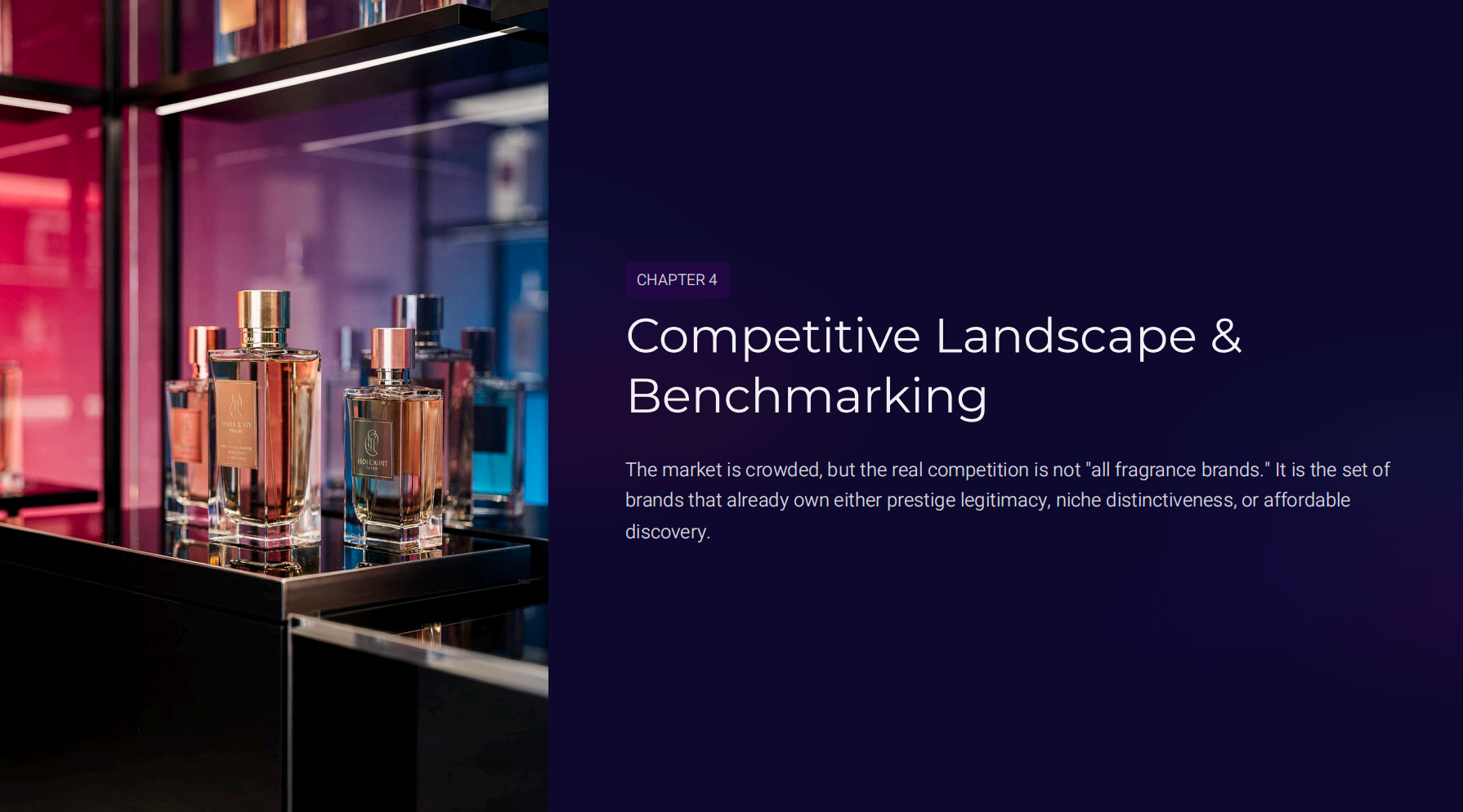
Competitive Landscape &
Benchmarking
Channel Strategy
A new UK unisex fragrance launch should not use the exact same SKU hierarchy in every channel.
For Amazon, the strongest setup is usually one clearly positioned hero EDP, one travel spray, and one discovery or gift set. The focus should be on review concentration, easy product comprehension, and strong value framing.
For DTC, the opportunity is broader. This is where scent storytelling, layering education, founder narrative, bundles, and high-margin routines can do the most work.
For boutiques, confidence matters more than breadth. One strong hero bottle plus one discovery mechanism is usually easier to place than a diffuse collection.
For gift-driven channels, set architecture matters more than single-bottle storytelling. Here, the question is whether the product looks giftable, understandable, and commercially coherent.
Compliance and Quality Considerations
Compliance should be integrated into development from the start, not left until packaging is nearly finished.
For UK market entry, brands need to think early about:
- Responsible Person setup
- product notification pathway
- Product Information File readiness
- correct labeling
- ingredient consistency
- claims discipline
- spray and leakage performance
- pack compatibility
- stability and transport resilience
Many launch delays come not from lack of demand, but from weak compliance planning or packaging issues that should have been solved earlier.
OEM and Private Label Execution Plan
The strongest fragrance RFQs are commercially clear before they become technically detailed.
A good brief should make five things obvious:
- what the hero SKU is
- which retail price band it must land in
- which channel matters first
- what scent direction is in scope
- whether the brand is building one hero fragrance or a system
Once those are clear, the supplier can help structure the right pack mix, sampling route, MOQ logic, and timeline.
For many UK unisex fragrance programs, the most workable entry structure includes a hero EDP, a travel spray, a mist, and a discovery set. That gives the brand a manageable but commercially useful assortment without forcing excessive inventory complexity.

OEM / Private Label Execution
Plan
Recommended First-Wave SKU Portfolio
A practical first-wave portfolio can include:
- one 50ml hero EDP in a clean musk or woody amber direction
- one 10ml travel spray in the same scent world
- one 100ml hair and body mist for layering and repeat use
- one 3 x 10ml discovery wardrobe set
- one giftable EDP plus travel duo
If budget is limited, the strongest minimum viable launch is:
- one 50ml hero EDP
- one 10ml travel spray
- one 100ml hair and body mist
- one 3-piece discovery set
That is enough to test product-market fit, channel response, and repeat logic without overextending early.
Final Takeaway
The UK unisex fragrance market in 2026 is attractive because it combines premium fragrance resilience with more accessible discovery behavior. Consumers are open to unisex scent concepts, but they expect those concepts to be wearable, giftable, and commercially coherent.
The brands most likely to win are not the ones launching the widest range. They are the ones building the clearest scent system: a strong hero EDP, a lower-barrier discovery product, a gifting or layering mechanic, and a disciplined format ladder matched to the right channels.
If you are evaluating a UK unisex fragrance launch, the smartest next step is to define your hero scent direction, launch price ladder, and first-wave SKU structure first. Once those are clear, development and go-to-market execution become much easier.
Download the Full Report (PDF)
Tell us your target region, product category, and the decision you’re trying to make. We’ll suggest the closest existing report—or build a tailored version.