


Executive Summary
This report explores the Southeast Asia women’s perfume market in 2026, including scent trends, product format logic, pricing architecture, platform strategy, compliance priorities, and OEM launch planning. It is designed to help brands, distributors, importers, and e-commerce sellers turn market insight into a more practical fragrance launch strategy.
Southeast Asia Women’s Perfume Market 2026: Product Strategy, Scent Trends, and OEM Launch Guide
Southeast Asia is becoming one of the most commercially attractive fragrance regions for brands that want scale without depending entirely on luxury price architecture. The opportunity is not driven by one single trend. It is shaped by hot-climate fragrance usage, fast digital beauty discovery, strong social-commerce conversion, and the growing role of fragrance as an affordable indulgence.
For beauty brands, importers, distributors, and e-commerce sellers, this creates a different kind of market logic. Success is not defined only by prestige branding. It is increasingly defined by whether the product fits the climate, reads clearly in short-form content, has a convincing price-to-experience ratio, and is structured in formats that consumers are willing to test and repurchase.
This report translates that opportunity into practical launch strategy. It covers scent directions, product format logic, pricing architecture, platform strategy, compliance priorities, and OEM-ready execution paths for entering the Southeast Asia women’s perfume market in 2026.
Executive Summary
The Southeast Asia women’s perfume market is no longer a narrow prestige category. It is evolving into a layered fragrance ecosystem that includes EDP, EDT, body mist, discovery formats, gift sets, and mini sizes. That shift matters because it changes how brands should build and launch fragrance portfolios in the region.
Consumers are not only looking for one signature perfume. They are buying fragrance for different roles: daily freshness, feminine identity, sweet social wear, gifting, and portable refresh use. At the same time, digital-first beauty behavior means products must be easy to explain visually and quickly. A strong scent concept alone is no longer enough. The product also needs channel fit, price clarity, and a format that lowers first-purchase risk.
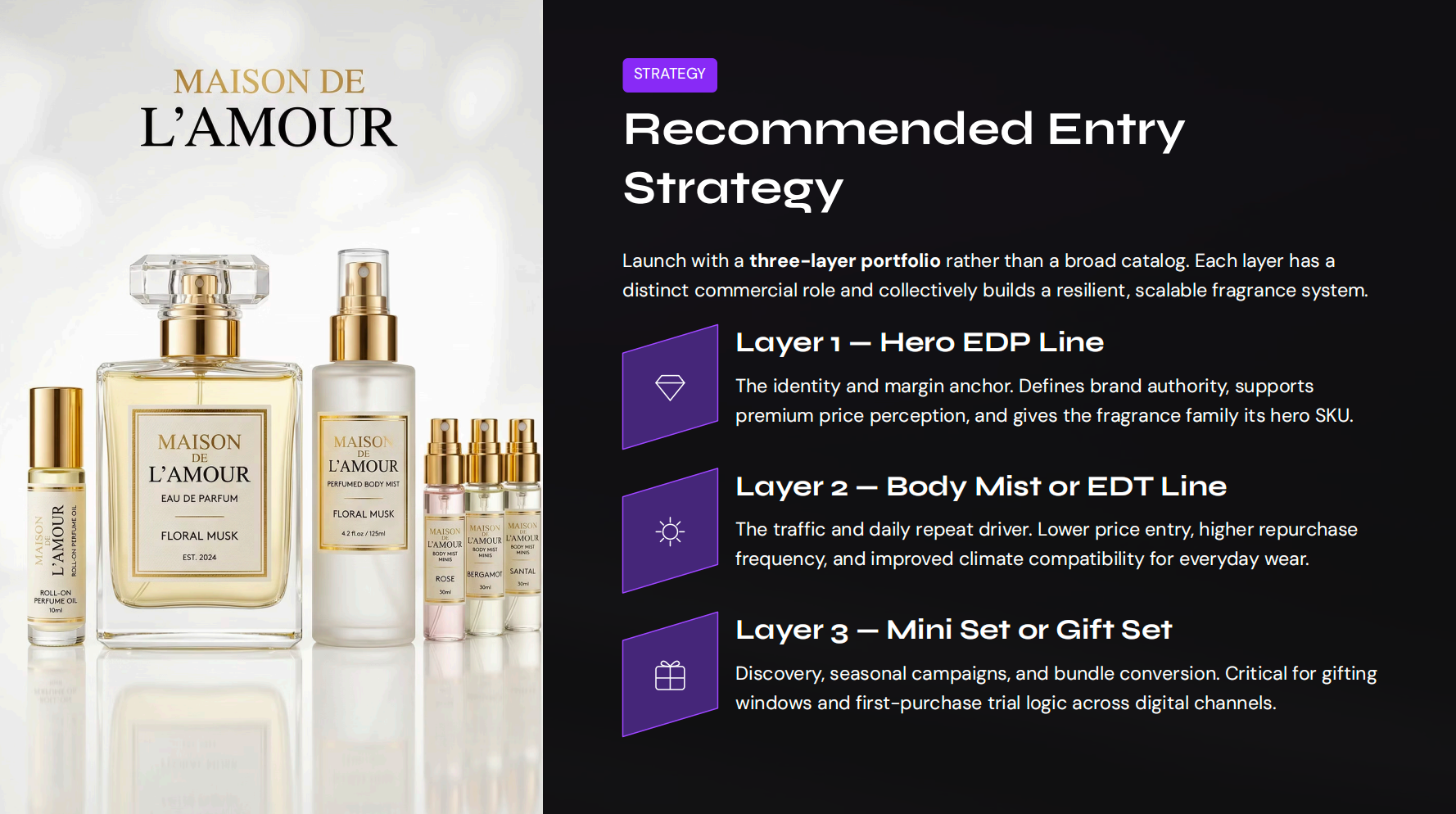
For most new entrants, the smartest launch is not a broad catalog. It is a structured 6–10 SKU starter range built around a hero EDP, a lighter daily-use format such as body mist or EDT, and a discovery or gifting format that helps reduce trial friction and improve conversion.
Market Opportunity Overview
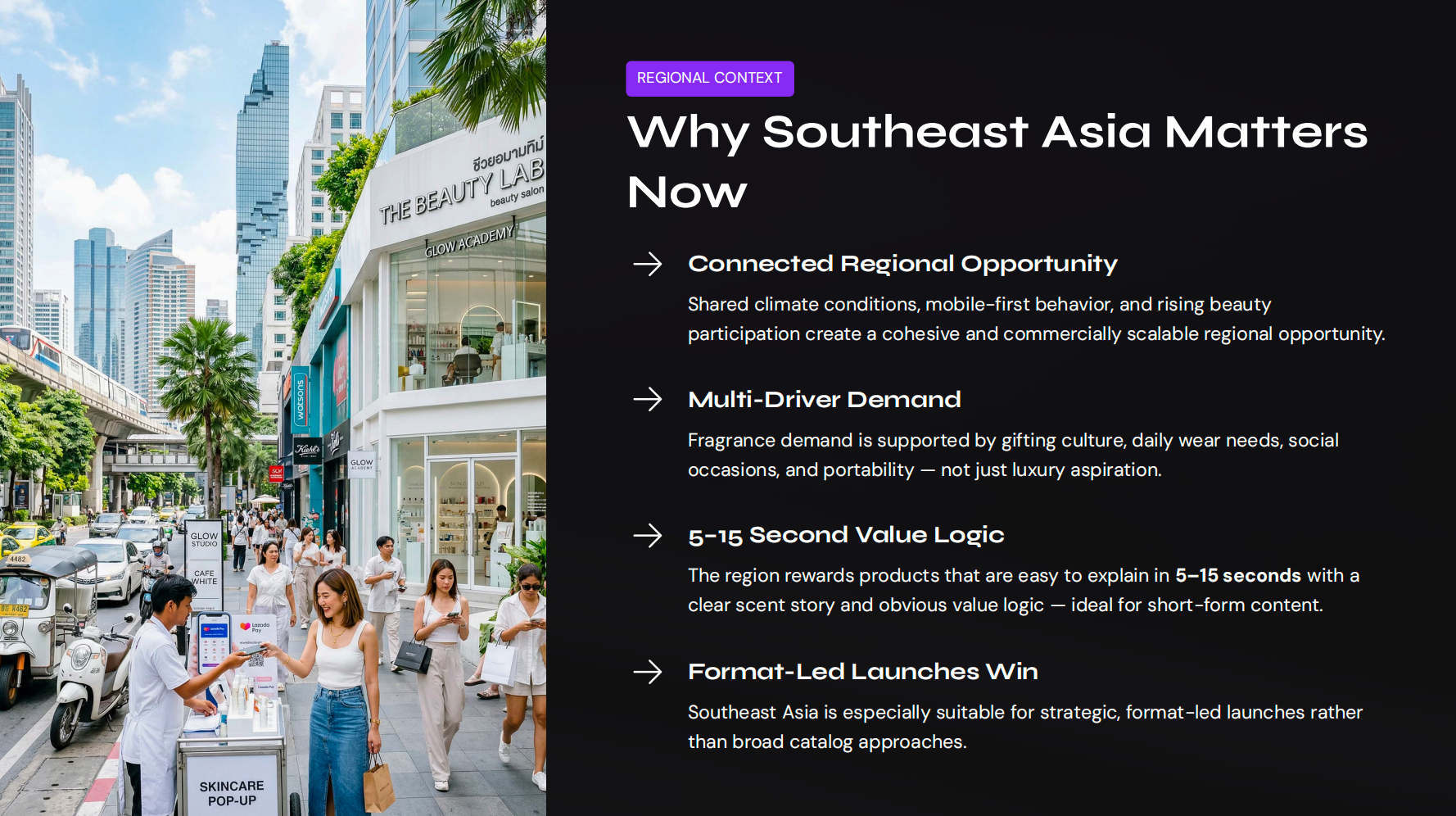
Southeast Asia should not be treated as one uniform fragrance market. It is a connected regional opportunity shaped by shared climate conditions, high mobile commerce penetration, rising beauty participation, and strong gifting behavior. The commercial logic is less dependent on traditional department-store fragrance culture and more dependent on platform-led discovery and conversion.
This is what makes the region so attractive. Fragrance is becoming easier to justify, easier to discover, and easier to purchase. Consumers are increasingly willing to buy products that feel premium-looking and emotionally expressive, as long as the pricing still feels accessible.
In practical terms, the opportunity is strongest for brands that can deliver:
- climate-appropriate scent performance
- premium-looking packaging at reachable prices
- a clear use-case structure
- multiple formats for different buying moments
- operationally ready OEM execution
Southeast
Asia
Women's
Perfume
Market 2026
Why the Market Is Growing
Several forces are pushing the category forward.
The first is social commerce. Product discovery is increasingly shaped by short-form video, creator recommendation, livestream selling, and platform-native bundle logic. Products that can be explained in seconds with a clear scent story and visible format advantage are more likely to convert.
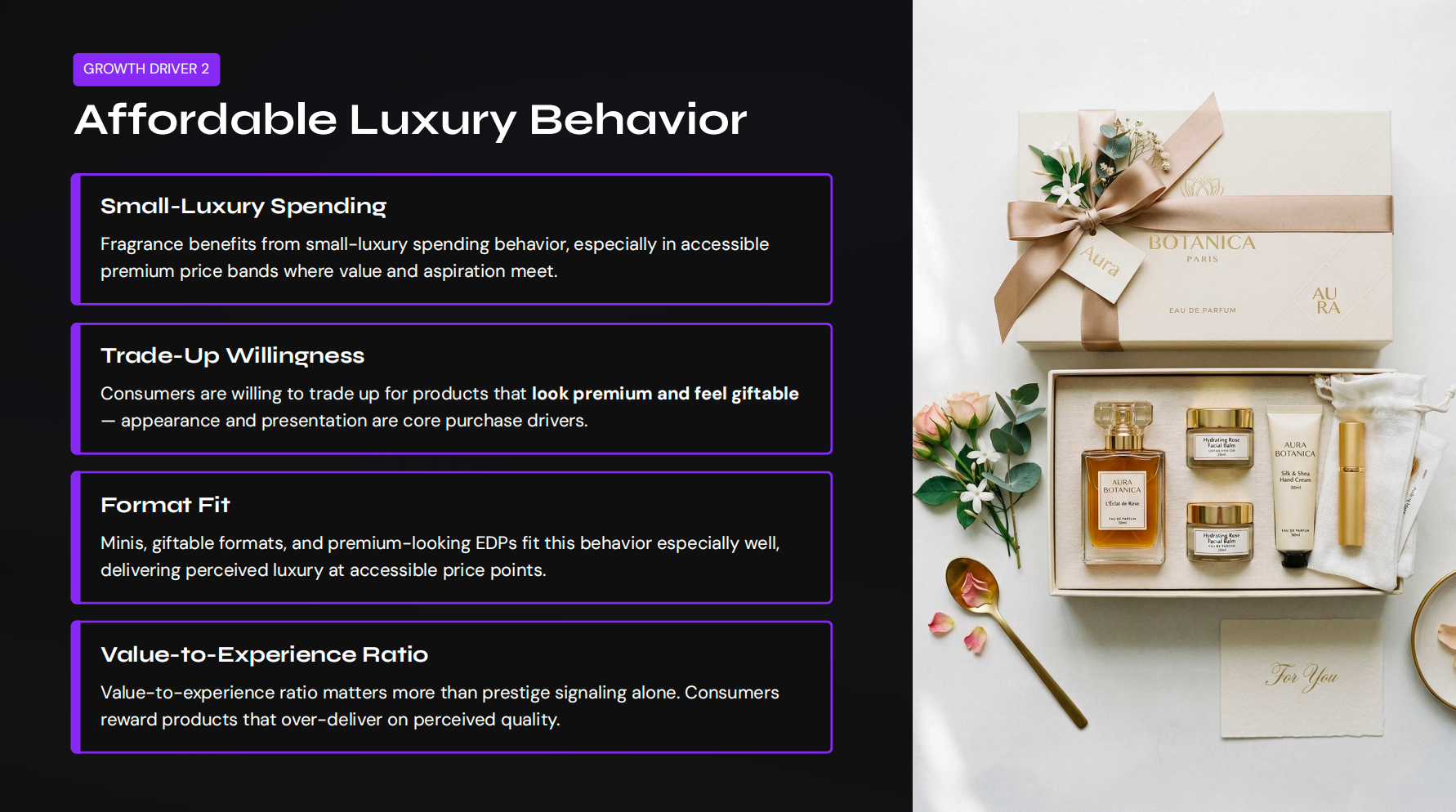
The second is affordable luxury behavior. Fragrance benefits from the fact that consumers see it as a relatively reachable indulgence. Even when budgets are constrained, smaller and mid-tier fragrance purchases can still feel emotionally rewarding.
The third is format expansion. Growth is no longer concentrated in full-size perfume alone. Body mist, mini sets, travel formats, and giftable bundles are becoming more important because they reduce risk, improve gifting value, and support online conversion.
The fourth is multi-occasion use. Consumers increasingly buy fragrance not only for one social identity, but for daytime wear, post-shower freshness, date-night use, festive gifting, and portable refresh.
Why Southeast Asia Matters
Now
Consumer Segments That Matter
A practical way to understand the market is to focus on four key consumer groups.
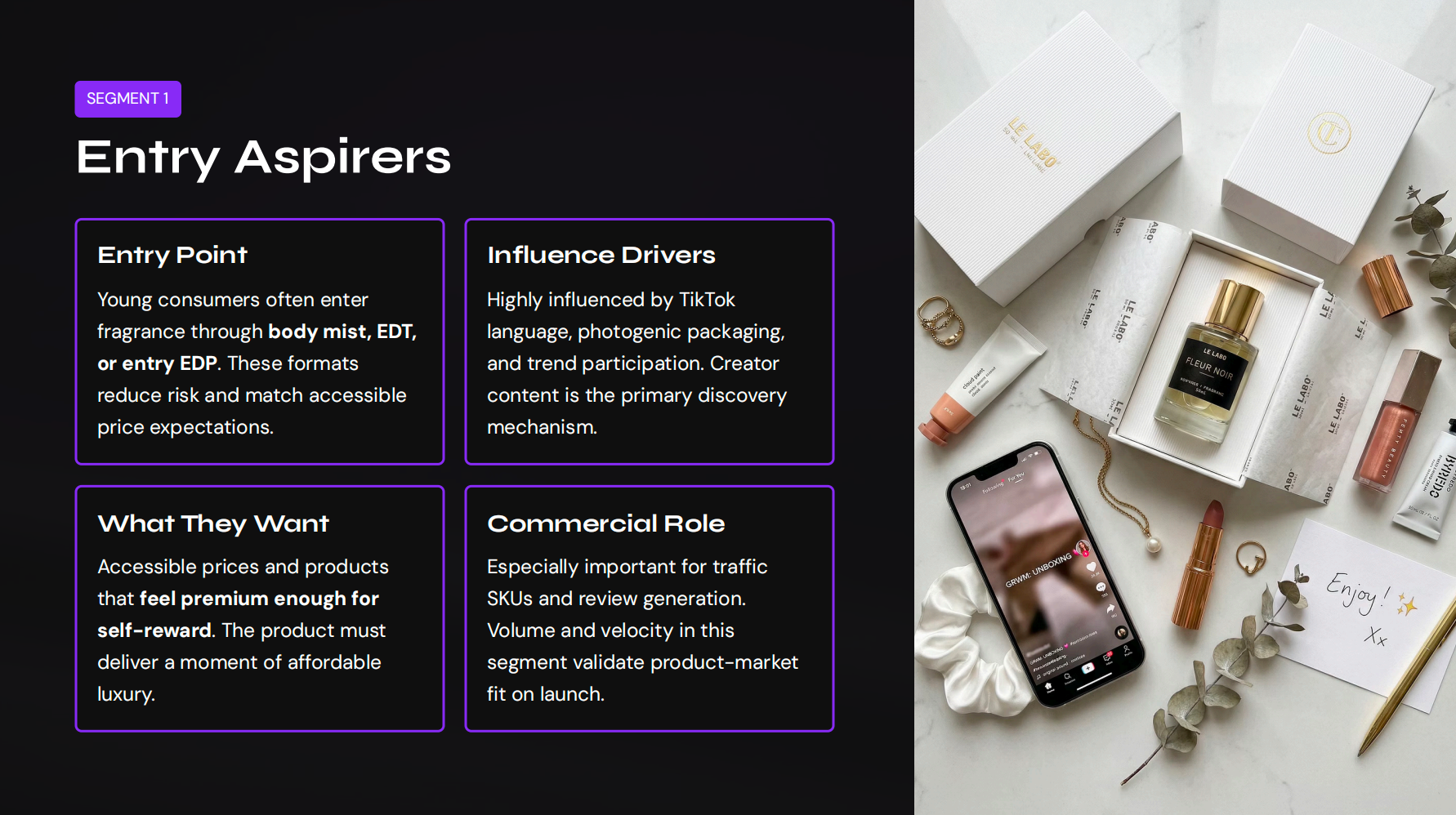
The first is the entry aspirer. This is usually a younger buyer entering fragrance through body mist, EDT, or entry-level EDP. Packaging appeal, creator language, and “smells expensive” positioning matter strongly here.
The second is the mass-premium upgrader. This buyer already uses fragrance and wants better longevity, a better-looking bottle, and a stronger scent identity. They are often the best target for 50ml EDP hero SKUs.
The third is the gifting buyer. This person may not be a heavy fragrance user themselves, but they buy during personal gifting moments and festive periods. They respond best to visually strong sets and safer scent directions.
The fourth is the platform opportunist. This buyer is triggered by convincing short-form content, livestream offers, and bundle logic that feels like a low-risk decision. They are a major source of fast market validation.
A strong product system should serve more than one of these groups without becoming confusing.
Affordable Luxury Behavior
Scent Trends with the Strongest Commercial Potential
The most scalable scent families in Southeast Asia women’s perfume are the ones that balance familiarity, femininity, climate suitability, and digital readability.
Fruity Floral
This remains one of the strongest entry points for the category. It is easy to understand, easy to merchandise online, and works well with youthful yet feminine positioning.
Typical directions include:
- pear
- peach
- berry
- lychee
- apple blossom
- rose
- peony
- moderated jasmine
This family is ideal for entry and traffic SKUs.
Fresh Floral and Clean Musk
This is especially important for daytime wear, office-safe positioning, and premium minimalist branding. It fits hot and humid daily-use conditions well and supports clean, soft, and modern femininity.
Typical directions include:
- white tea
- green tea
- citrus blossom
- freesia
- lily of the valley
- soft musk
- watery floral notes
This family works especially well in EDT, body mist, and low-risk giftable formats.
Soft Gourmand
Sweetness still sells, but it has to be adapted for climate. The strongest versions are airy, creamy, or lifted rather than dense and syrupy.
Typical directions include:
- vanilla
- caramel milk
- whipped musk
- coconut cream
- praline in moderation
- warm amber with airy freshness
This family works well for date-night, gifting, and emotionally expressive positioning.
Fruity-Gourmand Hybrids
This is one of the strongest bridges between trend-led demand and wearable sweetness. It performs well in social-commerce storytelling and supports both EDP and mist formats.
Typical directions include:
- strawberry cream
- peach vanilla
- berry musk
- tropical fruit with soft amber
These are strong candidates for hero launches and limited-edition drops.
Climate-Adapted Fragrance Logic
Southeast Asia’s climate does not remove demand for sweet or richer scents. It changes how those scents should be built.
Winning formulas usually need:
- brighter top-note lift
- less sticky dry-down
- moderated sweetness
- better freshness perception
- less oppressive daytime projection
This is one of the most important differences between fragrance designed for cooler markets and fragrance designed for Southeast Asia. Products that smell attractive in a testing room may feel too heavy once worn in heat and humidity.
That is why climate adaptation is not a niche technical detail. It is one of the core commercial decisions in the region.
Format Strategy: Why EDP Alone Is Not Enough
One of the clearest takeaways for 2026 is that the strongest fragrance launches are not built around one full-size perfume alone. They are built around a format system.
Recommended Entry
Strategy
EDP
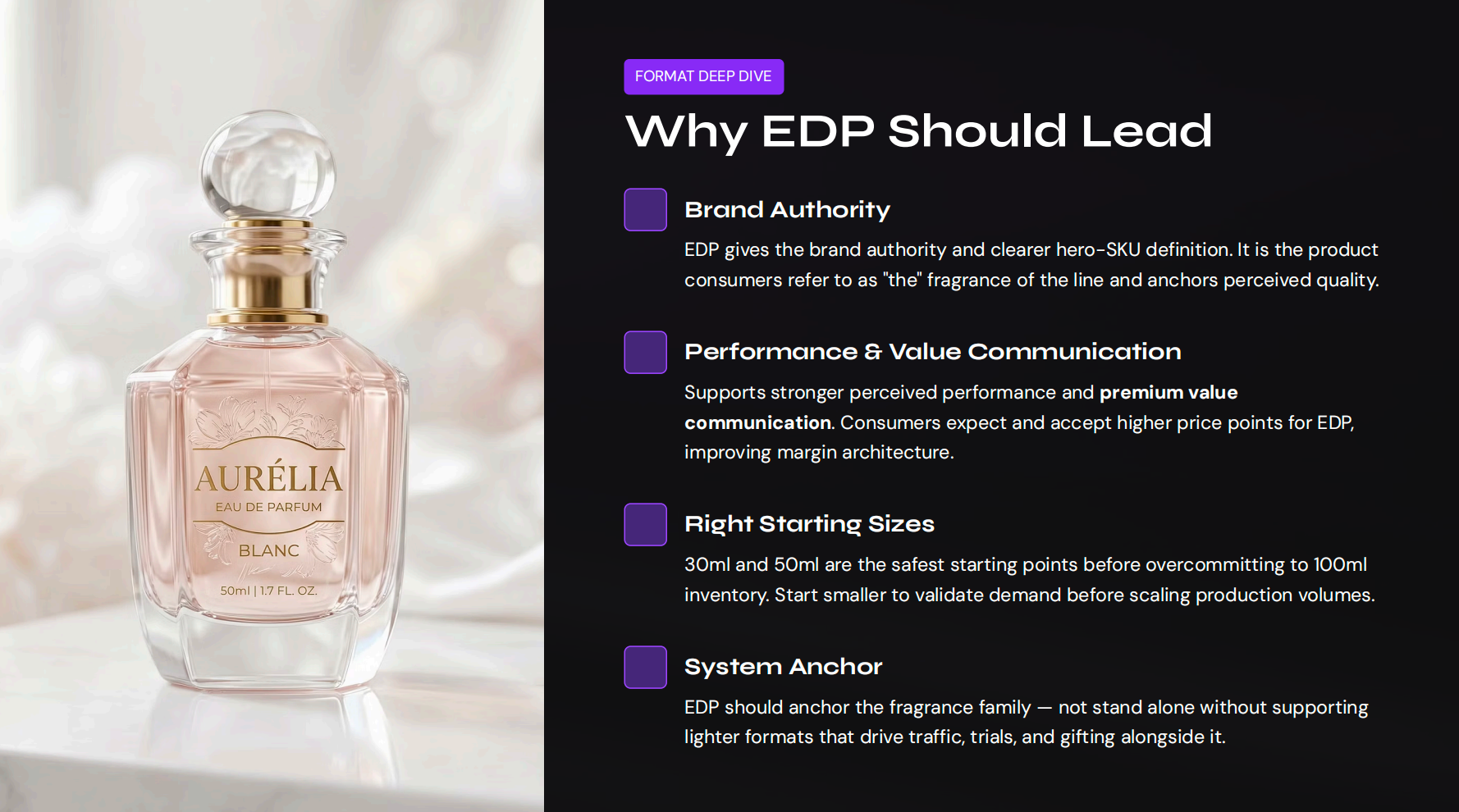
EDP is still the hero format for brand identity, stronger perceived value, and better margins. It is the right choice when the brand needs authority and the product must anchor the fragrance line.
For most launches, 30ml and 50ml are the best starting sizes.
EDT
EDT is useful for daytime wear, younger users, and fresher warm-climate positioning. It can be especially effective when the scent direction is tea floral, citrus floral, or clean musk.
Body Mist
Body mist is a major traffic and repeat-use driver, especially for younger consumers and platform-first commerce. It should not be treated as a cheap substitute. It should be positioned as a lifestyle fragrance format with its own role in the portfolio.
Gift Sets
Gift sets are highly useful for seasonal selling, distributor presentation, and value perception. They make it easier for the customer to justify spending and lower the decision risk of choosing just one bottle.
Travel Size and Mini Sets
These are important because they solve online fragrance trial risk, improve creator seeding efficiency, and create giftable, collectible, and bundle-friendly formats.
The strongest format mix is usually:
- one hero EDP
- one lighter daily format such as EDT or body mist
- one discovery or gifting format
Pricing Structure and Commercial Positioning
The market can be viewed across three main price layers.
Entry Aspirers
Entry Tier
This tier is useful for traffic generation, first-time purchase, and fast e-commerce conversion. It usually includes body mist, EDT, 10ml minis, and basic 30ml EDPs. Positioning here is trend-driven, youthful, and low-risk.
Mass Premium
This is often the best starting point for serious launches. It offers the strongest balance between value perception and margin. Typical formats include 30ml and 50ml EDP, curated gift sets, and upgraded mist lines. This is where premium-looking products with reachable pricing can scale.
Affordable Luxury
This tier serves as a margin anchor and a stronger distributor showcase line. Typical formats include 50ml and 100ml EDP, premium gift coffrets, and layered ritual sets. It works best when the brand already has a clear hero scent and stronger packaging narrative.
For many new entrants, the best launch logic is:
- a traffic SKU in entry tier
- a hero SKU in mass premium
- a margin-supporting bundle or premium EDP above that
Platform Strategy: TikTok Shop, Shopee, Lazada, and Offline
A Southeast Asia fragrance launch should be channel-native from the beginning.
Why EDP Should Lead
TikTok Shop
This is best for fast trend capture, creator-led launches, mini-size conversion, and body mist traffic. Products need visually attractive packaging, simple scent descriptors, and bundle logic that works in short-form video and livestream formats.
Best-suited products include:
- body mist
- 30ml EDP
- 10ml travel spray
- mini discovery set
Shopee
Shopee works well for search-driven traffic, review accumulation, repeatable bundles, and stable assortment browsing. It is often a stronger long-term infrastructure layer than trend-driven launch spikes.
Best-suited products include:
- 30ml and 50ml EDP
- duo gift sets
- structured best-seller collections
- repeat-purchase formats
Lazada
Lazada remains relevant, especially in broader marketplace logic, but is often less dynamic than TikTok Shop and Shopee in fragrance-led fast-growth plays. It can still support structured assortment and regional presence.
Offline and Distributor Channels
Offline and distributor sales require stronger packaging quality, safer scent selection, better shelf logic, and more reliable reorder structure. These channels are often better suited to validated winners rather than experimental first-launch scents.
The best route is usually:
- validate online first
- identify hero performers
- expand proven winners into distributor or offline channels second
Competitive White Space
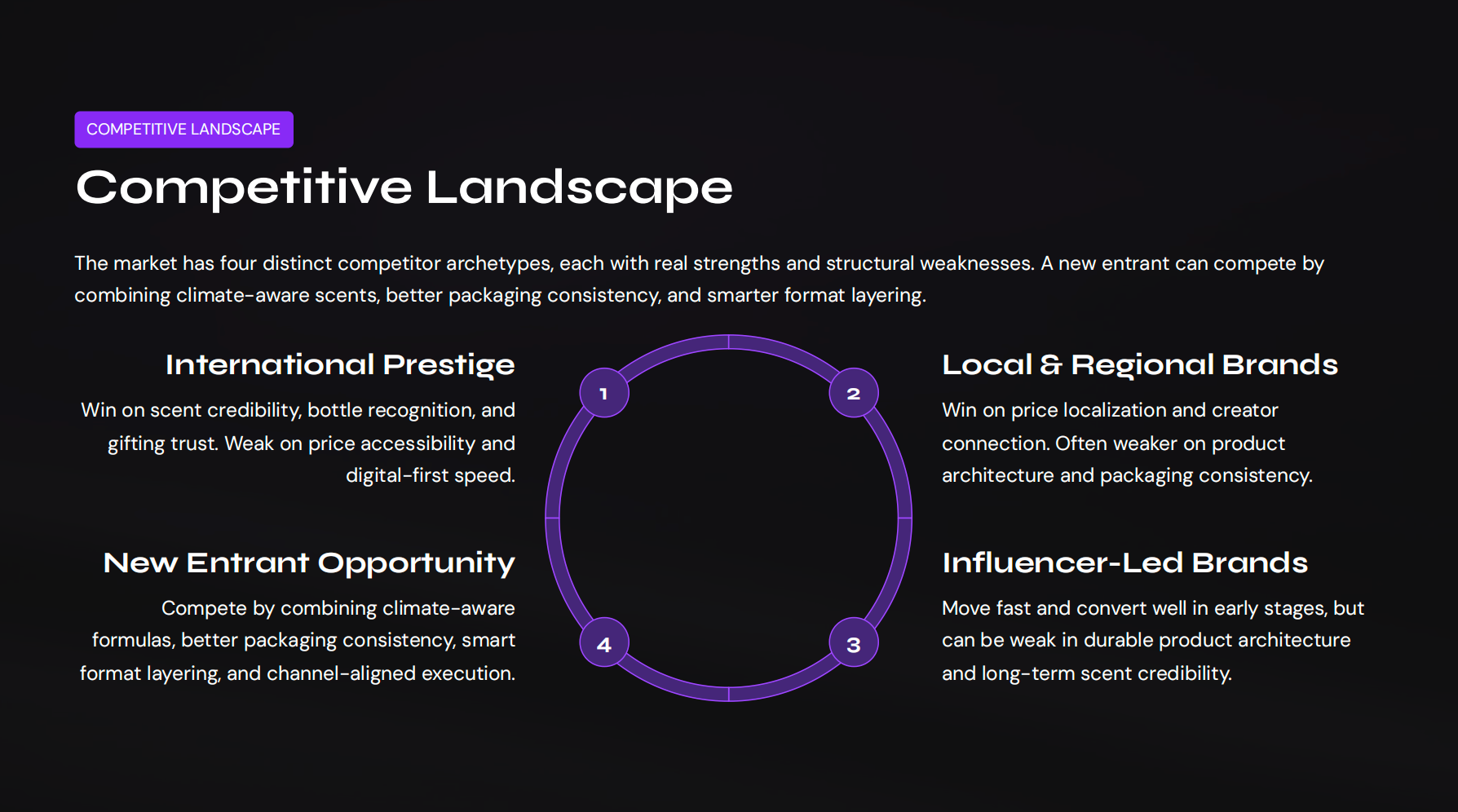
The biggest opportunity in Southeast Asia is not pure luxury fragrance and not purely low-price volume. It sits in the middle.
The strongest white space is:
- climate-aware fragrance performance
- premium-looking design
- socially legible scent stories
- reachable pricing
- useful format layering
- strong OEM execution and documentation readiness
This creates an opening for brands that can compete against international prestige, local beauty brands, and trend-led influencer brands without copying any of them directly.
A winning fragrance system should feel:
- easy to understand
- easy to gift
- easy to trial
- easy to repurchase
- easy to sell through content
Competitive Landscape
Compliance and Risk Control
Southeast Asia offers some harmonization benefits under regional cosmetic frameworks, but fragrance launches still require country-by-country execution discipline.
Key priorities include:
- formula suitability for target markets
- intended-use fragrance compliance
- Product Information File readiness
- label localization
- responsible-party and market-facing details
- supportable claims language
- stability in heat and humidity
- packaging compatibility
- local market filing or notification readinessqwhere required
The region can be forgiving of new brands, but not forgiving of poor execution. If a product leaks, feels too heavy in the climate, has unclear labeling, or makes weak first impressions in reviews, those issues surface very quickly in social and marketplace environments.
That is why climate testing, label readiness, and documentation planning should be treated as commercial priorities from the start.
OEM Execution Framework
The strongest OEM projects are not the most complicated. They are the most clearly scoped.
Before requesting quotes, buyers should define:
- target country or region
- product format
- target retail band
- scent direction
- target customer profile
- expected MOQ
- launch timeline
- channel strategy
- customization level
A more useful brief would sound like this:
- women’s 50ml EDP
- fruity floral with soft musk
- mass-premium positioning
- TikTok Shop and Shopee first
- mini set in phase two
- target launch in 14 weeks
That level of clarity improves quotation speed, reduces revision cycles, and lowers the risk of misaligned sampling.
Typical OEM planning should also account for:
- stock-pack versus custom-pack speed differences
- longer timelines for gift sets and multi-component packs
- documentation support such as SDS, COA, fragrance conformity support, ingredient lists, specifications, and stability planning
- packaging compatibility checks
- artwork and compliance approval before bulk
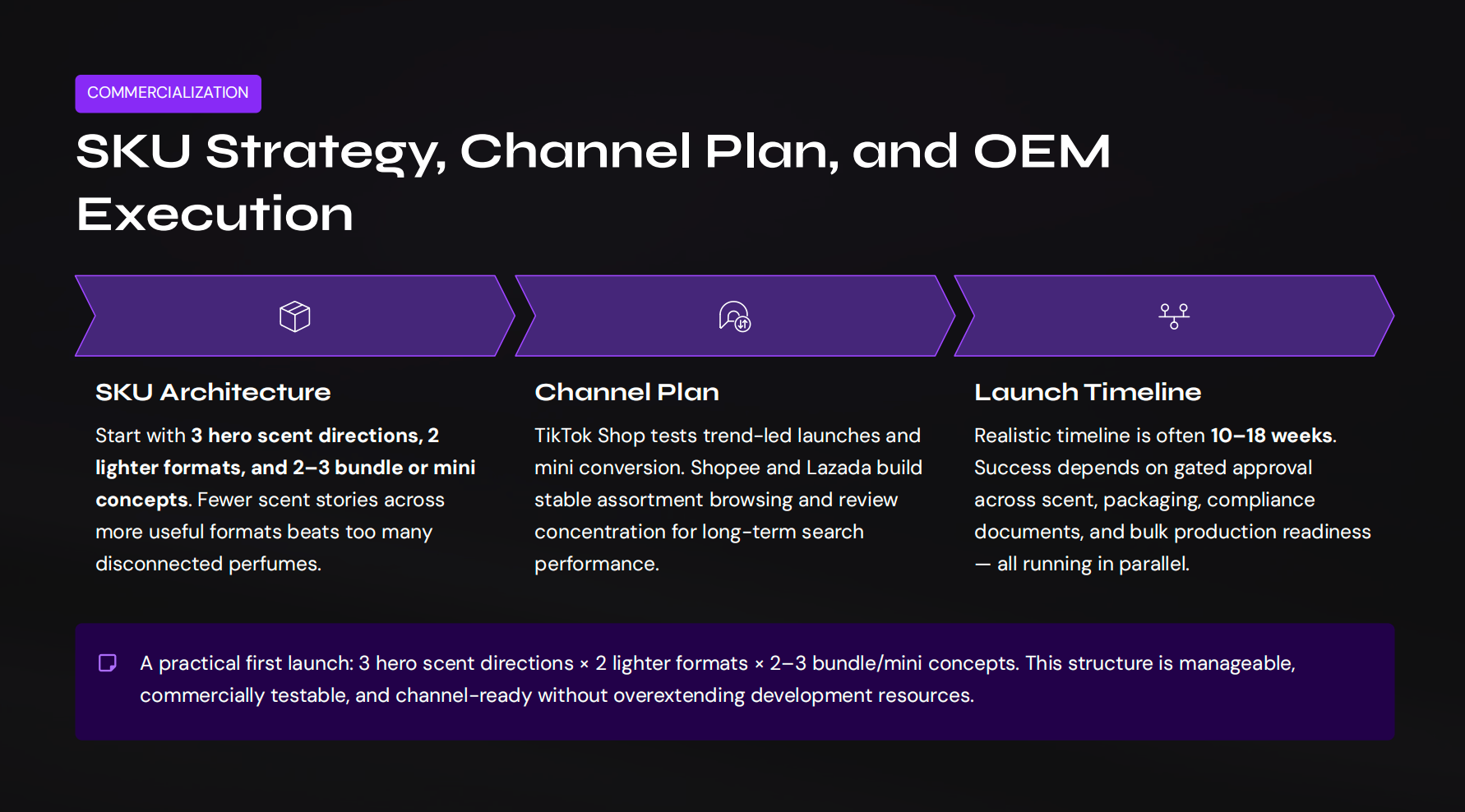
SKU Strategy, Channel Plan, and OEM
Execution
Recommended Launch Strategy
For most B2B entrants, the best first move is not a wide fragrance catalog. It is a controlled 6–10 SKU starter architecture.
A strong opening system can include:
- 2 to 3 hero EDPs
- 1 to 2 body mist or lighter daily-use formats
- 2 to 3 mini or bundle formats
A practical launch mix could include:
- one fruity floral hero
- one clean floral-musk daily scent
- one soft gourmand or floral amber social scent
- one body mist for traffic
- one travel spray or mini trio
- one giftable duo or discovery set
This structure helps with:
- content clarity
- better MOQ management
- stronger review concentration
- easier price architecture
- lower trial friction
- stronger gifting opportunities
What Brands Should Do Next
If you are planning a Southeast Asia women’s perfume launch, the best next step is not to request a broad assortment immediately.
Start by defining:
- target market
- target platform
- hero scent family
- lighter supporting format
- discovery or gifting format
- core price band
- customization depth
- target launch month
Once those decisions are clear, it becomes much easier to move into OEM quotation, sampling, packaging alignment, and launch preparation without wasting time on vague or overly broad development.
Final Takeaway
The most attractive 2026 Southeast Asia women’s perfume opportunity is not pure luxury positioning and not pure low-price volume. It sits in the middle: premium-looking, climate-adapted, socially understandable, OEM-executable fragrance portfolios built for digital commerce first and scalable offline second.
The brands most likely to win are not the ones launching the most scents. They are the ones building the clearest fragrance system: a strong hero EDP, a lighter daily format, a trial-friendly mini or gift set, and packaging that performs both on camera and in logistics.
If your team is evaluating a Southeast Asia women’s fragrance launch, the strongest next step is to align scent family, format structure, price architecture, channel strategy, and OEM path first, then move into development with a much more commercially usable brief.
Download the Full Report (PDF)
Tell us your target region, product category, and the decision you’re trying to make. We’ll suggest the closest existing report—or build a tailored version.