


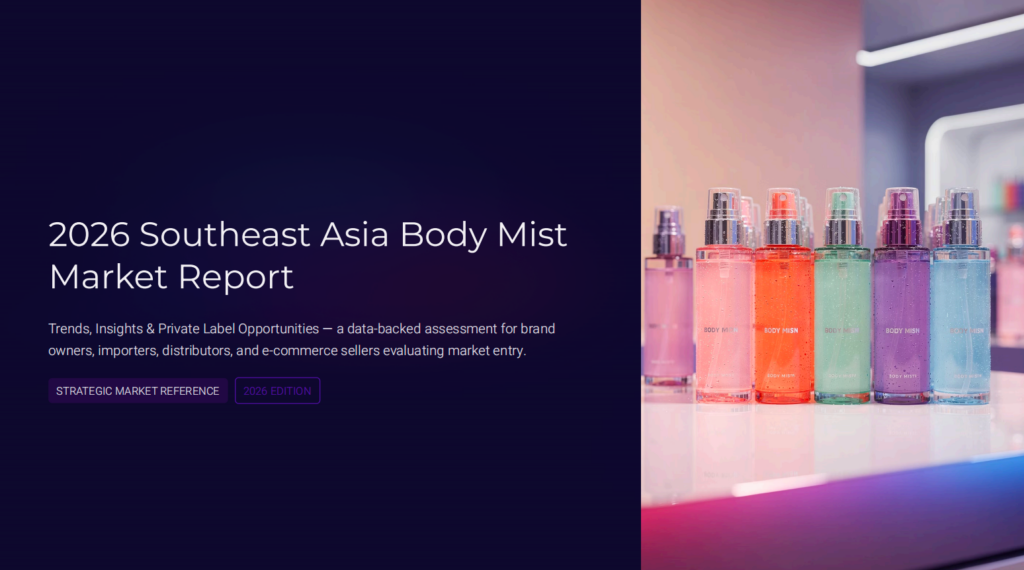
Executive Summary
This report explores the Southeast Asia body mist market in 2026, including country priorities, consumer demand, scent direction, price tiers, channel fit, compliance considerations, and private label launch planning. It is designed to help brands, distributors, sourcing teams, and e-commerce sellers turn market opportunity into a more practical body mist launch strategy.
Southeast Asia Body Mist Market 2026: Trends, Country Insights, and Private Label Launch Strategy
The Southeast Asia body mist market in 2026 is not a category where any new product can succeed automatically. It is a commercially attractive segment, but the winning products are the ones that fit how the region actually buys, uses, and discovers fragrance.
Across Indonesia, Thailand, Vietnam, the Philippines, and Malaysia, body mist matches several powerful market realities at once: hot and humid weather, younger beauty consumers, mobile-first shopping behavior, affordable fragrance entry points, and strong short-video and social-commerce influence. Compared with heavier fine fragrance formats, body mist often fits daily life better because it is lighter, easier to reapply, easier to gift, and easier to buy on impulse.
This report translates the Southeast Asia body mist opportunity into practical launch logic. It covers country priorities, consumer demand, scent direction, price tiers, format strategy, channel fit, compliance considerations, and private label execution planning for brands entering or expanding in the region.
Executive Summary
Southeast Asia is a credible entry market for body mist in 2026, but it should not be approached as a one-size-fits-all regional category. The best opportunities are concentrated in mass to affordable-premium body mist lines designed for daily refresh, layering, social use, gifting, and mobile commerce.
The category is commercially attractive because it aligns with the region’s climate, younger consumer demographics, and digital shopping behavior. Consumers do not always begin their fragrance journey with prestige perfume. Many begin with lighter, lower-commitment, more affordable products that can be carried, reapplied, gifted, and bought in multiple scents.
For most buyers, the most practical launch is not one hero SKU alone. A 3-SKU or 5-SKU starter line is usually stronger. This creates better shelf presence, better online storytelling, more bundle potential, and lower launch risk than trying to lead with one scent only.
Market Opportunity Overview
The Southeast Asia body mist market remains smaller than major Western fragrance markets in absolute value, but it is strategically attractive because the category is still fragmented and far from fully saturated. This gives focused entrants room to win through better product-market fit, stronger channel execution, and more relevant scent architecture.
What makes body mist especially suitable for the region is its role in everyday life. Consumers are buying for freshness, portability, mood, scent variety, and easy reapplication rather than only for long-lasting sophistication. That changes the development logic. A successful body mist line in Southeast Asia should feel easy to wear, easy to understand, and easy to repurchase.
For private label buyers, the market is attractive not because it is simple, but because it is commercially usable. There is room for new entrants that understand price expectations, visual packaging language, and the role of social-commerce-led discovery.
Market Snapshot: Southeast
Asia Focus
Country Priority View
Southeast Asia should not be approached as one uniform launch market. Country selection matters.
Indonesia
Indonesia is the largest scale opportunity in the region. It combines population size, beauty demand, strong local-brand activity, and significant price sensitivity. It is the most important market for validating whether a body mist line can achieve real volume. It is especially suitable for mass and masstige body mist launches with clear value logic, familiar scent direction, and strong promotional readiness.
Thailand
Thailand is one of the most commercially important social-commerce and short-video markets in Southeast Asia. It is highly suitable for trend-led, visual, gifting-friendly, and creator-driven body mist launches. Sweeter, more expressive, and more playful scent directions often work well here when supported by good packaging and strong content.
Vietnam
Vietnam is a fast-growing digital beauty market with rising e-commerce maturity. It is a good market for youth-oriented body mist lines, aesthetic packaging, shimmer extensions, and slightly more polished mid-tier positioning.
Philippines
The Philippines suits affordable, giftable, fresh, and approachable body mist concepts. It is especially relevant for everyday-use formats and for products that work well in drugstore, pharmacy, and social-commerce environments.
Malaysia
Malaysia is smaller in scale than Indonesia and Thailand, but it can be attractive for affordable premium positioning, cleaner design language, and more polished assortment building. It is often a useful market for testing slightly upgraded packaging and higher-margin positioning.
For most buyers, the most practical market sequence is to start with Indonesia for scale validation, Thailand for social-commerce momentum, then expand into Vietnam or the Philippines, while using Malaysia for premiumization testing.
Consumer and Demand Signals
The core body mist buyer in Southeast Asia is typically Gen Z to young millennial, often female-skewed at entry level, but increasingly open to unisex freshness, multi-use formats, and mood-based fragrance routines.
This customer is not always shopping for a signature perfume. More often, she is shopping for a small scent wardrobe:
- one fresh everyday scent
- one sweet or flirty scent
- one giftable or going-out scent
- one possible shimmer or hair-and-body variant
This matters because body mist should not be briefed as a cheaper perfume. The consumer is often buying for refreshment, portability, ease of use, and emotional vibe.
The most commercially relevant usage occasions include:
- morning fresh start before school or work
- midday refresh after heat, commute, or activity
- layering over lotion, deodorant, or body wash
- casual social outings and daily routines
- low-ticket gifting
- bag-carry reapplication
A successful launch should therefore be built around use occasions, not just fragrance-family labels.
Consumer & Demand Signals
Fragrance Directions with the Strongest Commercial Fit
The body mist market in Southeast Asia is driven more by easy likability than by fragrance complexity.
The most scalable directions include:
- fresh fruity
- clean floral
- sweet but light gourmand
- tropical juicy fruit
- soft musky skin scent
- tea, citrus, watery, and laundry-clean profiles
These scent types perform well because they feel approachable, wearable, and relevant to the climate. They are easier to understand in social content, easier to gift, and easier to repurchase.
The weaker starting directions for most entry launches include:
- very dark oriental profiles
- niche-style accords that need fragrance education
- overly mature powdery signatures
- strong perfume-clone directions without clear brand positioning
A useful rule is this: in Southeast Asia body mist, a scent should feel easy to like before it feels prestigious.
Product Architecture and SKU Strategy
The strongest body mist launches in Southeast Asia are not overloaded with too many scents. They are built around a clear architecture.
A practical starter range usually includes:
- two fresh everyday scents
- one sweet or social-media-friendly scent
- one layering or gifting SKU
- one optional extension such as shimmer, mini, or hair-and-body
This creates a more usable assortment and gives the line a stronger commercial role across multiple channels.
A typical first collection can be structured like this:
- one clean daily refresh scent
- one tropical youthful scent
- one soft laundry or skin-musk scent
- one sweet fruity gifting scent
- one mini or duo set for trial
This type of launch works better than a large unfocused line because each SKU has a job:
- one drives volume
- one creates social buzz
- one supports repeat use
- one improves basket building
- one enhances giftability
Every launch should clearly define:
- which SKU is the everyday bestseller
- which SKU is the social-content hook
- which SKU is the gifting SKU
Without these answers, assortment planning becomes weak very quickly.
Go-to-Market Playbook
Price Tiers and Format Strategy
The strongest commercial density in Southeast Asia body mist is in the mass to affordable-premium range. Prestige-style pricing is usually not the best starting point for a body mist line unless the brand already has strong equity.
Three pricing bands matter most:
Low / Mass Tier
This tier focuses on affordability, repeat purchase, and wide accessibility. It is strongest in value-driven and drugstore-style channels, particularly in Indonesia and the Philippines.
Mid Tier
This is often the most interesting zone for brand-building. It allows better packaging, improved fragrance storytelling, and stronger digital presentation without pricing the product out of reach.
Affordable Premium
This tier works when the brand has a clear design identity, more polished storytelling, and stronger visual coherence. It is not prestige perfume, but it feels elevated enough for gifting and premium everyday use.
The lead commercial format remains the 100 ml spray. That size usually offers the best balance of price perception, practicality, portability, and margin.
The strongest supporting formats include:
- 30–50 ml mini versions
- duo or trio sets
- hair-and-body mist
- shimmer mist
- gifting bundles
For most first launches, the right approach is:
- 100 ml as hero size
- mini or duo as conversion booster
- set or shimmer as seasonal or content-driven extension
Category Landscape: Price
Tiers, Formats & Packaging
Packaging and Visual Direction
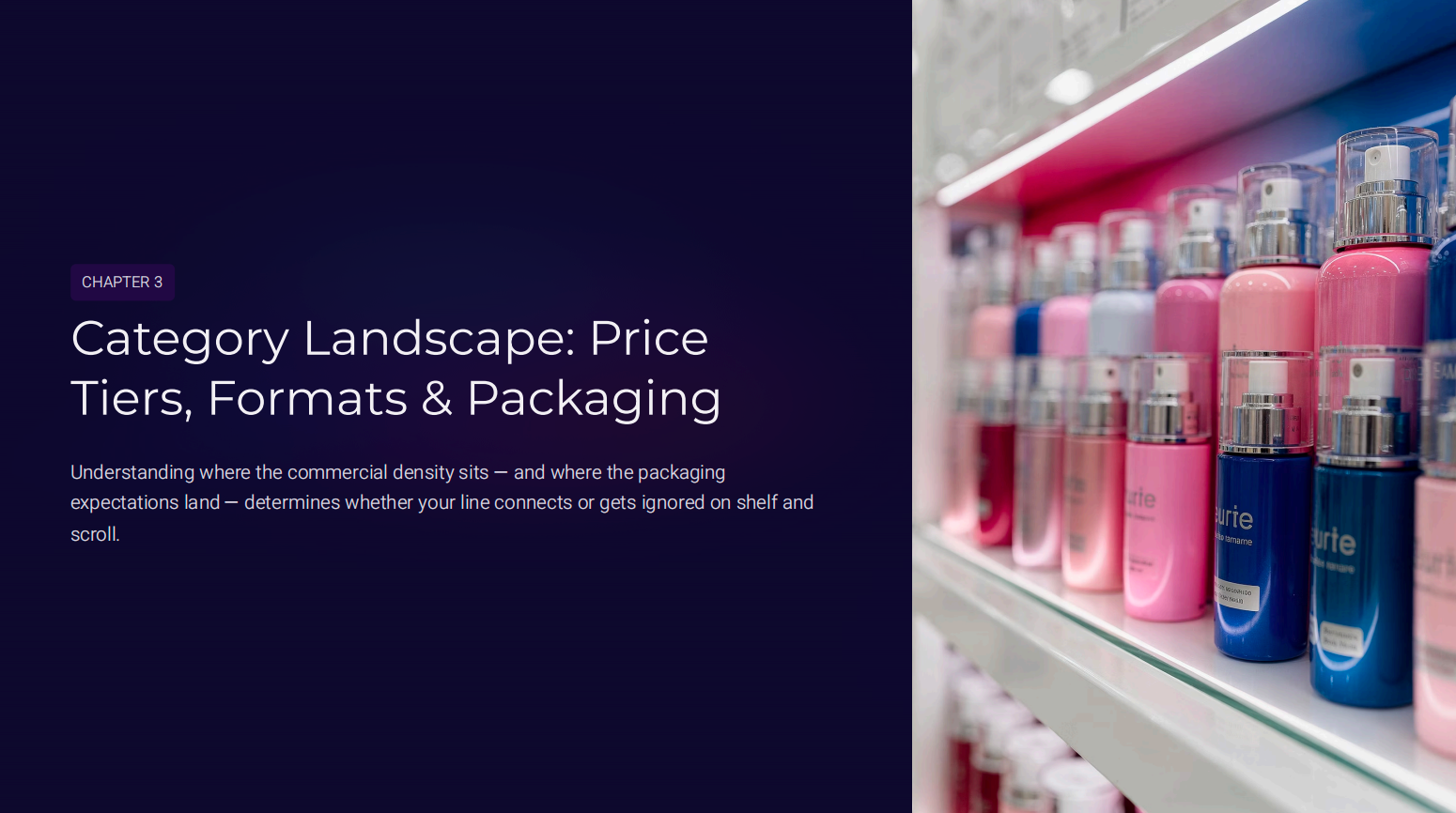
Body mist is a visually led category. Packaging performance is not just about shelf presence. It also affects social-commerce performance, creator content, gifting appeal, and repeat purchase.
The strongest packaging directions usually include:
- colorful translucent bottles
- pastel or candy-tone graphics
- good front-label readability
- portable rounded silhouettes
- visually coordinated multi-scent collections
- packaging that feels bright, giftable, and youthful
At the same time, the product should not look too cheap or too serious. One common failure is launching packaging that is either too generic for digital competition or too premium and formal for the actual body mist buyer.
The stronger route is affordable delight:
- bright enough to stop the scroll
- polished enough to gift
- practical enough for daily use
For most first launches, buyers should commit to one visual route:
- playful youth
- clean soft premium
- tropical travel fun
- night-out shimmer
Trying to mix all of them at once usually weakens the line.
Channel Strategy
The best body mist launches in Southeast Asia are channel-aware from the start.
E-commerce
Useful for wider assortment, bundle testing, review building, and fast consumer feedback. It is the right channel when you need quick market signal and can support strong content and traffic.
Retail
Important for repeat purchase, physical discovery, gifting visibility, and broader credibility. It works best when the product is shelf-ready and pricing is compatible with retail margin structures.
Social Selling
Especially important for new brands and affordable products. It is ideal for impulse triggers, seasonal gifting, limited drops, and creator-led conversion.
TikTok-Driven Discovery
This is one of the most important realities of the category. Body mist performs naturally in short-form content because it is affordable, visually demonstrable, easy to compare, and easy to sell in bundles.
A practical launch route often looks like this:
- seed micro-creators early
- develop three core content angles: freshness, sweetness, and giftability
- lead with a duo or trio offer
- use the best-performing content for retargeting and conversion
A strong channel structure should not force the same pack, same set, and same pricing into every channel.
A more effective structure is:
- online for bundles and minis
- retail for 100 ml heroes and gift sets
- social-commerce for duo offers, limited drops, and shimmer-led visuals
Compliance & Quality
Considerations
Compliance and Quality Considerations
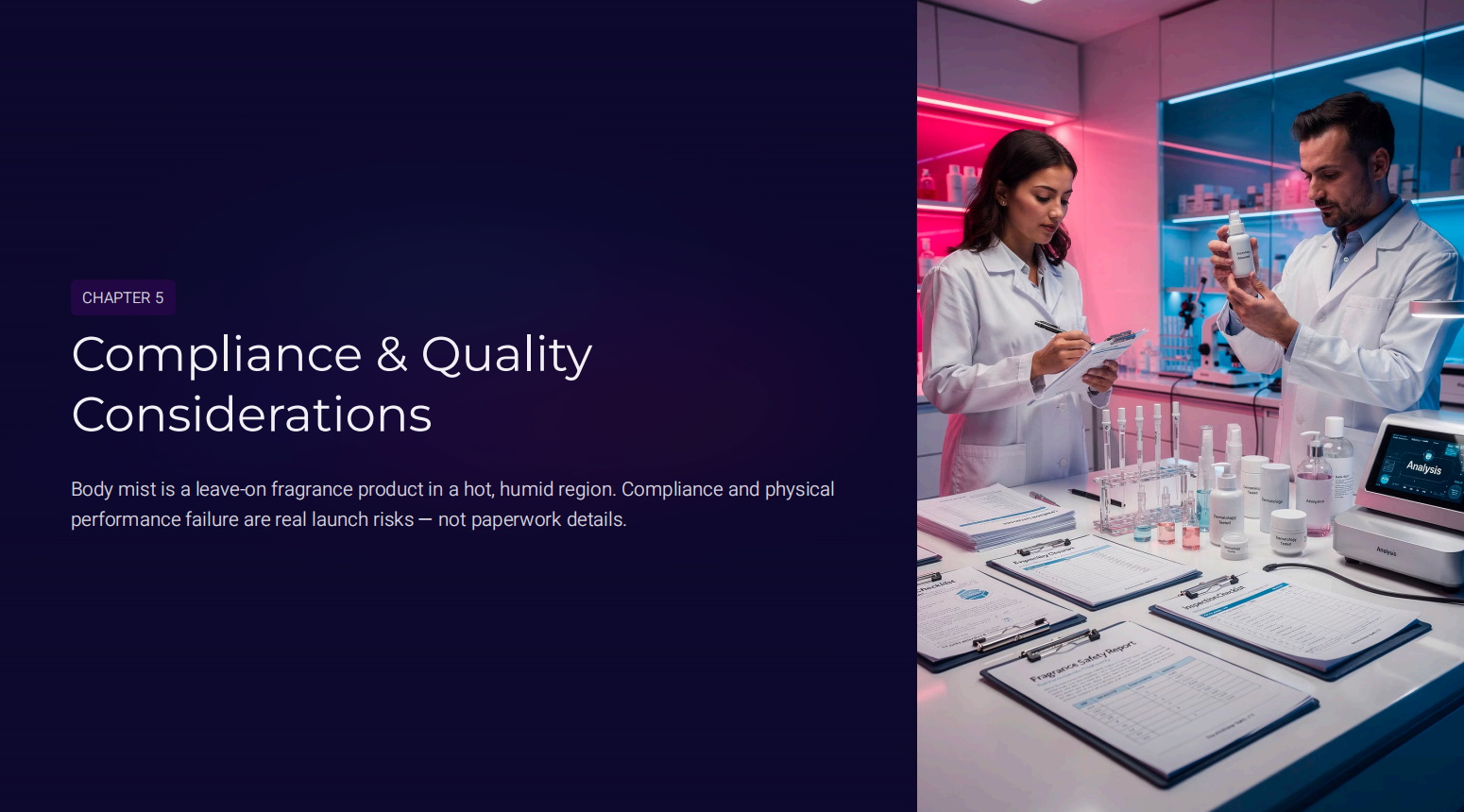
Body mist is a leave-on product, so fragrance review, claims control, and packaging compatibility all matter.
The main commercial risks include:
- launching fragrance profiles without full documentation
- under-testing packaging in hot and humid conditions
- overclaiming skin or “clean” benefits
- overlooking local language and notification requirements
- finalizing artwork before full compliance review
For Southeast Asia, buyers should pay close attention to:
- product classification in the target market
- formula review and fragrance documentation
- allergen and ingredient labeling requirements
- stability in heat and humidity
- bottle, pump, cap, and label compatibility
- micro and preservative strategy where relevant
- artwork review and market-specific notification readiness
- claim substantiation for terms such as alcohol-free, hydrating, or long-lasting
High heat, humidity, transport vibration, and repeated daily handling make this category less forgiving than it may look on paper.
A supplier that cannot clearly explain fragrance compliance support, stability scope, compatibility testing, and documentation is usually a higher-risk partner than the quoted price suggests.
OEM and Private Label Execution Plan
For body mist, the most effective private label strategy is not chasing the lowest MOQ at any cost. It is building a commercially usable first run.
A realistic first-launch structure usually includes:
- one target launch market
- three to five hero SKUs
- one 100 ml hero format
- one clear visual theme
- simple compliant claims
- standard packaging where possible
Typical MOQ planning depends on bottle, formula, decoration, and customization level, but many projects work best when they balance flexibility with enough volume to support launch, seeding, bundles, and repeat stock availability.
A strong execution process usually includes:
- briefing
- formula and fragrance alignment
- packaging selection
- sampling
- pre-production validation
- production and launch support
Before sending an RFQ, buyers should clarify:
- target country
- target retail price
- channel strategy
- SKU count
- size and format
- scent references
- brand direction
- claims direction
- packaging preference
- target launch date
The better the brief, the better the quote, the shorter the sampling loop, and the lower the execution risk.

OEM / Private Label Execution
Plan
Final Recommendations
The Southeast Asia body mist market is worth entering in 2026, but only with precision.
The category is especially attractive for brands that can:
- launch a focused 3–5 SKU line
- choose one lead market first
- support creator or digital-first discovery
- build around body mist behavior rather than perfume assumptions
It is less suitable for brands that:
- treat body mist as leftover fragrance inventory
- want one universal assortment for all Southeast Asia markets
- rely only on offline retail without digital support
- over-customize the first launch
The strongest first move depends on buyer type.
For brand owners and founders, a 3-SKU line with one clean, one sweet, and one tropical direction is often the most practical.
For sourcing and product development teams, it is usually smarter to standardize the pack first and differentiate through fragrance curation and assortment logic.
For importers and distributors, a 5–8 SKU structure with one retailer-exclusive scent or set can work well.
For e-commerce sellers, the best entry often combines one clean hero, one sweet trend scent, and one discovery mini set.
Download the Full Report (PDF)
Tell us your target region, product category, and the decision you’re trying to make. We’ll suggest the closest existing report—or build a tailored version.