


Executive Summary
This report explores the Russia men’s perfume market in 2026, including scent trends, consumer demand, price architecture, gifting formats, marketplace strategy, compliance priorities, and OEM launch planning. It is designed to help brands, importers, distributors, e-commerce sellers, and product teams turn market insight into a more practical fragrance launch strategy.
Russia Men’s Perfume Market 2026: Scent Trends, SKU Strategy, and Launch Guide
The Russia men’s perfume market in 2026 is not best approached through highly experimental niche perfumery. The strongest commercial opportunity lies in familiar, masculine-coded fragrance profiles built around confidence, gifting, daily wear, evening appeal, and strong value perception.
For brands, importers, distributors, marketplace sellers, and private label buyers, the real opportunity is to build a disciplined and scalable assortment rather than a broad and unfocused fragrance catalog. In Russia, product success depends not only on scent quality, but also on giftability, thumbnail appeal, price-to-volume clarity, and marketplace readiness.
This report translates the Russia men’s fragrance opportunity into practical launch logic. It covers market context, consumer demand, scent direction, price architecture, SKU planning, marketplace strategy, compliance considerations, and OEM execution planning for brands preparing to enter or expand in the category.
Executive Summary
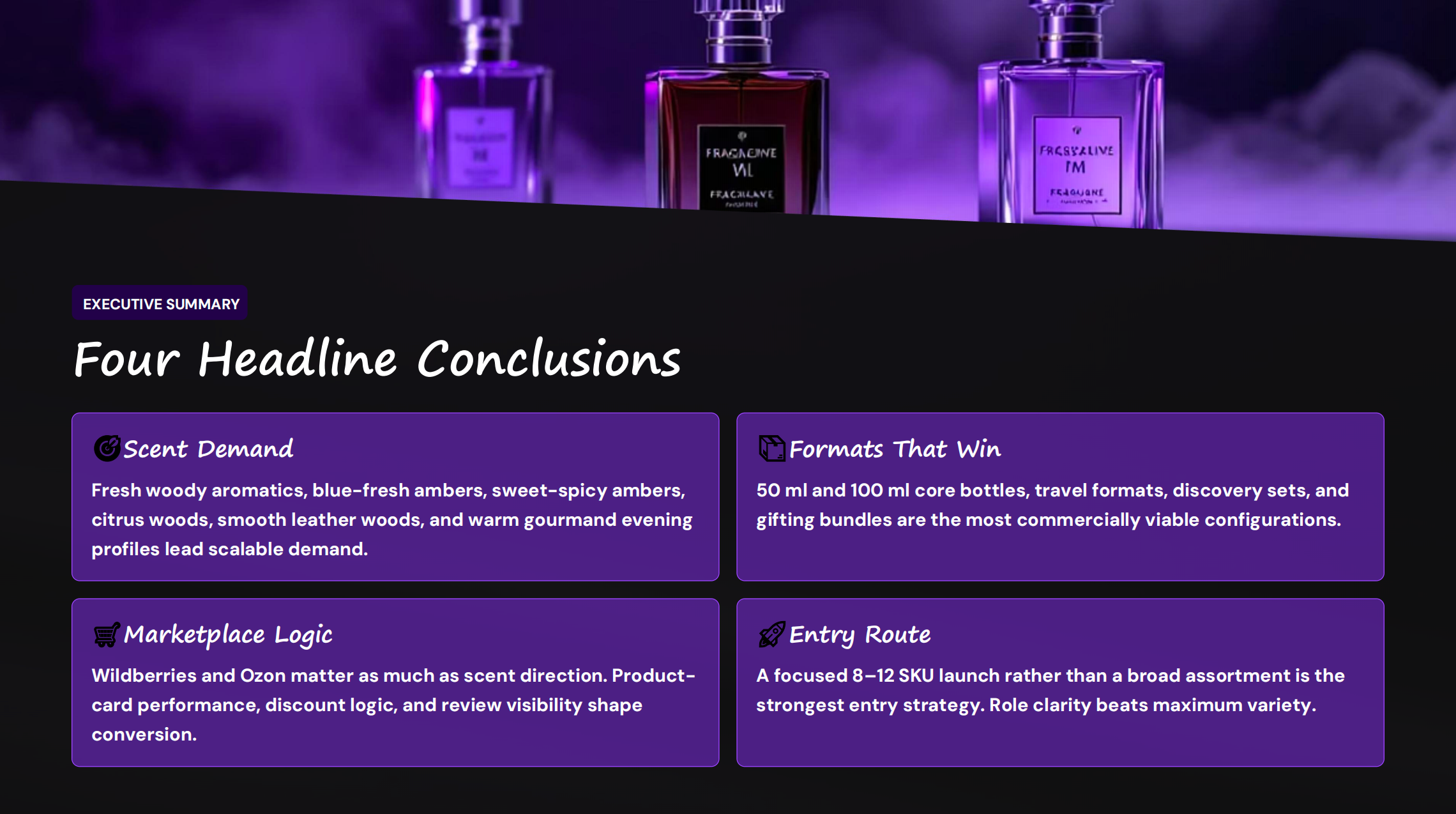
Russia’s men’s perfume opportunity in 2026 is strongest in commercially familiar fragrance families that feel masculine, wearable, and easy to understand. The market is supported by a combination of grooming demand, status signaling, gifting behavior, and strong marketplace-based shopping habits.
The most scalable scent directions are fresh woody aromatics, blue fresh ambers, sweet spicy ambers, citrus vetiver woods, smooth leather woods, and warm gourmand woods. These profiles work because they map clearly to recognizable use cases such as daily wear, office use, evening attraction, gifting, and colder-season rotation.
The most commercially viable formats are 50ml and 100ml core bottles, travel sprays, mini discovery sets, and gifting bundles. Winning brands typically succeed not by launching too many scents, but by building a compact SKU ladder with entry products, volume heroes, margin-supporting premium options, and gift-ready formats.
For most operators, the strongest 2026 entry strategy is a focused 8 to 12 SKU launch anchored by two mainstream masculine scent families, one sweeter evening profile, one gifting format, and one premium-signaling hero SKU.
Four Headline Conclusions
Market Opportunity Overview
The Russia fragrance market remains commercially relevant because perfume sits at the intersection of personal presentation, self-upgrade, gifting, and visible masculinity signaling. Men’s fragrance is not the entire market engine, but it is a meaningful and scalable subcategory because it combines emotional purchase drivers with repeat-use behavior and seasonal gifting demand.
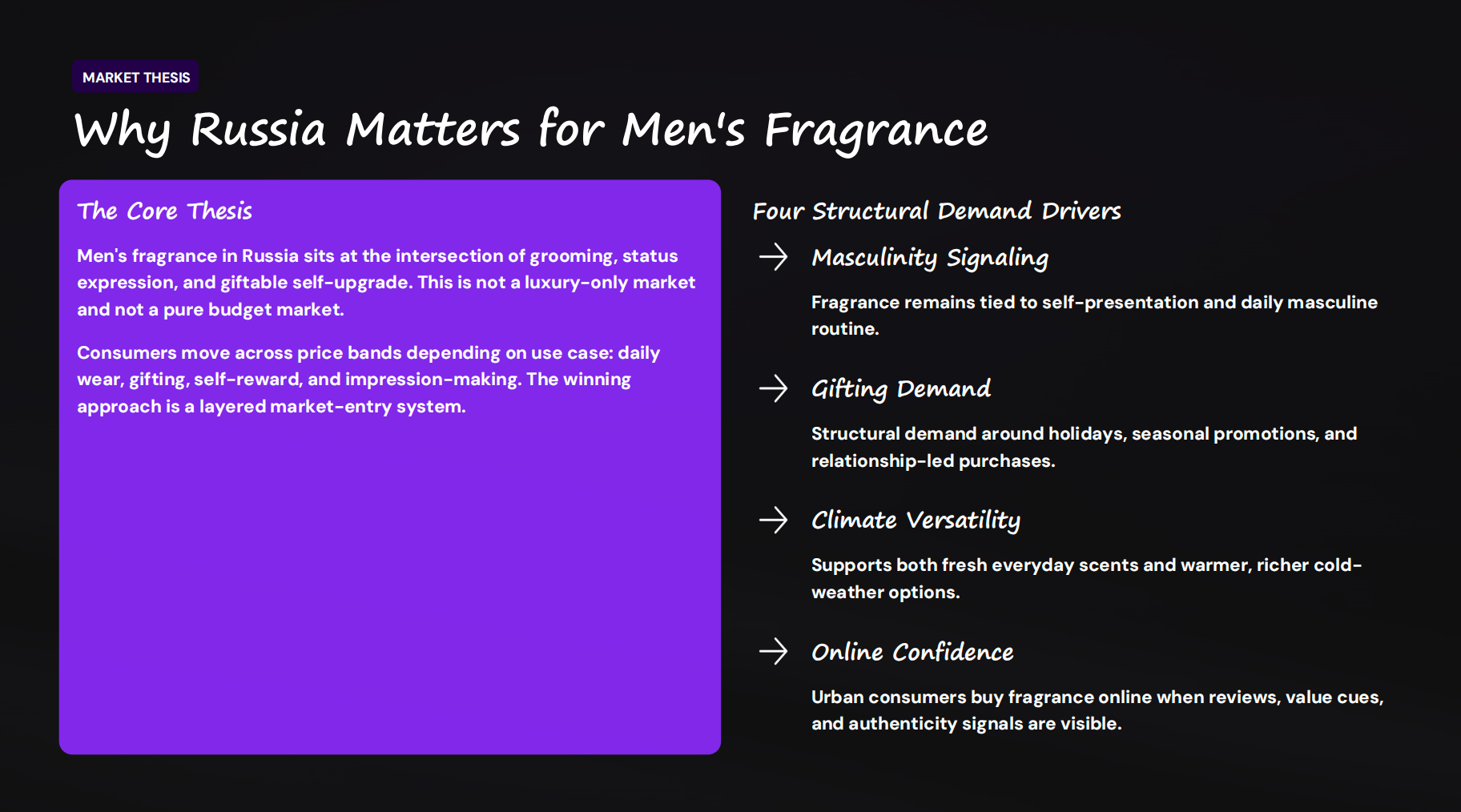
What makes Russia especially important from a product strategy standpoint is that the market does not behave as “luxury only” or “budget only.” Instead, it operates as a layered market where consumers move across price bands depending on use case. A fragrance may be bought for everyday wear, for status expression, as a practical gift, or as a seasonal self-reward.
This means successful product planning should not rely on one fixed price position or one bottle format. It should reflect the reality that Russian men’s perfume demand is driven by both practical use and perceived value.
What Is Driving Demand in 2026
Several structural forces are shaping the market.
The first is masculinity signaling. Fragrance remains closely connected to confidence, presence, and personal image. Buyers want a scent that reads clearly and supports identity without being too abstract or difficult to understand.
The second is gifting. Men’s fragrance is frequently purchased not only by men themselves, but also by partners, relatives, and occasion-led buyers. This makes safe-to-gift scent profiles and presentable packaging especially important.
The third is climate and seasonality. Fresh masculine scents matter for daily and year-round wear, but richer amber, spicy, and warmer profiles are especially valuable during colder periods and seasonal gifting windows.
The fourth is marketplace behavior. Online shopping environments reward products that communicate quickly. Consumers compare bottle size, discount depth, reviews, bundle value, and visual presentation before they buy. That makes clear scent framing and strong value architecture especially important.
Core Buyer Groups
The Russia men’s perfume market is not driven by one single buyer type. It is shaped by several commercially important demand groups.
Young adult buyers
This group typically responds to confidence, attractiveness, identity expression, and stronger-signature modern masculinity. Sweet-fresh, blue, amber, and more noticeable evening styles often perform well here.
Mature daily-use buyers
This segment tends to prefer versatile and reliable masculine scents that work across office, casual wear, and evening transition. Fresh woods, citrus aromatics, and clean spicy woods are especially relevant.
Gift buyers
Gift buyers are structurally important in the category. For this group, the product must feel easy to choose, safe to gift, masculine, and visually trustworthy. Packaging plays a major role in conversion.
Value-maximizing online shoppers
This segment compares milliliters, price ladders, discounts, review count, and bundle value. They often respond well to value bottles, travel formats, discovery sets, and gift-oriented bundles.
What Russian Consumers Value in Men’s Perfume
In practical terms, the strongest commercial demand is shaped by a few recurring consumer expectations:
- long-lasting perception
- masculine but wearable scent direction
- clear value for money
- attractive and trustworthy packaging
- safe-to-gift format and appearance
- familiarity without looking cheap
- a scent story that can be understood quickly
That is why overly technical descriptions, highly niche olfactive storytelling, or confusing artistic positioning often underperform compared with products that clearly communicate when and why they should be worn.
Why Russia Matters for Men's Fragrance
Scent Directions with the Strongest Commercial Potential
The Russia men’s perfume market in 2026 is best approached through recognizable masculinity with selective warmth and sweetness.
Fresh Woody Aromatic
This is the safest all-purpose direction. It supports daily wear, office use, gifting, and broad age appeal. It feels clean, masculine, and easy to understand.
Blue Fresh Amber
This remains one of the strongest mass-appeal directions because it promises freshness with noticeable depth. It works particularly well in e-commerce because consumers already understand what this kind of scent is supposed to deliver.
Sweet Spicy Amber
This direction performs especially well for evening use, gifting, colder weather, and younger consumers who want a more noticeable masculine fragrance.
Citrus Vetiver Wood
This profile signals maturity, polish, and refinement. It is useful for more professional positioning and for gift recipients who prefer cleaner, less sweet masculinity.
Smooth Leather Wood
This is a good premium-margin direction when executed in a wearable and polished way. It helps create a stronger halo product without pushing too far into difficult niche territory.
Warm Gourmand Wood
This type of scent performs well in colder months and for attraction-led positioning. It can be especially effective for younger online buyers when balanced with clear masculine structure.
What to Avoid
A first-wave Russia men’s fragrance launch should generally avoid leading with:
- overly smoky incense profiles
- harsh oud-heavy construction
- animalic leather styles
- bitter green aromatics
- abstract minimalist musks without clear masculine framing
These may have value later as extensions, but they are usually weaker choices for scalable first-entry product planning.
Price Architecture and Product Ladder
The category works best when price is translated into clear perceived value rather than prestige language alone.
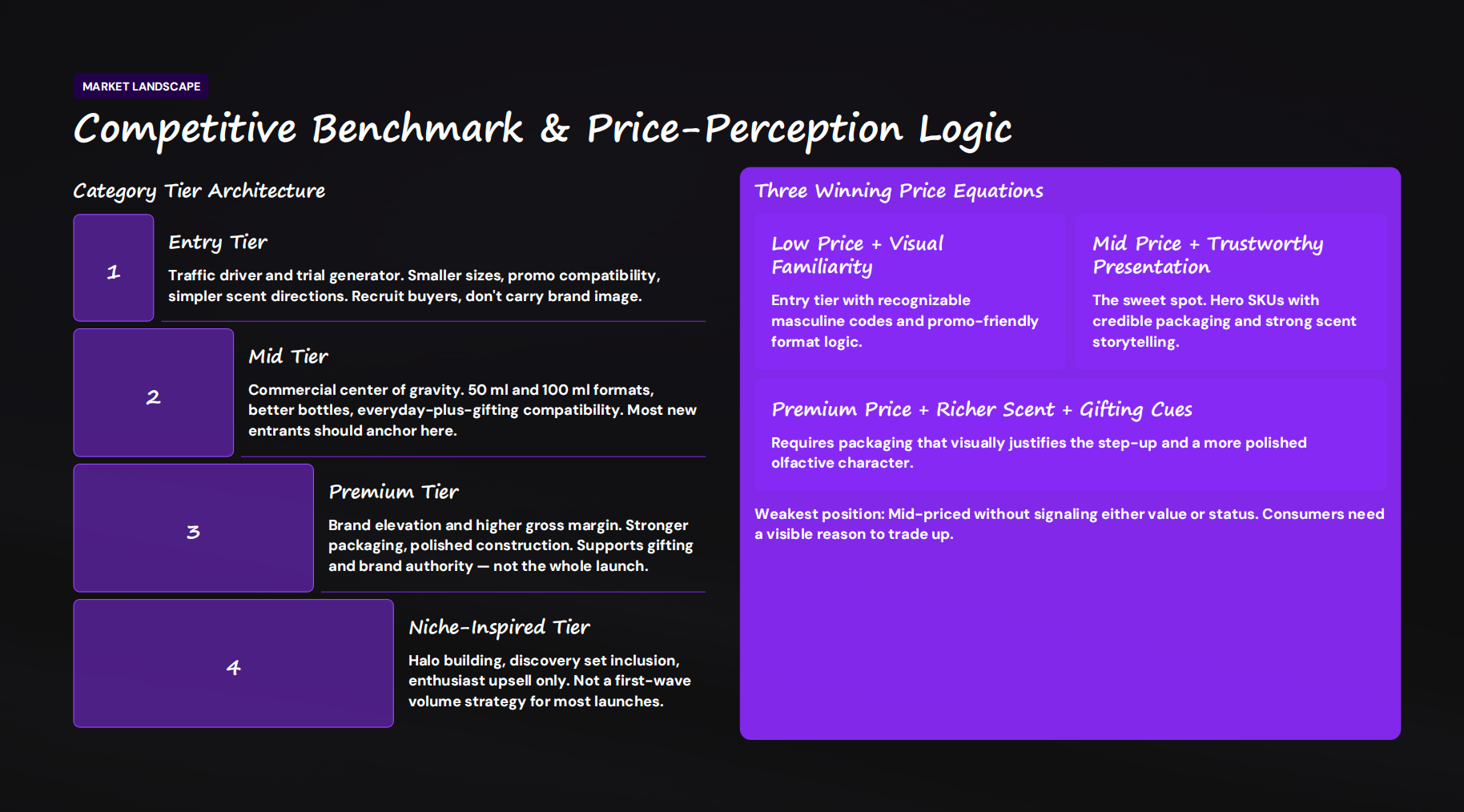
Entry Tier
This tier is useful for trial, promo participation, and traffic generation. It works best with smaller formats, simple masculine profiles, and strong marketplace compatibility.
Mid Tier
This is the commercial center of gravity. It is where 50ml and 100ml products can offer strong everyday wear, gifting suitability, and repeat-purchase logic.
Premium Tier
This supports better margins and stronger visual elevation. It works best with richer scent construction, improved packaging, and more gift-ready execution.
Niche-Inspired Tier
This can work, but only selectively. It is most useful as a halo or discovery extension rather than a broad first-launch strategy.
For most new entrants, the best approach is not to compress all SKUs into one price band. Consumers need a visible reason to trade up.
Competitive Benchmark & Price-Perception Logic
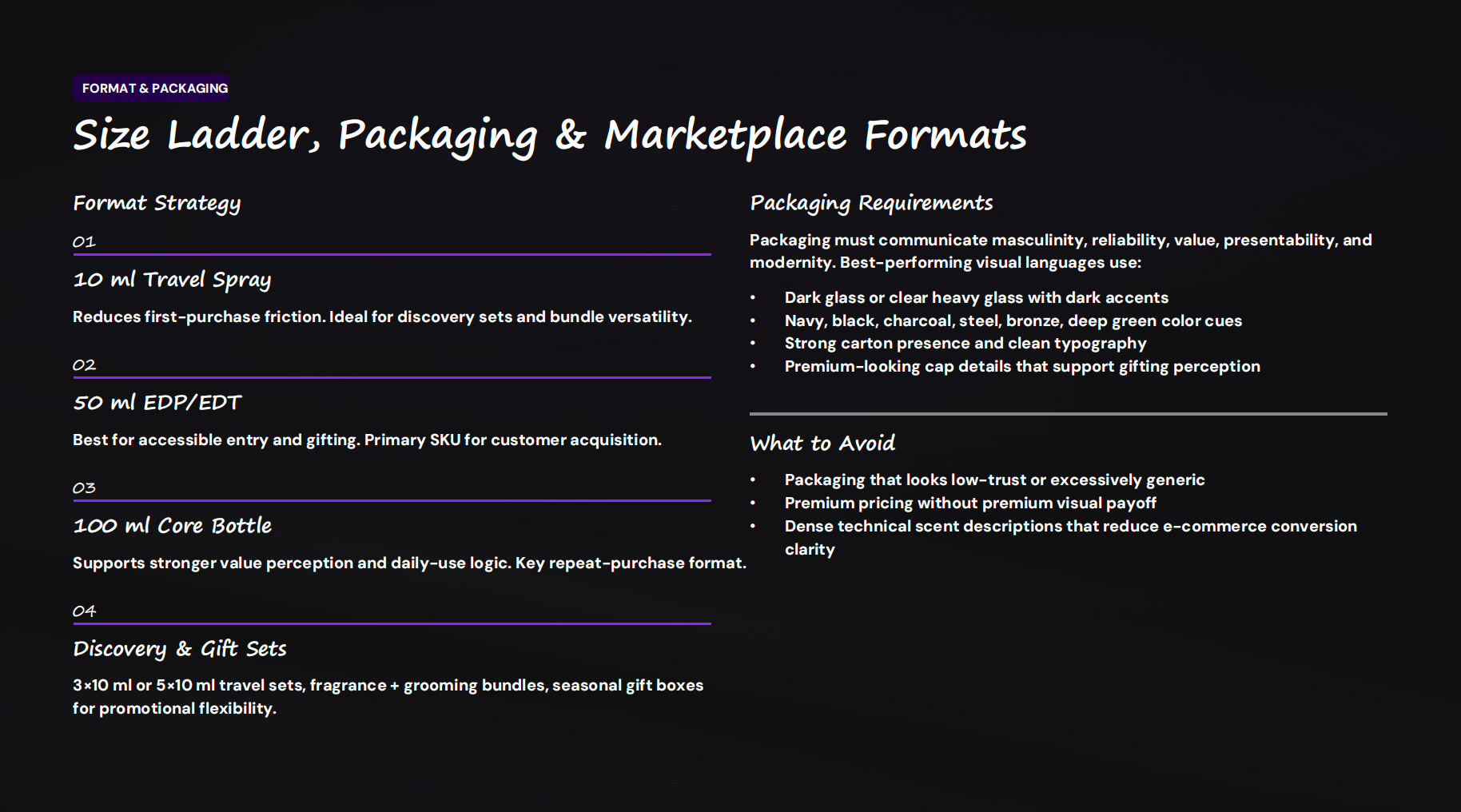
The Most Viable Sizes and Formats
The most commercially practical formats for Russia men’s perfume include:
- 50ml EDP or EDT for accessible entry and gifting
- 100ml core bottle for value and repeat use
- 10ml travel spray for trial and basket building
- 3-piece or 5-piece discovery and travel sets
- fragrance plus grooming companion gift bundle
- limited seasonal gift box for Q4 or occasion-led selling
A successful launch should treat formats as part of the merchandising strategy, not just as packaging variations.
Packaging Expectations
Packaging for Russia men’s perfume should communicate:
- masculinity
- reliability
- value
- presentability
- modernity
The most commercially effective visual languages usually include:
- dark glass or heavy-feel clear glass with dark accents
- black, navy, charcoal, steel, bronze, or deep green tones
- clean typography
- strong outer box presence
- premium-looking cap and atomizer details
Giftability matters here. If the packaging does not feel trustworthy and presentable at first glance, it will weaken conversion, especially in marketplace environments.
Marketplace Strategy
A Russia men’s perfume launch should be marketplace-aware from the beginning.
Marketplaces are often the fastest way to test:
- which scent family converts best
- which size is most commercially effective
- which price thresholds the market accepts
- which bundles improve basket value
- which visual styles perform best in thumbnail-based browsing
This means product pages, bottle sizes, discount logic, review accumulation, and gift-oriented presentation all matter as much as the fragrance itself.
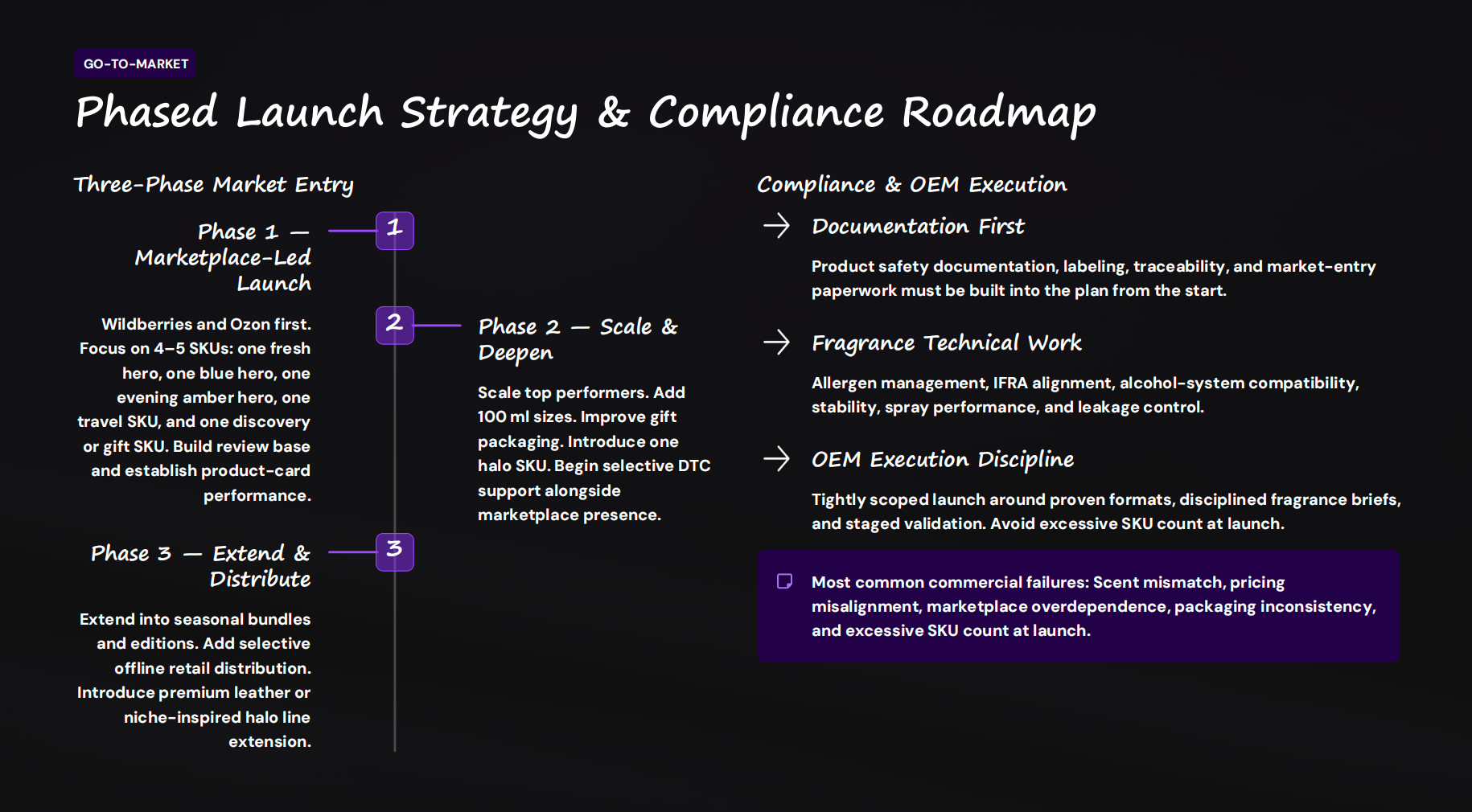
A strong launch sequence usually begins with a small, disciplined assortment on marketplace channels, followed by scaling of the best performers, then selective expansion into DTC and retail support.
Size Ladder, Packaging & Marketplace Formats
Recommended Launch Assortment Logic
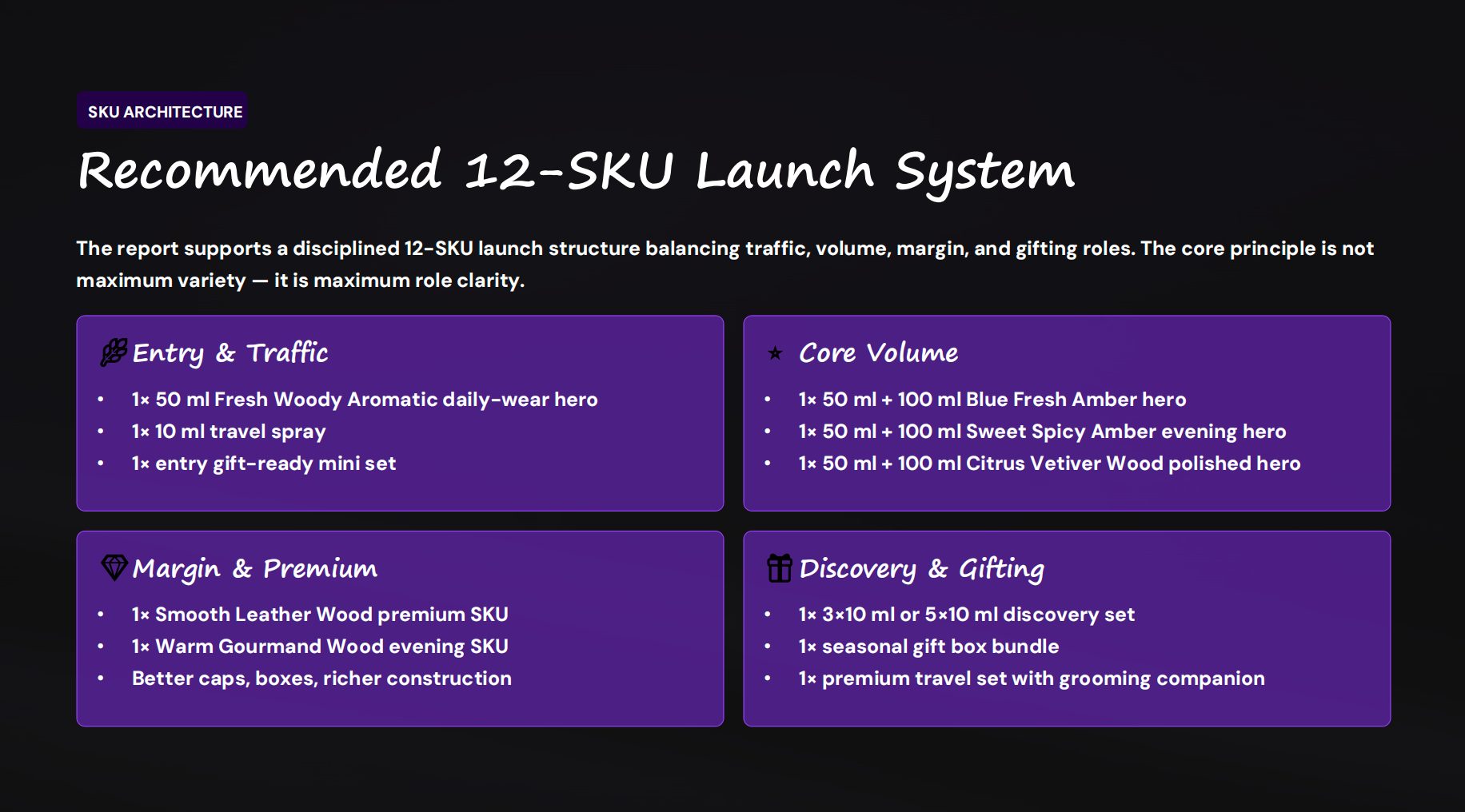
A Russia launch should be built as a layered commercial system, not as a random assortment.
A practical first-stage structure often includes:
- one fresh woody aromatic hero
- one blue fresh amber hero
- one sweet spicy amber evening SKU
- one mature citrus vetiver or polished woody option
- one premium leather or richer amber halo SKU
- one 10ml travel spray for trial
- one discovery set
- one gift-oriented bundle
This kind of assortment gives the brand enough variation to cover real buying occasions without creating unnecessary complexity.
Channel and Bundle Strategy
Different channels require different product roles.
For marketplaces, the strongest products are usually 50ml heroes, 100ml value bottles, travel sprays, and mixed mini sets. For DTC, bundles, discovery sets, gifting logic, and premium-margin formats become more useful. For retail or offline partners, gift boxes, tester visibility, and stronger secondary packaging matter more.
Useful bundle structures include:
- 50ml plus 10ml same-scent duo
- 3 x 10ml mixed discovery set
- 50ml fragrance plus grooming companion
- seasonal rigid-box gift edition
This is especially important in Russia because gifting and perceived deal value strongly influence fragrance purchases.
Recommended 12-SKU Launch System
Compliance and Product Development Priorities
Compliance should be built into the launch plan from the beginning rather than treated as a final paperwork step.
At a practical level, brands should plan for:
- product safety documentation
- formula review against restricted substances
- claims discipline
- locally acceptable labeling
- batch coding and traceability
- importer or responsible-party coordination where needed
- packaging compatibility and stability checks
- spray performance and leakage resistance
Fragrance development should also account for alcohol-base compatibility, packaging durability, odor stability, color stability, and temperature-related performance.
For a market like Russia, commercial readiness depends not only on scent and packaging, but also on documentation and execution discipline.
OEM Launch Strategy
The most efficient OEM path is a tightly scoped launch built around proven formats and clear fragrance briefs.
A stronger manufacturer brief should define:
- target customer
- price band
- channel strategy
- scent direction
- benchmark references
- bottle size and format
- packaging level
- intensity and longevity expectations
- target order quantity
- timeline
- required technical documents
The more specific the brief, the easier it becomes to align fragrance development, packaging sourcing, testing, and production timing.
For most buyers, 50ml and 100ml standard-format launches are the easiest entry point. Discovery sets and rigid-box gift packs are valuable, but they usually introduce more assembly and packaging complexity and should be planned carefully.
Four Headline Conclusions
Key Risks and Market Entry Barriers
The biggest commercial failures in Russia men’s perfume are usually strategic rather than technical.
Common risks include:
- launching too many SKUs too early
- choosing scent directions that are too abstract or difficult to understand
- weak value perception in mid-tier price bands
- packaging that feels generic or low-trust
- overdependence on one marketplace
- underestimating promo pressure and bundle expectations
- compliance and labeling delays
- over-customization too early in the launch cycle
The strongest defense against these risks is disciplined assortment planning, clear price ladders, and a staged rollout model.
Final Takeaway
What works in Russia’s men’s fragrance market in 2026 is not a broad catalog. It is a disciplined commercial system built around recognizable masculine scent codes, strong value logic, gift-ready presentation, and marketplace-aware execution.
The strongest launch strategy is to begin with a compact assortment led by fresh woody aromatic and blue fresh amber heroes, supported by one sweeter evening fragrance, one mature woody option, and one clear gift or discovery format.
For brands preparing to enter the market, the most important step is to align scent direction, price architecture, packaging trust, format strategy, and compliance planning from day one.
Download the Full Report (PDF)
Tell us your target region, product category, and the decision you’re trying to make. We’ll suggest the closest existing report—or build a tailored version.