


Executive Summary
This report explores the 2026 Middle East men’s fragrance market through a GCC-first lens, with a focus on Saudi Arabia and the UAE as the region’s core launch markets. It covers consumer demand, scent direction, format strategy, pricing logic, channel planning, compliance, and OEM execution to help brands, importers, distributors, and Amazon sellers make better launch decisions.
Middle East Men’s Fragrance Market 2026: GCC Trends, Saudi & UAE Insights, and Launch Guide
Middle East Men’s Fragrance Market 2026: GCC Trends, Saudi & UAE Insights, and Launch Guide
The Middle East men’s fragrance market is not one uniform opportunity. For most brands, importers, and private label buyers, it should be approached as a GCC-first market, with Saudi Arabia and the UAE acting as the main demand centers, cultural trend drivers, and launch gateways.
This report is designed for decision-makers who want more than headline market growth numbers. It translates regional demand signals into practical launch logic: what scent directions are moving, which format ladder makes the most commercial sense, how to think about pricing and gifting, what buyers should watch in compliance, and how to build a launch-ready SKU roadmap for 2026.
If you are developing a men’s fragrance line for the Middle East, this guide will help you move from trend observation to product planning, channel selection, and execution.
Section 1
Why the GCC Should Be the Starting Point
For most new entrants, the Middle East men’s fragrance opportunity should be sequenced rather than treated as one broad region. Saudi Arabia and the UAE are the two most important launch priorities because they combine premium demand, strong fragrance culture, digital readiness, and re-export influence across surrounding markets.
Saudi Arabia matters because fragrance is deeply tied to identity, gifting, ritual, and everyday personal care. The UAE matters because it is both a consumer market and a regional trade and brand showcase hub. Kuwait, Qatar, and Oman can be strong expansion markets, but for a 2026 launch, the first commercial logic usually starts with Saudi Arabia and the UAE.
This matters for product planning. A brand that tries to build one generic “Middle East fragrance” often misses the nuances that actually drive conversion, repeat purchase, and distributor confidence.
Section 2
What Is Driving Demand in 2026
Demand in the region is not centered on minimalism. Buyers are looking for performance, projection, identity, and gift-worthiness. In practical terms, that means masculine scent territories with stronger signature appeal continue to outperform weak or overly generic concepts.
The most commercially relevant directions for men’s fragrance in the region include:
-
oud-amber compositions
-
saffron-led signatures
-
leather and incense directions
-
fresh-aquatic profiles with Middle Eastern depth
-
woody masculine blends with better longevity and projection
Layering is also an important market behavior. Consumers do not always think in terms of one bottle for one occasion. They may combine perfume with oils, body products, or gifting sets. That means winning portfolios are often built as a system, not as a single hero SKU.
Another key demand driver is the cultural and gifting calendar. Ramadan, Eid, weddings, and premium gifting occasions can significantly influence assortment, packaging, and bundle planning.
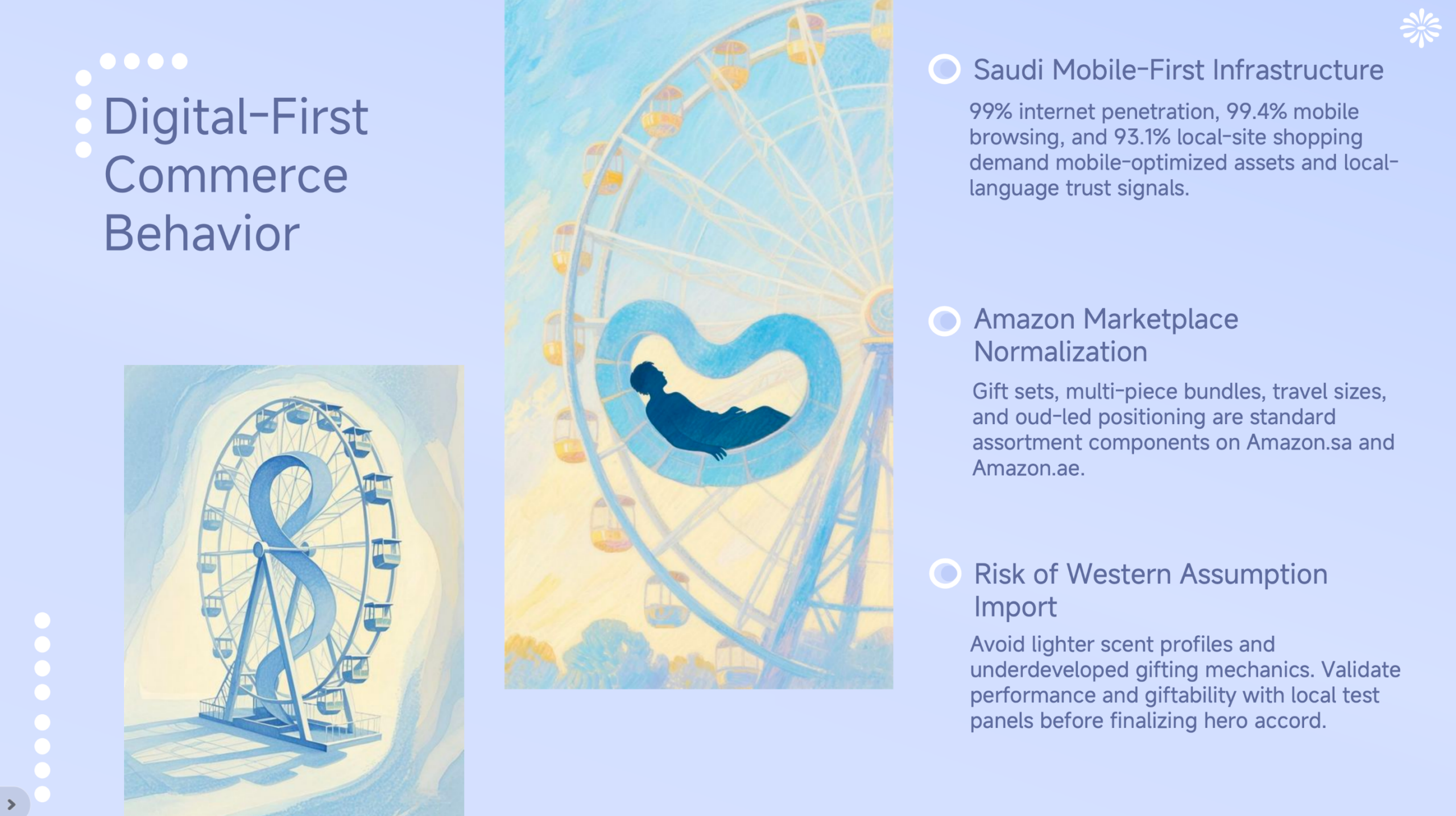
What Is Driving Demand in 2026
Section 3
The Product Architecture That Makes the Most Sense
A strong 2026 launch is usually not built on one SKU alone. The more investable structure is a laddered portfolio.
A practical opening architecture often includes:
-
one hero Eau de Parfum
-
one stronger extrait, oil, or prestige extension
-
one travel or discovery format
-
one gift-ready set or bundle
This structure works because it supports both trial and trading-up. It gives buyers a clearer pricing ladder and gives channels more flexibility. For DTC and Amazon, discovery sets and travel sizes help reduce purchase friction in a category where customers cannot smell before buying. For wholesale and distributors, gifting bundles and stronger premium options help protect margin and shelf presence.
In other words, the Middle East men’s fragrance opportunity is not just about “which scent to launch.” It is about building a commercially usable fragrance system.
Section 4
Competitive Reality: What New Entrants Need to Understand
The competitive landscape is active but readable. Regional fragrance houses often win on cultural relevance, strong scent signatures, gifting logic, and value engineering. Imported and global brands still hold prestige, but they do not automatically win unless they localize their launch logic.
For many buyers, the whitespace is not at the extreme low end or the ultra-luxury end. It sits between affordable regional popularity and high-priced imported prestige. That creates room for brands that can offer:
-
premium-looking presentation
-
culturally aligned scent direction
-
strong projection and longevity
-
clear price-to-value logic
-
flexible formats and gifting options
This is also where OEM and private label buyers have an advantage. A well-positioned product line with the right scent brief, bottle route, and packaging structure can move faster than many brands that rely only on image-led storytelling.
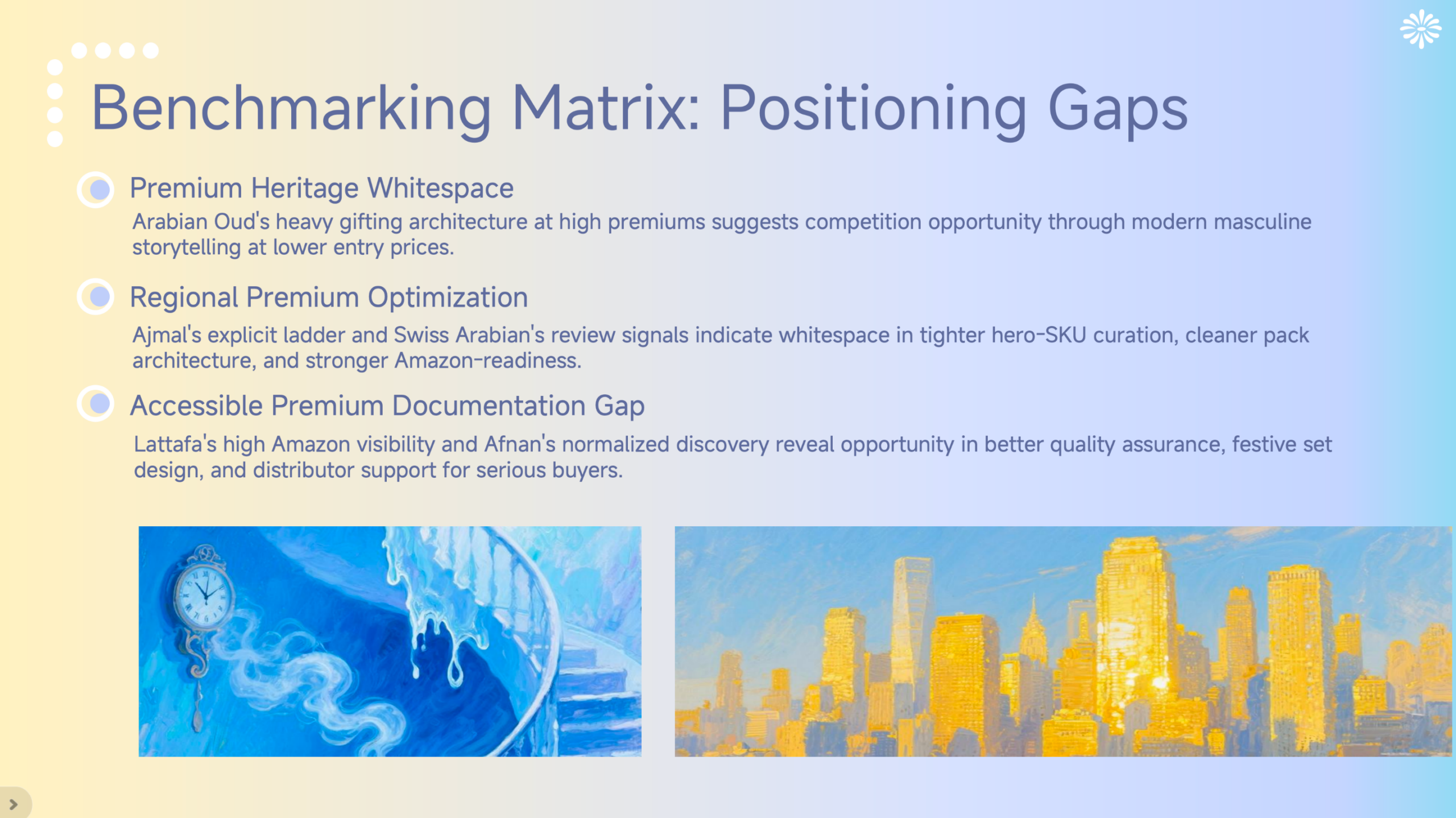
Competitive Reality: What New Entrants Need to Understand
Section 5
Channel Strategy: Brand, DTC, Amazon, and Wholesale
A successful launch should be channel-native. The same bottle, pack, and message do not work equally well across every channel.
For brand owners, the priority is usually a clear masculine story, a strong hero SKU, and a premium ladder that supports both everyday sales and gifting periods.
For DTC sellers, sampling and trial mechanics matter more. Discovery sets, travel sizes, quiz-driven recommendations, and content that explains projection, dry-down, and occasion use can meaningfully improve conversion.
For Amazon sellers, clarity wins over poetry. Titles, bullets, and images should clearly communicate scent family, concentration, size, use occasion, and bundle contents. Packaging also has to be operationally ready for parcel handling, leakage prevention, and return-risk control.
For importers and distributors, repeatability matters as much as fragrance concept. Buyers want to know whether the supplier can hold consistency, protect margins, support festive or premium packaging, and scale reliably once the line starts moving.
Section 6
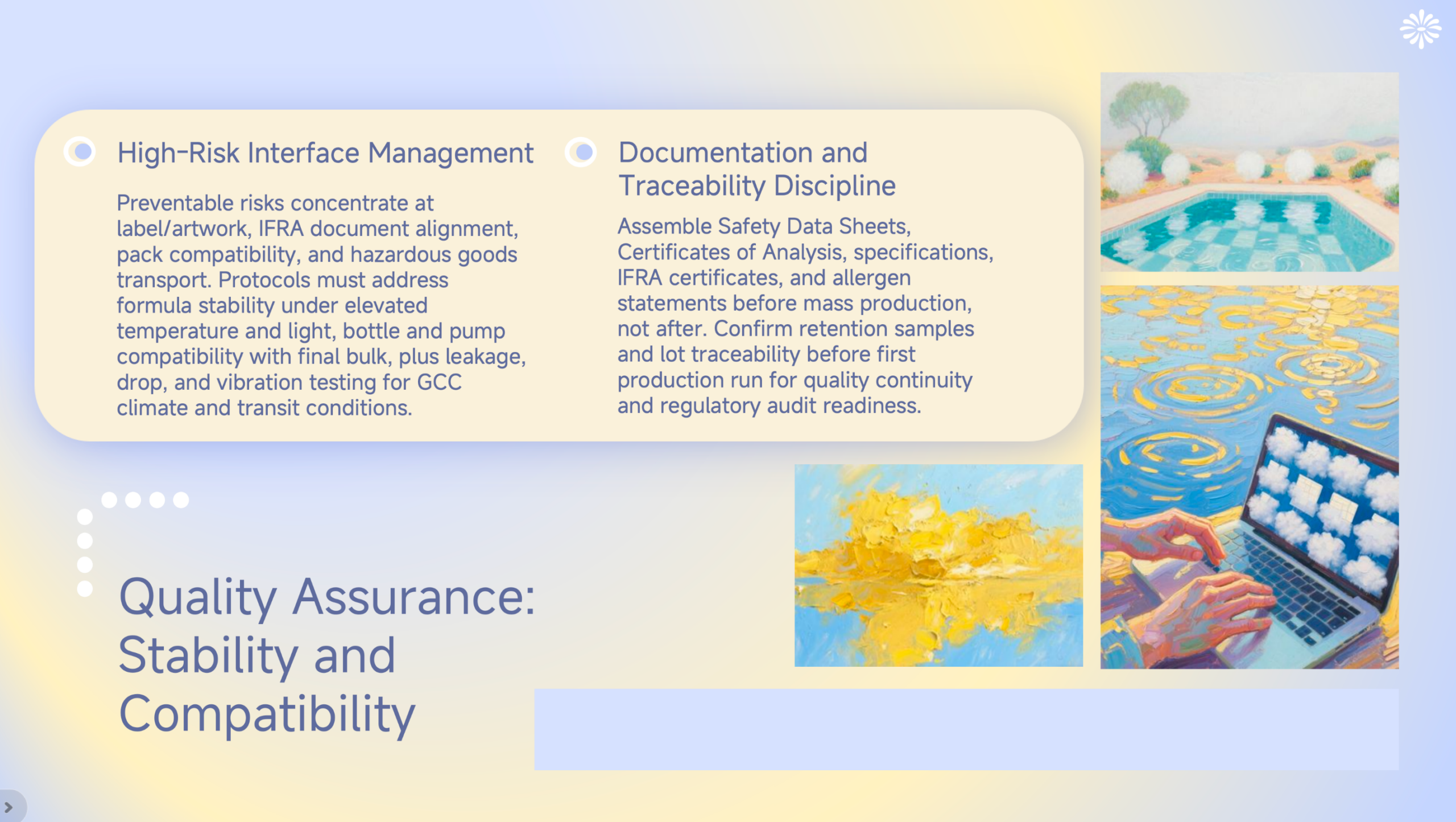
Compliance, Labeling, and Quality Are Not Side Issues
One of the biggest mistakes in fragrance launches is treating compliance as something to fix after design. In reality, compliance, labeling, documentation, and transport stability are part of market entry.
Before launch, buyers should align on:
-
applicable labeling requirements
-
fragrance safety documentation
-
formula and packaging compatibility
-
leakage and transport resistance
-
high-temperature stability
-
artwork accuracy for local-market presentation
In the Middle East fragrance business, many failed launches are not caused by weak scent ideas. They are caused by preventable execution problems: label issues, unstable packs, leakage, unclear claims, or packaging that looks premium online but performs poorly in logistics.
Section 7
What Buyers Should Prepare Before Sending an RFQ
The fastest way to move from market research to actual sampling is to give the factory a commercially usable brief.
A strong RFQ usually includes:
-
target market
-
target retail price or price band
-
scent direction
-
preferred concentration
-
target size
-
bottle route: stock or custom
-
carton or gift set expectations
-
launch channel
-
MOQ expectations
-
timing requirements
The more clearly these elements are defined, the easier it is to recommend the right SKU path, sampling route, and packaging strategy.
Section 8
Final Takeaway
The Middle East men’s fragrance market in 2026 remains one of the most commercially attractive fragrance opportunities for brands that understand how the region actually buys, gifts, layers, and upgrades fragrance.
The right way to enter is not with a generic “Middle East scent.” It is with a GCC-aware launch plan, a clear Saudi and UAE priority, a strong masculine scent territory, a laddered SKU architecture, channel-specific execution, and an OEM plan that is built for both brand fit and operational repeatability.
If your team is evaluating a Middle East men’s fragrance launch, the next step is not just to ask for a sample. The next step is to align your market, price point, scent direction, and packaging route first, then build the right SKU recommendation path from there.
Planning a Middle East men’s fragrance launch?
Share your target market, price point, and scent direction — and we can help recommend a more suitable SKU path for your brand.
Download the Full Report (PDF)
Tell us your target region, product category, and the decision you’re trying to make. We’ll suggest the closest existing report—or build a tailored version.