


Executive Summary
This report explores the Middle East gender-neutral fragrance market in 2026, including GCC trends, layering demand, scent direction, format roles, price architecture, competitive whitespace, channel fit, compliance priorities, and OEM/ODM launch planning. It is designed to help brands, distributors, importers, and e-commerce sellers turn market insight into a more practical fragrance launch strategy.
Middle East Gender-Neutral Fragrance Report 2026: Layering Trends, Product Formats, and OEM Launch Guide
The Middle East gender-neutral fragrance market in 2026 is not defined by one more standalone perfume launch. The stronger opportunity lies in building a layering-led fragrance system that supports daily wear, gifting, ritual use, and repeat purchase across multiple formats.
For brands, importers, distributors, private label buyers, and e-commerce sellers, this matters because the region does not buy fragrance in a single-format way. Consumers often expect freshness, projection, longevity, and touch-up flexibility across the day. That makes format strategy just as important as scent direction.
This report translates the regional market opportunity into practical launch logic. It covers GCC market characteristics, consumer demand signals, scent direction, format roles, price structure, competitive whitespace, channel strategy, compliance priorities, and OEM execution planning for a Middle East gender-neutral fragrance launch in 2026.
Executive Summary
The Middle East fragrance market remains one of the most commercially attractive fragrance environments in the world, especially for brands that understand ritual, gifting, and premium presentation. In 2026, one of the clearest opportunities is gender-neutral fragrance positioned through layering, not through rigid male-female segmentation.
This matters because the region rewards product systems rather than isolated hero bottles. Consumers want fragrances that can work for daily use, evening use, gifting, travel, and repeat purchase. They are also highly responsive to scent formats that feel premium yet usable, such as Eau de Parfum, body mist, perfume oil, and discovery sets.
For most new entrants, the best entry strategy is not to launch a large and fragmented fragrance line. It is to launch a focused system built around one hero EDP, one matching body mist, one perfume oil extension, and one discovery or travel format. This gives stronger channel fit across Amazon, social commerce, distributor conversations, and gifting occasions.
Market Opportunity Overview
The Middle East fragrance market is premium-skewed, and the GCC remains the most commercially important regional cluster. Saudi Arabia is the anchor market by value, while the UAE plays a major role in trend transmission, premium retail visibility, and gifting culture.
What makes this market attractive is not only spending power. It is also usage behavior. Fragrance is closely tied to identity, hospitality, occasion dressing, generosity, and daily ritual. This means purchase frequency and format depth are often higher than in more occasional-use markets.
For gender-neutral fragrance, that creates a strong commercial advantage. A well-positioned unisex line can reach a broader audience, reduce development complexity, and fit modern scent discovery behavior better than a rigidly split male-female portfolio.
The smarter question for 2026 is not whether unisex can work in the Middle East. The smarter question is how to build a gender-neutral fragrance system that still feels regionally relevant, premium, and commercially usable.
Market Snapshot: Middle East
Fragrance Context
Why Layering Matters More Than a Single Bottle
One of the most important realities of the Middle East fragrance market is that fragrance is often used as a system rather than as one isolated SKU.
Consumers may use:
-
a freshening layer during the day
-
a perfume oil for close-to-skin richness
-
an EDP for signature projection
-
a smaller format for touch-up or travel
-
a giftable format for festive or social occasions
This means layering is not a niche habit. It is a practical product architecture. For brands, this is powerful because one scent direction can support multiple SKU roles:
-
mist for traffic and repeat purchase
-
oil for ritual value and higher-margin add-on
-
EDP for hero identity and gifting
-
discovery or travel format for trial and conversion
The strongest 2026 launches will be built around this logic.
Consumer Demand Signals
Demand in the Middle East gender-neutral fragrance market is not driven by age or gender alone. It is driven by use intent.
A strong launch should account for several core user missions:
Consumer & Demand Signals
Daily scent users
These buyers want freshness, comfort, and reapplication flexibility. They often respond well to body mist, lighter sprays, and wearable clean-warm profiles.
Signature scent seekers
These buyers want identity, longevity, richness, and social presence. They are more likely to purchase EDP and perfume oil formats.
Gift buyers
These consumers are motivated by premium presentation, broad appeal, and perceived generosity. Gift sets, layering duos, and hero-plus-extension formats work especially well here.
Online trial buyers
These shoppers enter through social content, reviews, and bundle logic. Discovery sets, travel sprays, and accessible-premium mists reduce blind-buy hesitation.
Distributor and importer buyers
These buyers want SKUs that are easy to explain, easy to sell through, and broad enough to serve multiple account types. Clear line logic matters more than overbuilt complexity.
The key lesson is simple: format should follow usage behavior, not internal product naming habits.
Best Scent Directions for 2026 Launches
The strongest commercial base for a Middle East gender-neutral fragrance launch remains warm, wearable, and extensible across formats.
The most reliable hero directions include:
-
amber
-
musk
-
vanilla
-
oud
-
warm woods
These notes are commercially safe because they align with regional expectations around depth, presence, and gifting value.
At the same time, there is room for more modern crossover directions:
-
gourmand amber
-
clean musk
-
smoky vanilla
-
soft oud for unisex wear
-
saffron-amber accords
-
airy woods layered with warm musk
The biggest risk is not choosing the wrong note. The biggest risk is launching a scent that feels flat, over-sweet, too generic, or not strong enough to justify premium positioning.
A stronger product brief should define the role of the scent:
-
daily fresh luxury
-
warm signature wear
-
modern clean unisex
-
social-night presence
-
premium gift-friendly ritual scent
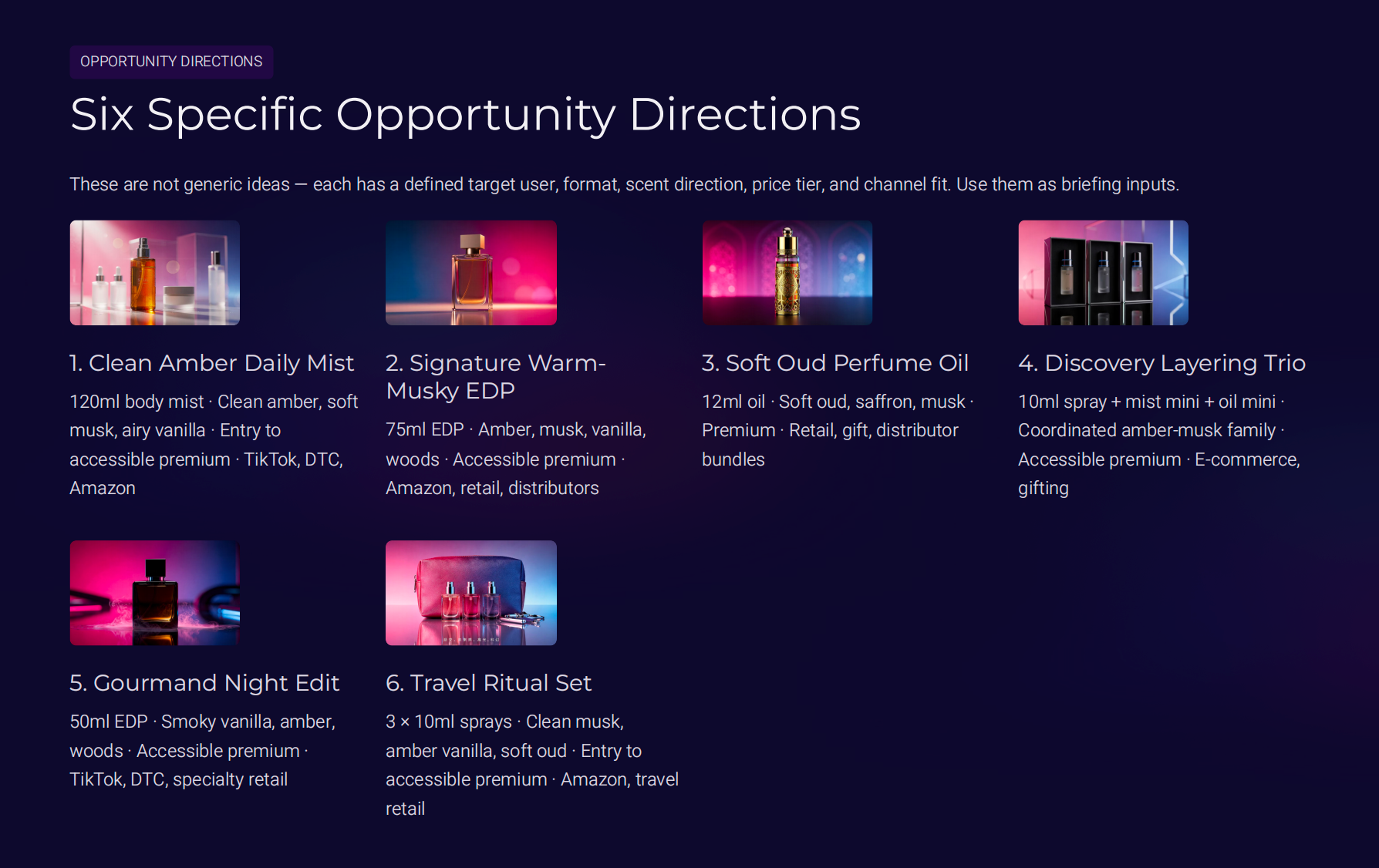
Six Specific Opportunity Directions
Product Architecture: The Right Format Roles
The Middle East gender-neutral fragrance category should be built by format role, not by concentration name alone.
Body Mist
Body mist is the high-frequency entry product. It lowers the barrier to trial, supports daytime use, and works well for social commerce and bundle conversion. In warm climates, it also gives consumers a practical reapplication format.
Eau de Parfum
EDP is the hero format. It carries the line identity, builds gifting credibility, and gives the strongest premium impression in both retail and distributor conversations.
Perfume Oil
Perfume oil is the ritual and margin-enhancing format. It fits regional fragrance habits, adds close-to-skin richness, and works especially well in gift sets and layering bundles.
Discovery and Travel Sets
These formats reduce blind-buy risk, improve online conversion, and give the line more flexibility across gifting, sampling, and digital-first selling.
For most new launches, the strongest opening structure includes:
-
one hero EDP
-
one matching body mist
-
one matching perfume oil
-
one discovery or travel set
That is a much stronger commercial system than launching several unrelated bottles at once.
Price Tier Strategy
A successful Middle East gender-neutral fragrance line should usually cover more than one price role, but it does not need too many disconnected price points.
A practical structure includes:
Go-to-Market Playbook
Entry
This tier works best for body mists, minis, and discovery formats. It is important for traffic, social commerce, and first-time trial.
Accessible Premium
This is often the strongest commercial center for the line. It is where hero EDPs, standard-size mists, and travel-ready formats can offer both reasonable conversion and healthy margins.
Premium
This tier works best for perfume oils, curated gift sets, and higher-touch presentation formats. It helps the brand look more complete and supports gifting and distributor confidence.
The goal is not to look cheap in entry or inaccessible in premium. The goal is to create a ladder that makes sense.
Competitive Whitespace
The market is crowded with premium-looking fragrance products, but fewer brands are building a true unisex, format-led fragrance system.
Common market patterns include:
-
oud-amber-vanilla storytelling
-
Arabian luxury positioning
-
prestige gifting cues
-
inspired scent logic
-
premium packaging without strong format architecture
This means the whitespace is not simply “another luxury fragrance.” The whitespace is:
-
premium-smelling unisex body mist
-
modern clean-musky lines with regional warmth
-
layering kits designed for digital-first selling
-
travel fragrance systems for trial and gifting
-
distributor-friendly 3-format fragrance lines with clear hero, traffic, and profit roles
A new entrant should not try to win by copying the most common scent story. It should win by building a more usable product system.
Channel Strategy
A Middle East gender-neutral fragrance launch should be channel-specific from the start.
TikTok and social commerce
Best formats:
-
body mist
-
travel sprays
-
discovery sets
-
layering kits
These work because they are easy to demonstrate visually, lower in risk for first purchase, and naturally suited to educational content such as how-to-layer routines.
Amazon
Best formats:
-
50ml to 100ml EDP
-
10ml travel sprays
-
giftable bundles
-
discovery sets
These work because shoppers need structured comparisons and lower-risk entry points. Packaging must also hold up in delivery and maintain a premium feel.
Retail and distributors
Best formats:
-
hero EDP
-
matching perfume oil
-
gift set
-
selected mist SKU
These work because simpler line logic is easier to pitch and faster to explain. Gift-ready presentation improves sell-in, and a clear hero product makes line adoption easier.
The strongest strategy is not to push the same SKU mix everywhere. It is to adapt the line by channel role.
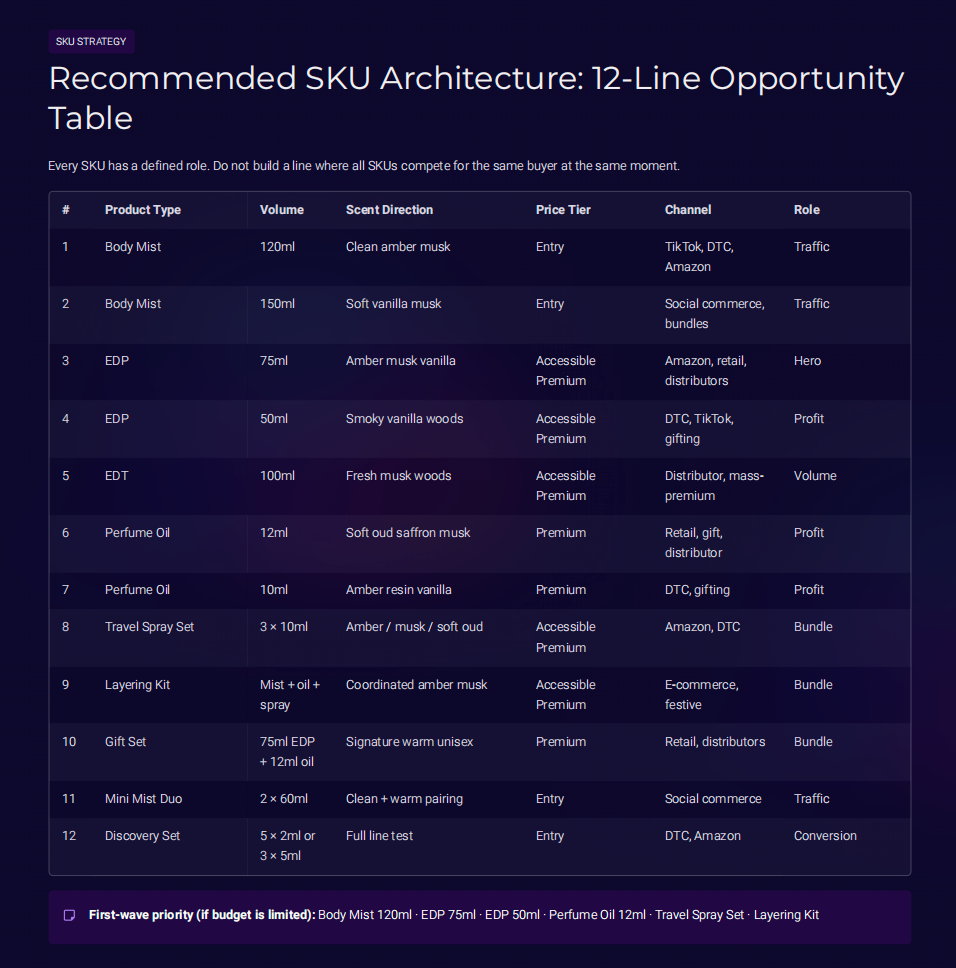
Recommended SKU Architecture: 12-Line Opportunity
Table
Launch Strategy: Recommended First-Wave Assortment
If budget is limited, the most efficient first-wave launch is a focused portfolio rather than a full fragrance wall.
A strong first-wave structure includes:
-
one 120ml body mist
-
one 75ml hero EDP
-
one 50ml supporting EDP
-
one 12ml perfume oil
-
one travel spray set
-
one layering kit
This gives enough coverage for:
-
trial
-
repeat purchase
-
gifting
-
social commerce
-
Amazon conversion
-
distributor pitching
Once a hero scent family is validated, the line can expand through gift sets, mini duos, and seasonal edits.
Compliance and Risk Control
Compliance should be built into the project from the beginning, not added at the end.
For Middle East fragrance projects, the most important priorities include:
-
keeping the product clearly within cosmetic scope
-
reviewing claims to avoid therapeutic or misleading language
-
preparing local-market labeling correctly
-
planning Arabic labeling where required
-
checking IFRA conformity early
-
reviewing allergen implications before artwork finalization
-
validating packaging compatibility
-
testing stability under heat and storage stress
-
checking leakage risk for pumps, caps, rollers, and inserts
-
ensuring batch traceability and shelf-life support
Fragrance projects in this region often fail because of late-stage artwork, packaging, or compatibility issues rather than because of poor scent choice. That is why formula, packaging, labeling, and transport risk should be reviewed together as one approval gate.
Compliance & Risk Checklist
OEM and ODM Execution Logic
For brands working with an OEM or ODM supplier, speed depends on the quality of the brief.
A stronger development brief should define:
-
target country cluster
-
target price tier
-
hero product format
-
supporting formats
-
scent direction
-
packaging preference
-
launch timing
-
channel priority
A practical example:
-
target market: Saudi Arabia and UAE
-
core consumer: premium unisex buyer aged 22–38
-
hero format: 75ml EDP
-
supporting formats: 120ml mist and 12ml oil
-
price tier: accessible premium
-
scent direction: amber musk vanilla with soft oud option
-
packaging: premium stock bottle with custom decoration
-
channel: Amazon, distributor, and DTC
The clearer this brief is, the faster sample development, pricing accuracy, and launch planning become.
OEM/ODM Execution Plan
What Buyers Should Do Next
If you are evaluating a Middle East gender-neutral fragrance launch, the smartest next move is not to request a long list of unrelated scent samples.
Instead:
-
choose one hero scent family
-
define the first 4 to 6 commercially distinct formats
-
align the price ladder early
-
confirm which channel each SKU is meant to serve
-
review formula, packaging, and artwork risk together
-
build a launch plan around a layering system, not a single bottle
That approach creates a stronger assortment, clearer margins, and better long-term repeat purchase potential.
Final Takeaway
The strongest 2026 opportunity in the Middle East is not another isolated perfume launch. It is a premium-smelling, gender-neutral fragrance system designed around layering, gifting, and repeat use.
The brands most likely to win are not the ones offering the most scent names. They are the ones building the clearest commercial architecture: one hero EDP, one high-frequency mist, one ritual oil, one trial format, and one scent family that holds the portfolio together.
If your team is preparing a Middle East fragrance launch, start by aligning market, format, price, and scent architecture first. Then build the right OEM or ODM path around that system.
Download the Full Report (PDF)
Tell us your target region, product category, and the decision you’re trying to make. We’ll suggest the closest existing report—or build a tailored version.