


Executive Summary
This report explores the EU women’s fragrance market in 2026, including growth outlook, scent direction, price tiers, packaging formats, channel strategy, compliance priorities, and OEM launch planning. It is designed to help brands, importers, distributors, and e-commerce sellers turn market insight into a more practical fragrance launch strategy.
EU Women’s Perfume Market 2026: Growth Trends, Price Tiers, and Go-to-Market Guide
The EU women’s fragrance market in 2026 remains one of the most commercially attractive beauty categories for brands that understand how to balance premium positioning, practical pricing, and disciplined launch execution.
This is not a market driven by volume alone. It is a market shaped by premiumisation, gifting, everyday self-purchase, stronger concentration formats, refillable packaging, and discovery-led shopping behavior. For brands, importers, distributors, and e-commerce sellers, the opportunity is not simply to launch another perfume. The opportunity is to build the right product structure for how women in Europe actually discover, trial, gift, and repurchase fragrance.
This report translates EU market signals into a more practical go-to-market plan. It covers growth outlook, consumer demand, scent direction, price tiers, SKU architecture, channel strategy, compliance priorities, and OEM execution planning for brands entering or expanding in the category.
Executive Summary
The EU women’s fragrance market in 2026 should be approached as a resilient, premium-led category rather than a speculative trend play. Consumers continue to spend on fragrance even in more selective retail environments because fragrance remains one of the most emotionally rewarding and giftable beauty purchases.
What is changing is not whether women buy fragrance, but how they buy it. Long-lasting concentrations, elegant but wearable scent stories, refillable systems, travel formats, mini sets, and discovery tools are becoming more commercially important. At the same time, buyers are more selective. A launch without a clear scent story, price logic, and channel fit is much less likely to succeed.
For most new entrants, the strongest path is not to launch a wide assortment immediately. It is to lead with one hero Eau de Parfum, one lower-barrier trial format, and one repeat-driving extension such as a travel size, hair perfume, or body mist.
Market Opportunity Overview
The EU women’s fragrance category is attractive because it combines scale with defensibility. It is large enough to support meaningful brand entry, yet selective enough to reward disciplined positioning.
This is especially important for new or growing brands. The market does not reward vague launches. It rewards products that feel premium enough to justify trial, but still accessible enough to support repeat purchase and channel expansion.
For 2026, the strongest commercial logic sits in the accessible-premium corridor. This is where premium cues, wearable scent direction, and practical pricing can work together without forcing a new brand into ultra-luxury expectations too early.
Market Snapshot: EU Women's
Fragrance Landscape
Why the Category Is Growing
Several structural forces continue to support growth in the EU women’s fragrance market.
The first is premiumisation. Consumers still treat fragrance as an affordable luxury and are willing to spend on products that feel emotionally meaningful and sensorially elevated.
The second is stronger format preference. Eau de Parfum continues to lead commercial relevance because consumers increasingly associate higher concentration with better value, longer wear, and more satisfying performance.
The third is gifting. Women’s fragrance continues to benefit from holiday, seasonal, and occasion-driven purchasing, especially when products are supported by mini sets, travel companions, or premium presentation.
The fourth is discovery behavior. Minis, travel sizes, hair perfume, body extensions, and layered routines help reduce trial barriers and create more entry points into the category.
The fifth is sustainability-linked premium cues. Refillable packaging, material reduction, and repeat-use systems are no longer niche ideas. They are becoming part of mainstream premium fragrance logic.
Regional Market Differences Across the EU
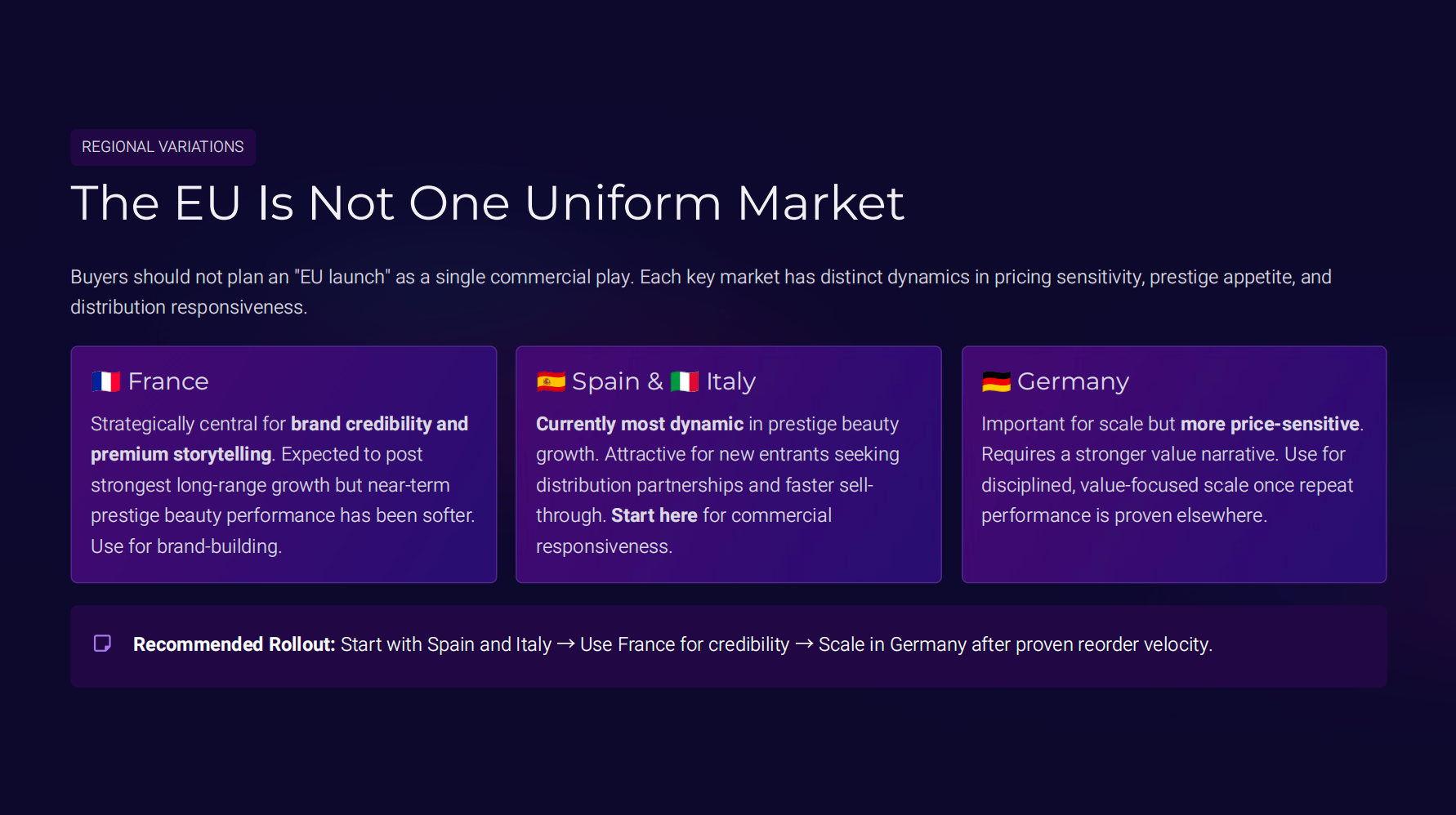
The EU should not be treated as one uniform market.
Spain and Italy currently offer strong commercial responsiveness and can be attractive starting points for distribution and sell-through testing. France remains highly important for premium storytelling and category credibility, even if short-term performance can be more selective. Germany offers meaningful scale, but it usually requires stronger value logic and more disciplined pricing.
This means a smarter 2026 rollout is country-sequenced rather than region-wide from day one.
A more practical launch order is:
-
Spain and Italy for commercial responsiveness
-
France for prestige credibility
-
Germany for disciplined scale after traction is proven
The EU Is Not One Uniform Market
Consumer Demand Signals
The women’s fragrance market in the EU is increasingly shaped by emotional and practical decision-making at the same time.
Consumers are looking for:
-
longer-lasting fragrances
-
feminine scent stories with modern wearability
-
clear use occasions such as daily signature, workday confidence, gifting, or evening elegance
-
formats that lower trial risk
-
premium cues without unnecessary complexity
-
products that feel personal rather than generic
This is why emotionally coded but wearable fragrances are performing better than abstract luxury concepts without clear identity.
The consumer is not simply buying “floral” or “gourmand.” She is buying calm sophistication, modern femininity, everyday luxury, soft sensuality, or polished confidence.
High-Potential Scent Directions for 2026
The strongest fragrance directions for EU women’s launches in 2026 are the ones that feel both emotionally relevant and commercially wearable.
The most promising directions include:
-
modern floral-musk
-
fruity-floral with elegant softness
-
soft gourmand with controlled sweetness
-
warm amber florals
-
musky clean skin scents
-
refined floral-wood compositions
-
elevated comfort scents with smooth, long-lasting dry-down
For new launches, the mistake is trying to smell “interesting” before smelling desirable. The first job of the hero scent is to be immediately understandable and easy to like. Complexity can come later through extensions, premium editions, or layering products.
Product and SKU Strategy
A strong phase-one assortment should be focused rather than broad.
The best commercial structure for many new entrants is:
-
one hero 50 ml Eau de Parfum
-
one lower-barrier 10 ml travel spray or 30 ml EDP
-
one repeat-driving extension such as hair perfume or body mist
-
optional discovery or mini set for sampling and gifting
This structure works because it creates commercial logic without overloading inventory. The hero builds brand identity. The smaller size improves trial. The extension supports repeat purchase and basket-building.
A launch with too many concentrations, too many scent directions, or too many sizes usually creates confusion and slows sell-through.
Category & Product Landscapeqq
Why EDP Should Be the Hero Format
Eau de Parfum is the strongest starting point for most EU women’s fragrance launches in 2026.
It aligns with current consumer expectations around performance, longevity, and value. It also allows brands to position themselves above basic entry-level fragrance without immediately entering niche-luxury price territory.
EDT can work, but usually only when freshness, seasonality, or lower entry pricing is the core concept. Parfum can be highly attractive, but it is usually better introduced after the brand has already established pricing authority.
That is why the strongest format sequence is often:
-
EDP first
-
travel or mini second
-
body or hair extension third
-
Parfum later as a margin or prestige upgrade
Price Tier Strategy
A practical EU women’s fragrance pricing structure for 2026 looks like this:
-
entry / mass-premium for lower-barrier formats
-
accessible premium for hero launches
-
premium designer for stronger brand equity plays
-
niche or luxury for established pricing authority
For most new entrants, the best operating corridor is accessible premium. It offers enough room for perceived quality, acceptable margin, trial conversion, and packaging investment without demanding ultra-luxury brand recognition from day one.
A practical pricing ladder often looks like:
-
10 ml travel spray as entry
-
30 ml or 50 ml EDP as core hero
-
100 ml EDP or premium set as higher-AOV extension
-
body mist or hair perfume as repeat-purchase support
Go-to-Market Playbook
Packaging and Format Trends
Packaging now plays a strategic role, not just a visual one.
The strongest packaging directions include:
-
refillable bottle logic
-
premium-feel glass with restrained decoration
-
travel-friendly formats
-
mini discovery sets
-
elegant gifting structures
-
practical extensions such as hair perfume or body mist
What matters is not only how the product looks on shelf, but how it performs across transport, gifting, e-commerce, and repeat-purchase cycles.
A package that looks premium but leaks, chips, or travels poorly is not commercially strong. Premium feel and operational usability now have to work together.
Competitive White Space
The most attractive white space is not at the very lowest price band and not at ultra-luxury launch pricing.
The strongest opportunity for many new brands is:
-
accessible-premium feminine EDP
-
modern floral-musk or fruity-floral profile
-
premium-feel packaging
-
visible longevity story
-
travel or mini companion format
-
extension path through hair perfume, body mist, or refill system
This space is commercially attractive because it combines premium aspiration with better conversion potential and more flexible launch economics.
Channel Strategy
A new EU women’s fragrance launch should be channel-aware from the beginning.
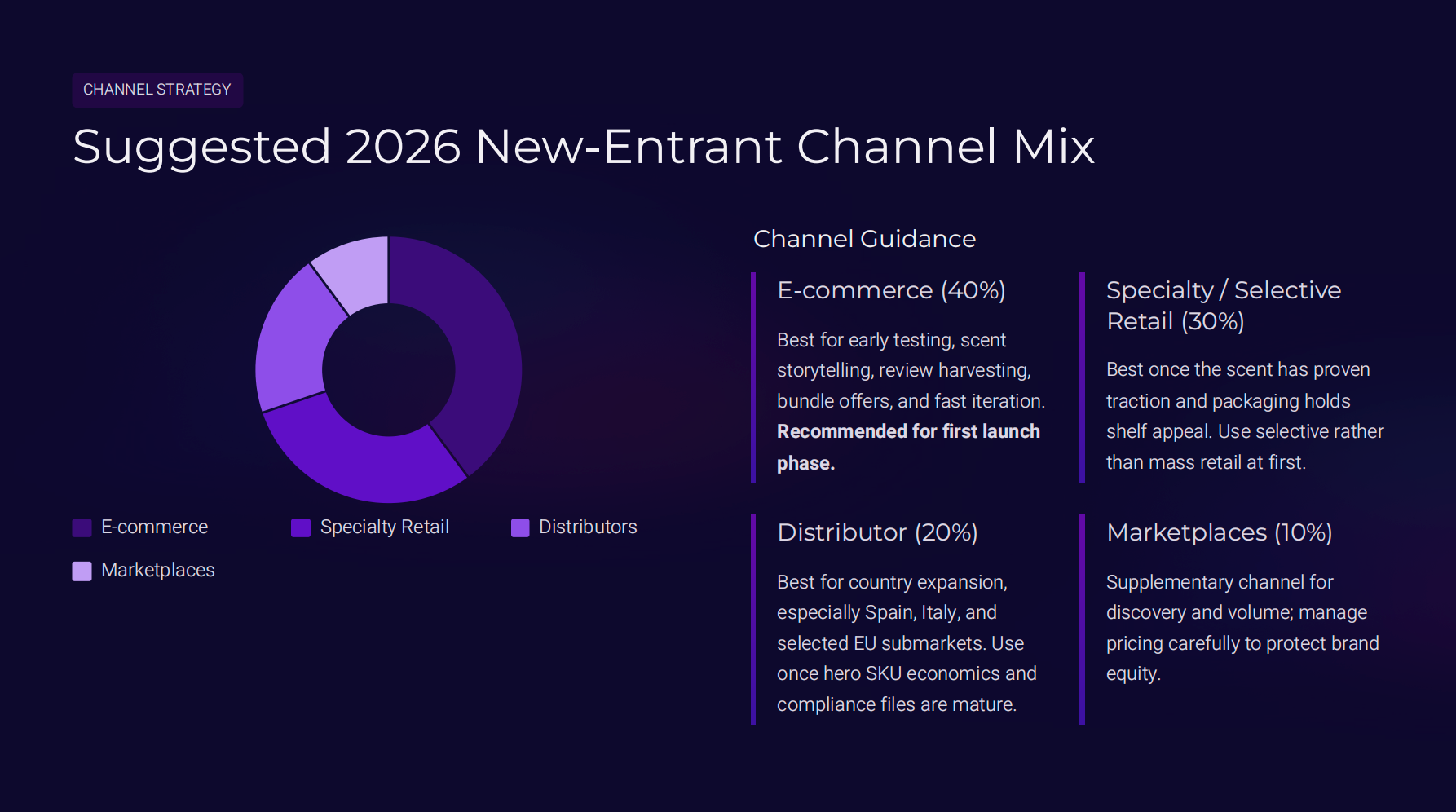
For e-commerce, the strongest advantages are faster testing, stronger storytelling, better review capture, and easier bundle building. Discovery formats, travel sprays, and giftable sets perform especially well here.
For selective retail and specialty channels, the product must justify physical presence through packaging quality, clear scent identity, and better shelf readability.
For distributors, the opportunity grows once the hero SKU, price logic, and compliance files are already mature enough to support expansion.
The smartest model for many brands is:
-
digital-first launch
-
selective offline reinforcement
-
distributor expansion after proof of traction
Suggested 2026 New-Entrant Channel Mix
Compliance and Quality Priorities
EU fragrance launches require compliance to run in parallel with product development, not after it.
The core priorities include:
-
responsible person readiness
-
product information file planning
-
safety assessment and notification workflow
-
labeling accuracy
-
allergen review before artwork finalization
-
IFRA category suitability
-
packaging compatibility
-
pump and spray performance
-
transit and stability validation
A common mistake is approving fragrance and packaging first, then trying to solve compliance and artwork at the end. That usually creates delays, extra revisions, and unnecessary launch risk.
For 2026 projects, development, compliance, and packaging engineering should move together.
OEM Execution Strategy
The best OEM projects start with a better brief.
A stronger client brief should define:
-
target market
-
target consumer
-
scent direction
-
format
-
target retail price
-
channel plan
-
packaging direction
-
launch timeline
-
expected documentation
-
order model
-
whether the priority is speed, low-risk testing, or stronger differentiation
The clearer these inputs are, the easier it becomes for the manufacturer to quote accurately, sample effectively, and reduce wasted revision rounds.
For women’s fragrance in the EU, the best OEM partners do more than filling. They help align fragrance direction, pack structure, compliance timing, and launch sequence.
OEM / Product Development
Execution Plan
What Buyers Should Do Next
If you are planning a women’s fragrance launch for the EU market, the strongest next step is not to ask for a generic floral sample.
Instead:
-
define the country priority first
-
choose the hero scent story
-
select the hero format
-
set the retail corridor
-
decide whether travel, mini, or body extension will support trial
-
run compliance planning early
-
launch with a lean SKU system instead of a broad assortment
This will improve quoting accuracy, accelerate development, and create a far more usable phase-one portfolio.
Final Takeaway
The EU women’s fragrance market in 2026 is attractive because it rewards disciplined positioning rather than random trend-following.
The brands most likely to win are not the ones with the most SKUs or the most elaborate bottle. They are the ones with the clearest scent story, the right accessible-premium price logic, a strong hero EDP, lower-risk trial formats, and compliance-ready execution.
The best opportunities sit where premium feel, practical pricing, and structured launch execution meet.
Download the Full Report (PDF)
Tell us your target region, product category, and the decision you’re trying to make. We’ll suggest the closest existing report—or build a tailored version.