


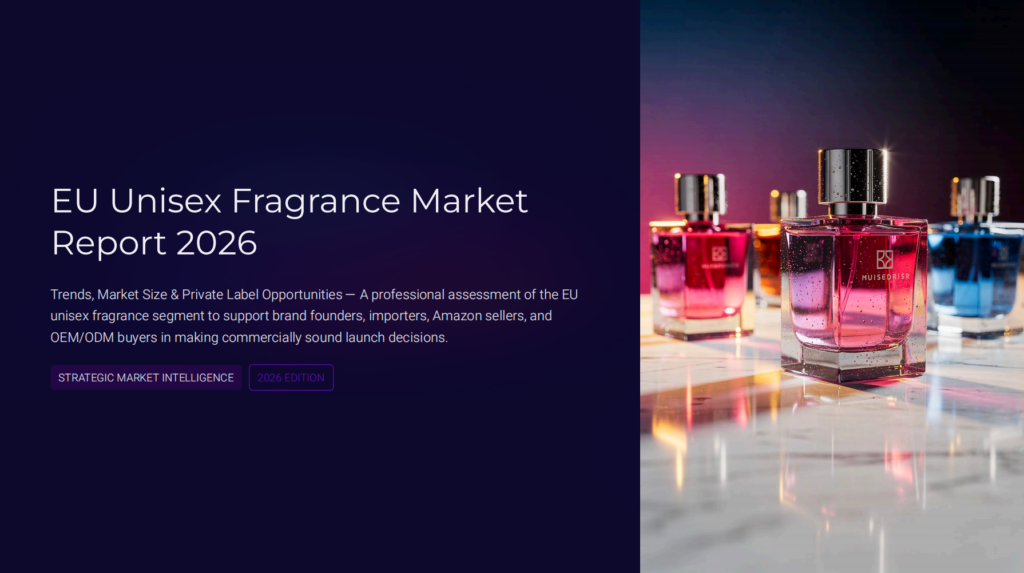
Executive Summary
This report explores the EU unisex fragrance market in 2026, including market size, consumer demand signals, scent directions, format strategy, price tiers, compliance priorities, and private label launch planning. It is designed to help brands, importers, distributors, and e-commerce sellers turn market insight into a more practical fragrance launch strategy.
EU Unisex Fragrance Market 2026: Trends, Size, and Private Label Launch Strategy
The EU unisex fragrance market in 2026 is no longer a niche category built on concept alone. It is becoming a commercially meaningful segment shaped by premiumisation, discovery-led shopping, travel-friendly formats, body mist premiumisation, and identity-led fragrance consumption.
For brands, importers, distributors, private label buyers, and e-commerce sellers, the opportunity is not simply to label a perfume as unisex. The real opportunity is to build a product system that fits how modern consumers actually shop for fragrance: they sample before committing, rotate scents more often, buy for mood and occasion, and expect packaging and pricing to work across Amazon, DTC, retail, and gifting.
This report turns those market signals into launch logic. It covers the EU unisex fragrance opportunity, key consumer demand patterns, format and price strategy, channel fit, compliance priorities, and a practical private label roadmap for bringing a fragrance concept to market.
Executive Summary
The EU unisex fragrance market is entering a more commercially mature stage in 2026. It is no longer driven only by trend-led inclusivity messaging. It is increasingly supported by broader shifts in fragrance buying behavior: premium concentration demand, smaller format conversion, mood-based scent selection, discovery kits, and multi-scent wardrobes.
That makes unisex fragrance especially attractive for modern launches. A well-positioned unisex line can serve broader audiences, simplify gifting, reduce overdependence on traditional “for him” and “for her” category structures, and perform well across both online and offline channels.
For most new entrants, the best launch path is not one hero 100ml bottle alone. It is a three-tier structure: a discovery or trial format, a core 30ml or 50ml EDP, and a routine extension such as a body mist or layering companion. This lowers risk while matching how consumers now discover and adopt fragrance.
Market Opportunity Overview
The broader EU fragrance market remains structurally healthy, premium-oriented, and resilient. Within that environment, unisex fragrance is benefiting from a clear cultural and commercial shift: consumers increasingly buy scent based on mood, identity, note family, and occasion rather than strict masculine or feminine coding.
This matters because it changes how fragrance should be developed and sold. Buyers are no longer choosing only between traditional men’s and women’s lines. They are increasingly looking for fragrances that feel more versatile, easier to gift, more modern in image, and more adaptable to daily routines.
For private label buyers, this creates a meaningful opening. Unisex fragrance is not just a branding angle. It is a portfolio strategy that can support premium positioning, simpler assortment planning, cleaner merchandising, and broader customer reach.
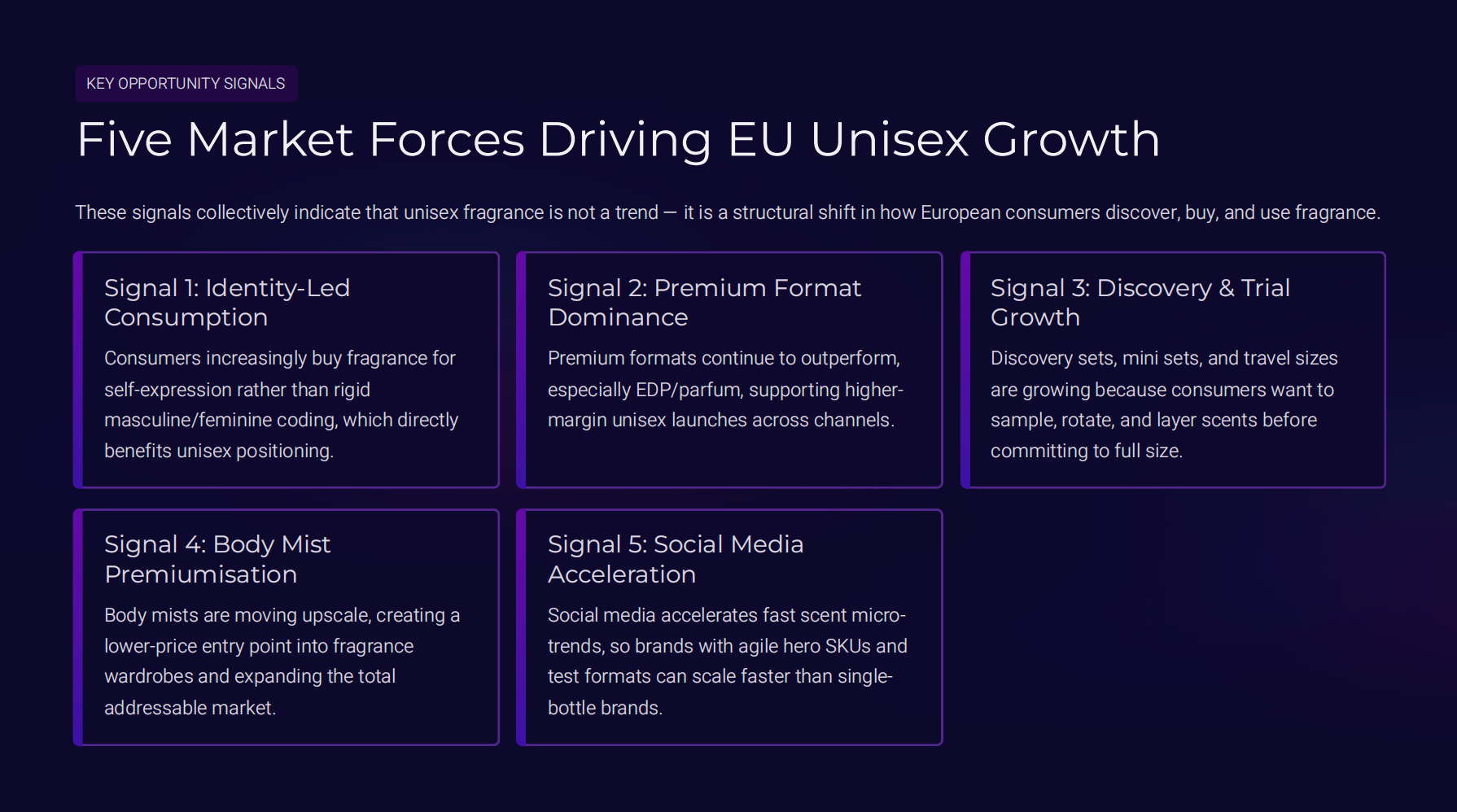
Five Market Forces Driving EU Unisex Growth
What Is Driving Demand in 2026
Several structural shifts are helping the category grow.
The first is self-expression. Consumers increasingly want fragrance to reflect personality and mood rather than gender coding.
The second is discovery-led shopping. Many buyers prefer to try before they commit, especially in online channels where scent cannot be tested directly.
The third is format diversification. Travel sprays, discovery kits, mini sets, and premium body mists are giving brands more ways to capture entry-level trial and repeat use.
The fourth is fragrance wardrobe behavior. Consumers are less likely to rely on one signature scent only. Instead, they rotate between fragrances for work, travel, social occasions, gifting, or layering.
This means the real product opportunity is not just in the juice. It is in how the scent is structured into formats, price points, and use cases.
Consumer Demand Signals
Unisex fragrance is gaining traction because it aligns with how modern consumers want to buy and use fragrance.
Typical demand patterns include:
-
easier gifting
-
more versatile daily wear
-
mood-based selection
-
layering and scent rotation
-
lower-risk entry through minis and travel sizes
-
premium but accessible indulgence
Different buyer groups approach the category differently. Gen Z is more likely to start with discovery and portable formats. Millennials are more likely to seek a polished everyday EDP that works from workday to weekend. Niche buyers are looking for more distinctive note structures and stronger storytelling. E-commerce buyers often need clearer value, lower risk, and more review-friendly formats.
For brands, the most useful takeaway is simple: unisex does not sell because it is neutral. It sells because it feels useful, modern, giftable, and easier to integrate into real routines.
Consumer & Demand Signals
Scent Directions with the Strongest Commercial Potential
The strongest unisex fragrance launches in 2026 are not built around vague “clean” claims alone. They are built around scent directions that feel wearable, distinctive, and commercially flexible.
The most useful scent territories include:
-
citrus woods
-
tea musk
-
skin scents
-
green aromatic blends
-
mineral amber
-
fig leaf and iris wood
-
soft spice woods
These directions work because they can be positioned by mood and occasion rather than by gender stereotype. They are also easier to build into product systems that include hero EDPs, travel sprays, discovery kits, and layering formats.
As a first launch, it is usually better to avoid highly polarising oud-heavy concepts, overly dessert-led gourmands, or abstract avant-garde compositions unless the brand already has strong niche equity.
Price and Format Strategy
One of the clearest truths in the category is that format strategy matters almost as much as scent direction.
A practical market ladder often looks like this:
-
entry through premium body mist, discovery, or travel
-
core conversion through 30ml or 50ml EDP
-
gifting and basket-building through duos, mini sets, or layering systems
-
premium upsell through flagship 50ml hero or giftable duo
This works because consumers want different levels of commitment. Not every customer is ready for a full-size first purchase. Many need a lower-risk trial path before they convert.
A strong unisex fragrance line is therefore not one SKU. It is a structured system where each format has a clear role:
-
discovery creates trial
-
travel supports portability and gifting
-
30ml or 50ml creates conversion
-
layering or mist extends routine and repeat use
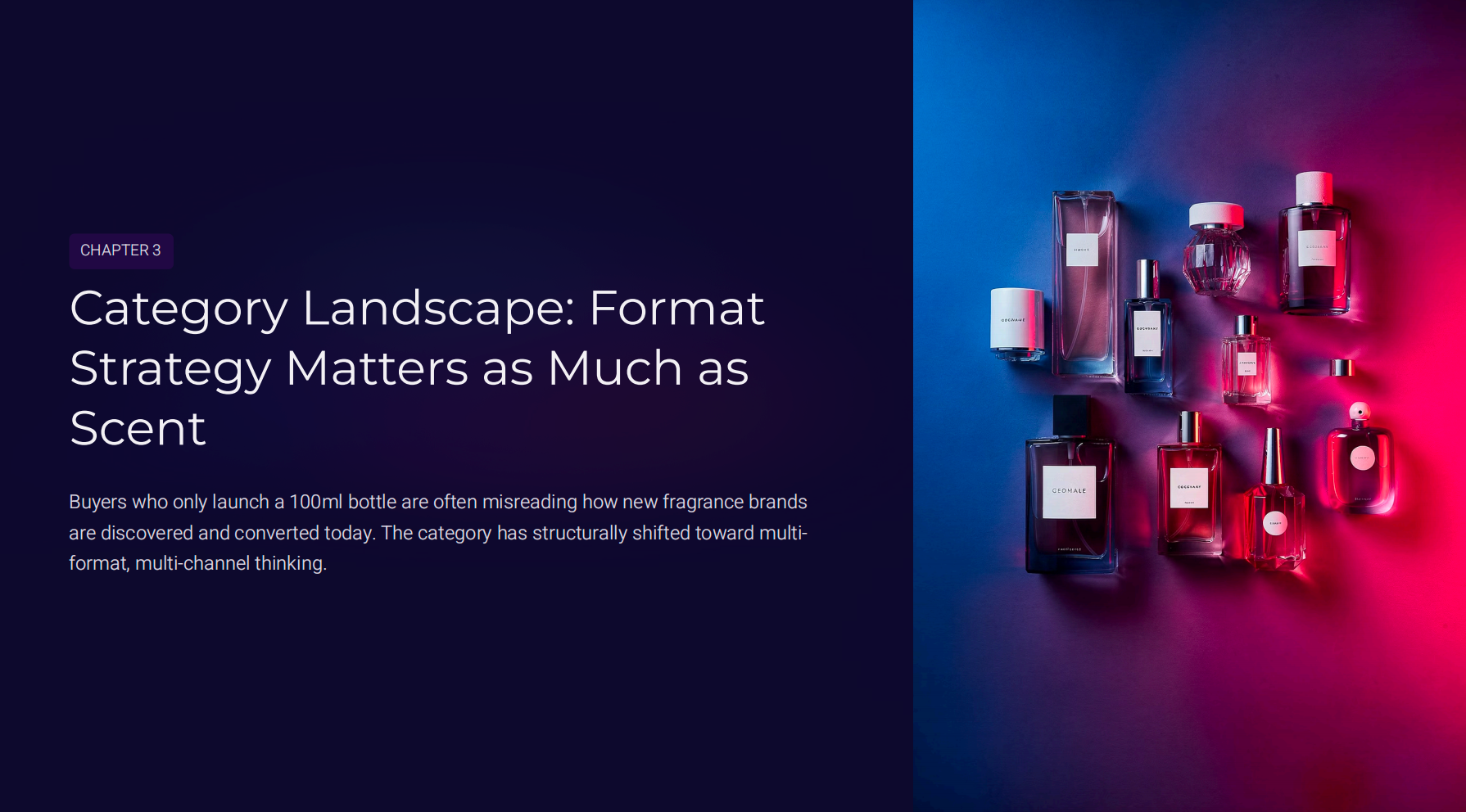
Category Landscape: Format
Strategy Matters as Much as
Scent
Why 30ml, 50ml, and Discovery Sets Matter
New fragrance brands are often discovered through smaller formats, not through full-size bottles alone.
That is why the strongest EU unisex launches in 2026 are likely to prioritize:
-
30ml EDP
-
50ml hero EDP
-
10ml travel spray
-
5 x 2ml discovery set
-
3 x 10ml giftable mini set
-
premium body mist as accessible entry
These formats reduce blind-buy friction, support multiple channels, and make the brand easier to merchandise across gifting, travel, and online-first conversion.
For private label buyers, this also creates operational advantages. One core scent can be extended across multiple formats without needing a broad and risky scent lineup from the beginning.
Packaging and Positioning
Winning unisex fragrance packaging is not bland. It is non-polarised but still distinctive.
Useful packaging principles include:
-
minimalist but premium structure
-
emotionally clear scent naming
-
soft-neutral or modern tonal color systems
-
premium materials without over-decoration
-
travel-friendly secondary packs
-
gifting-ready bundles
-
clean layout that works online and on shelf
The goal is not to remove identity. The goal is to avoid over-coded masculinity or femininity while still creating a memorable presence.
This is especially important for private label brands, because packaging often does as much work as the fragrance story in building initial trust and conversion.
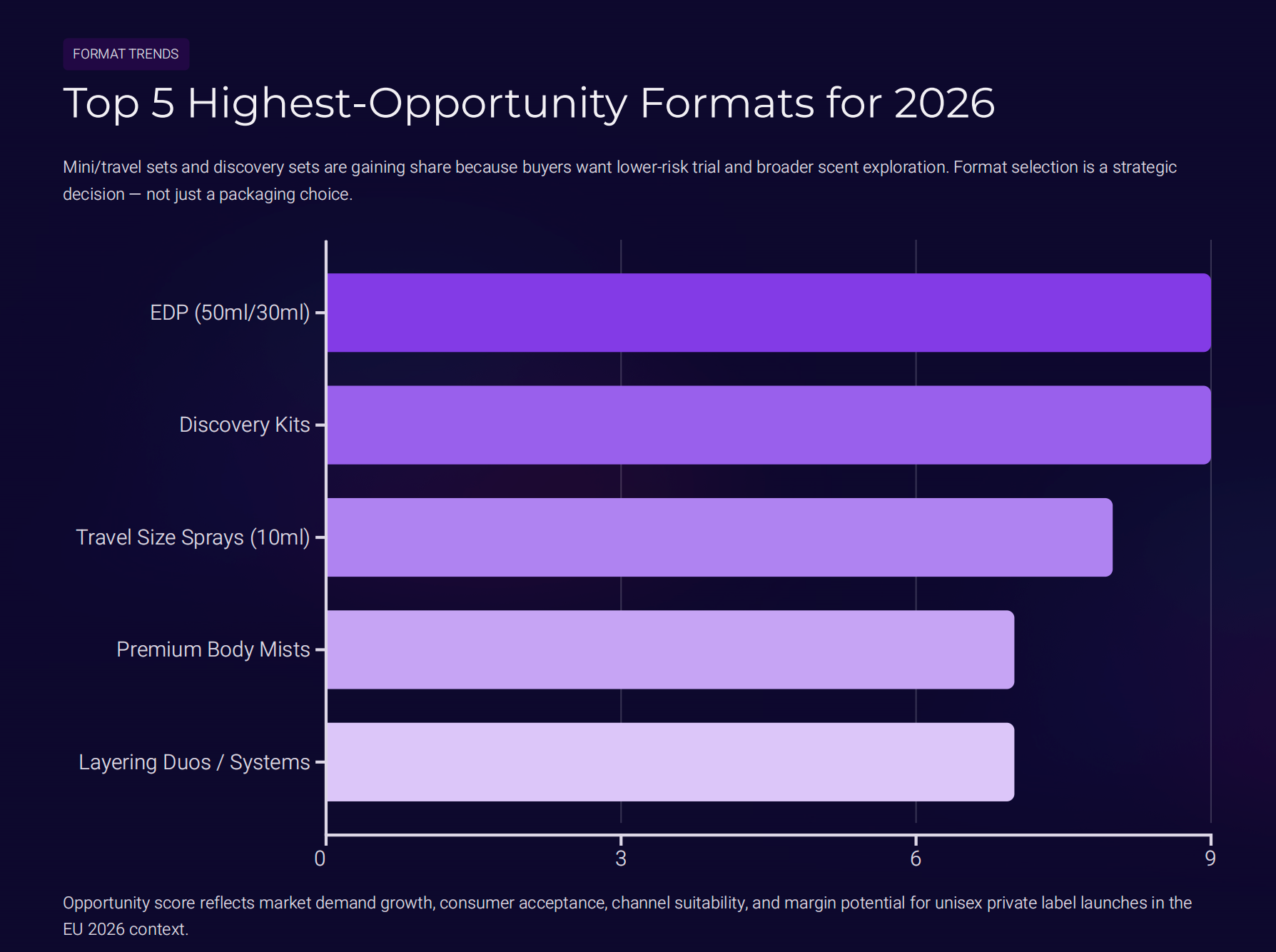
Top 5 Highest-Opportunity Formats for 2026
Channel Strategy
A strong unisex fragrance launch should be built for channel fit from the start.
For Amazon, the strongest entry points are usually 30ml EDPs, travel sprays, discovery sets, and premium body mists. These reduce blind-buy risk and give shoppers clearer value.
For DTC, 50ml hero EDPs, layering duos, discovery plus voucher formats, and seasonal drops are often more effective because they support storytelling, bundling, and data capture.
For retail, the hero 50ml bottle, mini gift sets, and polished premium duos usually work better because shelf presence and gifting logic matter more.
For distributors and importers, the most scalable route is often a proven hero SKU supported by a small number of set formats that make regional rollout easier.
The strongest launch plans do not push one identical assortment everywhere. They align product mix with the way each channel converts.
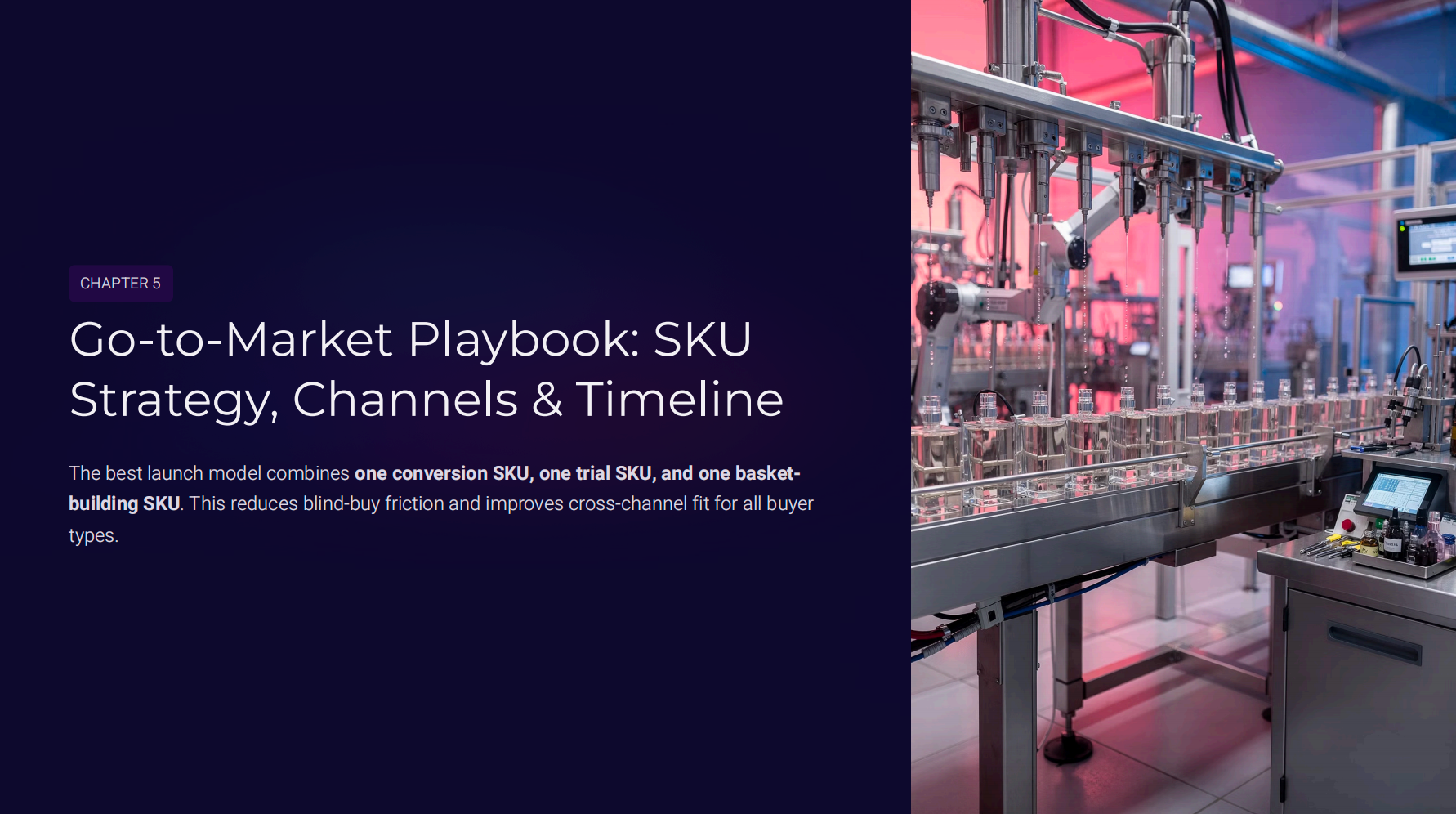
Go-to-Market Playbook: SKU
Strategy, Channels & Timeline
Compliance and Quality Priorities
Compliance in the EU fragrance market is not a later-stage detail. It directly affects launch timing, label design, formula approval, and private label execution.
Key priorities include:
-
IFRA conformity for the intended use category
-
fragrance allergen declaration readiness
-
Responsible Person setup
-
Product Information File preparation
-
CPSR completion
-
CPNP notification before market placement
-
label accuracy and ingredient alignment
-
packaging compatibility with alcohol systems
-
stability and transport readiness
-
claims wording that can be defended
One of the most common problems in fragrance projects is that the scent is approved first, but the formula, packaging, and compliance workflow are not aligned early enough. That leads to artwork changes, delays, reprints, and unnecessary cost.
The safest strategy is to lock formula, concentration, and packaging compatibility before final artwork approval.
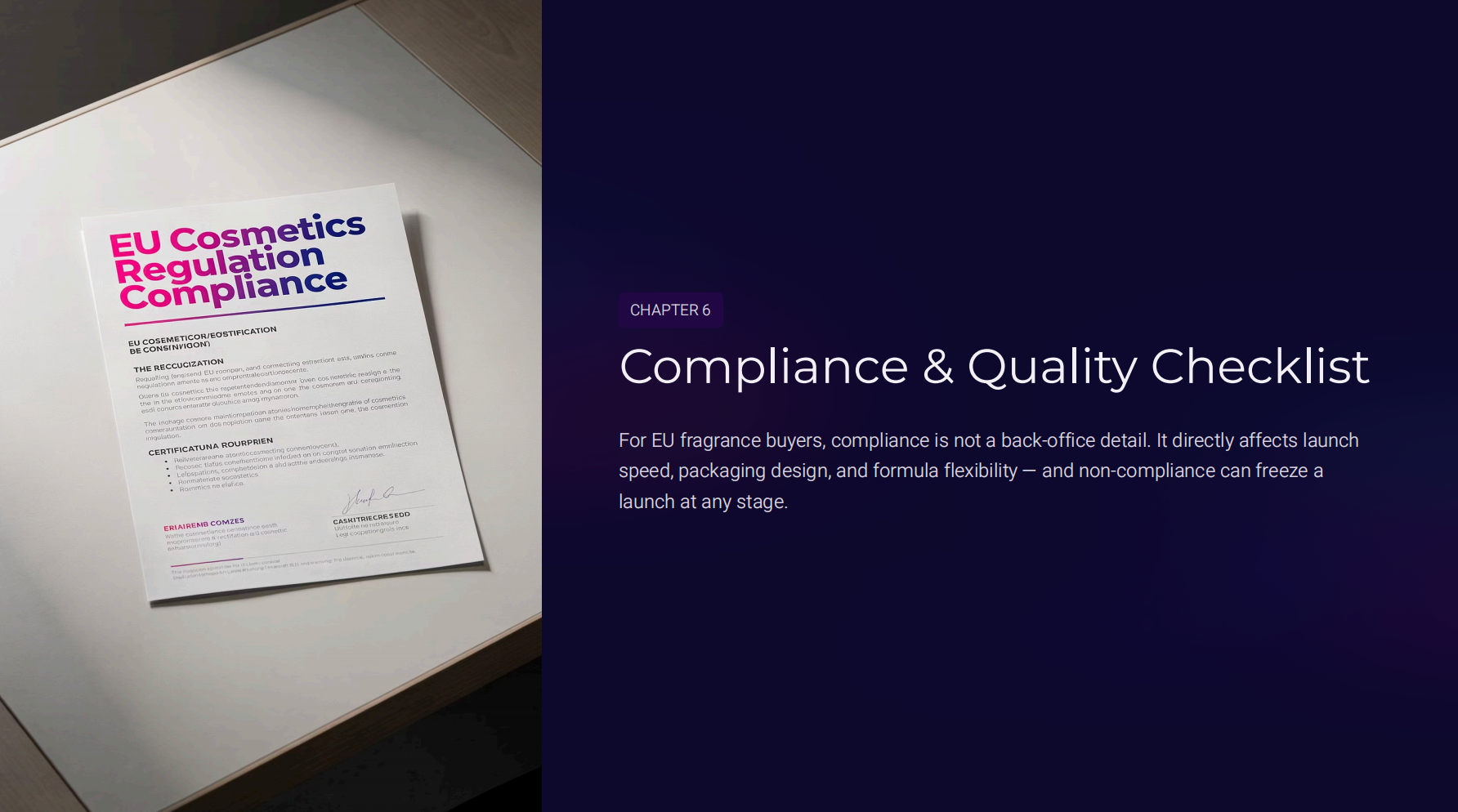
Compliance & Quality Checklist
Private Label and OEM Launch Strategy
For private label buyers, the most important question is not whether a fragrance can be made. It is whether it can be made at the right MOQ, compliance level, channel fit, and launch timing.
A stronger launch brief should include:
-
target EU countries
-
target channel
-
retail price tier
-
preferred format and size
-
scent direction or benchmark references
-
expected volume
-
packaging preference
-
launch timing
-
compliance ownership plan
-
required documents
-
gifting or seasonal priorities
For most first-time projects, the smartest approach is not to launch multiple scents across too many formats. It is to start with one core scent and extend it into a small, well-structured format system.
A strong private label entry model often looks like this:
-
discovery set first
-
30ml conversion SKU second
-
50ml flagship SKU third
This validation-first model reduces risk and gives brands better visibility into scent-market fit before they commit to broader inventory.

OEM / ODM Execution Plan
What Brands Should Do Next
If you are evaluating a unisex fragrance launch for the EU market, the smartest next step is not to ask for one random perfume sample.
Instead:
-
choose the target market and channel first
-
define the price tier
-
set the hero format
-
select a clear scent territory
-
decide the trial path
-
align compliance before final artwork
-
build one scent across multiple formats before expanding the range
This creates a much stronger path to quotation, sampling, production, and launch.
Final Takeaway
The EU unisex fragrance market in 2026 is attractive because it fits how fragrance is now bought and used: through discovery, mood-based selection, travel-friendly formats, layering, gifting, and identity-led consumption.
The brands most likely to win are not the ones using “unisex” as a label only. They are the ones building a disciplined commercial system: one clear scent identity, one low-risk trial path, one strong conversion format, premium but accessible packaging, and compliance planning from day one.
If your team is planning a private label unisex fragrance project for the EU market, the strongest next step is to align target market, format, price tier, and scent direction first, then move into development with a much clearer brief.
Download the Full Report (PDF)
Tell us your target region, product category, and the decision you’re trying to make. We’ll suggest the closest existing report—or build a tailored version.