


Executive Summary
This report explores the EU sensual fragrance market in 2026, including market direction, unisex demand, top sensual scent profiles, price strategy, discovery formats, compliance priorities, and private label launch planning. It is designed to help brands, importers, distributors, and e-commerce sellers turn market insight into a more practical fragrance launch strategy.
EU Sensual Fragrance Market Report 2026: Trends, Size & Private Label Opportunities
The EU sensual fragrance market in 2026 is becoming one of the most commercially attractive sub-segments in fragrance for private label brands. It is no longer defined by overt “sexy perfume” positioning alone. Today, the category is driven by identity, intimacy, confidence, layering, nightlife, and emotionally expressive scent storytelling.
For brands, importers, distributors, and e-commerce sellers, this creates a meaningful opportunity. Consumers are actively looking for fragrances that feel more personal, more gender-fluid, and more emotionally resonant than traditional designer launches. At the same time, private label manufacturing now makes it easier to bring these concepts to market with faster development cycles, more flexible packaging, and more accessible entry costs.
This report translates the EU sensual fragrance opportunity into practical launch logic. It covers market direction, demand drivers, scent profile trends, price tiers, private label opportunity areas, compliance priorities, and a more actionable go-to-market path for 2026.
Executive Summary
The EU sensual fragrance market is moving into a stronger growth phase, supported by changing consumer attitudes toward intimacy, self-expression, and gender-neutral fragrance use. Sensual fragrance is no longer limited to designer-style “date night” scents. It is becoming a broader category shaped by mood, memory, confidence, softness, warmth, and identity.
This creates a strong opening for private label brands. In many cases, emotional relevance and product clarity matter more than heritage branding. That makes sensual fragrance one of the most accessible white spaces for companies that can combine niche-inspired scent directions with flexible pricing, discovery-led formats, and modern packaging.
For most new entrants, the most practical route is not to launch a large portfolio at once. It is to begin with a focused assortment built around hero sensual directions such as amber-vanilla, musk skin scents, and oud-led evening fragrances, supported by a discovery set and a channel-ready format strategy.
Market Opportunity Overview
The EU sensual fragrance category is increasingly distinct from the broader fragrance market because consumers are approaching it with a different mindset. They are not only buying for attraction or nightlife. They are buying for self-possession, emotional atmosphere, intimacy, and identity.
This matters because the category rewards positioning depth. A generic “seductive fragrance” is no longer enough. Consumers now respond better to concepts such as quiet confidence, skin closeness, warm mystery, soft projection, or emotionally memorable scent signatures.
Niche and indie fragrance brands have helped create this shift by pushing originality, concentration, and storytelling quality. That has opened a gap in the market for private label brands that can deliver similar emotional and olfactory direction at more accessible price points and with faster execution.
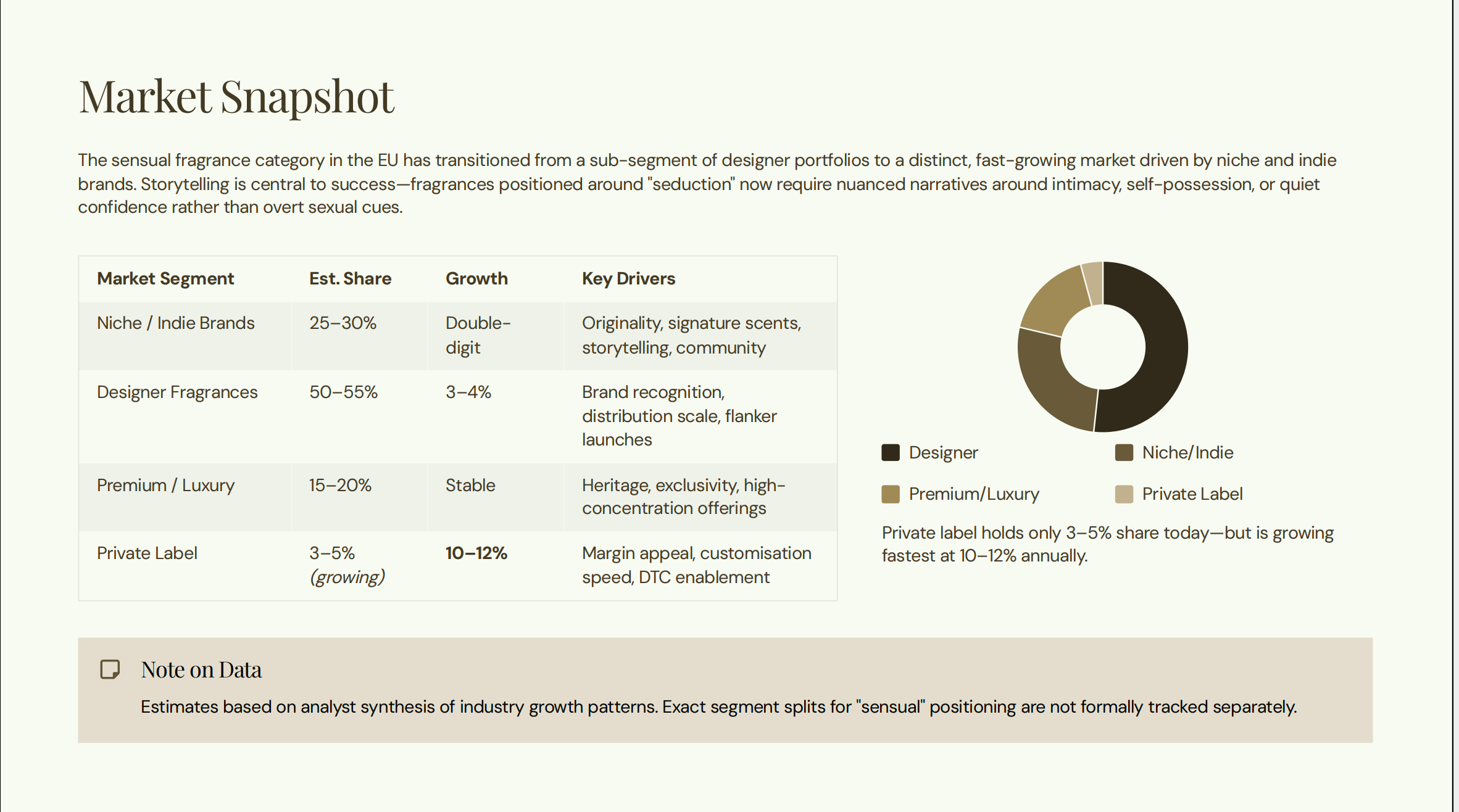
Market Snapshot
What Is Driving Demand
Several structural drivers are supporting growth in the EU sensual fragrance space.
The first is the rejection of rigid gender fragrance codes. In this segment, unisex positioning is increasingly expected rather than experimental.
The second is the rise of layering. Consumers are building their own fragrance identity by combining scents, which increases demand for musk, skin scents, vanilla-amber bases, and discovery-led trial formats.
The third is social discovery. Platforms such as TikTok and fragrance communities have made sensual scent language more visible, especially around themes like projection, intimacy, compliment value, and signature-scent culture.
The fourth is emotional and wellbeing alignment. Consumers increasingly want fragrance to do more than smell good. They want it to support mood, self-awareness, confidence, and ritual.
The result is a market where emotional clarity matters as much as fragrance composition.
Consumer Demand Signals
The most commercially useful demand signals point to a few clear behaviors.
Consumers are responding strongly to:
-
unisex sensual fragrance positioning
-
warm amber and vanilla signatures
-
musk-led skin scents
-
oud, leather, and incense for evening wear
-
discovery sets that reduce blind-buy risk
-
layered storytelling built around confidence, closeness, and identity
-
packaging that feels modern, tactile, and socially shareable
This is important because sensual fragrance in Europe is not being bought only for one occasion. It is being integrated into daily routines, social environments, gifting, and personal experimentation.
That means the category should be built as a scent experience system rather than as one dramatic hero bottle alone.
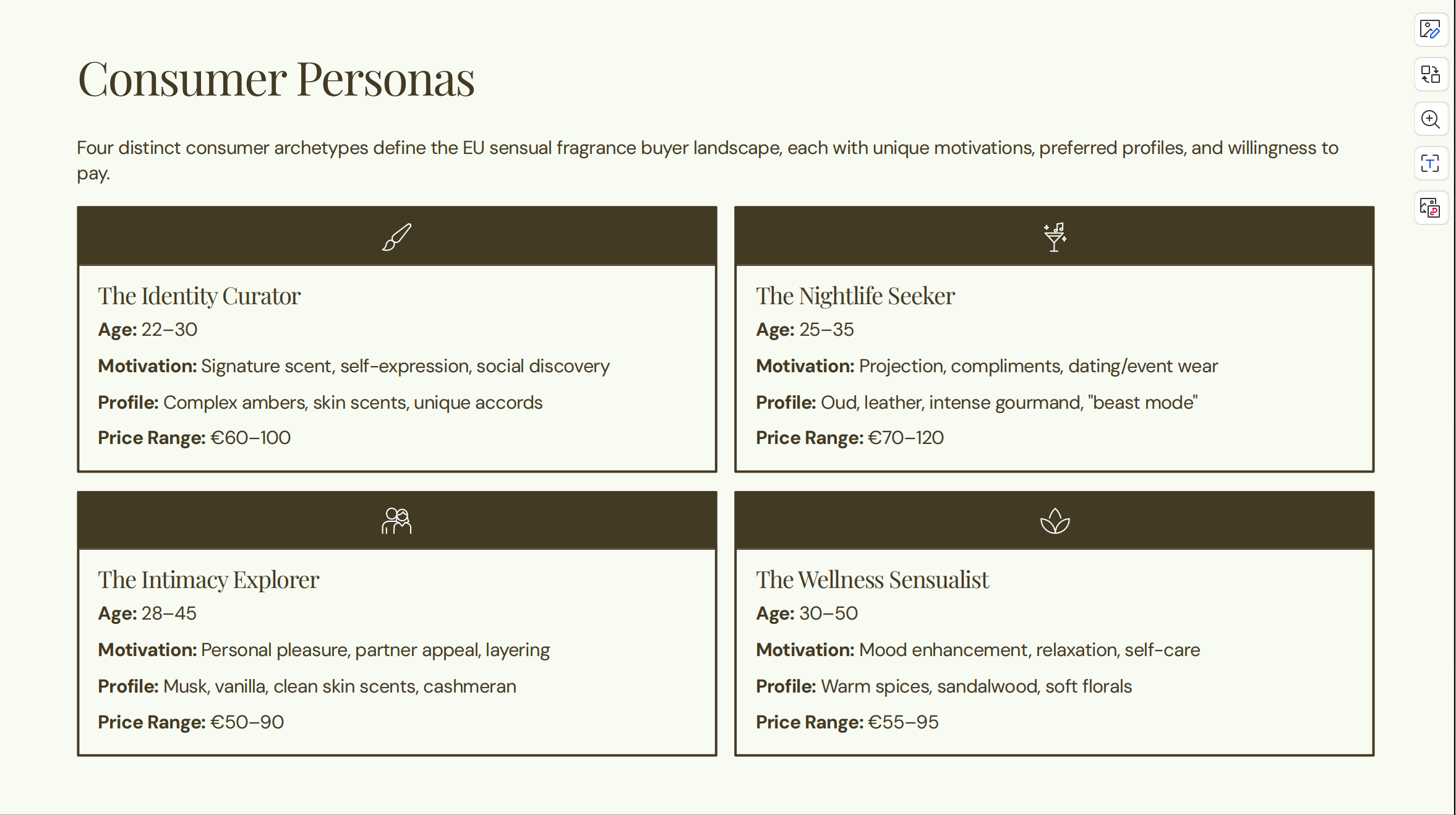
Consumer Personas
The Scent Profiles with the Strongest Commercial Potential
The strongest sensual fragrance profiles in the EU market combine warmth, recognisability, and emotional flexibility.
The most commercially attractive directions include:
-
amber and vanilla sensual blends
-
white musk and skin-scent compositions
-
oud with rose, leather, or vanilla accents
-
tobacco-vanilla or smoky gourmand profiles
-
incense and resin-based warm signatures
-
suede and saffron for tactile evening sophistication
-
salted musk and airy sensual freshness
-
gender-fluid woody amber blends
For most private label launches, the best approach is to combine one broader-appeal hero scent with one darker or more statement-making profile. This gives the brand a clearer assortment structure and helps serve both daytime and evening fragrance needs.
Why Unisex Positioning Matters
In the EU sensual fragrance segment, strict masculine or feminine coding is becoming less useful. Consumers increasingly choose these fragrances based on emotion, atmosphere, and note profile rather than traditional gender labels.
That makes unisex presentation one of the strongest strategic decisions for 2026. It expands the addressable audience, simplifies gifting, and aligns with how consumers already browse niche and premium fragrance content online.
The goal is not to erase identity. The goal is to create fragrance stories that feel open, modern, and personally interpretable. This is especially effective in sensual fragrance, where the emotional projection of the scent often matters more than category labels.
Price Tier Strategy
The EU sensual fragrance market works across multiple price levels, but the most commercially attractive opportunity for many new entrants sits in the accessible mid-tier.
Entry-level products can drive sampling and trial, but they often struggle to communicate depth and premium sensuality. Luxury products can deliver strong margins, but require a higher level of brand authority and distribution support. Mid-tier products offer a more balanced route because they allow better scent quality, better packaging, and stronger storytelling without requiring ultra-premium positioning from day one.
A practical pricing ladder often includes:
-
entry point through discovery set or mini format
-
core hero through a mid-tier 50ml sensual fragrance
-
premium expression through extrait, oud-led, or special-edition profile
-
seasonal or gifting format for Q4 or romance-led occasions
This structure makes the line easier to merchandise across DTC, selective retail, and online channels.
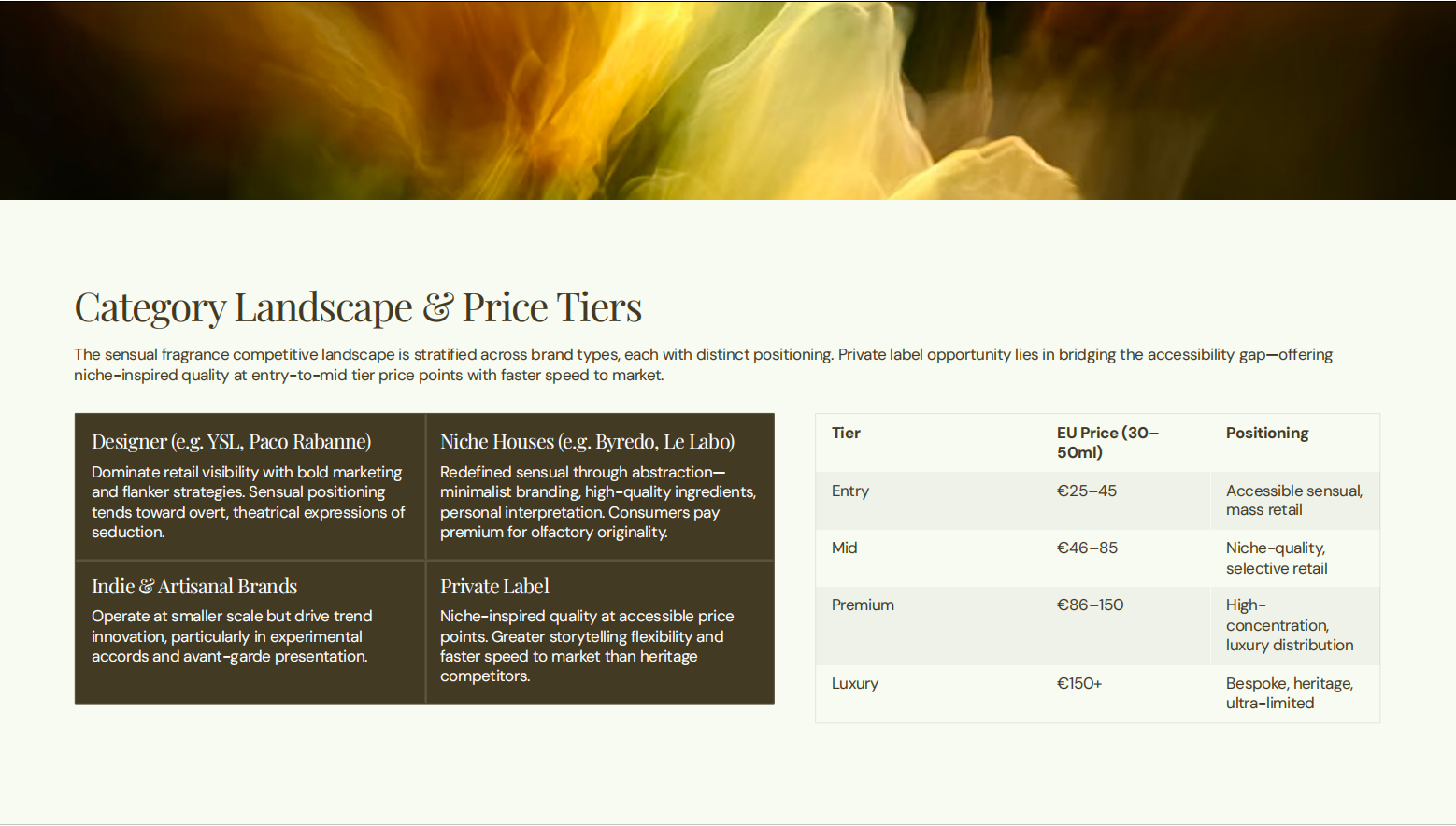
Category Landscape & Price Tiers
Discovery Sets and Bundle Strategy
Discovery sets are one of the most effective entry tools in this category. Sensual fragrance is highly personal, and many consumers hesitate before committing to a full bottle.
A discovery-led strategy helps solve that problem. It reduces risk, encourages layering, increases interaction with the scent range, and creates a more natural bridge to full-size conversion.
A strong launch system may include:
-
two or three permanent hero scents
-
one discovery set with smaller vials
-
one travel format or mini bundle
-
one pairing or layering duo
-
one limited or seasonal sensual edition
This not only improves trial, but also helps brands tell a stronger emotional story across the collection.
Competitive White Space for Private Label
The private label opportunity in this market is especially strong because many established players are either too theatrical, too heritage-driven, or too premium-priced for newer consumers.
That leaves a clear white space for brands that can offer:
-
niche-inspired scent quality
-
unisex and emotionally intelligent positioning
-
tactile premium packaging
-
accessible mid-tier pricing
-
flexible discovery and gifting formats
-
faster launch timelines
-
stronger storytelling control
This is where private label has a real advantage. It allows new entrants to move faster, test concepts earlier, and refine assortment strategy without needing legacy brand infrastructure.
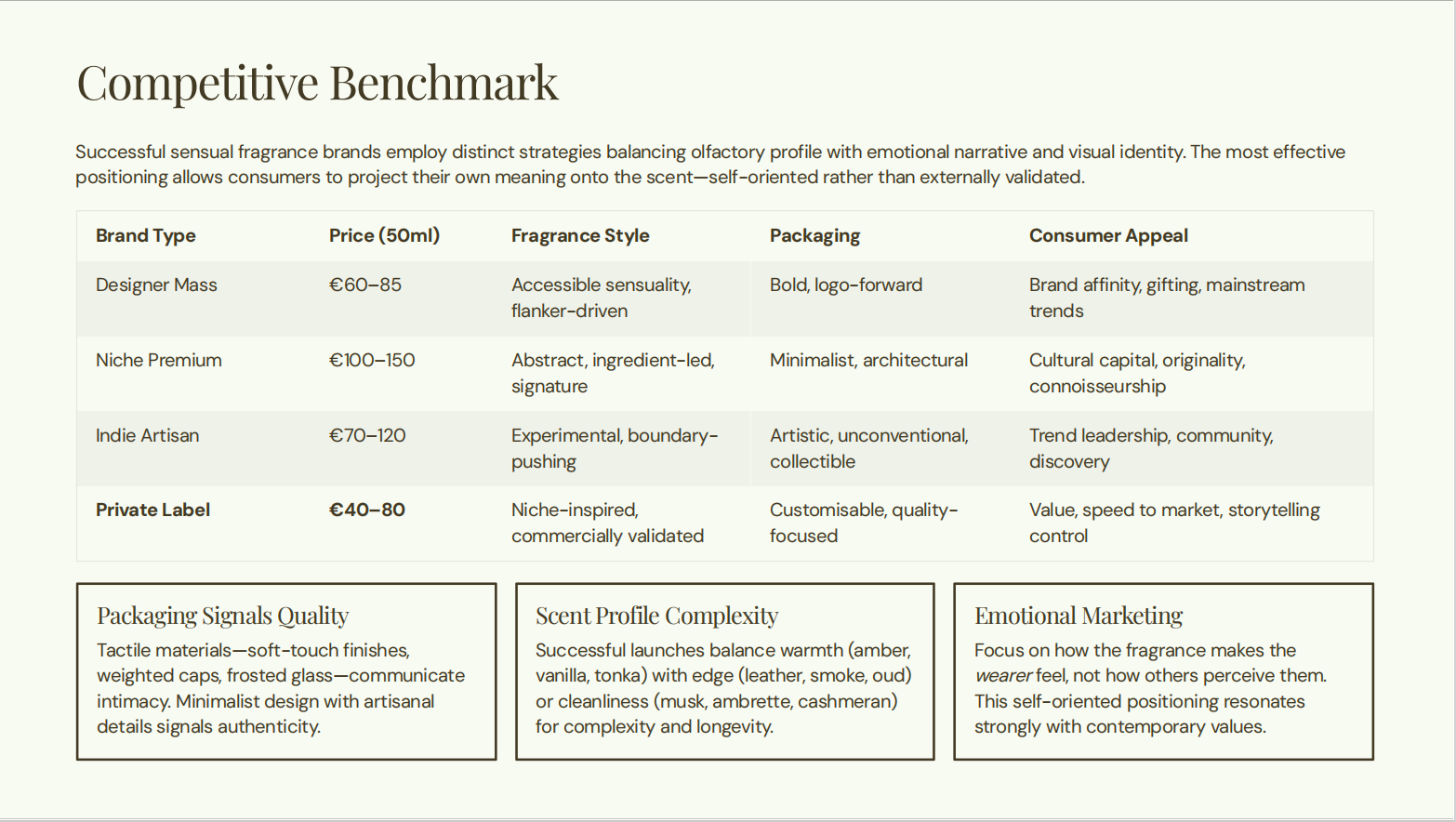
Competitive Benchmark
Packaging and Visual Direction
Sensual fragrance packaging no longer needs to look loud or overly provocative to succeed. In fact, many of the strongest launches in this space use understated, tactile, and emotionally suggestive design systems.
Useful packaging cues include:
-
frosted or tinted glass
-
weighted caps
-
soft-touch cartons
-
warm neutrals or darker rich tones
-
minimalist typography with premium finishing
-
tactile outer packaging that feels intimate and giftable
-
visual structure that supports a full collection rather than one isolated SKU
The best packaging in this segment communicates mood and quality without overexplaining.
Go-to-Market Strategy
A successful EU sensual fragrance launch should align product, narrative, and channel from the beginning.
For brand founders, authenticity matters most. Consumers in this segment are highly sensitive to forced or generic positioning. Discovery-first launches, strong emotional narratives, and selective influencer seeding tend to work better than broad awareness campaigns.
For distributors, selective retail is often a better starting point than mass expansion. Independent perfumeries, concept stores, and niche-aligned online channels provide credibility and support more premium storytelling.
For Amazon and e-commerce sellers, the focus should be on clear scent storytelling, format logic, and bundle economics. Discovery sets, pairings, and seasonal edits can help improve average order value and repeat interest.
The best launch strategy is usually to start with two or three core scents, establish a clear emotional identity, and then add supporting formats once the first demand signals are validated.
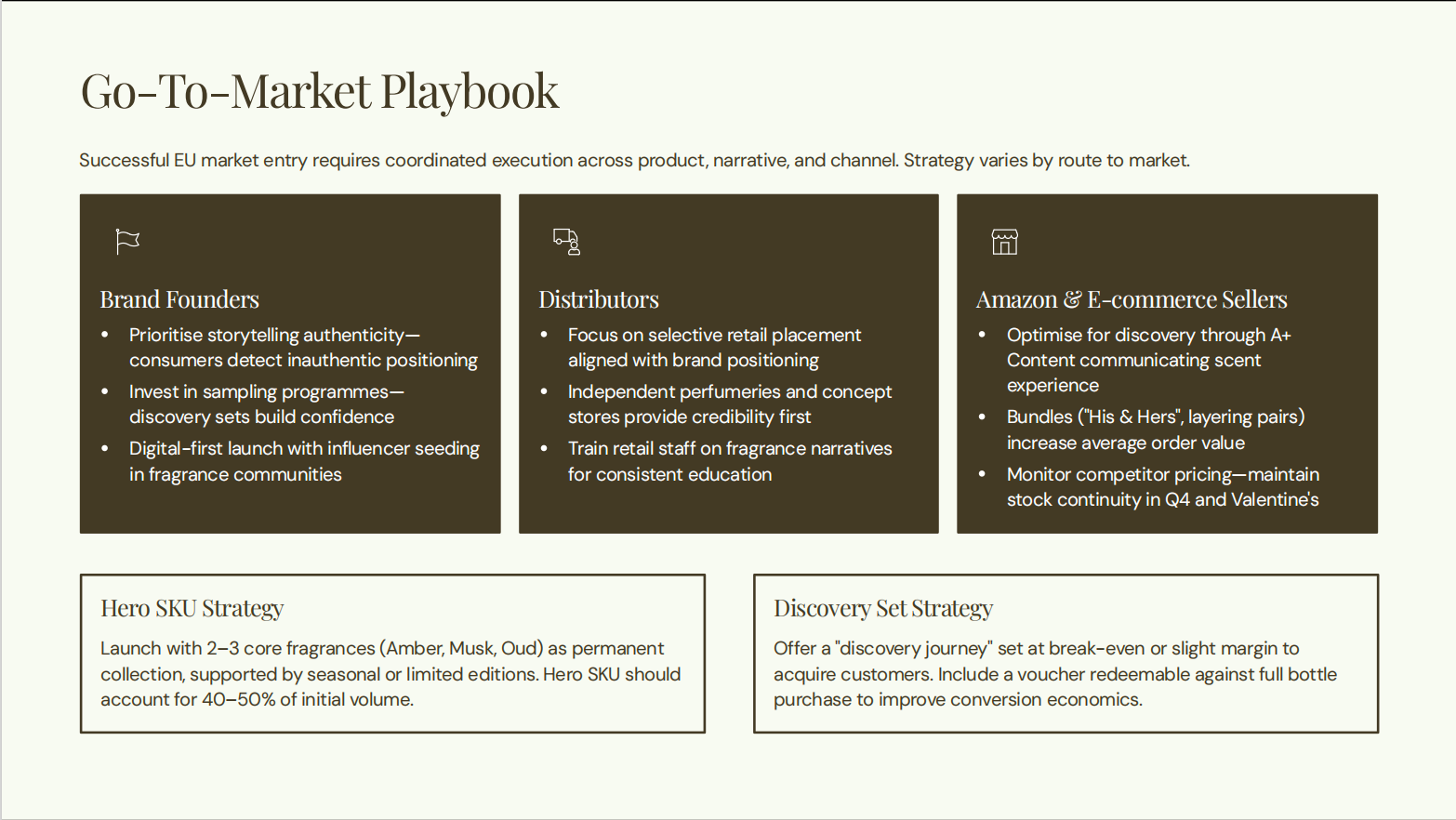
Go-To-Market Playbook
Compliance and Quality Priorities
Compliance needs to be built into development from the beginning, especially in the EU market where fragrance regulation is highly structured.
Key priorities include:
-
IFRA alignment and forward-looking formulation planning
-
allergen declaration readiness
-
safety assessment and documentation
-
CPNP-related launch preparation
-
INCI accuracy
-
batch coding and traceability
-
stability testing in final packaging
-
packaging compatibility with fragrance oil and alcohol system
For sensual fragrance launches, compliance is not just a legal step. It is part of product credibility, distributor confidence, and long-term market access.
Download the Full Report (PDF)
Tell us your target region, product category, and the decision you’re trying to make. We’ll suggest the closest existing report—or build a tailored version.