



Executive Summary
This report explores the EU private label body mist market in 2026, including demand trends, price tiers, scent directions, packaging priorities, compliance requirements, and OEM launch planning. It is designed to help brands, sourcing teams, distributors, importers, and e-commerce sellers turn market signals into a more practical body mist launch strategy.
EU Private Label Body Mist Market 2026: Trends, Pricing, Compliance, and Launch Strategy
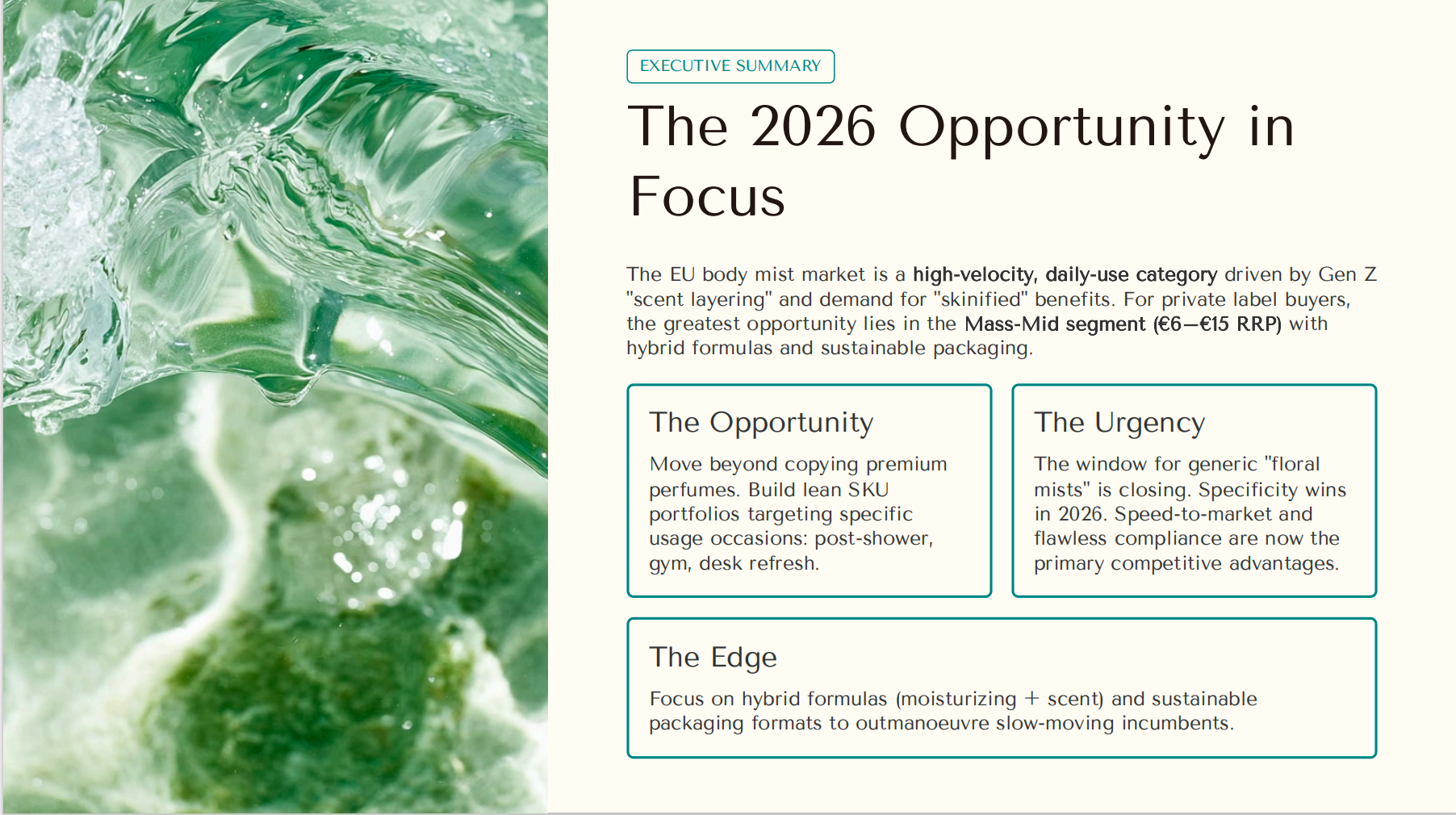
The EU private label body mist market in 2026 is no longer a simple extension of fragrance. It is becoming a faster-moving, daily-use category shaped by scent layering, post-shower routines, gym and desk refresh habits, skin-friendly formulas, and rising demand for sustainable packaging.
For private label buyers, this creates a clear opportunity. The winning products are no longer generic floral mists with low pricing alone. Buyers now expect more specific usage occasions, more functional product concepts, more reliable compliance support, and better packaging decisions that fit both retail and e-commerce.
This report turns EU body mist demand into a practical launch roadmap. It covers market direction, buyer demand signals, price tiers, format strategy, packaging priorities, compliance pitfalls, and an OEM-ready path for taking a body mist concept from brief to commercialization.
Executive Summary
The EU body mist market in 2026 should be treated as a dedicated category with its own demand logic, not just as a lighter version of perfume. It is growing because it fits modern fragrance behavior: frequent reapplication, layering, casual freshness, seasonal rotation, and affordable self-care.
For private label buyers, the strongest opportunity sits in the mass-mid price band, where consumers want better spray experience, modern scent direction, skin-friendly positioning, and sustainable packaging without moving into premium fragrance pricing.
The strongest launches are not built on copying existing prestige perfumes. They are built on clearer usage occasions, cleaner scent stories, better packaging choices, and stronger compliance execution. In practical terms, speed to market and documentation readiness are now competitive advantages just as important as fragrance quality.
Market Opportunity Overview
The EU body mist category remains commercially attractive because it sits between personal care, fragrance, and routine-based lifestyle use. Consumers use body mist differently from fine fragrance. It is applied more frequently, carried more casually, bought more impulsively, and often selected for specific moments such as post-shower refresh, gym use, work breaks, summer wear, or bedtime calm.
This behavior creates a different launch logic for private label. Instead of asking how to build a prestige fragrance alternative, buyers should ask how to create a body mist line that feels more usable, more specific, and easier to repeat-purchase.
One of the strongest structural trends is the growth of non-aerosol body mist. Pump sprays and fine-mist formats are gaining stronger traction because they align better with skinification, portability, sustainability language, and cleaner daily-use positioning.
For buyers entering the EU market, this means the product opportunity is not only in scent. It is in format, spray experience, pack material, and compliance readiness.
The 2026 Opportunity in
Focus
What Is Driving Demand in 2026
Several demand shifts are shaping the category.
The first is scent layering. Younger consumers increasingly use body mist alongside deodorant, body lotion, and perfume rather than as a standalone replacement product. This gives body mist a more frequent, lower-pressure role in daily life.
The second is skinification. More consumers now expect body mist to offer something beyond fragrance alone. Hydration, freshness, soothing feel, alcohol-free positioning, and skin-friendly ingredient stories are becoming more commercially relevant.
The third is affordable indulgence. Body mist remains accessible enough to support impulse buying, seasonal rotation, and multi-SKU ownership. That makes it especially attractive for Gen Z and younger millennial consumers.
The fourth is sustainable packaging. Recycled PET, recyclable pack structures, and lower-complexity packaging formats are becoming more important, especially in DTC and more compliance-aware retail environments.
The fifth is scent specificity. Generic floral positioning is becoming less effective. Consumers are responding more clearly to named scent territories and functional occasions such as vanilla comfort, clean cotton freshness, hydrating aloe refresh, calming lavender, or fruity summer cool-down.
Consumer Demand Signals
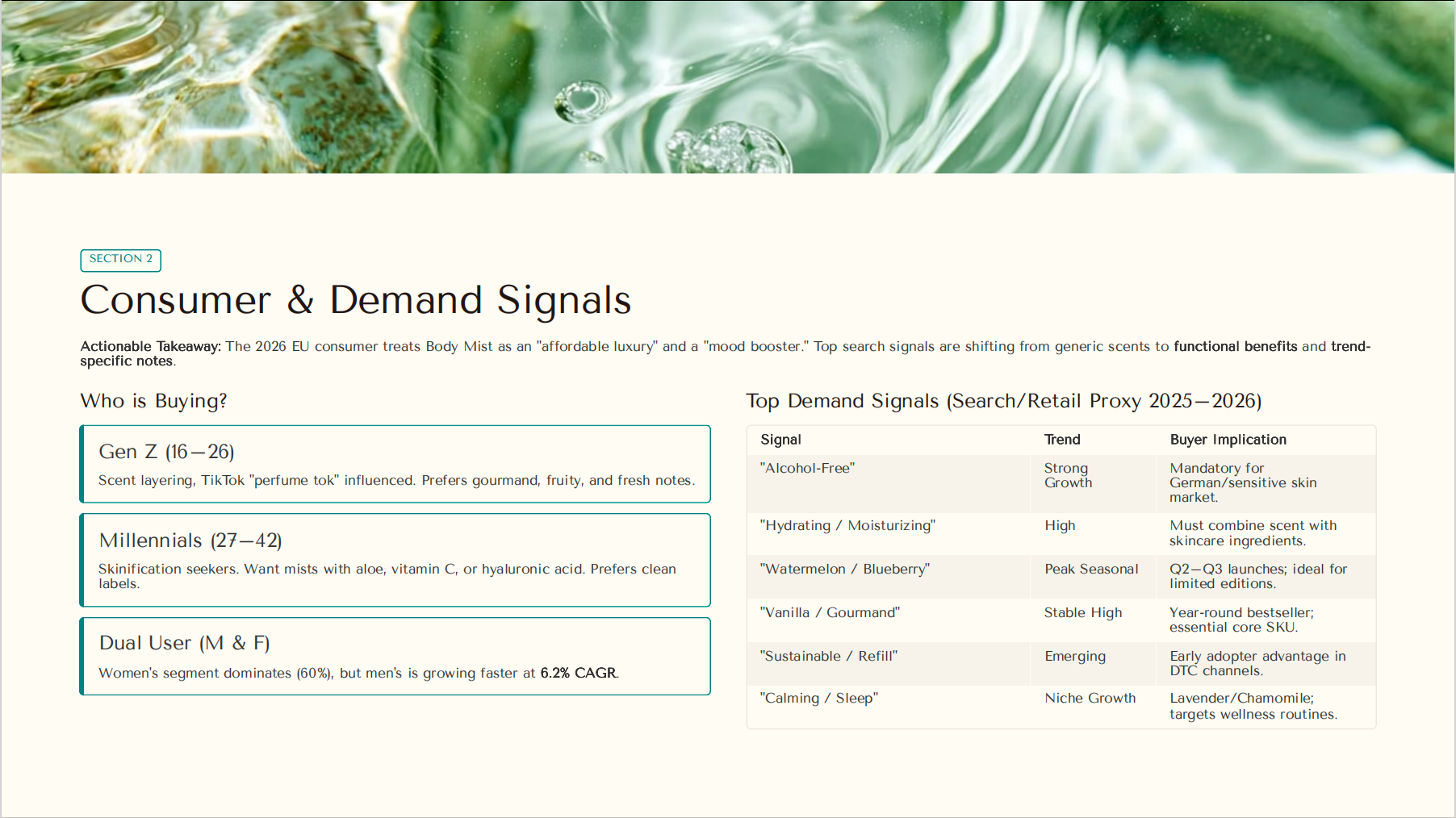
The strongest buyer signals in 2026 show that body mist is increasingly chosen by purpose, note, and routine rather than by generic fragrance family labels.
The most commercially relevant demand directions include:
-
alcohol-free or aqua-based formulas
-
hydrating and moisturizing body mist concepts
-
fruity seasonal scents such as watermelon and berry
-
stable year-round gourmand directions such as vanilla
-
clean cotton and laundry-fresh scent stories
-
calming or sleep-oriented wellness mists
-
vegan and cruelty-free as baseline expectations
-
refillable or recyclable packaging as an emerging advantage
This matters because the consumer is no longer simply buying “a nice mist.” The consumer is buying a very specific use case. That means the product brief should define where, when, and why the body mist will be used.
Consumer & Demand Signals
The Best Entry Point for Private Label Buyers
For most private label launches, the best commercial entry point is the mass-mid tier.
This is where buyers can still reach attractive retail prices while offering better packaging, better spray feel, stronger claims discipline, and more modern scent direction than the cheapest mass products.
A practical 2026 private label strategy often includes:
-
one core vanilla or comfort-driven SKU
-
one fresh clean-cotton or laundry-fresh SKU
-
one seasonal fruity or summer-led SKU
-
one functional aloe or hydrating SKU
-
one mini or trio format for travel and gifting
This structure works because it covers both volume and differentiation without overcomplicating the assortment.
Price Tier and Product Structure
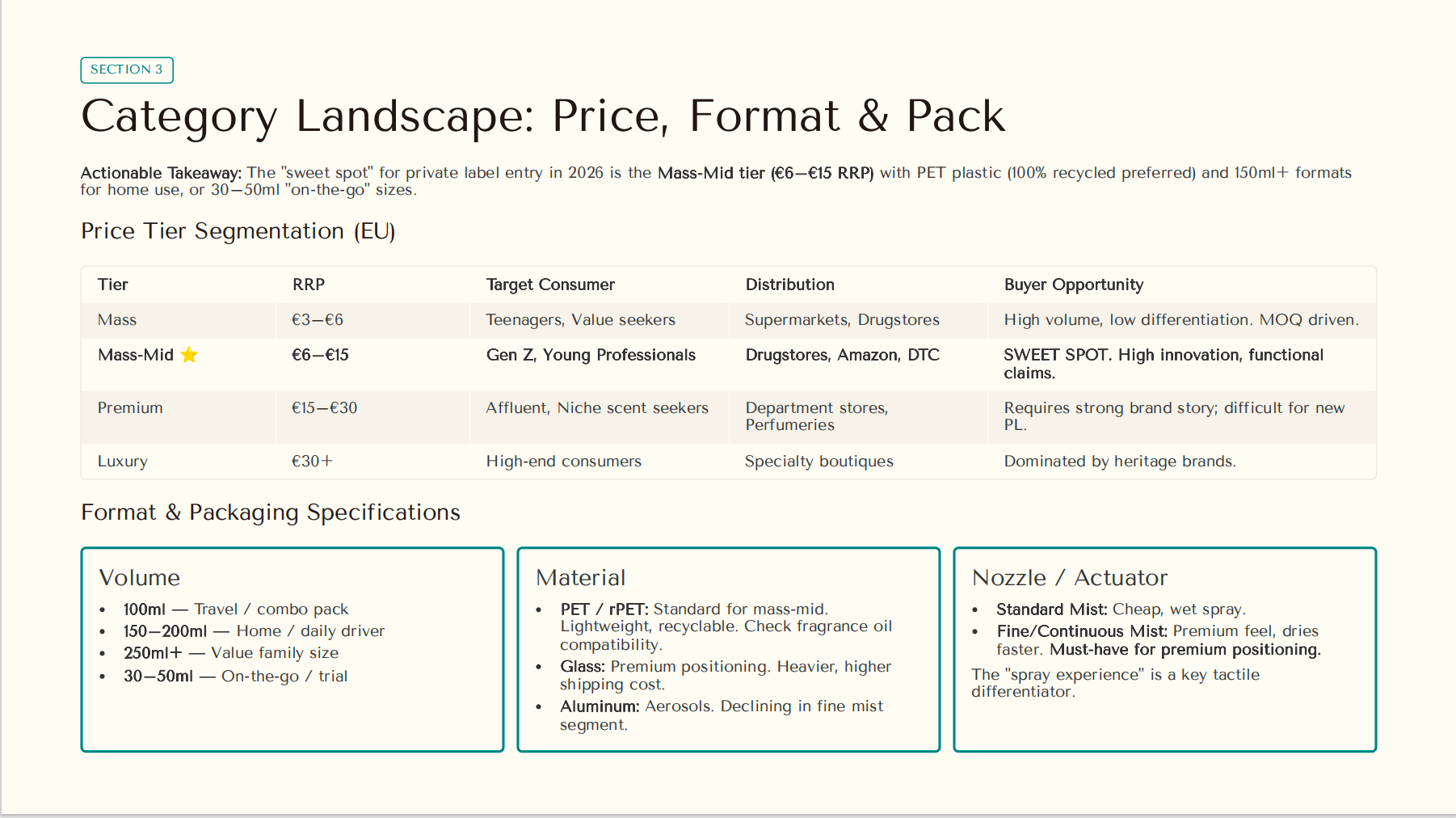
The EU body mist market can be understood through four broad pricing bands.
The lowest tier focuses on entry price and high volume. These products are often easy to distribute but harder to differentiate.
The mass-mid tier is the strongest commercial zone for private label buyers because it combines better margin potential with real room for product innovation. This is where functional claims, better spray quality, and recyclable packaging can make a meaningful difference.
Premium and luxury body mist positioning exists, but these segments require a stronger brand story, more refined packaging, and a more selective distribution strategy. They are usually less suitable for early-stage private label launches.
For many buyers, the more effective plan is not to launch too many price points at once. It is to build a clear ladder with a hero home-use format, a smaller travel or mini format, and one or two function-led variants that make the line easier to understand.
Category Landscape: Price, Format & Pack
Format Strategy and Packaging Priorities
Format choice is one of the most important decisions in body mist development.
Larger sizes such as 150ml to 200ml often work well for daily home use and better value perception. Smaller sizes such as 30ml to 50ml are useful for travel, handbags, desk refresh, gifting, and set-building.
For private label buyers, a strong format system often includes:
-
one daily-use hero size
-
one on-the-go mini size
-
one seasonal or giftable set option
Packaging material also matters. PET remains the standard for mass-mid launches because it is lightweight, cost-effective, and operationally practical. Recycled PET strengthens the sustainability narrative and is increasingly relevant in EU-facing channels. Glass can support more premium positioning, but it also increases freight complexity and breakage risk.
The spray experience is a major differentiator. Standard spray systems are cheaper, but fine mist and continuous mist systems create a more premium feel and better align with daily reapplication behavior. In many cases, the actuator choice influences review quality as much as the fragrance itself.
Channel Strategy
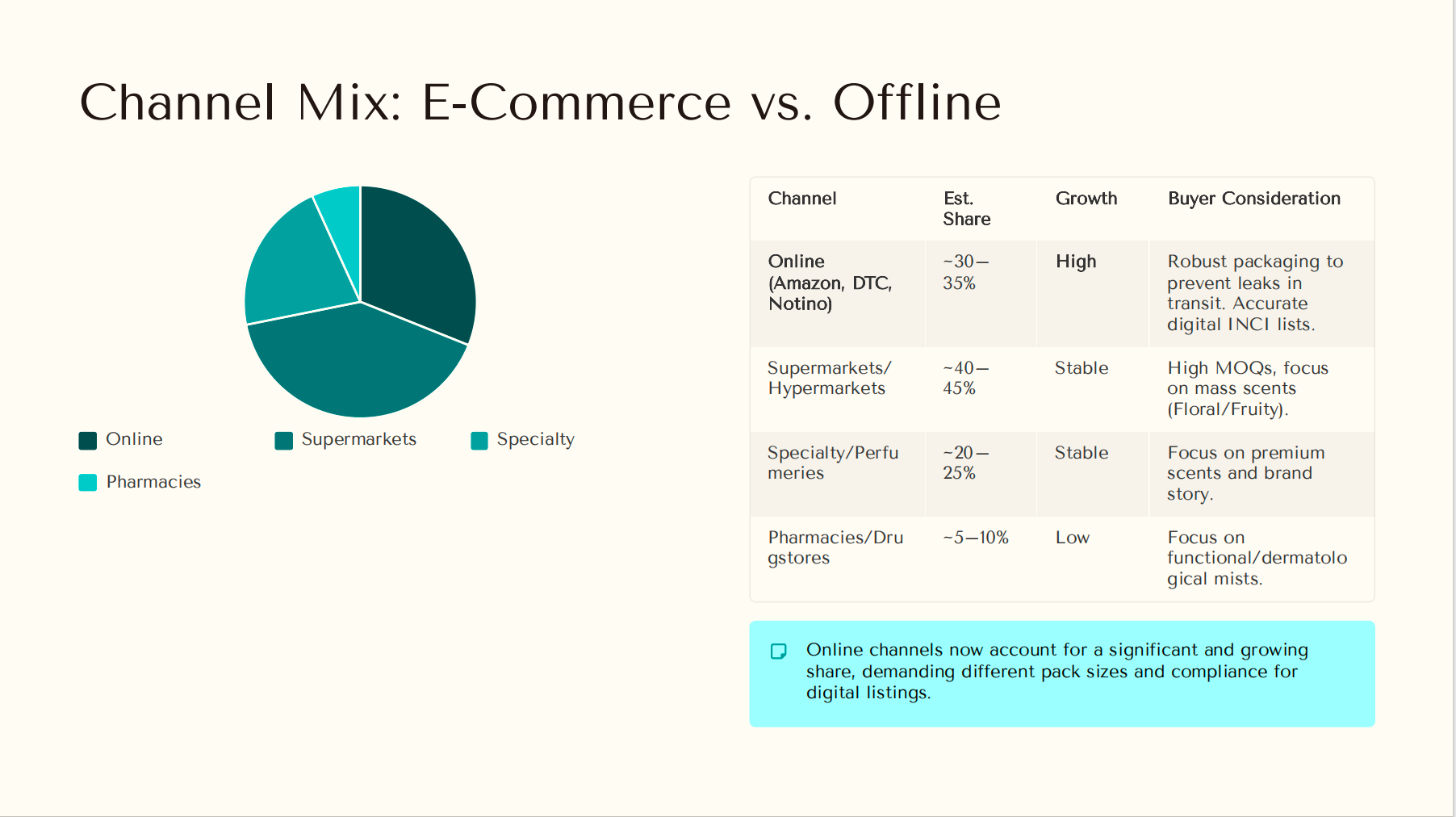
A successful EU body mist launch should be built for its target channel from the beginning.
For Amazon and e-commerce, durability and listing clarity matter most. Products need packaging that resists leakage in transit, correct digital INCI presentation, and claims that are clear, compliant, and easy to understand online.
For DTC, the opportunity is broader. Discovery bundles, build-your-own sets, refill concepts, scent routines, and aesthetic packaging can all improve conversion and repeat purchase.
For retail and drugstore channels, volume, shelf-readiness, and broad scent appeal matter more. Buyers in these channels often prefer proven directions such as floral, fruity, clean, and vanilla, combined with practical price points and scalable supply.
The strongest approach is not to sell the same product the same way everywhere. It is to match scent, format, packaging, and claims to the way the channel actually converts.
Channel Mix: E-Commerce vs. Offline
Competitive White Space
The EU body mist market remains fragmented, which is good news for agile private label operators.
Large incumbents still dominate distribution, but they are often slower to move on packaging sustainability, niche scent moments, and function-led product stories. Smaller DTC and clean-label brands are pushing the market toward a more modern mix of fragrance, skin benefits, and sustainability, but many of them still operate with limited scale.
This creates a clear opportunity in the clean and functional body mist space:
-
body mist with a clearer use occasion
-
scent plus skin benefit positioning
-
better spray feel
-
better recycled packaging story
-
faster response to seasonal notes and trend-led launches
-
stronger compliance support for professional buyers
That is a better opportunity than trying to compete only on low price or only on luxury image.
Compliance and Risk Control
In the EU body mist category, compliance is not just a technical requirement. It is a launch filter. Buyers who cannot provide the right documentation, allergen visibility, and category fit are increasingly excluded before pricing is even considered.
The most important compliance priorities include:
-
correct IFRA category alignment
-
full allergen declaration for leave-on use where required
-
CPSR readiness
-
Product Information File preparation
-
CPNP notification before sale
-
INCI consistency across packaging and digital listings
-
packaging compatibility testing
-
correct transport classification where applicable
-
batch coding and PAO marking
-
realistic and supportable claims language
One of the biggest practical decisions is whether the formula is alcohol-based or alcohol-free. Alcohol-based body mist may trigger more transport complexity and cost. Alcohol-free or aqua-based concepts can be especially attractive for sensitive-skin positioning and lower shipping friction, depending on the exact formula and market route.
For EU launches, compliance should be designed into the project from the first RFQ, not added after artwork is already approved.
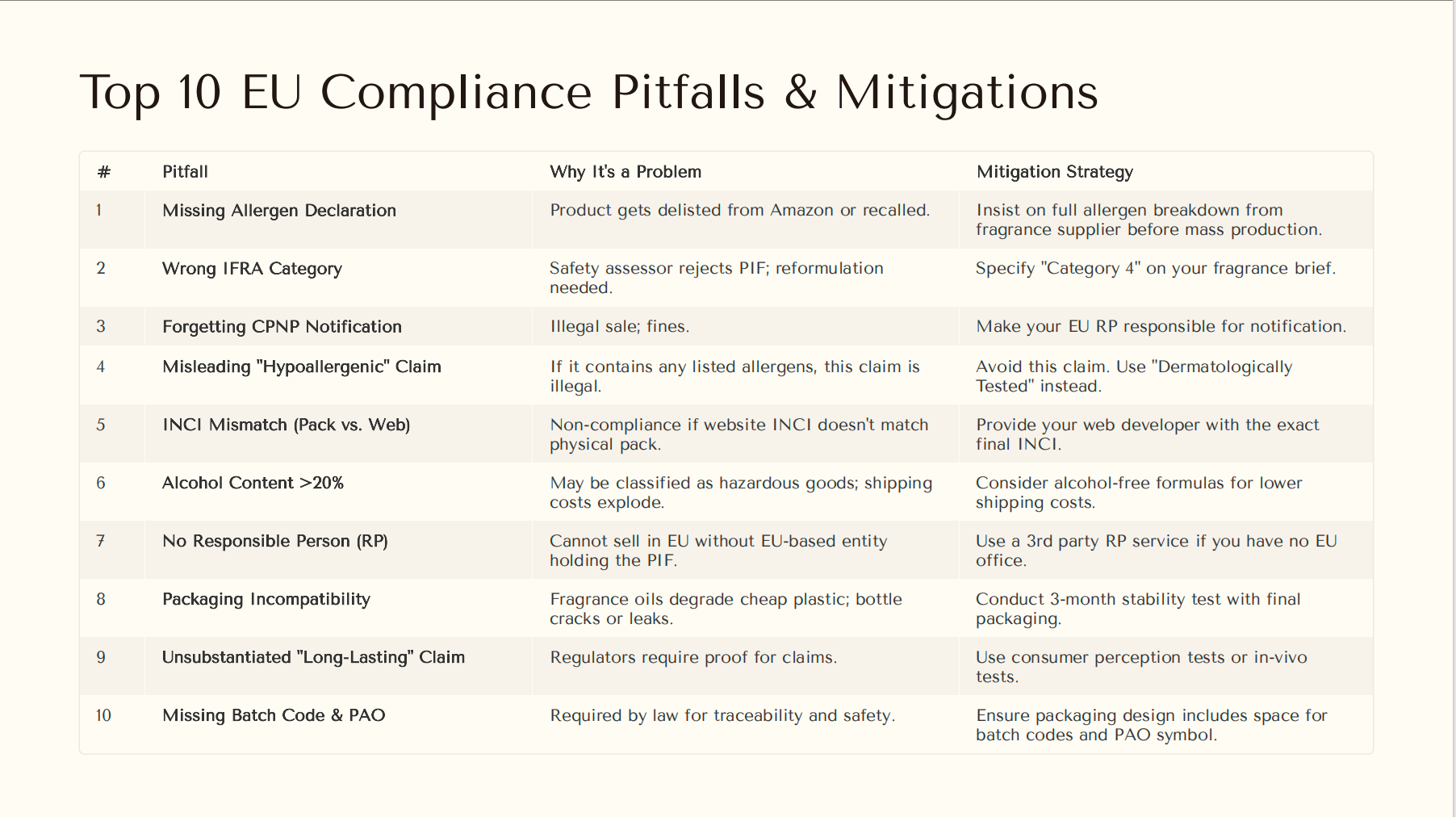
Top 10 EU Compliance Pitfalls & Mitigations
OEM Launch Logic
The fastest way to move from concept to launch is to give the factory a more commercial brief.
A stronger body mist RFQ should include:
-
target EU country or countries
-
target retail price
-
target ex-works cost
-
scent direction
-
usage occasion
-
function claim
-
alcohol-based or alcohol-free preference
-
bottle material
-
spray type
-
volume
-
sustainability requirement
-
compliance support required
-
target launch timing
The clearer these inputs are, the easier it becomes to recommend the right formula base, pack route, spray system, claims path, and documentation plan.
For body mist in 2026, the best OEM partners are not just filling liquid. They are helping buyers match consumer demand, compliance logic, packaging practicality, and cost structure into one commercially usable project.
A Practical 2026 SKU Strategy
For most EU private label buyers, a lean launch works better than a large assortment.
A practical opening lineup could include:
-
Vanilla & Comfort for everyday use
-
Cotton & Clean for fresh routine use
-
Watermelon & Cucumber for seasonal freshness
-
Aloe & Vitamin C for a more functional angle
-
Mini Trio for gift and trial conversion
This type of lineup works because it combines stable best-seller logic with enough novelty and functionality to feel current.
The goal is not to cover every fragrance trend. The goal is to launch a line that is easy to understand, easy to merchandise, and easier to reorder.
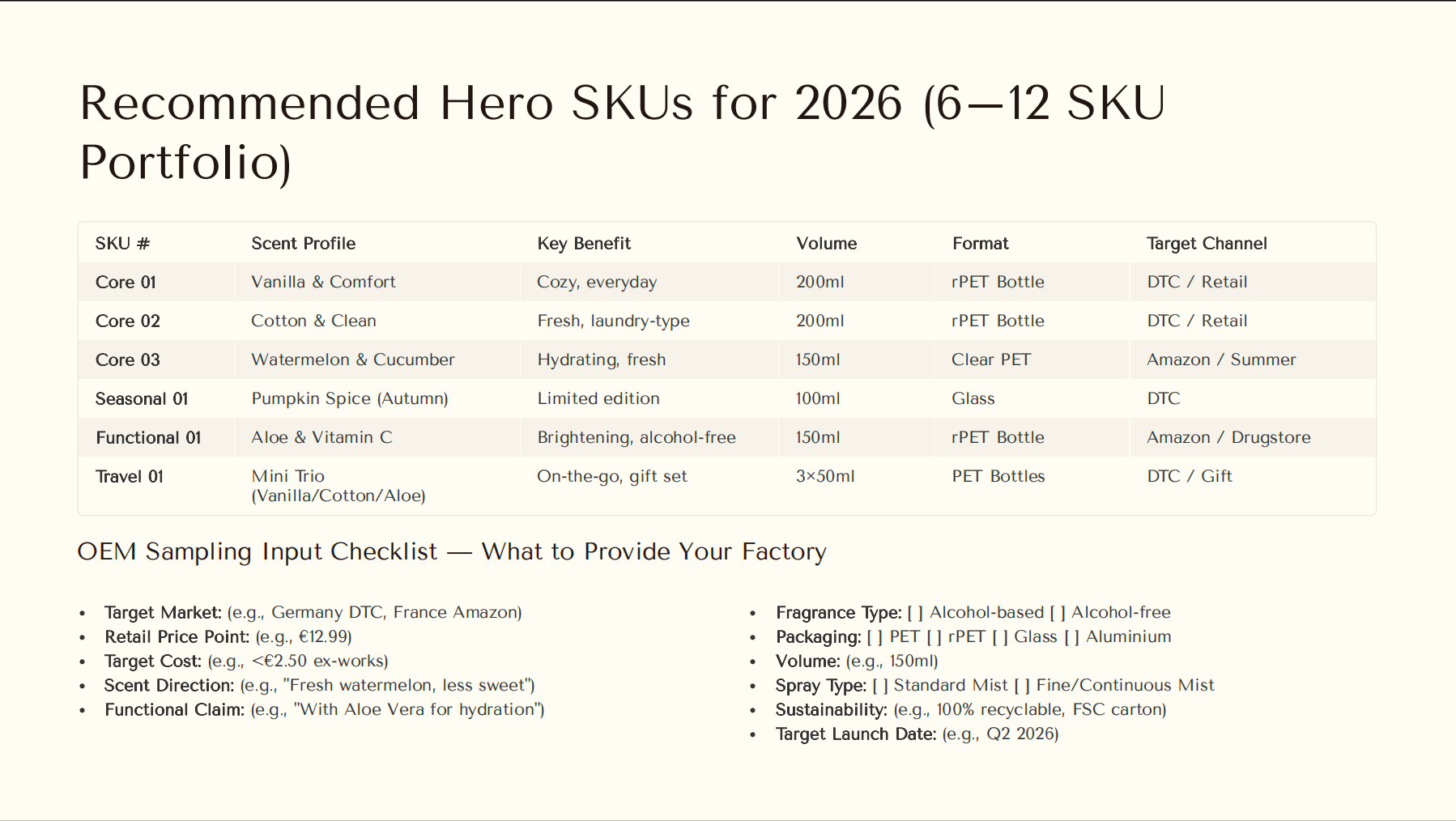
Recommended Hero SKUs for 2026 (6312 SKU
Portfolio)
What Buyers Should Do Next
If you are planning an EU private label body mist launch, the smartest next step is not to ask for a generic floral sample.
Instead:
-
choose your target market first
-
choose your retail price zone
-
define the scent and usage occasion
-
decide whether alcohol-free is commercially valuable for your project
-
choose PET, rPET, or glass based on channel and positioning
-
confirm spray experience before bulk planning
-
request allergen and IFRA support early
-
build packaging and compliance into the timeline from day one
This approach reduces wasted sampling rounds, improves quoting quality, and gives buyers a much more reliable launch path.
Final Takeaway
The EU private label body mist market in 2026 is attractive because it matches how consumers increasingly use fragrance: more casually, more often, more functionally, and more affordably.
The brands most likely to win are not the ones launching the most generic scents. They are the ones building clearer product roles, better spray experiences, stronger packaging logic, more supportable claims, and more complete compliance systems.
If your team is evaluating a new body mist project for the EU market, the strongest next step is to align target country, price tier, scent direction, formula type, packaging route, and documentation plan first, then move into sampling with a much more precise brief.
Download the Full Report (PDF)
Tell us your target region, product category, and the decision you’re trying to make. We’ll suggest the closest existing report—or build a tailored version.