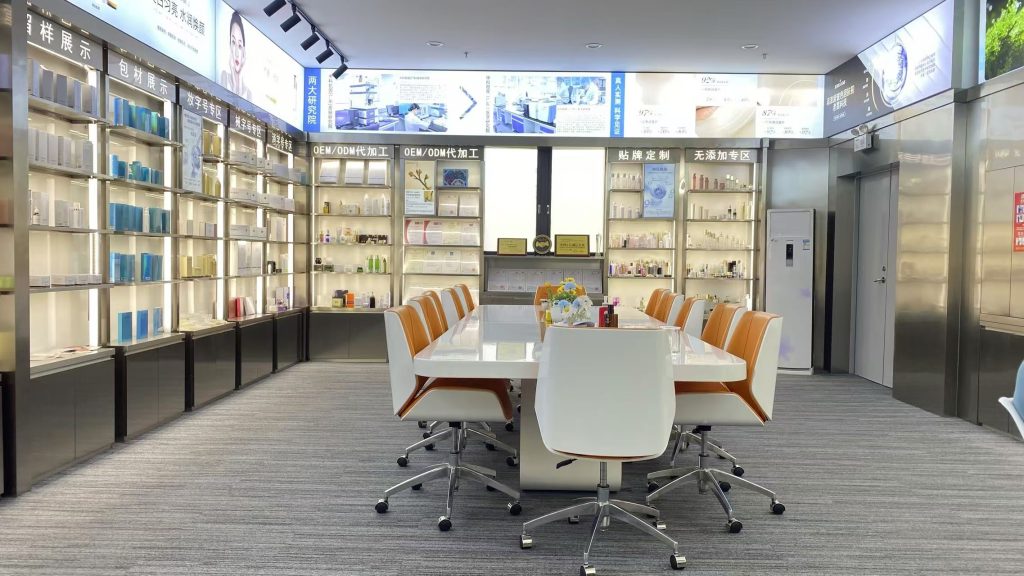
Guangzhou has earned the name “China’s cosmetics capital” thanks to its extensive industrial clusters, strong manufacturing base, and high concentration of licensed producers. For buyers and brand owners seeking a dependable manufacturing partner, understanding the local ecosystem and factory capabilities can help ensure you select a supplier that aligns with your product goals, compliance needs, and market strategy.
Why Guangzhou Stands Out
- Over 1,800 licensed cosmetics manufacturers, representing about 31% of China’s total.
- Specialized industry zones such as Baiyun “Beauty Bay” and Huangpu “Southern Beauty Valley.”
- Complete supply chain: formula R&D, raw material sourcing, packaging production, and logistics.
- Broad experience serving domestic, cross-border e-commerce, and professional salon segments.
Key Buyer Criteria When Choosing a Factory
Licenses & Compliance
- Check for valid production licenses and GMPC/ISO certifications.
- Ask for proof of recent regulatory filings or product registrations.
Production Capabilities
- Confirm daily or monthly output capacity versus your forecast.
- Review facility specs: cleanroom classification, automation, number of lines.
Formulation & R&D
- Size of the formula library (some factories offer 10,000+ mature formulas).
- Ability to customize ingredients for vegan, fragrance-free, or other niche markets.
Minimum Order Quantities (MOQ)
- Larger factories may require higher MOQs; balance your volume with scalability.
- Some offer pilot runs of a few hundred units for test marketing.
Sample Factory Evaluation Table
| Factor |
Why It Matters |
Checklist Item |
| Licensing |
Ensures legal manufacturing and market access |
Obtain copies of production license and certifications |
| Cleanroom Grade |
Critical for contamination control |
Site inspection or photos of facility |
| Formula Options |
Speeds up development and market fit |
Request formula library index |
| Production Capacity |
Supports growth without delays |
Monthly output figures |
| OEM/ODM Services |
Flexibility in product creation |
Service menu with timelines |
Tips for a Successful Factory Partnership
- Schedule on-site visits to verify operational scale and quality controls.
- Align your sales strategy with production: consider trial sizes for sampling campaigns.
- Discuss lead times in detail — typical ranges are 20–40 working days depending on packaging complexity.
- Ensure your packaging supplier and factory coordinate for compatibility testing.
FAQ
- Q: Can Guangzhou factories support small batch runs?
A: Many do, with MOQs starting at a few hundred to 1,000 units, ideal for new brands.
- Q: Do I need my own formula?
A: Not necessarily. Several manufacturers offer large formula libraries and can customize to your needs.
- Q: How long from order to shipment?
A: Depending on packaging readiness and order size, 20–40 working days is common.
- Q: What services beyond manufacturing do factories offer?
A: Some provide brand marketing support, AI tools, and training for sales channels.
Request a Quote to connect with a verified Guangzhou cosmetics factory. Include your target market, SKUs, desired formats, positioning, and packaging direction to speed up your quotation process.
Hi, I'm Alex Zong, hope you like this blog post.
With more than 20 years of experience in OEM/ODM/Private Label Cosmetics, I'd love to share valuable knowledge related to cosmetics & skincare products from a top-tier Chinese supplier's perspective.