

See the factory by live video walkthrough
Book an on-site factory visit in Guangzhou


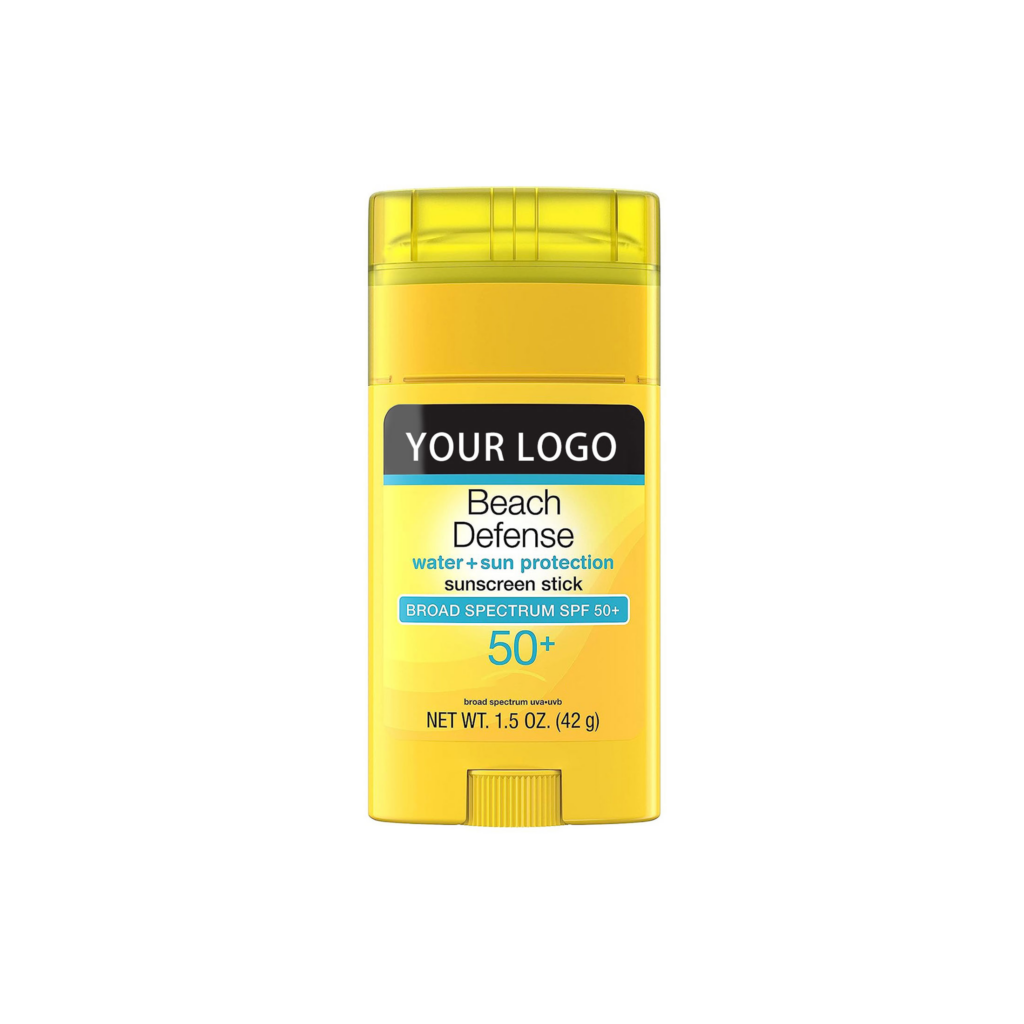
Water-Resistant Broad-Spectrum Protection in a Convenient Stick Format
From fast sampling to iterative optimization—aligned to your market and positioning.
Stable production workflow with quality checkpoints for consistency and scale-up.
Packaging options, decoration, labeling/INCI coordination—helping you launch shelf-ready SKUs.
beach trips, outdoor sports, travel use, family outings, daily sun care
broad spectrum protection, water resistant, gentle formula, hands free application, long lasting defense
Adults, teens, and family use
Supports in-vitro and in-vivo SPF testing as needed.
Ensures product consistency under different temperature and humidity.
Complies with general cosmetic safety standards; reports available upon request.
For sunscreen shipped to the Middle East, heat damage risks include formulation separation and viscosity changes. We recommend temperature-controlled sea freight using refrigerated containers set to 20-25°C, which is cost-effective for MOQs starting at 2000 units per SKU. Alternatively, expedited air freight with thermal liners reduces transit time to 3-5 days but increases cost. Insulated packaging with EPS foam or phase-change materials is critical, and we validate bottle seals under temperature cycles to prevent leakage. Our factory conducts accelerated aging tests at 40°C for 90 days to simulate transport conditions, ensuring product stability. Documentation support includes GCC compliance certificates, MSDS, and stability reports tailored for Middle Eastern markets. Lead time from order to shipping is 8-10 weeks: 2 weeks for material sourcing, 4 weeks for production with QA checks, and 2 weeks for final testing and packaging. We advise planning for 1-2 weeks customs buffer and can assist with Amazon FBA or retail distribution requirements. Experience shows that coordinating R&D and logistics minimizes rework from heat-related failures.
In summer shipping to the Middle East, sunscreen faces leakage risks due to thermal expansion of formulas and packaging fatigue from heat up to 50°C. Pressure drops in air freight can cause containers to bulge or leak, especially with pump dispensers or thin-walled bottles. Damage risks include label peeling from humidity and vibration during transit, leading to product loss or compliance issues. We address this through rigorous testing like accelerated stability studies at elevated temperatures and vacuum leakage checks. Packaging options include double-sealed caps, heat-resistant PET bottles, and reinforced secondary cartons. For MOQ guidance, higher volumes allow cost-effective use of durable packaging; we typically suggest 10,000 units minimum for custom designs. Sampling timelines add 2-3 weeks for summer-condition validations. We support documentation with test reports for customs, such as ISO 22716 and GCC conformity for the Middle East. Lead times must include extra 1-2 weeks for these tests to ensure safe delivery.
To prevent leaking during air freight to the Middle East, select sunscreen caps with robust sealing systems such as screw caps with internal silicone gaskets or double-seal mechanisms. Air pressure changes in flight can force product out, so orifice size must match viscosity—thicker sunscreens need wider openings to avoid back-pressure leaks. We recommend tamper-evident designs for added security. Our factory conducts rigorous testing including pressure chamber simulations and vibration tests to ensure cap integrity before shipping. For MOQ, custom cap molds cost around $1,500, leading to MOQs of 10,000-50,000 units per SKU, but stock options may have lower minimums. Sampling takes 2-4 weeks for cap prototypes and compatibility checks with your formula. Production lead time is 10-14 weeks from approval, including batch testing for microbial stability and leakage risks. We assist with documentation like GCC certificates of conformity and safety data sheets, though final regulatory approval depends on local authorities. Always use secondary packaging with sturdy corrugated boxes and cushioning to minimize movement during transit.
IFRA (International Fragrance Association) compliance sets limits on fragrance allergens in cosmetics to prevent skin reactions. For sunscreens in the Middle East, IFRA documents are typically required during product registration with authorities like the Saudi Food and Drug Authority (SFDA) or Emirates Authority for Standardization and Metrology (ESMA), particularly if the formulation includes added fragrances. This need arises early in development to avoid reformulation delays. From an OEM perspective, MOQ can be impacted if non-compliant fragrances are used, necessitating ingredient swaps that may affect cost. Sampling should include stability testing for fragrance integrity over 2-4 weeks, and packaging must list allergens accurately. Testing involves third-party labs to verify allergen levels, and documentation includes IFRA certificates from fragrance suppliers. Lead time for compliance adds 1-2 months, but we support with testing coordination and document preparation for smoother submissions.
To prevent fragrance instability or off-odor in sunscreen stored in heat, we focus on formulation, testing, and packaging. Our R&D selects fragrance oils rated for high temperatures and formulates to minimize oxidation, which is critical in Middle Eastern markets where storage can exceed 45°C. We run accelerated stability tests at 45°C for 3 months, checking for scent changes and chemical degradation to ensure product integrity. For MOQ, custom fragrances require at least 10,000 units per SKU to cover formulation and testing costs effectively. Sampling for stability takes 2-4 weeks, with adjustments based on feedback to meet your specific needs. We support documentation like test reports and compliance checks for regional standards, but final regulatory approval depends on local authorities. Packaging-wise, we recommend dark glass or UV-blocking PET bottles with airtight seals to reduce light and heat exposure. Lead time from approved sample to production is 8-12 weeks, factoring in order volume and packaging sourcing.
For the Middle East's high heat, airless pump packaging is the top choice to prevent sunscreen deformation. It uses a piston system to eliminate air contact, reducing formula separation and leakage from thermal expansion. Unlike tubes that can soften or sticks that may melt, airless containers made from heat-resistant PP or HDPE withstand temperatures up to 50°C. From our factory experience, MOQs start at 10,000 units per SKU due to mold costs for custom airless designs. Sampling takes 3-4 weeks, including compatibility tests to check for viscosity changes at high temperatures. We run heat stability tests at 50°C for 30 days and leakage tests simulating air-freight pressure drops. For compliance, we support documentation like GCC or SASO technical files, but final regulatory approval depends on local authorities. Production lead time is 8-10 weeks post-sample approval, with QA checks for pigment dispersion and microbial hold-time. Choose airless for broad protection; if cost-sensitive, opt for thick-walled tubes with UV stabilizers, but expect higher leakage risk in summer.
We start with mineral UV filters like zinc oxide and titanium dioxide, then customize iron oxide pigments to create shades from olive to deep tan that align with Middle East skin tones. Our R&D uses color-matching tools and local feedback for accuracy, with lab samples ready in 4-6 weeks for shade testing. Key details include MOQ starting at 10,000 units per SKU to balance cost, SPF/PA and high-temperature stability testing for regional climate, and packaging in airless pumps or tubes to prevent separation. We support documentation like test reports for GCC regulatory submissions, but approval depends on local authorities. Production lead time is 8-10 weeks after final sample approval, with QA checks for consistency and microbial safety throughout.
Based on direct production for regional brands, the ideal textures are water-light gels, fast-absorbing fluid milks, and soft-air 'invisible' creams. Formulation must balance high SPF (30-50+) and PA++++ with a dry-touch, non-occlusive finish. The challenge is stabilizing filters and emollients to prevent separation or greasiness in high ambient heat. For MOQs, a custom texture typically starts at 5,000-10,000 units per SKU. Sampling takes 4-6 weeks for lab dips and stability checks (like 45°C heat testing). Key packaging for these textures includes airless pumps for creams and flow-control dispensers for fluids to prevent leakage during transport and storage. Lead time from approved sample to production is 8-10 weeks. We support full documentation for GCC and UAE regulatory submissions, including product information files (PIF) and required test reports (SPF, broad spectrum, stability). We can also facilitate Halal certification for your brand if required.