

See the factory by live video walkthrough
Book an on-site factory visit in Guangzhou


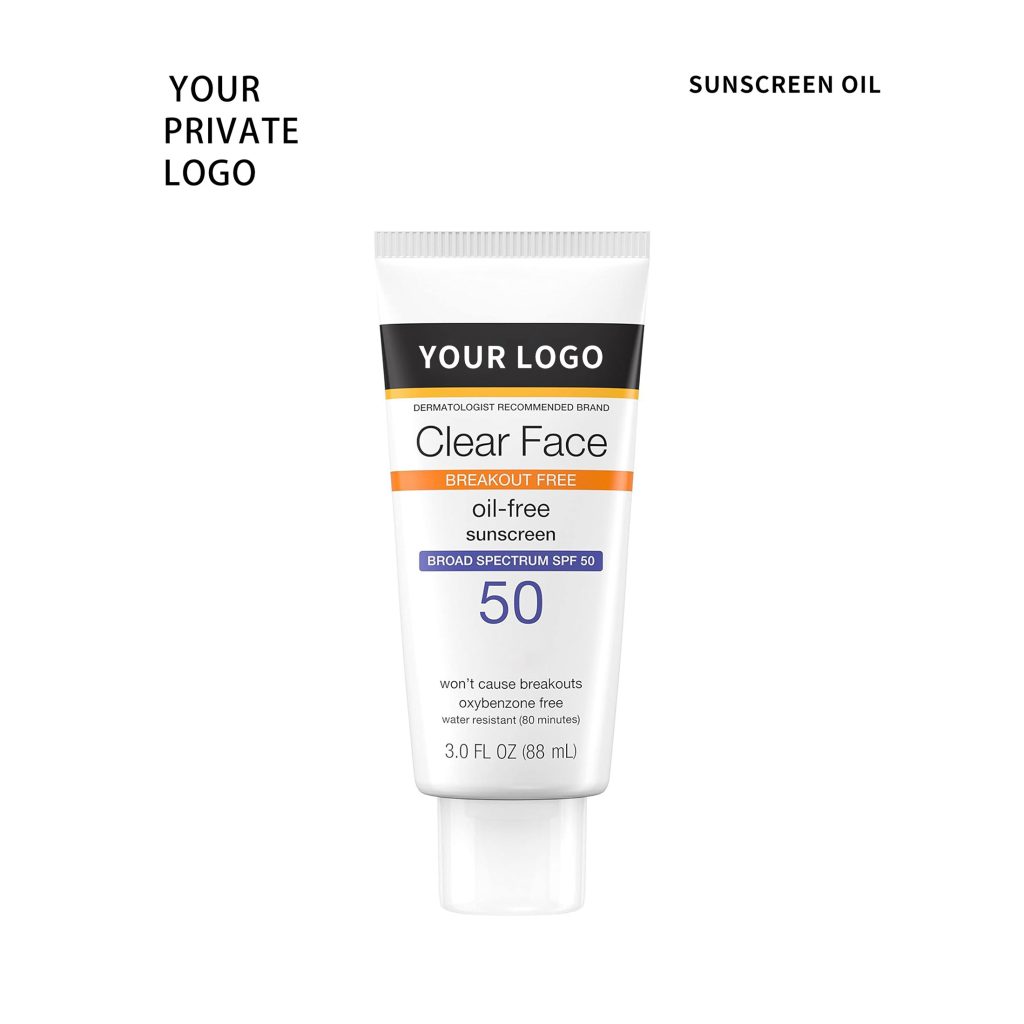
Lightweight, broad-spectrum facial sunscreen tailored for acne-prone skin
From fast sampling to iterative optimization—aligned to your market and positioning.
Stable production workflow with quality checkpoints for consistency and scale-up.
Packaging options, decoration, labeling/INCI coordination—helping you launch shelf-ready SKUs.
daily facial use, acne-prone skin, sensitive skin, outdoor activities, sunny climates
broad-spectrum SPF 50 protection, oil-free formula, fragrance-free comfort, non-comedogenic care, quick absorption
Individuals with acne-prone or sensitive skin seeking high SPF protection
Verification of UVA/UVB protection values.
Ensures formula will not clog pores.
Confirms product integrity under various temperature/humidity conditions.
For the Middle East market, sunscreen scent preferences lean towards subtle and culturally familiar fragrances. Fresh aquatic scents evoke a cooling effect, while floral notes such as rose and jasmine are well-received. Traditional oriental scents like oud add a luxury touch, and unscented variants cater to sensitive skin needs. Starting with these directions can enhance market acceptance. As your OEM partner, we provide MOQ guidance from 5,000 to 10,000 units per SKU to balance cost and scale. Sampling typically takes 2-3 weeks after formulation approval, including scent customization. We conduct comprehensive testing like stability, SPF verification, and microbial checks to support GCC compliance documentation. Packaging should use UV-resistant materials and include Arabic/English labeling. Lead time from order to production is 8-12 weeks, depending on packaging and scent complexity. We assist with all necessary testing and docs for regulatory submissions, ensuring a compliant product launch.
For private label sunscreen in the Middle East, key documents include a COA verifying SPF/PA values, ingredient analysis, and batch consistency; an SDS compliant with GHS standards for safe handling; stability tests under accelerated conditions (e.g., 40°C/75% RH for 6 months) to support shelf-life claims; and microbiological tests to ensure no bacterial or fungal contamination. As an OEM/ODM manufacturer, we support full documentation through in-house or accredited lab testing, but final regulatory approval depends on local authorities. MOQ typically starts at 10,000 units, with sampling taking 3-4 weeks for custom formulas and stability checks. Production lead time is 8-12 weeks after approval, with packaging designed for leakage-proof and UV-resistant performance in hot climates. We provide audit-ready docs, including stability and micro reports, to facilitate market entry.
Our approach starts with formulation optimization, selecting emulsifiers like polymeric types and rheology modifiers to maintain homogeneity up to 50°C. We conduct accelerated stability tests (e.g., 45°C for 3 months) and real-time checks for phase separation, oil sweating, and viscosity changes. For MOQ, sunscreen production typically starts at 5,000 units per SKU, influenced by packaging complexity and raw material sourcing. Sampling takes 2-4 weeks after formula approval, including small batches for efficacy testing like SPF verification. We support documentation for GCC or Saudi Arabian compliance, such as providing test reports for stability and safety, but final regulatory approval depends on local authorities. Packaging recommendations include opaque HDPE bottles with secure pump mechanisms to prevent leakage in heat, and we advise against air-freight for bulk shipments due to pressure changes. Lead time from order confirmation to production is 8-10 weeks, with QA checkpoints at pilot batch and filling stages to ensure consistency. Always share target cost and launch date early for accurate planning.
The tags in your query are empty, so I have no knowledge to base my response on. Packaging compatibility testing for sunscreen with high UV filters in the Middle East typically involves assessing interactions between the formulation and packaging materials under local conditions like high heat and humidity. Key tests include accelerated stability studies (e.g., at 40°C/75% RH), compatibility checks with materials such as HDPE or PET to prevent leaching or degradation, and specific analyses for UV filter stability over time. At LAEYO Labs, we support clients with testing protocols, documentation for GCC regulations, and practical steps like pilot batch runs to validate packaging before full production. However, without details on your specific UV filters (e.g., concentrations, types like avobenzone or zinc oxide), packaging components, target market specifics (e.g., Saudi Arabia or UAE), and timeline, I cannot offer concrete MOQ guidance, sampling schedules (usually 4-6 weeks for compatibility tests), lead time estimates, or cost breakdowns. Please provide this information for a tailored response that aligns with your procurement needs and ensures compliance and quality control.
In the Middle East, mineral sunscreens with zinc oxide or titanium dioxide are preferred because they provide physical UV blocking that remains stable in high temperatures up to 45°C, reducing white cast with micronized formulas. Creams and lotions outperform sprays, which evaporate quickly, and are favored for daily use in harsh sun. For OEM projects, MOQs typically start at 5,000 units per SKU to justify raw material costs, with sampling timelines of 4-6 weeks for stability testing. Packaging must use opaque, airless pumps or tubes to prevent ingredient separation and leakage during transit, especially in humid conditions. We support documentation for GCC compliance, including COA, stability reports at elevated temperatures, and microbial testing, but cannot guarantee regulatory approval. Lead time from formulation approval to production is 8-12 weeks, with pilot runs to verify fill accuracy and sunscreen efficacy in local conditions.
To get an accurate sunscreen quote for the GCC market, provide SPF level (e.g., SPF 30-50), UVA protection rating, and product format like lotion or spray. Specify packaging details such as bottle material, cap type, and label design to assess production feasibility and cost. Include your target MOQ, typically starting from 10,000 units per SKU, which impacts raw material sourcing and unit pricing.nnState compliance requirements, especially GSO certification for GCC countries, as this mandates specific testing like sun protection efficacy and stability studies. Mention any preferred ingredients or claims to ensure regulatory alignment, and provide a sampling timeline preference, usually 4-6 weeks for lab samples.nnAdd production lead time expectations, often 12-16 weeks after sample approval, and outline needed documents like technical files or safety data sheets. We can assist with testing and documentation support, but final regulatory approval depends on local authorities. Avoid vague descriptions to prevent delays and rework in the quoting process.
At LAEYO Labs, SPF consistency starts with precise raw material sourcing and controlled manufacturing environments. Each batch follows the same validated formula, with in-process checks for viscosity, pH, and homogeneity to prevent variation. We conduct in-vitro SPF testing on every production batch, providing test reports that align with Middle East regulatory expectations, such as GCC requirements. For private label orders, MOQ typically ranges from 5,000 to 10,000 units per SKU, depending on packaging complexity and formula stability. Sampling involves 2-3 weeks for formula approval and packaging fit tests, including leakage checks under simulated Middle East heat. Lead time from sample approval to bulk production is 8-12 weeks, factoring in raw material procurement, pilot batch testing, and quality assurance. We recommend stability testing under accelerated conditions to ensure efficacy in high temperatures. Our packaging includes UV-blocking materials and secure seals to maintain product integrity during shipping. We assist with all necessary documentation and testing but cannot guarantee regulatory approval, as final decisions rest with local authorities.
For sunscreens destined for the Middle East, MOQ is not a single number but a result of three key drivers: formulation, packaging, and compliance. A standard 'white-label' formula using our existing, proven bases for SPF 30 or 50 can have an MOQ as low as 5,000-10,000 units per SKU. However, if you require a fully custom formula with specific actives, a high SPF/PA++++ rating, or sweat/water resistance claims, the R&D and stability testing commitment increases, typically raising the MOQ to 15,000-25,000 units. Packaging is the second major cost and MOQ driver. Using our stock bottles and pumps keeps MOQs lower. If you require custom molded components (like a unique bottle shape or a specific pump head), the high mold fee (often $3,000-$8,000) is amortized into the order, significantly increasing the effective MOQ. Finally, the Gulf Standardization Organization (GSO) certification is mandatory. The required stability testing (3-6 months for ambient conditions) and SPF verification testing on final product batches create a fixed cost that is factored into the MOQ calculation to be economical. We can manage the entire testing and documentation process for GSO submission, though final approval authority lies with the GCC regulator.