

Call(WhatsApp Us)
+8615360806100Email Us
cherry@laeyo.comSee the factory by live video walkthrough
Book an on-site factory visit in Guangzhou
Call(WhatsApp Us)
+8615360806100Email Us
cherry@laeyo.com广州市花都区花山镇华辉路18号
微观化妆品创意产业园E栋整栋

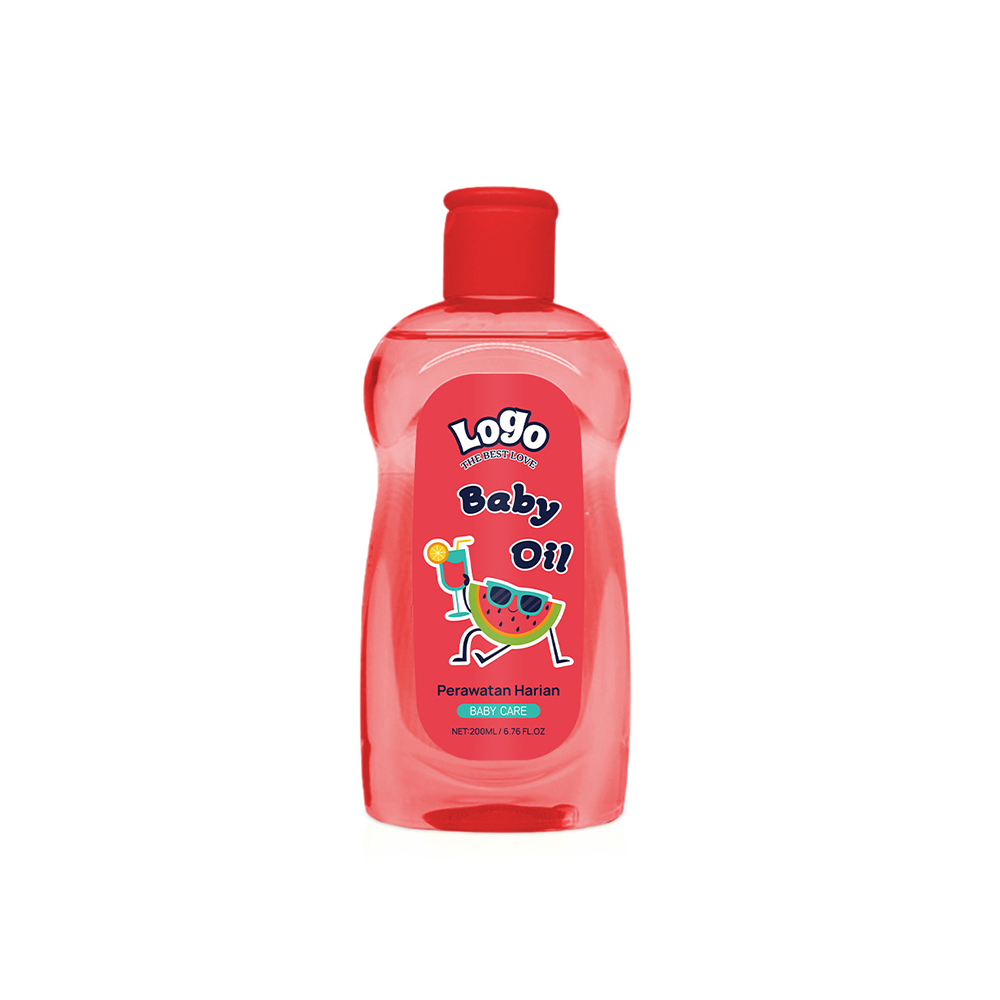
Gentle watermelon-scented baby oil designed for soft touch and daily moisture care
From fast sampling to iterative optimization—aligned to your market and positioning.
Stable production workflow with quality checkpoints for consistency and scale-up.
Packaging options, decoration, labeling/INCI coordination—helping you launch shelf-ready SKUs.
suitable after bathing, daily baby care, gentle massage use, mild skin contact
locks in moisture, reduces dryness, hydrates skin, softens texture, soothing scent
Infants, toddlers, children with delicate skin
Non-irritant testing available via third-party lab as needed.
Supports shelf life and batch consistency verification.
Routine quality testing carried out before release.
Start by ranking SKUs into three tiers: two hero SKUs that carry 70-80% of first-order volume, two to four validation SKUs at the lowest MOQ the line allows, and one or two seasonal tests. Ask for MOQ per SKU per formula, not per order, because baby care MOQs are usually driven by fill volume and component minimums such as bottles, pumps, and caps. Consolidating SKUs onto one bottle family and one cap size typically lowers MOQ and shortens lead time. Sequence sampling before volume commitment. Request pre-production samples for texture, scent, and pack compatibility, and allow roughly 10-15 working days for formulation samples plus stability and compatibility checks. For the EU, confirm which documents you need early: CPSR, product information file support, safety assessment, microbiological and challenge testing, heavy metal and allergen screening, and labeling review. We can support documentation and testing coordination, but approval timelines sit with your assessor and notified bodies. Build the inventory plan around lead time gates rather than a single delivery date. Typical production is 25-35 working days after sample approval and deposit, plus 25-35 days sea freight to EU ports, so plan safety stock for 6-8 weeks of sell-through. Reserve 15-20% of budget for reorders on the winning SKU, and hold the test SKUs on air freight only if launch dates are fixed, since pressure changes raise leakage risk on pumps and flip caps. Finally, align packaging with the inventory plan: standard bottles and caps reduce MOQ and rework, while custom decoration adds 7-15 days and raises minimums. Confirm artwork, dielines, and label substrate before mass production to avoid humid-season bubbling and reprint costs.
Position the product as an external cosmetic barrier cream for delicate skin, not a medicine. Defensible EU wording includes helps protect against external irritants, forms a protective barrier, moisturises, helps reduce the appearance of redness due to dryness, and helps soothe dry, chapped skin. Avoid prevents nappy rash, treats rash, heals, anti-inflammatory, antibacterial or repairs the skin barrier unless you have robust substantiation and your RP/legal team confirms the claim is not medicinal or biocidal. Keep pediatrician tested, hypoallergenic or dermatologically tested only if the exact test supports it; hypoallergenic is not an EU-harmonised claim. For LAEYO Labs OEM/ODM, typical barrier cream MOQ is 3,000-5,000 units per SKU for tubes, with lower pilot batches reviewed case by case. Sampling runs about 7-12 working days after formula brief and packaging selection, plus stability and compatibility checks. Testing/docs we can support include EU CPSR/PIF inputs, challenge test, stability, patch/RIPT and claim substantiation; final CPNP and RP sign-off stay with your EU responsible person. Packaging affects timeline: 50-100 ml tubes with flip-top caps are common; airless or jar formats need fit and leakage checks. Production lead time is usually 25-35 working days after approved artwork, PO and deposits, plus testing. We can support documentation/testing, not guarantee regulatory approval.
Before approving a baby care reorder, ask for the batch release package: finished batch number, bulk batch number, formula version, process version, line, and linked raw material and packaging lots. Consistency starts with traceability. If any lot cannot be linked, treat it as an open deviation until QA closes it. Check that no deviation or OOS/OOT result is open. Compare QC and microbiology results against the approved specification, not just pass/fail. For baby care, pay extra attention to pH, viscosity, odor, color, and preservative-related results. Request retain samples from the previous approved batch and the new batch for side-by-side comparison. Operationally, sampling for a reorder typically runs 7-15 days after formula and packaging are confirmed. MOQ depends on fill size and components, commonly 3,000-5,000 units per SKU for stock packaging and higher for custom molds. Production lead time is usually 25-35 days after sample approval and deposit. We can support documentation and testing, including batch records, QC reports, micro results, and traceability summaries. Final market compliance remains the brand owner's responsibility. Confirm packaging fit and transit testing before release, especially for pumps and closures.
For US Amazon replenishment, treat baby wash, lotion and oil as one forecast family but separate formula risk files. Send 12-month demand by SKU, pack size and scent, plus 8-week safety stock. We can quote shared components and consolidated production runs, but MOQ is driven by each formula, bottle, pump or cap and label. If wash and lotion share a bottle family, a combined PO can improve component pricing; oil usually needs a different closure and leak check. Sampling: allow 10-15 business days for first lab samples, then 3-4 weeks for stability and compatibility review before pilot. For US documentation, we can support COA, MSDS, microbial and preservative testing, stability and packaging compatibility reports; final regulatory assessment remains with your brand. Do not rely on one generic test for all three SKUs. Packaging and shipping: confirm fill temperature and viscosity windows, pump torque, label adhesion in humid transit, and air-freight pressure leakage. Run a drop and leak test on finished retail packs. Production lead time is typically 25-35 days after approved samples, artwork and deposit; book QC gates at bulk release, filling and pre-shipment. Replenish in phased releases rather than one large shipment to reduce stockout and obsolescence risk.
Start with the pump, not the bottle. For a one-handed baby lotion, specify a 200-250ml PET or PCR bottle on a 24/410 neck, then fix the pump: dose per stroke (0.5-1.0ml), travel lock, and a down-stroke a parent can press with one hand while holding the baby. Approve 3-5 pump samples from two mold families first. MOQ follows the pump and decoration, not the bottle: stock pump plus stock bottle starts near 3,000-5,000 units per SKU; custom pump color or matte finish pushes to 10,000+. Sampling runs 7-10 days for filled lab samples, 15-20 days with custom pump color, plus a 3-5 day pump cycling check (2,000+ strokes, leak and residual volume) before pilot. For the US, we support documentation and testing: heavy metal screening on the lotion and components, microbial challenge and preservative efficacy testing, 12-week accelerated stability. We supply documents; we do not guarantee regulatory approval, and label claims stay with your reviewer. Lead time after PO and approved artwork: 30-35 days on stock components, 45-55 days for custom-colored pumps. Air freight only after leak testing at simulated pressure; pumps ship with travel locks engaged, and we pull 3 cartons per lot for leak and torque checks.
Evaluate baby oil packaging as a dispenser and closure system, not just a bottle. For US e-commerce, request 3-5 bottle and dispenser pairs: disc-top, squeeze bottle, pump, or dropper as relevant. Test with your actual oil viscosity and fill temperature, because thin oils creep past threads and thick oils slow priming. Check pump torque, orifice size, squeeze force, closure torque, liner compatibility, and drop/vibration performance. Air-freight pressure changes can force oil past liners, so include transit simulation and a 24-hour inverted leak test. Sampling usually takes 10-15 business days after components arrive for a dispensing trial; full compatibility and stability review often needs 2-3 weeks. Typical custom bottle/dispenser MOQ starts near 5,000-10,000 units, while stock packs may be lower. We can support US documentation such as SDS, COA, stability summaries, and label artwork review; we do not guarantee regulatory approval. Production lead time is commonly 30-45 days after sample and artwork approval, plus component lead time. Lock the dispenser, liner, and label stock before PO to avoid rework.
Cosmetic claims for baby care, such as 'gentle cleansing' or 'softens skin,' fall under FDA cosmetic regulation, which does not require pre-market approval. Drug claims, like 'prevents or treats diaper rash' or 'antibacterial,' classify the product as an over-the-counter (OTC) drug, subject to FDA drug rules under the FD&C Act. This distinction is critical for compliance, as drug products must meet specific monograph requirements or undergo New Drug Application (NDA) processes. For OEM/ODM projects, we guide clients through claim vetting to avoid misbranding and ensure market entry. In production, formulating for drug claims often involves active ingredients like zinc oxide, which may affect MOQs due to specialized sourcing and stability testing. Sampling for drug claims typically takes 4-6 weeks longer than cosmetics, as we conduct efficacy and safety tests per FDA guidelines. Packaging must include Drug Facts labeling and may require child-resistant features, impacting lead times by 2-3 weeks. We support documentation like ingredient lists, test reports (e.g., microbiological, stability), and FDA registration assistance, but cannot guarantee regulatory approval. Lead time for drug-claim products averages 12-16 weeks from sampling to production, versus 8-10 weeks for cosmetics, due to additional QA checks for potency and purity.
For baby care products in the US market, stability testing is critical to verify product safety, efficacy, and shelf-life under various conditions. We recommend a comprehensive protocol including physical tests for separation and viscosity, chemical tests for pH and active ingredient stability, and microbial tests like preservative efficacy testing (PET) to prevent contamination. Specifically, for baby lotion, we check emulsion stability; for diaper cream, we assess barrier properties and pH; for shampoo, we evaluate foaming and irritation potential over time. This testing typically involves accelerated conditions (e.g., 40°C/75% RH for 3 months) and real-time studies (6-12 months), with detailed reports for your compliance files. Operationally, MOQs for baby care start at 10,000 units per SKU, which determines testing batch size and costs. Sampling for stability adds 4-8 weeks to the timeline, and we use pilot batches to mimic production conditions. Packaging compatibility tests are included to prevent issues like leakage or degradation in tubes or bottles. Lead time from final sample approval to production is 90-120 days with testing integrated. We support all documentation, including test reports and ingredient safety dossiers, but note that regulatory approval is your responsibility; we ensure products meet standard requirements.